

10 Unspoken Rules When Dining In Spain
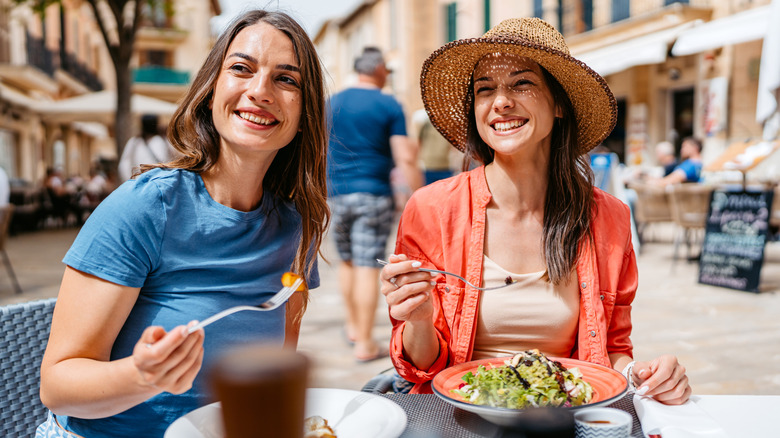
The picturesque dream vacation to Spain that you've been planning is coming closer to fruition. Your itinerary includes eating your way through the country, indulging in the finest wines that Spanish sommeliers have to offer, and basking in the sun without a care in the world on Playa de la Concha. As your flight to Spain inches ever closer, you save room in your rumbling stomach for as many tapas as humanly possible. You suddenly wonder if a big appetite is all you'll need — or if there are unspoken rules of etiquette while dining in Spain.
Then, the dread sets in: unstudied and ill-prepared, you fear you will come across as Michael Scott upon arrival at the first Spanish restaurant on your itinerary: mangled pronunciation of a famous dish, ignorant of the customs and cuisine, and unable to communicate properly with the wait staff. Indeed, from the fluid dining times depending on the season, to knowing when to order the appropriate drinks, to eating the most relevant dishes depending on region, there is much to learn about the nuances of dining in Spain.
To help you fully enjoy the brilliance of Spanish dishes and avoid breaking one of the many unspoken rules of dining in Spain, we turned to Andalusia native Olga Choquet Hatter to learn what matters most when visiting Spanish restaurants. Fear not, as Hatter guides us through the immersive "social experience" of dining throughout her beautiful home country.
Don't rush your check at the end of a meal
The urge to finish your meal quickly to make your way to as many Spanish attractions as possible is understandable. However, embracing Spanish dining culture means eschewing the nagging feeling to rush, and instead learning the art of the sobremesa. "Sobremesa is that time after a meal when nobody is eating anymore, but nobody is leaving either," Olga Choquet Hatter explained. "You just stay at the table, talking, laughing, and enjoying each other's company."
According to Hatter, it is common for the waiter to ask if you'd like a coffee, a shot of herbal liqueur or limoncello, or other post-meal drink. If the members of your group are enjoying themselves, you're staying out and enjoying each other's company, period. Indeed, it is through the culture of the sobremesa where I have found that America's rushed dining habits and Spain's social etiquette diverges the greatest. To wit: during the sobremesa, friends and family depart from the pressures of the endless to-do list. Instead, they embrace the present, fully immersing themselves in the unplanned and unpredictable nature of however long it takes to enjoy whatever comes next.
Going with the flow, as Hatter suggests, might feel unnatural, especially as you seek to make the most of your vacation. But embracing the social post-meal aspect of Spanish dining culture could lead to unexpectedly amazing experiences, too. The perfect digestif after a big lunch could help your body digest efficiently so you can properly enjoy the rest of your trip, as well.
Lunch and dinner are both eaten later in Spain than in the U.S.
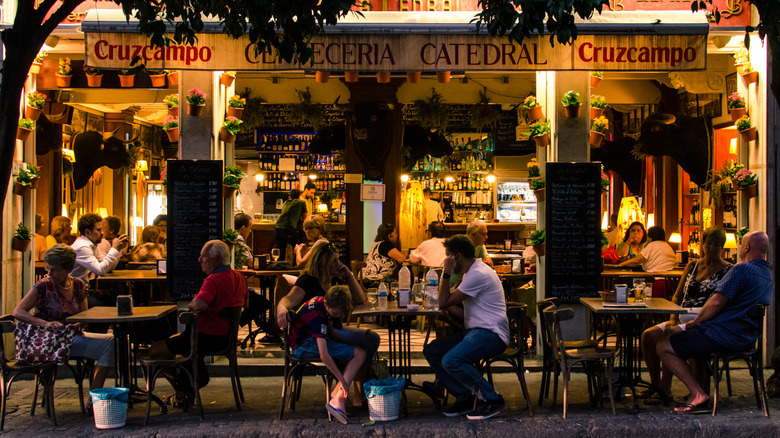
There's a lengthy history behind Spain's later meal times, and going to dinner at an hour when a tourist might otherwise be sleeping can feel unnatural. Those who have visited Italy in the past may also be acquainted with dining at later hours, but for first-timers in Spain, it can come as a sincere shock. However, as Olga Choquet Hatter points out, there is a very strategic reason for eating later in the evening, even if that means dining an hour or two before midnight.
"Summer is a whole different story. It gets really hot, especially in the south of Spain, so everything gets pushed later," she said. "During the hottest months, we often wait for the temperature to drop a little before going out. We want to sit on a terrace, have something cold to drink, maybe order a few tapas, and actually enjoy being outside without feeling like we're melting. So sometimes, we don't even meet up for a little drink and tapas until 9:30 p.m. or later."
Breakfast hours remain similar between Spain and the U.S., occurring roughly between 7 or 8 a.m. and 10 a.m. Tourists should prepare to have lunch around 2 or 3 p.m., Hatter said. That substantial midday meal should sufficiently hold you over until late into the evening, especially during summer, when many Spaniards go out for dinner.
Tapas are not the Spanish equivalent of appetizers
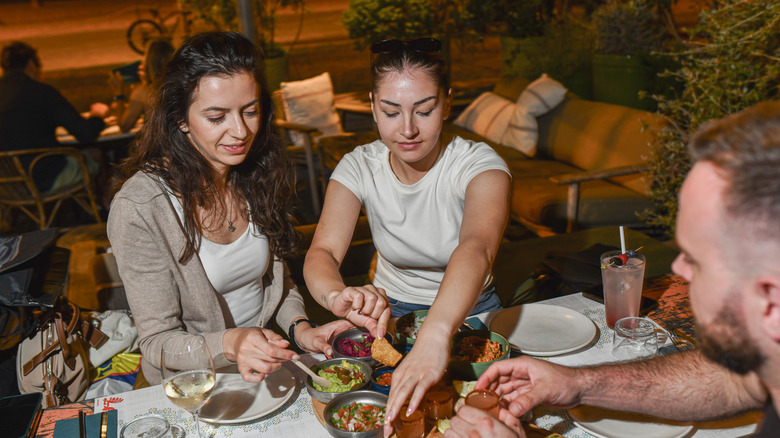
You would be doing yourself a disservice by likening Spanish tapas to appetizers. In fact, the consumption of tapas is an entire culture unto itself, and partaking in tapas with locals could be the thing that makes your trip a memorable one. As Olga Choquet Hatter explained, ordering tapas is a social event to be enjoyed with friends. You can also relax if you're worried about keeping track of who ordered each dish, as tapas are meant to be shared amongst the table.
"We Spaniards absolutely love going out for tapas," Hatter said. "You might order a tapa, have a drink, and then move on to another bar to try something completely different. Then, maybe you head to another bar and do the same thing all over again. That's part of the fun. You're not necessarily sitting down for one meal in one place. You're going from bar to bar, trying different tapas, sharing food, talking, laughing, and spending time with friends."
Indeed, there's a rich variety of tapas throughout Spain. There's a good chance there will be multiple dishes that suit even the pickiest eaters in your party. If simplicity and a straightforward tapa is your thing, there are no shortage of options. If rich, complex flavors bursting out of a masterfully assembled tapa are more your speed, Hatter notes that "some are prepared with so much care and attention to detail, and presented so beautifully, that they're practically little works of art."
Splitting dishes is the norm, but asking the waiter to split the check is frowned upon
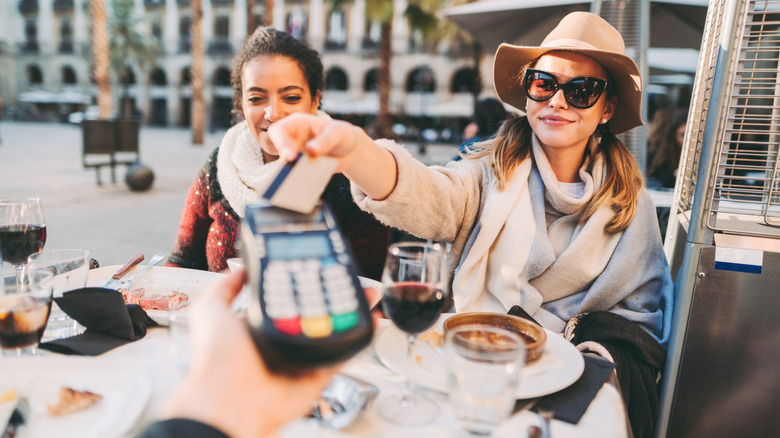
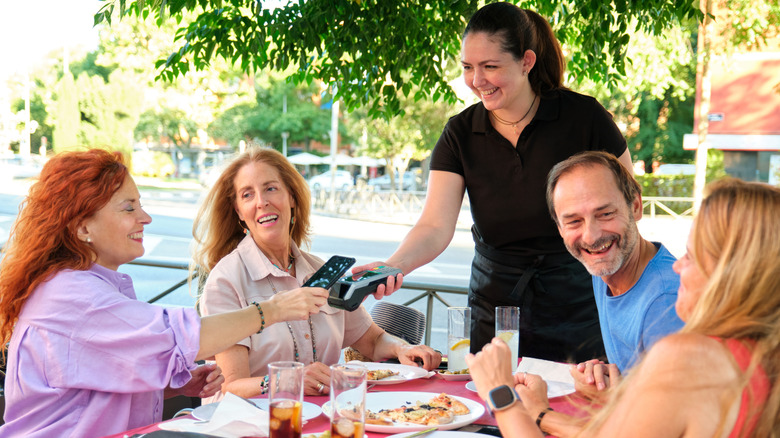
If you and your party are enjoying tapas throughout the night, resist the urge to ask your waiter to split the check and task multiple people with paying for each dish. It's a gaffe and nuisance in Spain to request a split check when dining out, as it especially violates the free-flowing, social nature of tapas culture. "We're not usually sitting there calculating, 'I had this tapa, and you had that one,'" Olga Choquet Hatter advised.
This doesn't mean, however, that one person is burdened with paying for everyone's meal. As Hatter clarified, "In Spain, it is very common to simply divide the bill among everyone at the table. We usually don't calculate exactly how much each person ate or who ordered the extra dessert, the most expensive wine, or the second round of drinks. We just split the total." In short, be prepared to pool your money with others at the table to provide the staff with one unified payment.
Hatter acknowledged that changing times can sometimes means a deviation from Spanish customs. Restaurants and waiters in Spain, she conceded, are more accustomed to handling separate checks these days. Ultimately, to be on the safe and respectful side, you should plan to pay one, unified bill, and work out the logistics amongst your group afterwards. As Hatter fondly summarized, "It's another little reflection of how we see a meal: as something we experience together, rather than as a collection of individual orders."
Order what is appropriate for the region you're visiting
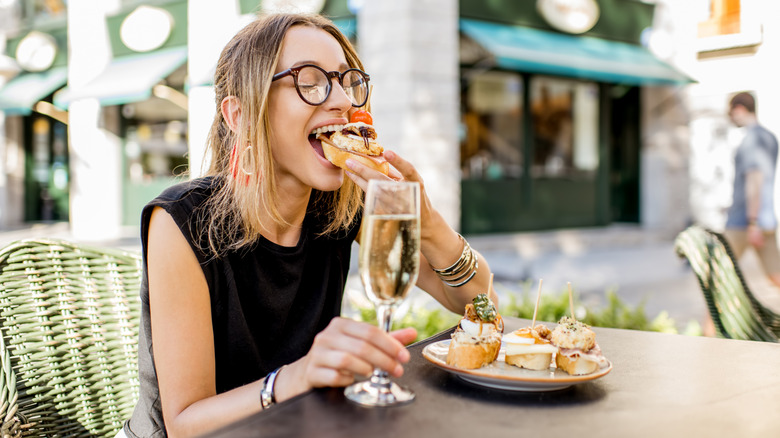
Your dining experience in Spain will fall short of expectations if you assume that all dishes are made uniformly throughout the country. To make the most of your journey eating your way through Spain and trying the many delectable dishes the country has to offer, be sure to research the traditional dishes unique to each region of Spain that you visit. You can also ask your waiter for their recommendations. For example, you'll want to try the patatas bravas in Madrid, paella in Valencia, gazpacho in Andalusia, and calçots con romesco in Catalonia.
"When you're somewhere in Spain, try what's traditional to that particular area. I think
that's when you really start to understand Spanish food," Olga Choquet Hatter explained. "We have so many different regional traditions, and even the same dish can change depending on where you are." If you find that you enjoyed a seafood dish at one of the many fine eateries in Barcelona, for example, don't assume that same dish will be prepared and taste identically within the confines of an inland city.
Even for a traditional Andalusian dish like gazpacho, Hatter explained that other regions of Spain — and even individual families — have their own spin on the recipe. "The dish evolves with the local ingredients, traditions, and way of cooking," she told us. "To me, that's the beauty of Spanish food. Spain doesn't have just one cuisine. It has many, and each one tells you something about the place where it comes from."
Never order coffee with your savory lunch or dinner
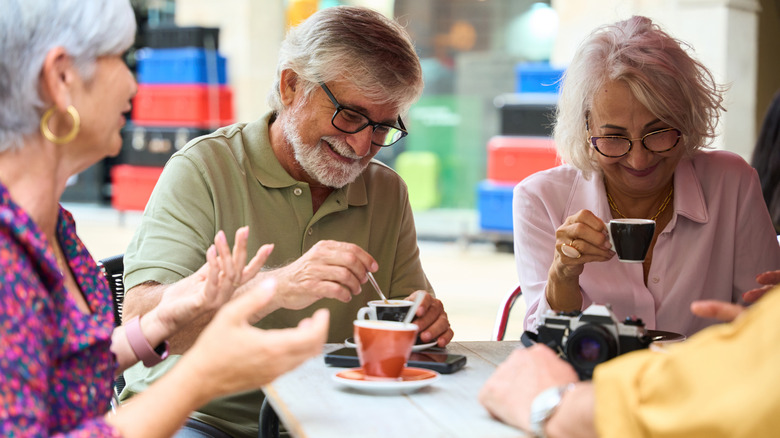
Unlike in Italy, where a coffee order later in the afternoon will elicit negative reactions, a Spanish coffee is perfectly acceptable at any time of day — so long as it doesn't accompany your savory meal. "You might have one with breakfast, mid-morning, after lunch, as part of your afternoon snack (merienda), or even after dinner," Olga Choquet Hatter explained. "But there's one little rule: we don't usually drink coffee while we're actually having lunch or dinner."
According to Hatter, a coffee order later in the day will typically come after a meal. ("It's almost like the official signal that the meal is moving into the sobremesa," she said.) Your Spanish coffee, then, is the comfy accompaniment when your social outing moves from the meal phase to drinks and even more conversation. What you should never do, however, is order a coffee as you prepare to enjoy a plate of seafood paella.
Coffee can also be thought of as a perfect pairing with a morning croissant or a churro dipped in warmed chocolate. So save your appetite for coffee for when it is most appropriate. Whether that's to start the day off on a delicious note, to signal to your fellow diners that your time at a restaurant has moved into the sobremesa phase, or to power you through a long night of dancing, conversation, and fun, coffee has its place in Spanish dining culture.
Bread is an edible utensil
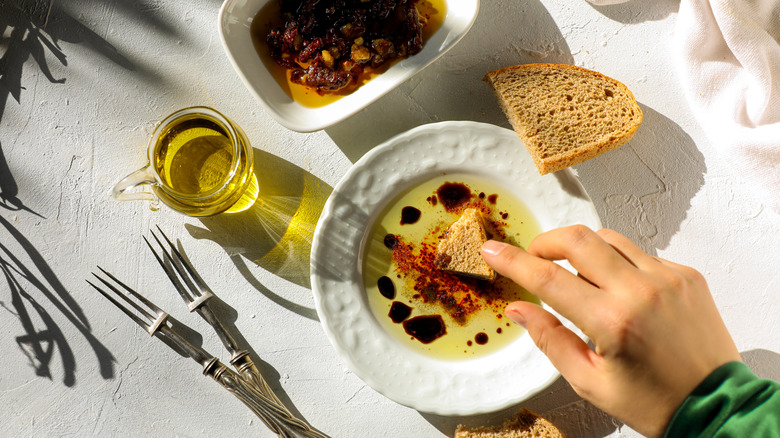
One behavior that might out you as a tourist in Spain is pouring olive oil onto a plate and dipping your bread into it as a makeshift appetizer. Butter on the table is also highly unlikely in a traditional Spanish restaurant. In fact, if you spot single-use packages of butter on the table, Olga Choquet Hatter told us that that's one sign that the Spanish restaurant is catering to tourists. Instead, take heed from other European, bread-loving countries and learn to use your bread as a utensil.
"I think there's something that really defines Spaniards: we simply don't know how to eat without bread," Hatter said. "We actually use it as a utensil. We use a piece of bread to push food onto our fork, almost like an extra little knife, and of course, we use it to mop up all those wonderful sauces." Letting leftover Spanish food go to waste is the real crime, and that's what your bread is there to help with.
If you are dining in Andalusia, for example, don't get thrown off if you find picos on your table, too. "We eat them with all kinds of things — a regular meal, a little plate of cheese and ham, some olives, or honestly, just about anything," Hatter said. "They're those little crunchy breadsticks that are perfect for picking at while you're eating, and somehow you always end up eating more than you intended."
Lunch is historically the main event — not dinner
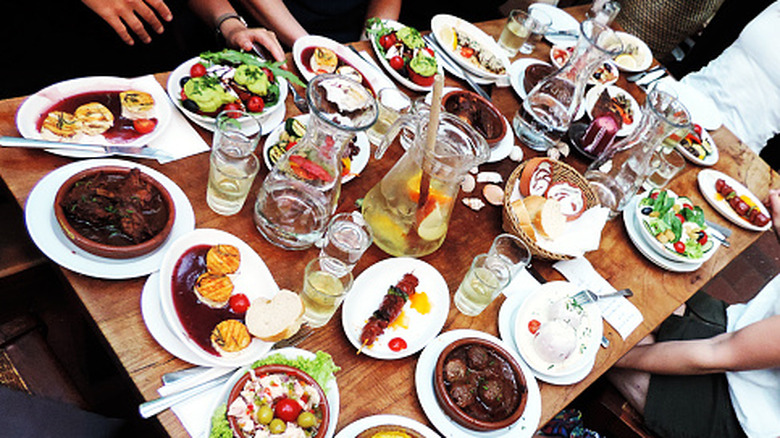
Eating a larger meal for lunch while on vacation boasts digestive benefits, of course. Thankfully, Spain has a history of catering to heavier meals for lunch and lighter meals for dinner. Although times may be changing, Olga Choquet Hatter told us that lunch is still the main and most substantial meal of the day while dinner remains the smaller of the two meals. Therefore, don't be surprised if multiple courses are encouraged for your midday meal in Spain while traditional restaurants suggest lighter fare for dinner.
Spain has traditionally been known for extended lunch breaks spanning multiple hours in order to accommodate a hearty meal, a midday siesta, and much-needed respite from the brutal sun. Those customs may be evolving throughout busier, major cities today, where workers must gobble up a hefty meal in an hour's time. What remains consistent over time, though, is the desire to consume a formidable lunch and keep dinner on the smaller side.
"Seriously, when you ask a Spanish person what they're having for dinner and they say, 'Just a tortilla francesa,' nobody thinks that's strange. It's basically the Spanish equivalent of saying, 'I'll just make something quick,'" Hatter said. The socializing and fun with friends and family is certainly a trait shared between meals in Spain. However, don't be caught off guard by the offering of a gentler meal come dinner time.
Dining etiquette differs by restaurant type
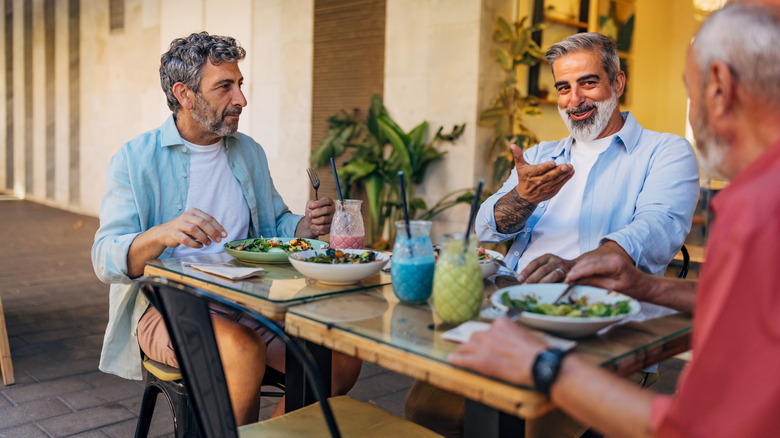
Shorts and sandals or button-down and slacks? Is cellphone use acceptable at the table? Dress code and demeanor vary by restaurant type, and etiquette is more relaxed in some types of Spanish eateries compared to others. "I think the etiquette and, more importantly, the way you experience the meal can be quite different depending on the type of restaurant," Olga Choquet Hatter said. "The restaurant itself gives you a pretty good idea of the social rules of the meal — whether you're going from bar to bar, sharing lots of small dishes, or sitting down for a longer meal centered around rice or grilled meat."
Hatter said a pintxos bar is usually casual. If going out for pintxos, plan for a lively experience at one tavern before moving on to the next location. A taberna, while also casual, offers a wider variety of food, Hatter said. Sharing is common, and Hatter says this style of restaurant is her favorite because of its relaxed, fun, authentically Spanish nature.
Count on planting yourself for a sit-down experience at an arrocería, where rice is the centerpiece of the meal. At an asador, grilled meat takes center stage. Sharing is also common. Said Hatter, "Depending on the size of the group, you might order several different cuts for the table rather than everyone ordering their own steak." Ultimately, it's a good idea to call ahead to the restaurant or bar or review their policy on attire if they have a website.
Expect to have wine with your meal
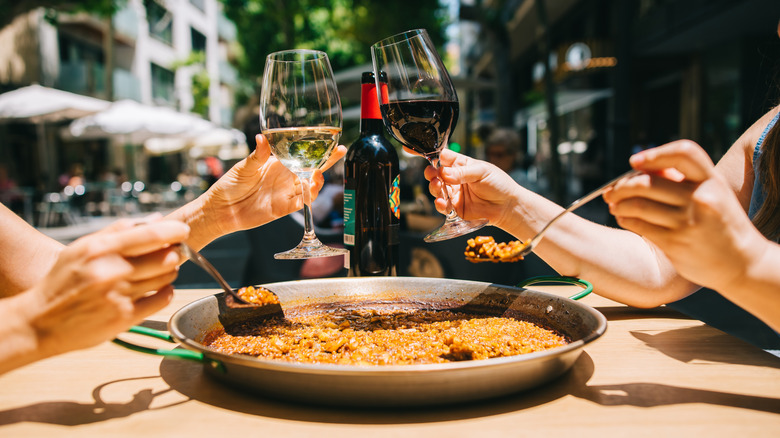
Spain remains the third-largest wine producer globally for good reason: Spanish wines are a divine accompaniment to a delectable dish. If you are of age to partake, it's a safe bet that at a restaurant or in a family's home, wine will be served. "Wine is deeply rooted in Spanish culture," Olga Choquet Hatter recalled. "Having a glass of wine with your meal is completely normal, and traditionally, in some families, people would even have a little sweet wine for breakfast." The Spanish sparkling wine cava — often produced in a cave in Catalonia — pairs wonderfully with an omelette just as well as paella later in the day.)
If you crave seafood for lunch, opt for a glass of Manzanilla Deliciosa, which pairs beautifully with fish. If the aforementioned cava isn't your style to accompany a midday tapas crawl, you can never go wrong with a glass of Sherry to pair perfectly with a variety of small dishes. (The name itself comes from the Andalusian town of Jerez.)
"One of the sweet wines from my part of Spain is Pedro Ximénez, a rich, naturally sweet wine made from grapes that are dried into raisins before being made into wine. It's delicious on its own after a meal, and it can also be served with dessert," Hatter said. If you happen to be in Andalusia for a wedding, prepare to buck tradition. According to Hatter, instead of traditional Champagne toasts after the wedding meal, some couples choose to toast with sweet wine.