

10 Common Issues With Le Creuset Cookware
We may receive a commission on purchases made from links.
Le Creuset has been around since 1925, and the company has a longstanding and well-deserved reputation for making exceptional cookware. While it now makes modern, non-stick, metal and silicone bakeware as well, its flagship line of enameled cast iron is still the first thing most people think of when they hear the name (the name "Le Creuset," itself, means "the crucible," a reference to the vessel used when melting the iron for casting).
But, being "exceptional" doesn't mean its cookware is perfect, by any means. In fact, some of its greatest strengths can also be weaknesses in some cases, or for some users. So while all the good things you've heard about Le Creuset are well justified, and you really can look forward to passing these ceramic dutch ovens along to your grandkids, its cookware does indeed have some common issues that can affect your enjoyment of them. The following are 10 issues you should be aware of, and consider carefully, before you tap on that "Order now" button.
It's pricey

The first thing to know about Le Creuset is that it's a premium product, still individually hand-made in France — not a center of low-cost manufacturing — in the same way it was a century ago. That kind of artisanal craftsmanship is rare today, and you'll pay accordingly.
Admittedly, the prices aren't quite as eye-watering as French-made copper cookware from brands like de Buyer or Mauviel, which can go for well over $1000 for a basic Dutch oven with a lid. In comparison Le Creuset's classic round Dutch oven, in a comparable 3 ½ to 4-quart size, runs in the low to high $500 range on the company's own website, or for under $400 (at time of writing) at the Le Creuset store on Amazon. So, while it's cheaper than copper, as French-made artisanal cookware goes, this is still definitely stuff that'll put a dent in your wallet.
On the upside, if you're patient, you can accumulate a worthy set of Le Creuset at a deep discount by haunting thrift stores and estate sales. Not only can thrifting for secondhand Le Creuset save you some big bucks, you could score a vintage piece that will make you the envy of your friends (and might be worth some serious coin, as well).
It's heavy
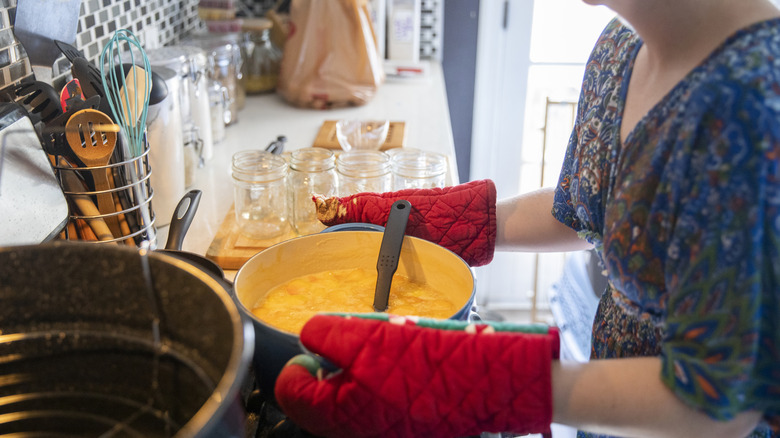
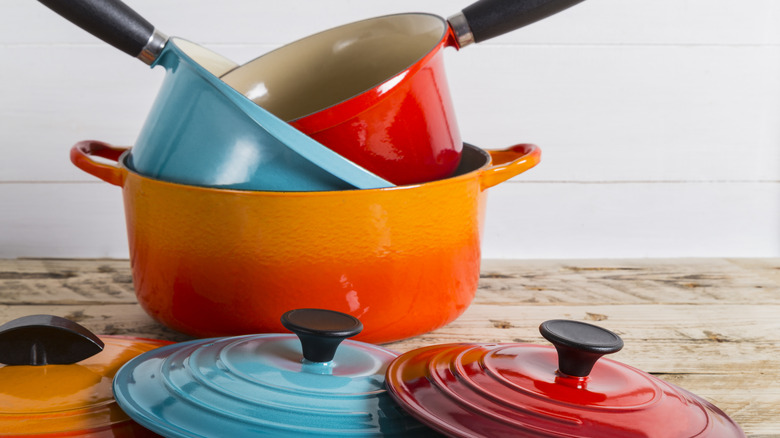
Le Creuset makes a wide range of kitchen products, including non-stick and stainless steel cookware, but its flagship line is its legendary enameled cast iron. Those pieces are hotly desired by cooks, both for their performance and their beauty. Part of the brand's appeal is its range of bold designer colors, which can add a vivid accent to your kitchen's decor.
That said, it's important to remember that underneath that beautiful enamel, what you're getting is still cast iron. And, if there's one adjective that applies to cast iron, it's "heavy." While the enamel coating is beautiful, and cuts down sharply on the time and labor to keep your cast iron in top condition, it does absolutely nothing for the weight.
That's a consideration people often overlook, even if you routinely reach past your vintage cast iron skillet to grab something lightweight and nonstick. A 6-quart Dutch oven with lid, for example, weighs 5.14kg — over 11 pounds — when empty. Add in 2 quarts of broth at 2 pounds each, and a 3-pound pot roast, and you're at 18 pounds. That's a lot to sling around your kitchen! So don't make the mistake of buying the largest size of Dutch oven (which starts at over 22 pounds empty) unless you're physically up to it. Cooks with physical issues might struggle to work with them at all, or need help moving the pots around and/or getting them from the cupboard.
The enamel coating is durable, but it chips
The beautiful, lustrous enamel finish on Le Creuset's cast iron cookware is one of its signature calling cards. The selection of vivid, eye-catching colors may be what grabs your attention first, but the main purpose of the enamel coating is purely functional.
Un-coated cast iron requires a lot of work. First you need to season the pan well in order to prevent food from sticking, then you need to protect the seasoned finish from damage, or from rust. Acidic foods can mar the finish, and the cast iron can discolor the food. Le Creuset's enamel coating avoids all of those problems, by protecting the cast iron against rust, and providing a moderately non-stick surface. Even the white interior has a specific purpose: It helps you gauge the color of any broth, sauce, or caramel you're cooking in the pot. It's also easy to see when the interior is thoroughly clean. That's an advantage over rival brand Staub, which uses black enamel interiors.
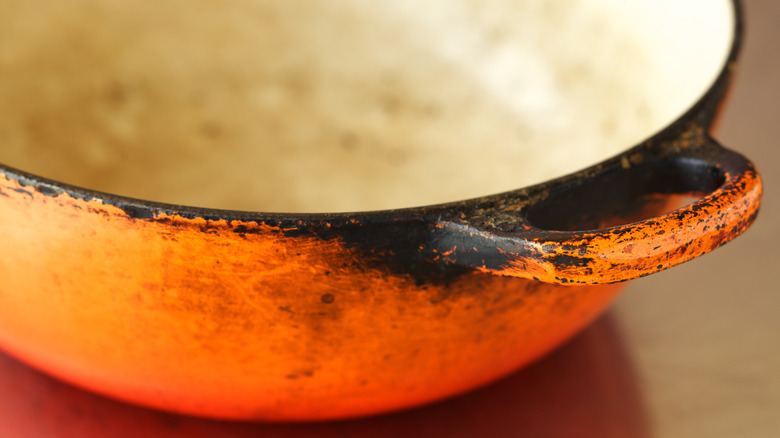
The problem with enamel is that, while it's durable in ordinary use, it's unfortunately brittle. The finish can be chipped through rough handling or clumsiness, like fumbling the lid while lifting it from the pot, or even by not storing it properly. A chipped surface exposes the underlying iron to your food (and vice versa), which undermines the coating's benefits.
High heat can damage the finish
One of the great things about cast iron in general is its durability and versatility. Not only will it last for decades, you can use it for just about any cooking method, from the oldest (an open fire) to state of the art technology, like induction cookery.
Unfortunately, there is a major limitation on iron's versatility, and it's extreme heat. Like most materials, cast iron expands when it's heated, and contracts when it's cooled. If you overdo it with heat, even regular cast iron pans can become warped and unusable (that's why you need to test any cast iron you buy at the thrift store). Coating cast iron with enamel only aggravates the issue, because these materials heat and cool at different rates. So extremes of heating can really stress the hard-but-brittle enamel coating.
The bottom line is that bare cast iron can go as high as 600 degrees Fahrenheit, as long as you bring it up to that temperature slowly. With enameled cast iron you'll need to check the manufacturer's recommendation, which Le Creuset tops out at up to 500 F. Beyond that, temperature cracks may form in the enamel, giving the "spiderweb" effect you see sometimes on older enameled pots. Food residues can get into those cracks, discoloring the finish over time and potentially harboring bacteria. That's why high heat is one of the quickest ways to ruin enameled cast iron.
Its cookware should always be hand-washed
You've probably been warned for years not to put your cast iron skillets in the dishwasher, because of the potential for it to rust, or for the harsh detergent to damage the seasoning. But, Le Creuset's skillets and Dutch ovens have an enameled coating, so why would you avoid the dishwasher?
Well, the company itself says its enameled cookware is dishwasher-safe, so if a visiting in-law runs yours through the dishwasher you don't need to have a meltdown. But, over time, by Le Creuset's own admission, the dishwasher will tend to dull the vivid color of your enamel finish, which is part of the joy of Le Creuset. In itself, you may think the tradeoff is worth the convenience of not having to hand-wash it every time.
But, in practice there's another risk that isn't spelled out on the company's website. How often have you walked past the dishwasher and heard the dishes and utensils clunking against each other, under the impact of the machine's powerful jets of water? Well, anything metallic or heavy that whacks your Le Creuset pot is a threat to chip the enamel. That's why we list enameled cast iron as a kitchen item that should never go in the dishwasher. So you're either committing to giving your skillet or Dutch oven the sole use of a whole rack each time, or washing it yourself by hand (and remember, those bad boys are heavy!).
Metal utensils or scrubbers can damage the finish
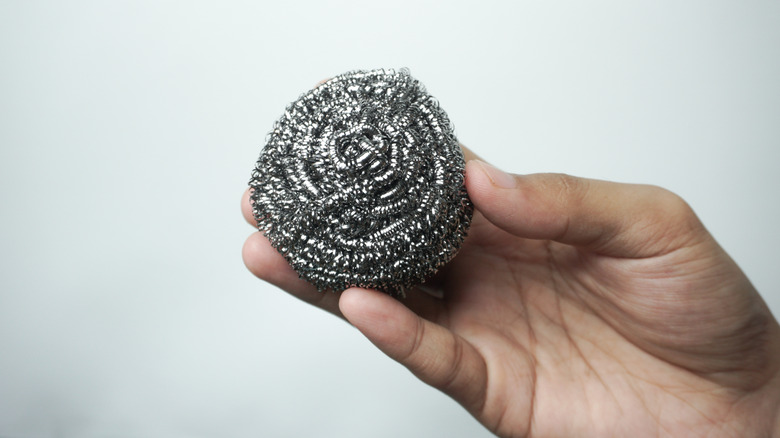
While we're on the subject of hazards that threaten your pot's enamel, let's talk about metal utensils. Well-seasoned conventional cast iron tolerates metal utensils' sharp edges pretty well, but you may want to think twice before using them on your costly, enameled Le Creuset.
Here's why. The manufacturer itself recommends using silicone, wooden, or heat-resistant nylon utensils when you're cooking in your enameled cast iron, because they're demonstrably safe to use with this material. It's not that you can't use metal utensils ever, at all — you can, if you're careful and don't scrape the pan's surface — but why flirt with danger? Metal utensils can chip or gouge the finish, and you should never use a metal tool to cut food inside the pan. A worst-case scenario is using your hand mixer inside the pan (for thickening a gravy or sauce, for example), because the high-speed metal beaters are especially likely to cause damage.
You should also be wary of metal scrubbers, including steel wool, soaped steel wool (like Brillo pads), or the kind with curly strands of thicker, flat metal. Instead, Le Creuset suggests using soft, abrasive pads or nylon scrubbers and brushes. Those don't represent the same risk that metal scrubbers would. You should also avoid coarse, abrasive cleansers. Soaking will get off most stuck-on food, but for tough debris you can use a mildly abrasive cleanser, like Barkeeper's Friend or Le Creuset's own cookware cleanser.
They're vulnerable to thermal shock
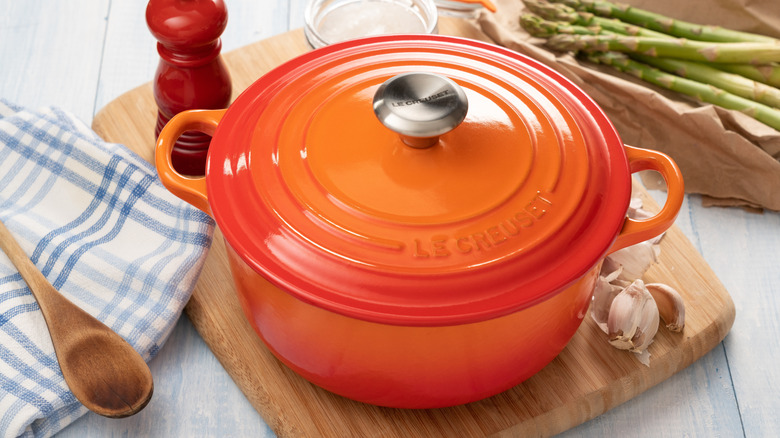
You may have seen videos of Pyrex tempered glass cookware shattering violently, usually because somebody has poured a cool liquid into them or put them down on a cold surface immediately after they come out of the oven (two of the worst things you can do with Pyrex). Your Le Creuset cocotte or Dutch oven won't shatter like Pyrex, of course, but sudden temperature changes are still problematic.
Those sudden changes cause what's called "thermal shock," and it's a big threat to cookware in general. Earlier, we mentioned that most materials expand when heated and contract when cooled. When you set your pan down on a cool countertop, or — a big one — run tap water into a still-hot pan, you're creating a scenario where one part of your pan is trying to contract from the cold, while other parts are still expanding from heat. That stress can cause your enamel to crack badly, or even damage the underlying cast iron. This is a very bad thing and necessitates the use of a trivet.
If you're a collector of Pyrex, you may know that older pieces are made of a sturdier kind of glass (borosilicate), and hold up better under temperature changes than newer pieces. Sadly, there's no such distinction with Le Creuset, because they still use the same, old-school manufacturing process they started with in 1925. So with vintage enameled cast iron, as for vintage cookware generally, thermal shock remains a significant concern.
The knobs and handles on your Le Creuset are a potential failure point
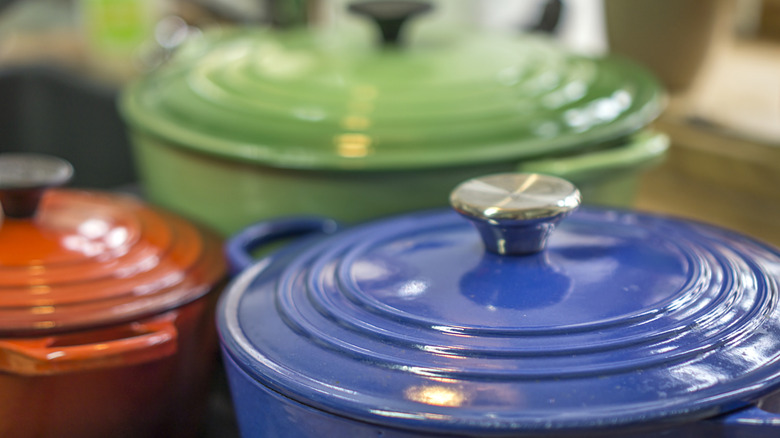
Le Creuset's cast iron cookware can usually go back and forth between the oven and the stovetop with no issues, assuming you're doing everyday cooking at moderate temperatures. But, that doesn't necessarily mean all Le Creuset is oven safe to the same temperatures.
If you plan to use a lid on your skillet or Dutch oven while it's in the oven, you should check the company's website (or the user guide that came with your pot) to verify what temperature the knob on the lid is rated for. The black knobs on the Signature range, for example, are good for the same 500 F as the pot, while the similar-looking black knobs on the Classic range are only rated for use at up to 390 F. Knobs made of stainless steel, if that's what your pots' lids have, are oven-safe to the same temperature as the pot itself. Any wooden knobs or handles on your Le Creuset are not meant to go into the oven at all.
So, while Dutch ovens are oven safe in a broad sense, it's safest not to automatically assume that the lid can follow along. Check your product literature, or Le Creuset's website, first. And, of course, over time, knobs may crack or loosen and need to be replaced even if they aren't subjected to misuse.
Not all of its products can be handled the same way
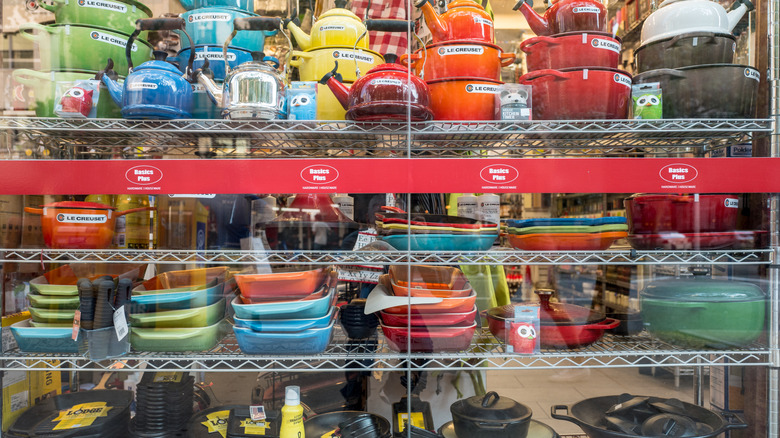
Because the name Le Creuset is so heavily identified with its enameled cast iron, it's easy to forget that the full product line also includes stainless steel and non-stick cookware, as well as non-stick and ceramic bakeware. They can't be used interchangeably.
It's especially easy to make this mistake with the company's stoneware products. They're also colorful and well made, but with one hugely important difference: Stoneware is not intended for stovetop use, at all. Direct, full-contact heat from a stovetop's cooking surface can quickly break your stoneware pieces because of thermal shock, while the same temperature — in the gentler, all-around heat of an oven — is perfectly fine. Similarly, a stoneware dish can't go straight from the fridge to a hot oven. You'll need to put it into the cold oven instead, and then bring the oven up to temperature, so they can warm up together at the same rate. The top temperature for Le Creuset's stoneware, like the cast iron, is 500 F.
The company's stainless steel and non-stick cookware also require different handling. With non-stick pans, you can begin a dish at a higher temperature and then turn it down; stainless steel holds its heat longer so that's not a good strategy. The heat-resistant glass lids available for use with Le Creuset's non-stick pans are rated for up to 425 F, while the pans themselves are good up to 500 F.
The warranty doesn't cover everything

Le Creuset is justifiably proud of its flagship products' durability, as it should be. Chances are, you've likely heard stories about people using Dutch ovens or other pieces that their grandparents bought, back in the day. And, yes, with proper care they can last for generations.
You'll also hear a lot about the company's lifetime warranty, which is definitely something you don't get with a lot of products, especially in this age of disposability. But, it's important to understand that the warranty doesn't cover everything. For example, it doesn't cover accidental damage. So if you fumble the lid of your pot, and it chips the enamel of both the lid and pot, that won't be covered. Neither will a chip your pot took in the dishwasher, or discoloration and fading from normal use. Each product line has its own specific exceptions, as well. If the non-stick coating on your skillet is flaking off, for example, the company knows you've used it at an excessive temperature. Not covered.
Even if your warranty claim is accepted — and to be clear, this warranty is a valuable marketing tool, so the company doesn't decline claims lightly — you'll be on the hook for shipping costs to and from Le Creuset's nearest repair facility. Given the weight of enameled cast iron, that's going to cost you a few bucks. It'll still be less than the cost of replacing your pot, though, so it's well worth it from that perspective.