

Sheet Pan Garlic Butter Halibut With Spring Vegetables Recipe
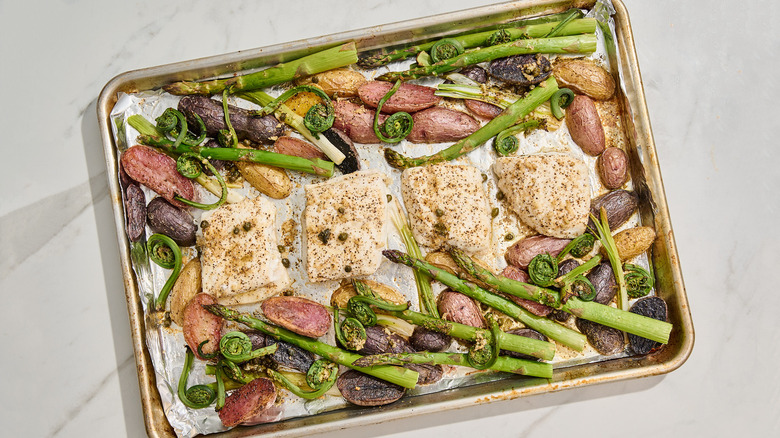
Sheet pan meals are the heroes of a busy weeknight. With barely any hands-on time, the recipe practically makes itself, roasting seamlessly on one tray in the oven until everything is ready to eat. The whole meal comes together at once, each element fitting snugly on the sheet tray so that all of the flavors are infused into one. With how easy sheet tray meals come together, it's easy to find yourself wishing every meal could be made that way — and for many recipes, they can.
Though there are ways to make sheet pan meals more elaborate, they aren't known for being a particularly gourmet offering. That's why halibut isn't a fish you'd generally find in sheet pan recipes, being that the best way to cook such a buttery, expensive fish is in a skillet with plenty of butter and lemon. It can still be done, though, and when the fish is accompanied by fresh spring vegetables like asparagus, spring onions, and tender, beautiful fiddleheads, the meal is restaurant-worthy with only half of the work. Still coated in plenty of butter and lemon, the halibut stays moist, bright, and flavorful, and is ready to eat in less than an hour.
The ingredients needed to make sheet pan garlic butter halibut with spring vegetables
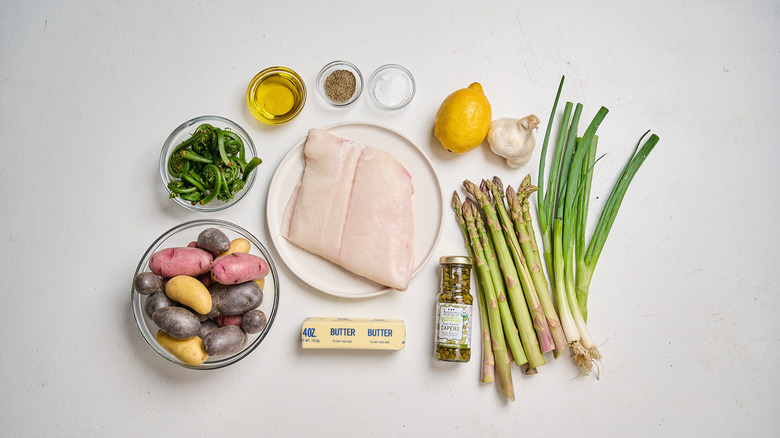
First, gather all of the produce you'll need for this recipe. You'll need fingerling or baby potatoes (any color works here), asparagus, lemon, garlic, fiddlehead greens, and spring or green onions, which are both long, slim onions with green tops and a white bulb. From there, grab butter, olive oil, salt, pepper, capers, and halibut.
Step 1: Heat up the oven
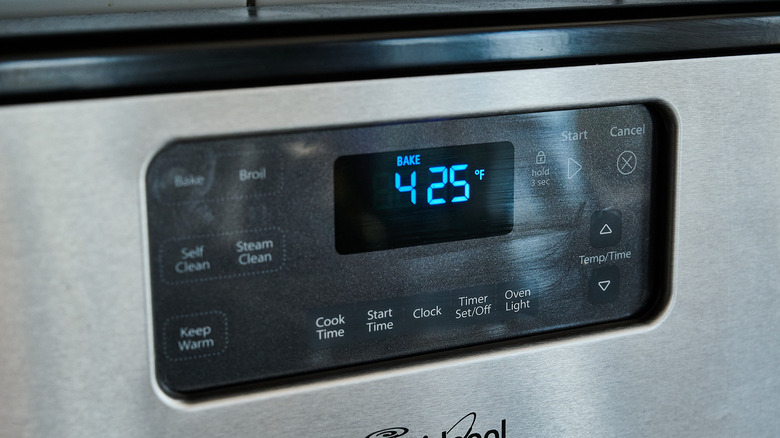
Preheat the oven to 425 F and line a baking sheet with foil.
Step 2: Toss the potatoes with oil and seasoning
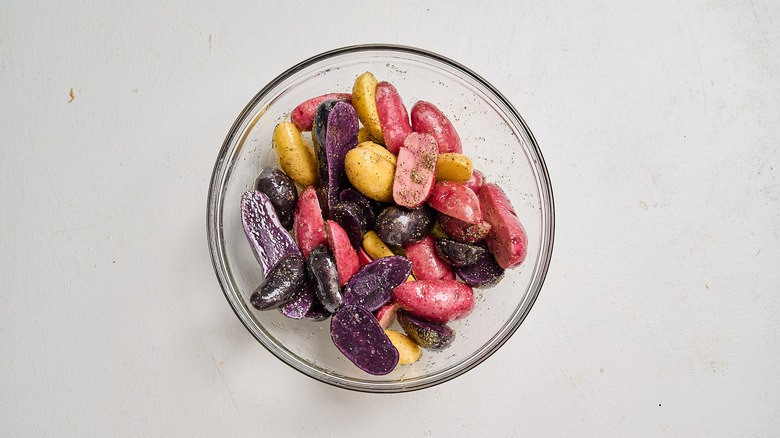
In a bowl, toss the potatoes with olive oil, 1 teaspoon salt, and 1 teaspoon pepper.
Step 3: Arrange on a baking sheet
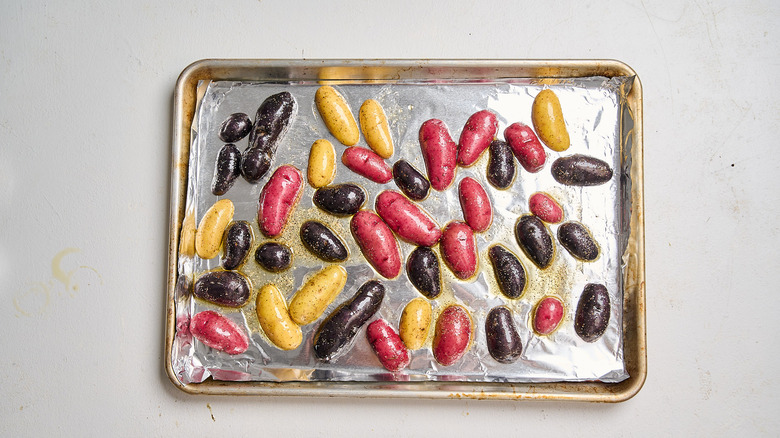
Arrange the potatoes on the baking sheet cut-sides down.
Step 4: Roast the potatoes
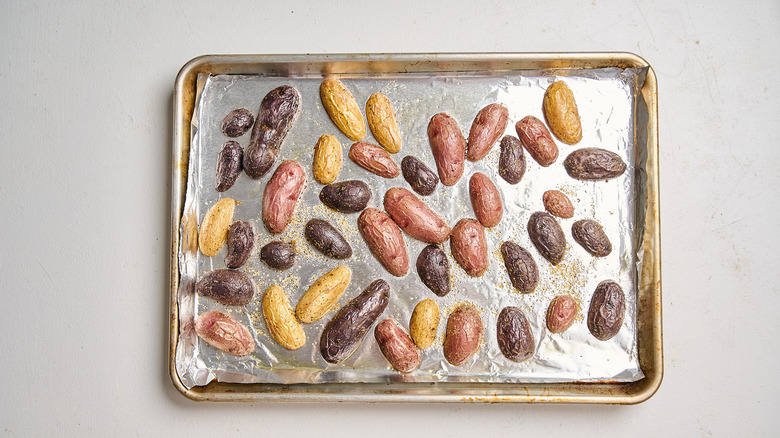
Roast the potatoes for 25 minutes.
Step 5: Bring water to a boil
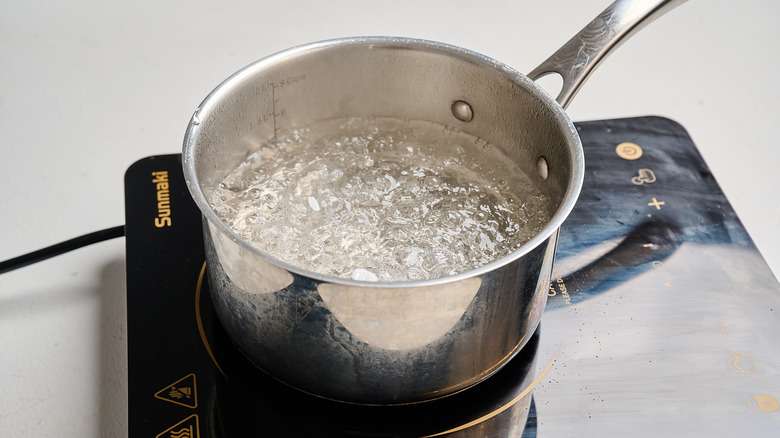
While the potatoes are roasting, prepare the fiddleheads. Bring a small pot of water to boil over medium heat.
Step 6: Boil the fiddleheads
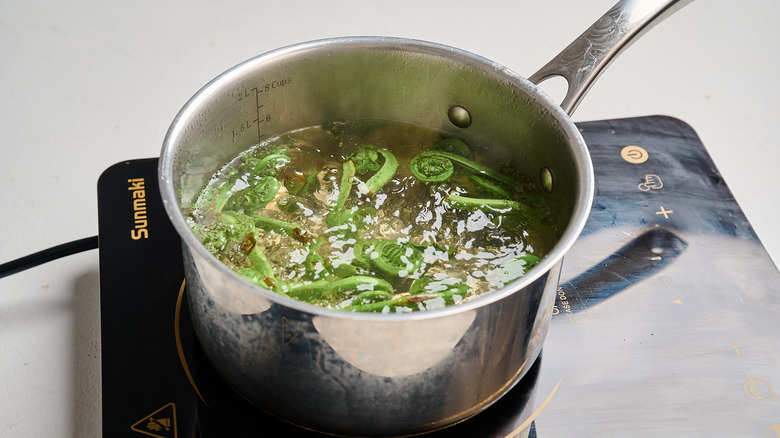
Add the fiddleheads and boil for 10 minutes to soften. Drain and dry.
Step 7: Stir together the garlic butter
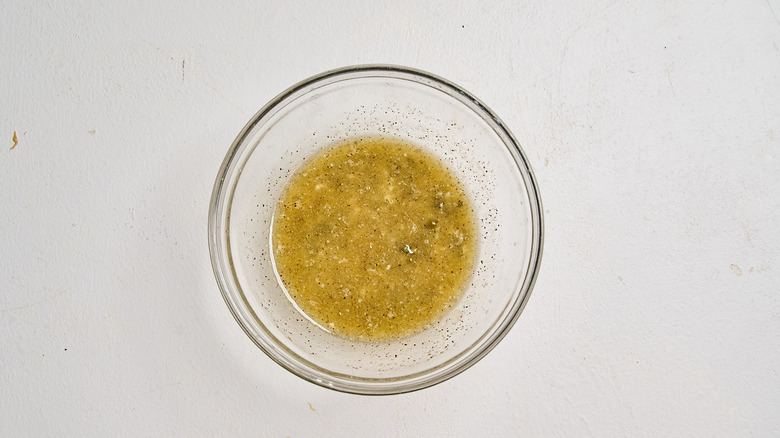
Melt the butter in a bowl, then stir together with garlic, ½ teaspoon salt, ½ teaspoon pepper, the capers, and lemon juice.
Step 8: Toss the potatoes
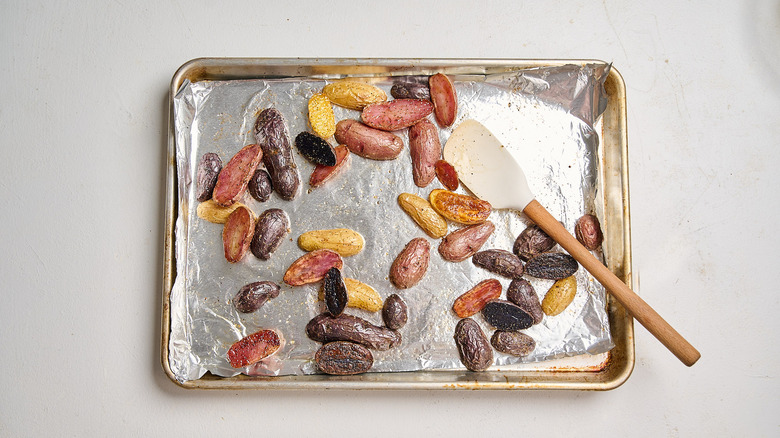
Remove the sheet pan with the potatoes from the oven and toss the potatoes to rotate.
Step 9: Add the vegetables and fish to the pan
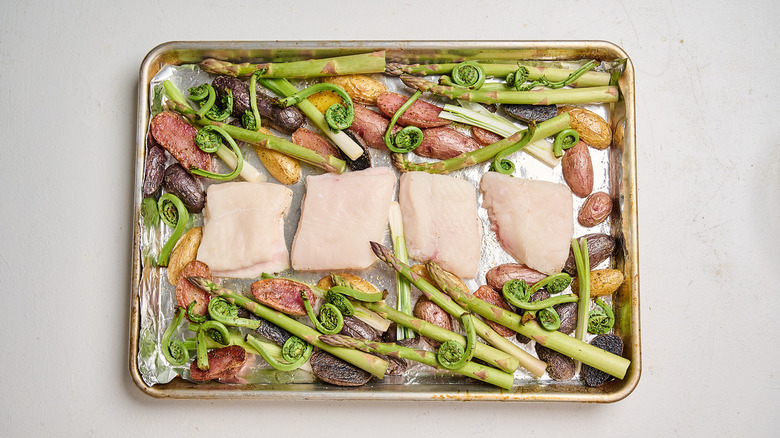
Add the boiled fiddleheads, onions, asparagus, and halibut filets to the sheet pan in a single layer. Sprinkle 1 teaspoon salt and 1 teaspoon pepper over the vegetables.
Step 10: Brush butter onto the halibut
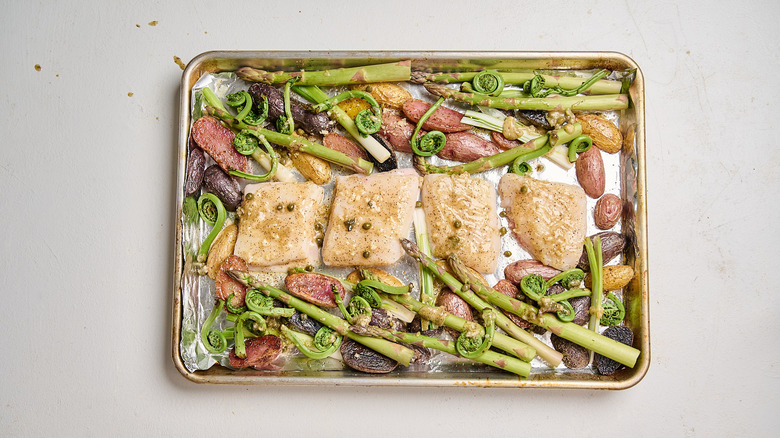
Brush the butter mixture onto the halibut, then pour the rest over the vegetables on the sheet pan.
Step 11: Roast until done
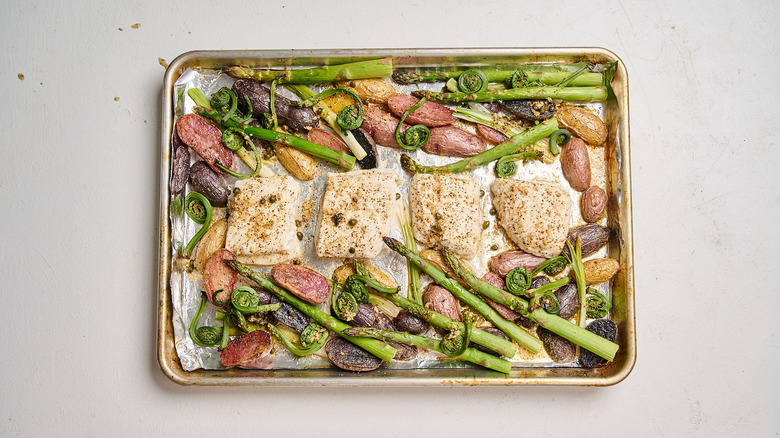
Return the sheet pan to the oven and cook for 15 minutes longer, or until the potatoes are tender, the halibut is cooked through, and the fiddleheads, asparagus, and onions are browned and tender.
Step 12: Remove and serve
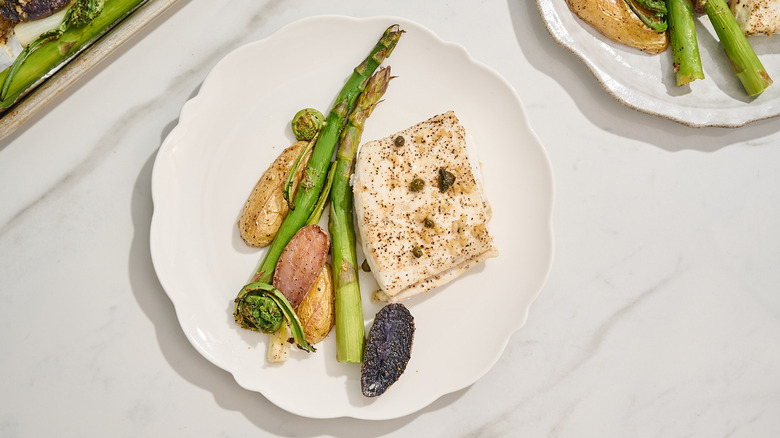
Remove the halibut from the oven and serve immediately.
What pairs well with sheet pan halibut?
Sheet Pan Garlic Butter Halibut With Spring Vegetables Recipe
Elevate your sheet pan game with our elegant but easy recipe for halibut, asparagus, fingerlings, and fiddle heads, all nestled together in garlic butter.
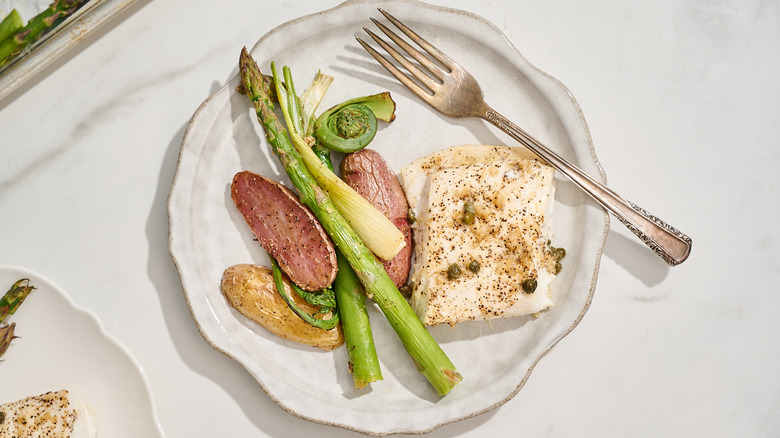
Ingredients
- 1 pound fingerling potatoes, halved
- 2 tablespoons olive oil
- 2 ½ teaspoons salt, divided
- 2 teaspoons pepper, divided
- 1 cup fiddlehead greens
- 4 tablespoons butter
- 3 cloves minced garlic
- 1 tablespoon capers
- 1 tablespoon lemon juice
- 4 spring onions or large scallions, trimmed and halved
- 12 asparagus spears, trimmed
- 1 pound halibut, trimmed into 4 pieces
Directions
- Preheat the oven to 425 F and line a baking sheet with foil.
- In a bowl, toss the potatoes with olive oil, 1 teaspoon salt, and 1 teaspoon pepper.
- Arrange the potatoes on the baking sheet cut-sides down.
- Roast the potatoes for 25 minutes.
- While the potatoes are roasting, prepare the fiddleheads. Bring a small pot of water to boil over medium heat.
- Add the fiddleheads and boil for 10 minutes to soften. Drain and dry.
- Melt the butter in a bowl, then stir together with garlic, ½ teaspoon salt, ½ teaspoon pepper, the capers, and lemon juice.
- Remove the sheet pan with the potatoes from the oven and toss the potatoes to rotate.
- Add the boiled fiddleheads, onions, asparagus, and halibut filets to the sheet pan in a single layer. Sprinkle 1 teaspoon salt and 1 teaspoon pepper over the vegetables.
- Brush the butter mixture onto the halibut, then pour the rest over the vegetables on the sheet pan.
- Return the sheet pan to the oven and cook for 15 minutes longer, or until the potatoes are tender, the halibut is cooked through, and the fiddleheads, asparagus, and onions are browned and tender.
- Remove the halibut from the oven and serve immediately.
Nutrition
| Calories per Serving | 395 |
| Total Fat | 20.3 g |
| Saturated Fat | 8.5 g |
| Trans Fat | 0.0 g |
| Cholesterol | 86.1 mg |
| Total Carbohydrates | 27.9 g |
| Dietary Fiber | 3.9 g |
| Total Sugars | 2.3 g |
| Sodium | 907.9 mg |
| Protein | 28.3 g |

How can I adjust the cooktime for different sizes of asparagus or halibut?
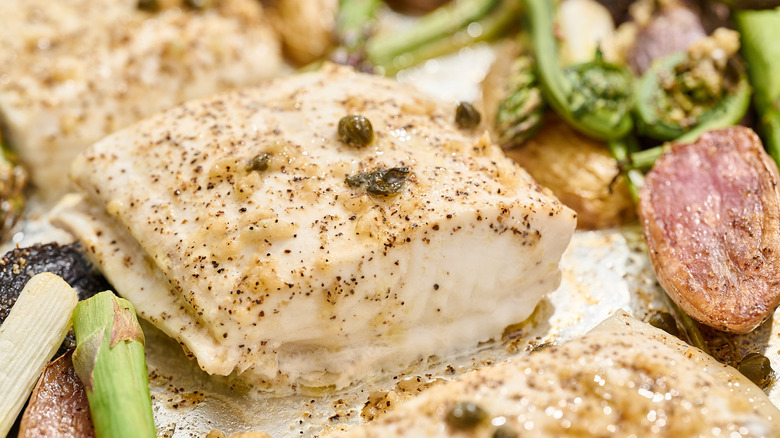
This sheet pan recipe is fairly straightforward, but requires that a few unique vegetables cook alongside a very delicate fish, which can be tricky to time correctly. Boiling the fiddleheads before roasting helps them become tender, and roasting the potatoes for double the amount of time than everything else is what cooks them to fluffy perfection. The ingredient that actually needs the least amount of cooking time, though, is the halibut, and overcooking it can lead to dry filets. To time everything right, make sure you choose asparagus that is about the width of a pencil and halibut that is about 2 inches thick for the best results.
Being a springtime recipe, you might find yourself with asparagus that is as thick as a quarter in diameter, and you might get unlucky enough at the fishmonger to get filets that are an inch or less thick. If this happens, add the asparagus first, reserving the halibut. Cook until the asparagus begins to soften, about 5 to 8 minutes, then add the halibut and butter. Cook until the halibut is done, then, about 12 to 15 minutes.
What are fiddleheads and why do I need to boil them before roasting?
Fiddlehead ferns are a somewhat rare type of green that taste a little like green beans or asparagus. Texturally, the ferns are between green beans and asparagus, as well, being both stalk-like and soft throughout. Fiddleheads get their name from their shape, which is curled at the top like the head of a fiddle, and are otherwise fern-like in nature. The unique greens have to be cooked thoroughly in order to avoid food poisoning, which is partially why the recipe calls for both boiling and roasting them. The other reason is for taste and texture.
In a similar way to asparagus, fiddleheads are not particularly flavorful when cooked without any seasoning or browning. Boiling first makes the fiddleheads tender, and roasting afterwards adds the flavor and color that boiling can't. Because of their tight, layered coils, fiddleheads are hard to roast without parboiling first to cook them on the inside. I don't recommend skipping the boiling step for this reason, but more importantly, because it is the best way to neutralize the toxins that cause food poisoning when fiddleheads are eaten raw or undercooked.