

10 1990s Fast Food Items That We're Glad Didn't Last
Fast food has come a long way from those early days of burgers and fries. Today, you can find fast food meals that are a feast for the entire family, and recent years have seen the development of some outstanding new menu items. However, not everything is an unconditional success, and fast food history is filled with some epic fails.
Sometimes, you might be able to understand how ideas seem great in theory, but when they're put into practice, they fall short. Other times, it's amazing they ever got off the ground in the first place. And let's go back to that strange, strange time that was the 1990s. Competition was stiff, everyone was hoping to hit on that next big product that would send sales into the stratosphere, and that meant the '90s were filled with big ideas that proved that "big" ideas and "great" ideas are not necessarily the same thing. Sometimes, they're not even in the same zip code.
Sure, some discontinued fast food menu items from the 1990s deserve to make a comeback. (We're still salty about the loss of Wendy's pitas, to be honest, and still pause to observe a moment of silence every time we make a homemade version of Taco Bell's Double Decker.) But not every '90s-era item that's gone the way of the dodo deserves a second chance. Some, we're glad we never have to see again, and have to wonder just how they made it into reality in the first place.
McDonald's McLobster
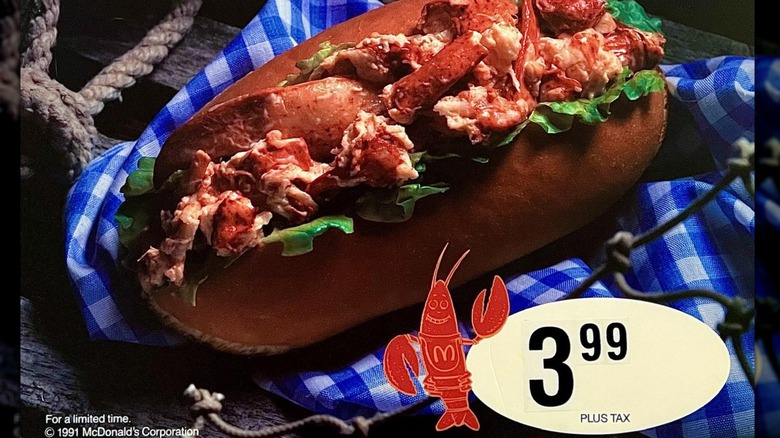
We get it: This one sounds completely fake. Literally everything about it just screams that it's an April Fools joke, because there is no possible way that McDonald's thought it was a great idea to not only offer a lobster roll, but offer a lobster roll for the low, low price of just $3.99. That's exactly what happened, though, and the start of this whole mess is perhaps understandably hazy, sort of like a fever dream you only partially remember.
A lot of sources claim this thing hit restaurants in 1993, but we've found other sources that claim 1992, and one ad that's dated 1991. Exactly what happened to it is unclear, too. We did find mentions of this being a seasonal offering in certain areas, popping up on menus in New England in 2015, and in Canada as late as 2017. In a now-you-see-it, now-you-don't vibe reminiscent of that summer you spent convinced there was a monster under your bed, this thing apparently kept popping up on menus before it finally disappeared for good and allowed us all to breathe a sigh of relief.
And yes, it's for the best — especially considering that it seems to have hung in the longest not in the Midwest, or Southwest, but for some bizarre reason, in New England. You know, the area that's known for having the best lobster rolls in the country, and access to some of the freshest lobster anywhere. We don't get it, either.
Burger King's Dinner Baskets
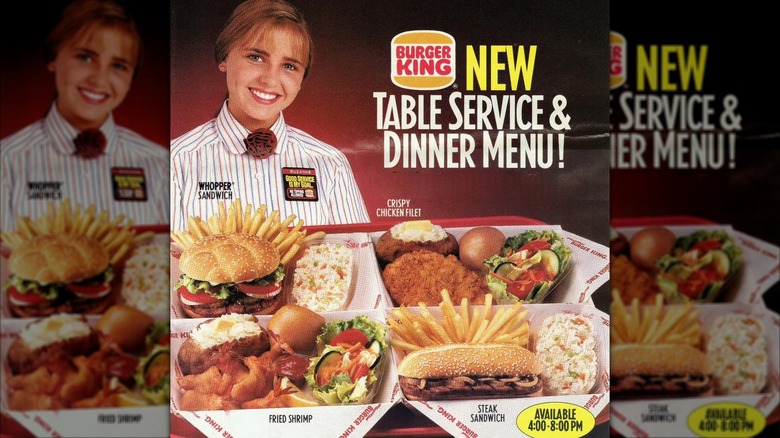
We realize we're kind of stating the obvious here, but it's something Burger King apparently missed the memo on back in the early '90s. Fast food should be that: fast. When we pick up a quick meal from any fast food restaurant, do you know what we've never thought: "Gee, I wish there was a way I could spend even more time here waiting for my food." But starting in 1992, that's what BK began experimenting with, and it did so by offering new options and table service.
The option to choose table service started at 4 p.m., and customers had a few dinner baskets they could order. There was a Whopper (why would I just wait longer for this?), a crispy chicken sandwich (we're cautiously optimistic on this one), a steak sandwich (that was a soggy mess by the time you made it through the first bites), and a fried shrimp basket. (Seriously, BK, just... stay in your lane here).
Those were the standards, and we did find some references to other items, too. A flame-broiled meatloaf sandwich existed at least somewhere, at some time, along with a chopped beefsteak sandwich. In spite of the fact that they were advertised with the help of both "MTV Sports" host Dan Cortese and his "No Fear" t-shirts, it turns out that the dinner service menu only lasted until 1994, presumably because no one wanted to spend more time in BK than absolutely necessary.
Domino's Dominator
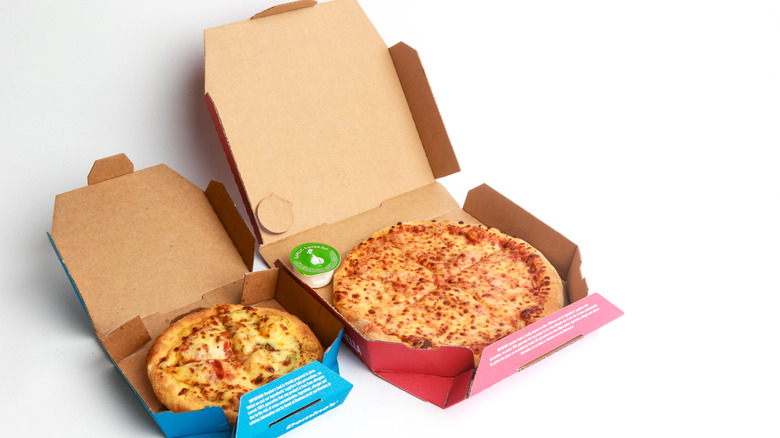
We all make mistakes; it's part of being human. Fortunately, there are moments when we can stop and think, "Wow, at least I'm not that guy," which brings us to Domino's. Back in the 1990s, Domino's, Pizza Hut, and Little Caesars were all fighting for supremacy in the pizza game. Each trying to outdo each other, Pizza Hut debuted the Bigfoot, Little Caesars did the Big! Big! Cheese and Pizza By the Foot, and Domino's scurried to catch up like a maniacal little goblin.
After a presumably panicked realization that they were lagging behind in these innovative new pizzas, they threw their hat in the ring with the Dominator. There was, however, a massive problem.
Pizza Hut was a sit-down place, and Little Caesars didn't deliver, so one would think that Domino's would come up with a giant pizza that would capitalize on its strengths as a delivery-based restaurant. Right? Wrong. Unlike the competitor's products, the Dominator was round. A long, rectangular pizza can easily fit in the back seat of a car, but do you know what a massive round pizza cannot do? If you said, "Fit through car doors and on seats," you would be absolutely correct — and you would have spotted a fatal flaw in the plan no one at Domino's saw. The Dominator was too big to be delivered, and when customers ordered it for pickup and the pizza became their problem, well... it didn't last.
McDonald's McStuffins
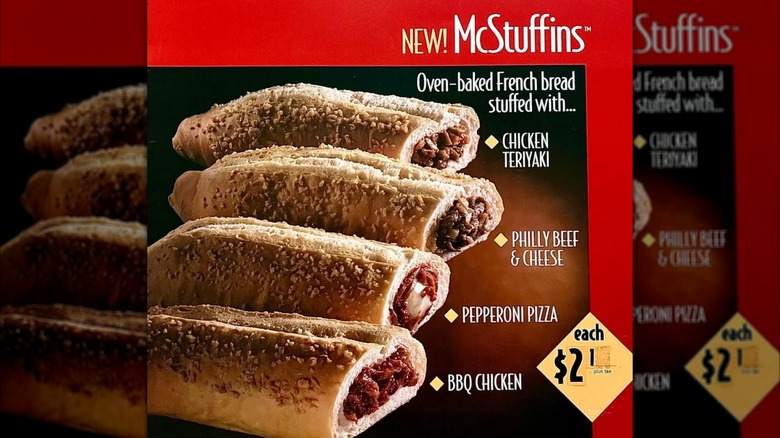
Our featured image is from a 1990s McDonald's advertisement for the vaguely naughty-sounding McStuffins, and when we headed to Reddit to see what we could learn about those who remembered them, the general sort of responses we found included a lot of people having no idea that they were ever a thing. Some even doubted they were in the U.S. at all, while others guessed that they were such a failure in test markets that they were pulled before they became recognizable.
We couldn't even find a concrete source for dates on this one, with some sources suggesting they appeared in the early '90s and disappeared anywhere between 1993 and 1996. Fillings were pretty standard and included pepperoni pizza, BBQ chicken, chicken teriyaki, and a Philly cheesesteak, and to be honest, we completely understand why these failed so hard.
Simply put: Hot Pockets exist, and have been a reliable staple in countless American freezers for years. They were invented around 1980, and provide the same experience as a McStuffins with one major benefit: You don't have to go to McDonald's to order them. If we have the option between a fast food item that's just fine and a microwaveable treat that means we don't have to change out of our PJs and leave the house, guess which one we're taking?
McDonald's Szechuan Sauce
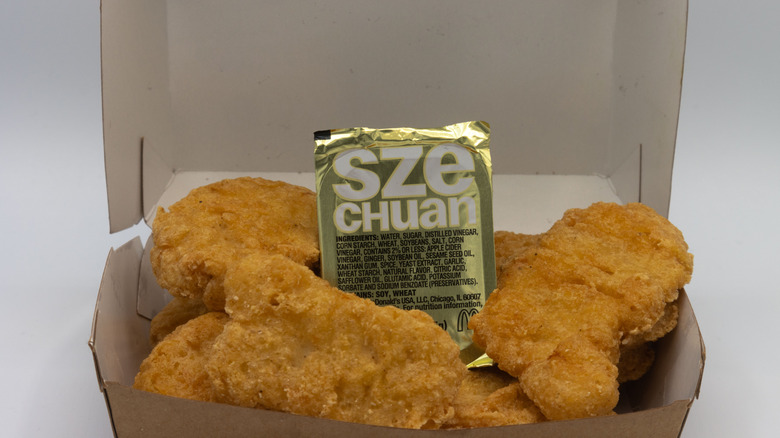
McDonald's Szechuan Sauce is easily one of the most overhyped fast food items of all time, and we will absolutely stand by that statement. Here's the short recap of a strange saga. Way back in 1998, McDonald's released this sauce alongside Disney's "Mulan." It was fine, no one really cared, and it disappeared. Fast forward to 2017, and an episode of "Rick and Morty" used a reference to trying to find this long-gone sauce as what was intended to be a valuable lesson about the futility of life.
Everyone seemed to miss the point in such a large-scale way that it's baffling, and when McDonald's brought back a limited quantity of the sauce, well, anyone familiar with crowd mentality knows that no good deed goes unpunished. McDonald's tried to make up for it in 2018 with a release of 20 million packets, and we're kind of glad to see this one fade into the past and remain one of those super-weird footnotes in foodie history.
Especially considering the fact that, according to an overwhelming number of people who actually tried the sauce, it was absolutely not-at-all special. It wasn't great, it wasn't bad, it was just the kind of thing you can definitely make at home and not have to arm-wrestle "Rick and Morty" fans for. Also, you definitely don't have to trade your car for a single packet, which is what one person did. (We wish we were making this up. We are not.)
Wendy's Country Fried Steak Sandwich
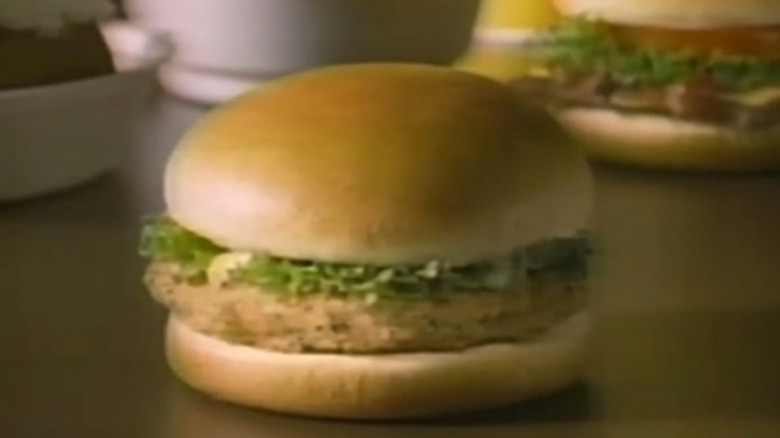
What if we told you that there was a long-forgotten 1990s-era menu item that took Wendy's into Southern diner territory? There was, and it was the Country Fried Steak Sandwich. Information is scarce, and that's kind of surprising. Wendy's was one of the coolest fast food chains until it got its boring, bland redesign, so we kind of feel like we would have heard more about this one if it were as good as country-fried steak can be. According to what we did find, this one was around from 1990 to 1994, may have come and gone for a bit after that, and cost just 99 cents.
But here's the thing. There are a lot of tips and tricks that you'll need to know about if you want to get country- or chicken-fried steak right, because when it's not-so-good, it's downright awful. From breading that falls off to tough meat, we'd argue that this perhaps isn't a dish for a fast-food sort of setting.
Interestingly, we did find a news article from 1991 that compared the nutritional value of different fast food items, and the general finding was that, almost across the board, menu items that were $1 or less were lower in fat and calories. The exception was at Wendy's, with both the country-fried sandwich we're talking about now and the Jr. Bacon Cheeseburger. Both got criticism from the Akron General Medical Center's Heart Center, and that's food for thought.
McDonald's Arch Deluxe
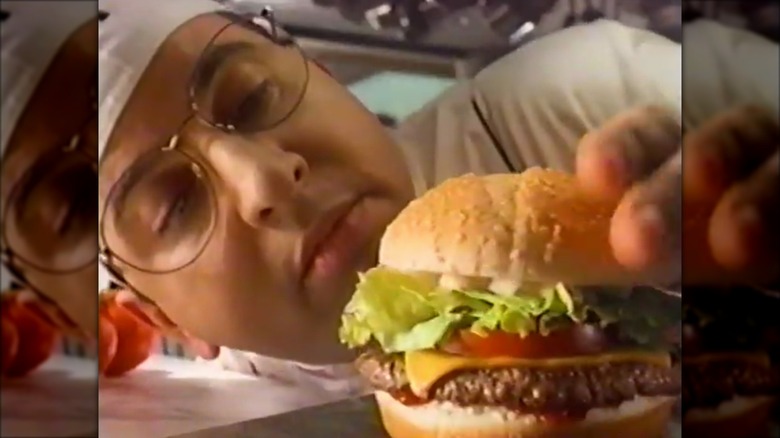
The entire story of McDonald's Arch Deluxe is a weird one. The idea was pretty straightforward, and it was just supposed to be a classy sort of burger that would attract adults — presumably, the kinds of adults who weren't going there anyway, because the kids were begging for a Happy Meal and a go on the playgrounds. The answer was the Arch Deluxe, and here are some shocking fun facts: It took a fine dining chef around a year to come up with a burger that was, at the end of the day, a burger that came with lettuce, a Dijon mustard sauce, tomato, and pepper-bacon on a potato roll.
Regardless, the burger tested really well with focus groups. In hindsight, experts have pointed out that the whole thing was kind of destined to fail, because those focus groups were largely made up of McDonald's fans and burger-lovers anyway, not people who needed to be sold on a new product by something outstanding. Whoops.
The Arch Deluxe became the poster child of a $200 million advertising campaign, which was weirdly focused on showing just how much kids didn't like the burger... as if that somehow made it more appealing to adults? We have no idea. We do like to think that the failure paved the way for McDonald's giving up on upscale offerings, and helping to guarantee a menu filled with the fries, Big Macs, and plain ol' nuggets that we know and love.
Little Caesars' Spaghetti Bucket
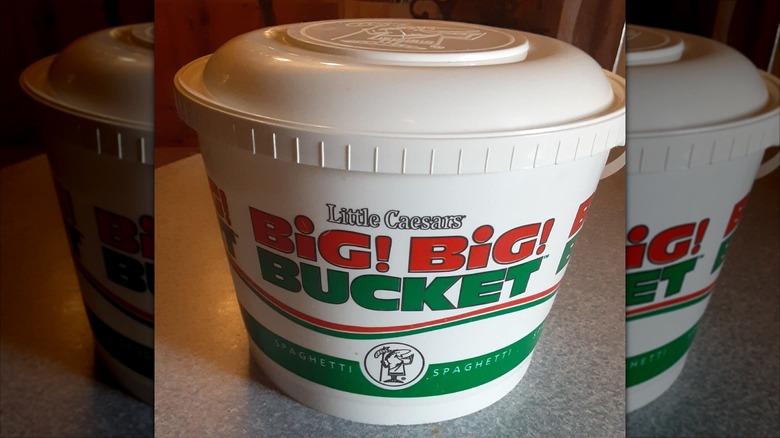
So, here's the thing about pasta: Texture is important. It's one of the reasons that some of Giada De Laurentiis' most brilliant cooking tips include using cupcake and sheet pans to create dishes with perfectly firm pasta and all those deliciously crispy bits on top that we all secretly try to sneak the most of, and do you know what we've never heard her say? "Then, put it all in a three-and-a-half-pound bucket, and serve at your leisure."
We're pretty sure that just putting that sentiment in the same sentence as invoking her name might have her hunting us down for a stern talking-to, but in the 1990s, Little Caesars thought that spaghetti by the bucket was a great idea. The Big! Big! Bucket of Spaghetti came in three sizes, with the aforementioned three and a half pound bucket being the largest. Can it get worse than what you're already thinking? Yes, because the spaghetti that made it into that bucket spent part of its life as frozen spaghetti.
If you're thinking that this is just going to result in very poorly-cooked spaghetti, there are plenty of comments on social media that indicate you're not alone in thinking that. We did find what we consider to be entirely apropos comments regarding this particular product, and it comes from several different Reddit users who have vivid memories of the bucket being repurposed for, shall we say, use by children suffering from stomach flu-like illnesses.
McDonald's McLean Deluxe
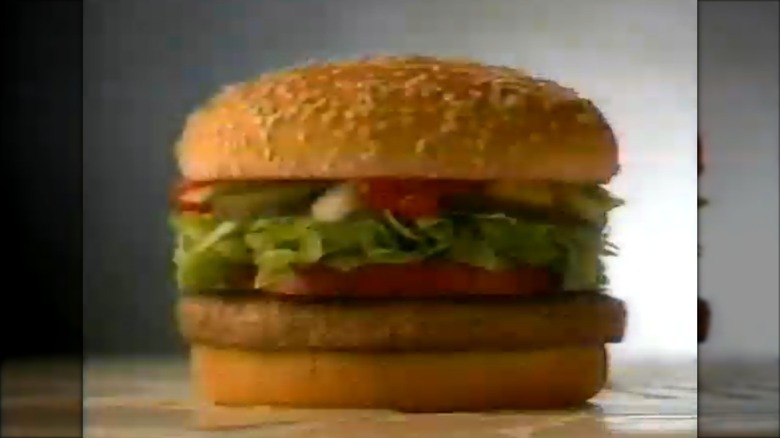
Every decade has been defined by various food trends, and in the 1990s, it was all about low-fat foods and healthy alternatives to mainstream foods. Back in 1987, the National Livestock and Meat Board teamed up with Auburn University in an attempt to find a low-fat ground beef. The idea was that it would pioneer a program that removed the fat content of beef, and it did. Technically. Fat was replaced with a seaweed extract called carrageenan, and it's possible that some are already familiar with this as an easy, vegan swap for gelatin. See where we're going with this?
McDonald's was the biggest buyer of the meat called AU Lean, and used it in the McLean Deluxe. It was on the menu for just about five years, and it was a massive failure. Not only was the texture completely unlike anything that anyone wanted in a burger, but Auburn scientists had loaded the meat up with salt in an attempt to improve the taste and texture.
Not only did the added salt completely derail attempts at making it an overall healthier option, but it just didn't work. The burger tasted, to use a technical term, really weird. It also apparently left customers still hungry, and burger fans know that a truly delicious burger is a juicy one. The McLean was notoriously dry, occasionally rubbery, and often reacted differently to cooking methods. More nutritious options are great, but only if people actually want to eat them.
Arby's Double Decker Sandwiches
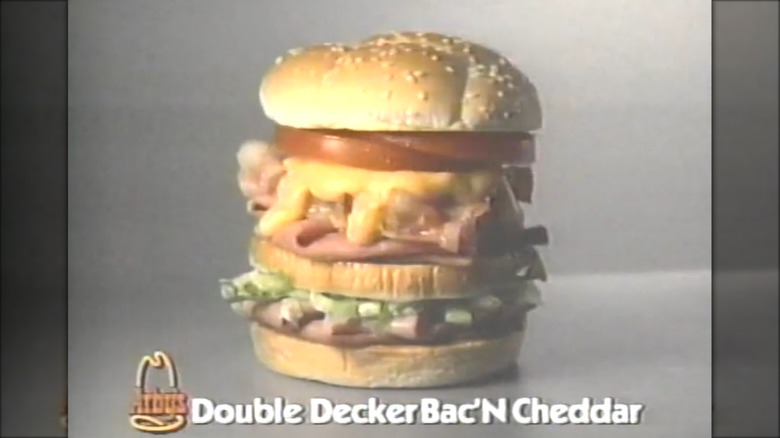
Here's another one of those long-lost, almost-forgotten missteps that we couldn't find too much on, and we do kind of understand why. Have you ever seen something on a menu that just made you want to find whoever is responsible, ask them if they've been feeling alright lately, and — if they answer in the affirmative, at least — suggest that they back the heck up for a minute? Those are the vibes given off by Arby's Double Decker Sandwiches, and they're exactly that.
There were three different options, including a roast beef and Swiss, a deluxe (with lettuce and tomato), and a bacon cheddar version, each one featuring the chain's signature roast beef. They were around in 1990, and while we're not sure what happened, we're going to go out on a limb and suggest that customers didn't feel like unhinging their jaws like boa constrictors to eat these things.
There are some discontinued Arby's items that we would love to see again. Pizza sliders? Never should have gone away. Steakhouse onion rings? We'd sign over our firstborn. But the Double Decker sandwiches are just way too much, well, everything, and we're glad these were gone so fast that even those who worked there at the time might not remember them.