

Why Beef Stroganoff Had Such A Hold On Boomers
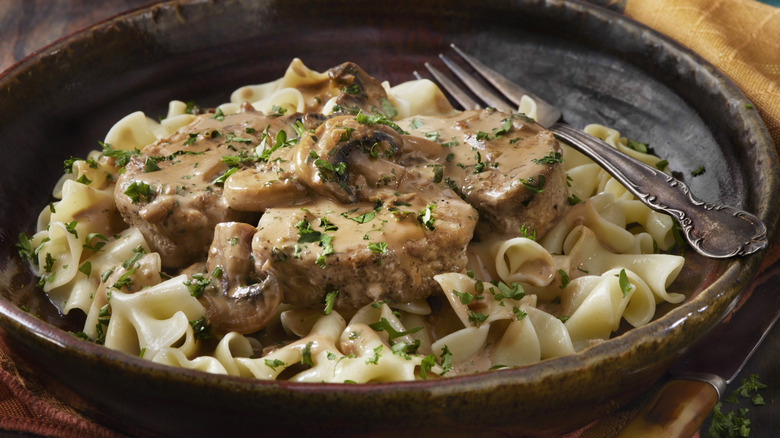
Given the opportunity, we'll take a pass on liver and onions for dinner tonight ... thanks. Although when it comes to other meat-centric comfort foods of the Boomer generation, more than a few enduring Boomer dinner recipes are still widely beloved today. That's why we're shining the spotlight on one midcentury marvel that (if you ask us) deserves a greater presence in modern foodies' weeknight dinner rotations: Beef stroganoff.
Not unlike pot roast, another Boomer generation classic, beef stroganoff transforms an unglamorous combination of stew meat and mushrooms into an elevated, rich, stick-to-your-ribs, Russian culinary institution. In fact, beef stroganoff's old-school, vintage feel was already centuries old by the time it became a Boomer favorite. The dish is named for the eponymous Stroganov family, nobility tracing back to 15th-century Imperial Russia who served as the viceroys of Siberia as contemporaries of the heralded Romanov family ("Anastasia" Broadway musical fans, rise up).
Several competing theories have emerged regarding its origin. One story posits that the shaved-beef dish was created for Count Grigory Stroganov (1770-1857), a fellow with very few teeth, who was better able to chew the tender morsels. Other theories maintain that the dish was created by the culinary staff of Alexander Grigorievich Stroganov (1795-1891) as easy-to-make fare for serving last-minute dinner guests at the family estate. But notably, the notion of beef mince in cream sauce is a versatile, wide-ranging concept that predates any specific dish bearing the "stroganoff" name.
Beef stroganoff could be made with tough meat rations during WWII
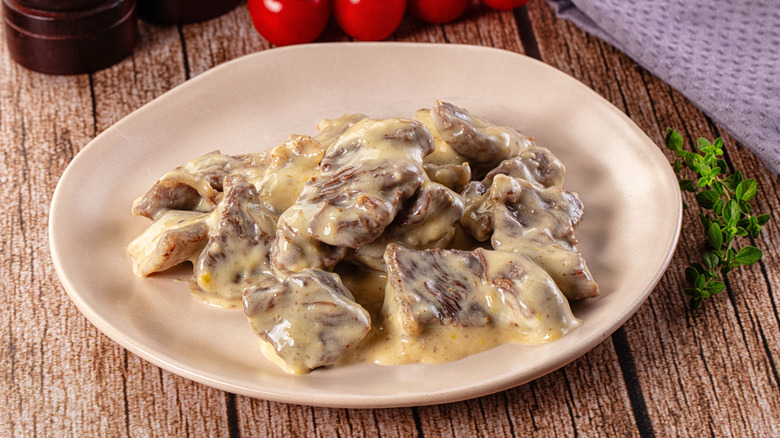
Whatever its exact origin, a recipe for "beef stroganoff" similar to modern preparations appears in the 1871 cookbook "Podarok molodym khozyaykam" (A Gift to Young Housewives) by Elena Molokhovets. Shortly thereafter, in 1891, French chef Charles Brière sent an official recipe for beef stroganoff to Russian publication "L'Art Culinaire" magazine – the same year that Alexander Stroganov (minister of Tsar Alexander III, Brière's employer, Governor-General of "Novorossia," and Count Grigory's son) passed away.
So, how did American Boomers develop a taste for this Russian classic? Enter: The Bolsheviks. When the Russian Revolution besieged the country in 1917, many Russians emigrated to China, taking beef stroganoff with them. Several decades later, when World War II brought American servicemen to the area in the 1940s, they brought the crowd-pleasing dish back to the States. Meanwhile, on the domestic homefront, U.S. households were facing ration-induced meat shortages – beef stroganoff's low-and-slow preparation provided a thrifty opportunity for braising and softening tougher, cheaper cuts of meat like tenderloin or rump roast. Here at Tasting Table, we even use stir-fry cuts to make our stroganoff, another nod to the dish's Asian evolution. While Asian iterations of beef stroganoff typically serve the creamy, stewed meat over rice, Russian stroganoffs feature potatoes, and egg noodles are the most common starch element in American stroganoffs.
The sauce features convenience-centric ingredients beloved by 1950s and '60s home cooks
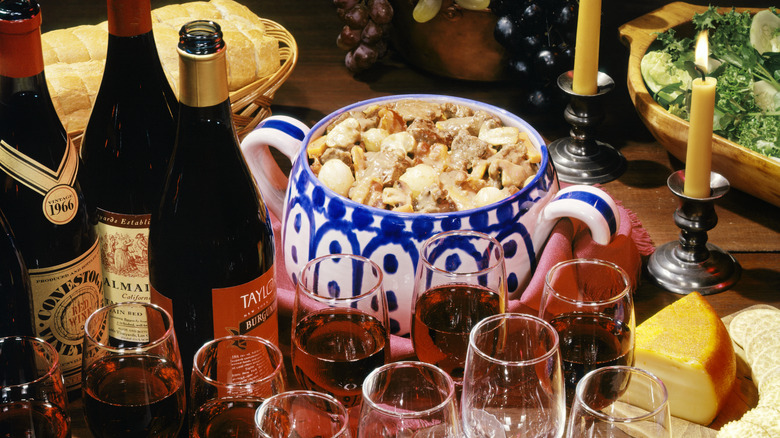
Transcending utility, beef stroganoff remained popular in post-war America as the food scene once again shifted to favor convenience-centric ingredients like canned cream of mushroom soup. All in all, the dish is versatile, cost-effective, elevated enough for a dinner party, and accessible to beginner home cooks – no special culinary techniques required.
By 1931, a recipe for "beef stroganoff" appeared in Irma S. Rombauer's seminal "Joy of Cooking," and in 1963, Craig Claiborne published a beef stroganoff recipe in The New York Times as an ode to the dish's climbing popularity among the American public. Indeed, velvety-sauced stroganoff accrued an especial following among the home entertaining scene of 1950s and '60s America. Ground beef also had a major moment during the '60s, and beef stroganoff's hamburger gravy provides a low-cost way to feed a houseful on a budget.
In a Reddit thread dedicated to the dish, one nostalgic foodie writes, "My mom made a 'poor man's' version of this when I was growing up. She used ground beef made into meatballs and cream of mushroom soup for the gravy. It was one of my favorites!" Another post shares a midcentury-style, convenience-centric hack for flavorful stroganoff: "[J]ust throw a pack of [L]ipton's onion soup mix in the sour cream, it's amazing." For more specific instructions, take a cue from our meaty, creamy, almost fancy beef stroganoff recipe, which comes together in less than 30 minutes.