

5 Disadvantages Of Using An Air Fryer
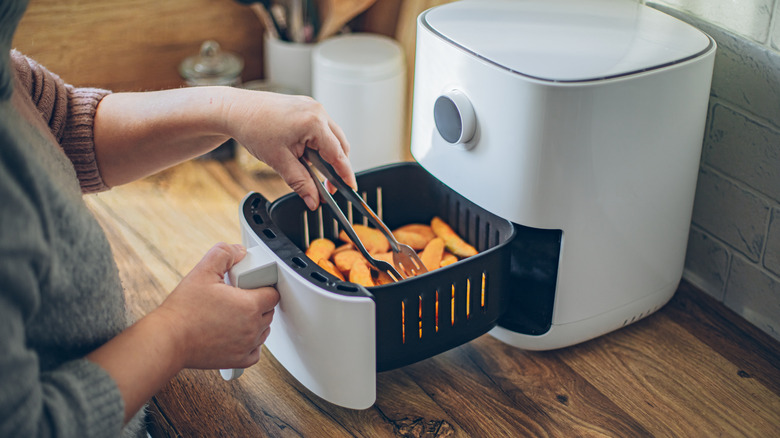
Almost overnight, the air fryer went from being an appliance that no one had ever heard of to one that occupied a spot on the countertop of nearly every kitchen in the U.S. The internet overflowed with lists of the best air fryer recipes and clever things that you didn't know your air fryer could do. These days, the hype around these appliances has faded some, but they continue to be exceptionally popular. Not everything about using an air fryer is wonderful, however. They can be quite handy, but there are some drawbacks as well.
On the air fryer's path to popularity — claiming its spot as America's favorite kitchen appliance — the simple device accrued many accolades. As soon as a friend plugged one in for the first time, it seemed like it was all that they could talk about. "It's healthier," they'd say, "because it doesn't use any oil." That is, of course, one of the many air fryer myths that became commonplace as more and more of the devices entered homes and recipe blogs. But on top of the often dubious claims about the healthfulness of the food they produced, air fryers were also lauded for things like speed and efficiency. There is a nugget of truth to each of these claims; air fryers do have some excellent features and can be very useful kitchen tools in the right context, but the points are often overstated. Examining some of the disadvantages can leave it looking like air fryers might be overrated.
1. Air fryers take up valuable countertop space
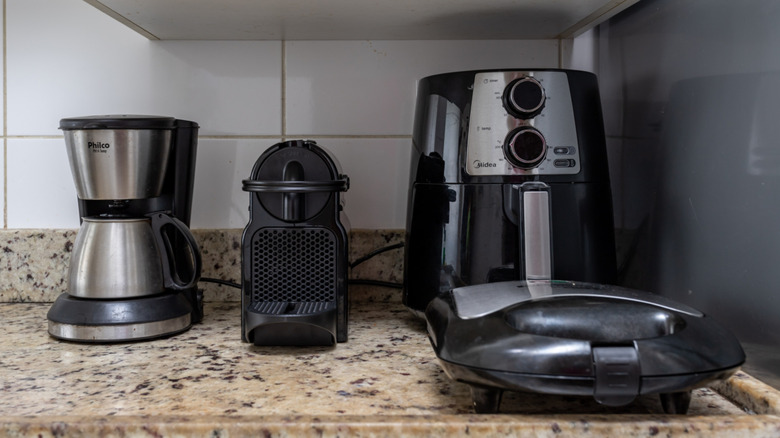
It doesn't matter how large the kitchen is; there is never quite enough space on the counter. Some air fryers are quite compact, but even small models need a place and a plug to prepare dinner. People who use their air fryers regularly will say that they are more than worth the space, but the trouble is that most of the appliances jockeying for that precious real estate add some new function to the kitchen arsenal, whereas the air fryer might not.
There isn't much an air fryer can do that a conventional oven can't. They are small, meaning that they heat up quickly and use less power to cook, but they are effectively just another dry heat cooking system. In truth, air fryers are not so different from convection ovens, just a clever rebranding of a technology that has actually been around in some form for over a century. Since the 1940s, convection ovens have been relatively common, and many modern ovens have a convection setting that activates a fan to move hot air and cook food just like an air fryer. For any kitchen with an oven, but particularly an oven with a convection setting, the air fryer is a somewhat redundant use of counter space.
When kitchen space is at a premium, air fryers can also end up crammed into small places where they may be unsafe to operate. These appliances generate a lot of heat, and it is important to ensure that they are properly ventilated — on a heat-resistant surface and with around 6 inches of space on all sides. If the kitchen is too tight for that, they can become a fire hazard.
2. The small air fryer basket limits cooking options
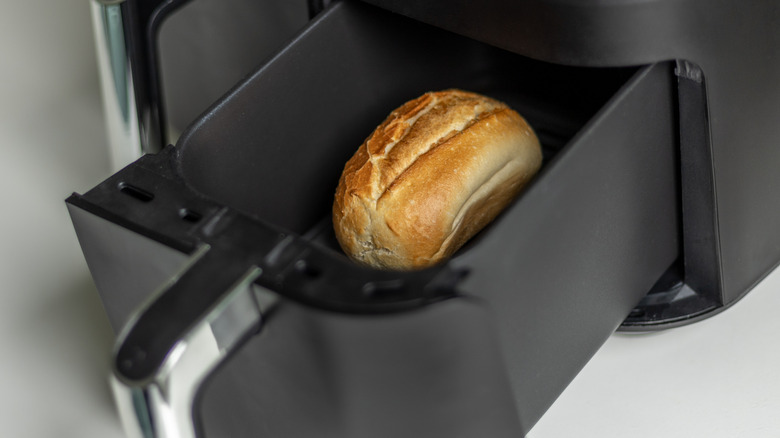
Many of the advantages of the air fryer come down to its small size. The quickness with which it prepares food as well as the lower power draw are both due in large part to the diminutive nature of the appliance. The trouble with this, of course, is that it means air fryers are incapable of doing a lot of common kitchen tasks easily handled by a conventional oven.
If you're cooking for one, that small air fryer basket is often just about perfect. Other best uses for the air fryer include heating up small portions of leftovers or making a single element of a meal, like roasted potatoes to accompany seared salmon and steamed broccoli. If you want to use the air fryer for the whole family, however, that small basket can necessitate cooking things in batches. At that point, you might as well use a conventional oven both to save yourself the extra labor and because the per-minute power consumption is lower, meaning that with multiple batches the energy savings of the air fryer may effectively disappear. Plus, it's tempting to overcrowd the basket to try to avoid a second batch, which prevents the signature crispiness of convection baking.
Finally, while there are plenty of foods that the air fryer does well, it is not quite as versatile as a conventional oven. The small basket means, for example, that you can't make a pizza in your air fryer — at least not a very large one. You also need to be careful when making anything cheesy in the air fryer, as it can drip through the basket and create a real mess, or even clog up the fan.
3. Air fryers can be painful to clean
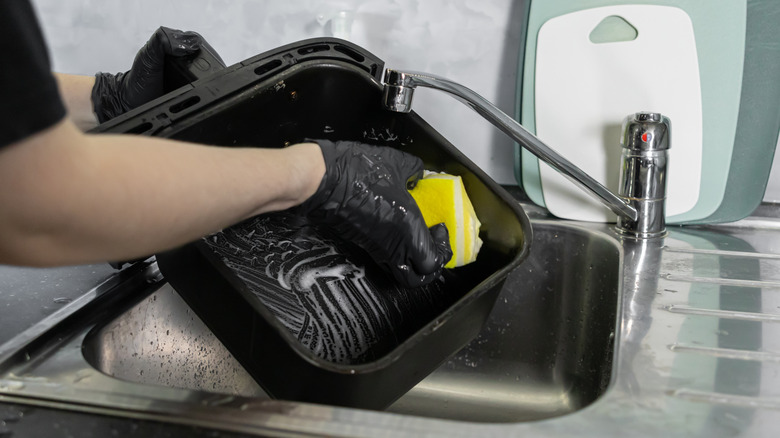
Foods prepared in the air fryer tend to have a fair amount of oil. It might not be as much as a deep fryer, but if the goal is to produce foods that look and taste fried, that necessitates a bit of it. Unfortunately, this means that they ought to be cleaned every time they're used, in the same way that a baking sheet needs to be cleaned after use in a conventional oven. That one is pretty straightforward. What many users might not realize, however, is that at least once a month the air fryer needs a deep clean. And for those that regularly cook greasy foods, this cleaning ritual should to take place much more frequently.
What makes air fryers special is the constant movement of hot air throughout the machine. This cooks food quickly and crisps it nicely, but it also creates a potentially hazardous environment. That hot air picks up airborne grease and runs it through the machine, leading to buildup on the fans and heating element. Without cleaning the proper parts of the air fryer, this can damage the machine or even create a fire hazard, and that cleaning includes those internal components.
It's possible to reduce the frequency at which the air fryer must be cleaned by using basket liners, but these are an imperfect solution. The silicone type blocks airflow, leading to soggy food, and the paper liners are prone to starting fires if not used carefully. The best practice is a regular, tedious deep cleaning.
4. Air-fried food may not be as healthy as you think
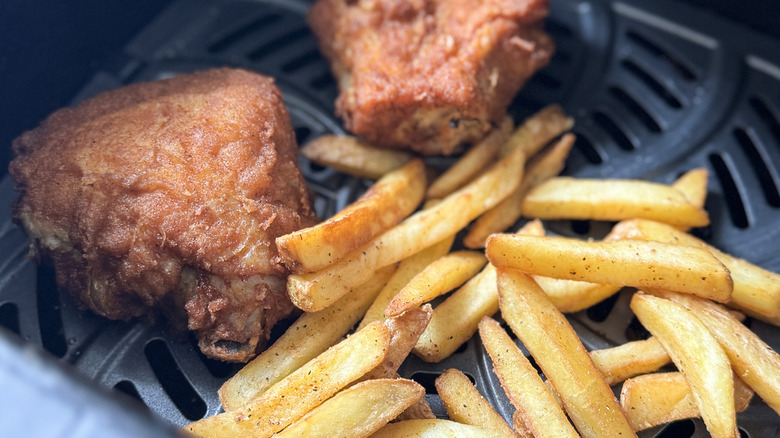
The sales pitch of the air fryer is largely built on this idea that it is somehow frying food without any additional oil. This is, of course, not at all what is happening in that little basket. As explained above, the air fryer is basically just a convection oven, and air-fried food isn't fried at all. The cooking chamber gets quite hot, and the constant flow of circulating air can crisp foods up nicely, but they are really just roasted. Air-fried french fries are no more fried than those cooked in a conventional oven.
If the comparison is made between deep-fried foods and air-fried foods, of course, the air fryer comes out on top health-wise. Compared to the oven, however, there's really no difference. The bigger trouble with the food coming out of the air fryer might be that the ease of use encourages home cooks to tilt their diets toward unhealthy options. Things like french fries, frozen fried chicken, and decadent appetizers like jalapeño poppers can all be made quickly and easily in the air fryer, but they are still less-than-ideal options for everyday fare.
Another common concern with air-fried foods is a compound called acrylamide. This is formed when foods — particularly those heavy in carbohydrates — are cooked at high temperatures. Long-term heavy exposure to acrylamide has been linked to some forms of cancer, though the FDA suggests that acrylamide is not a major concern for individuals with a balanced diet. Either way, the air fryer probably shouldn't be used every day.
5. Some air fryers may release toxic fumes
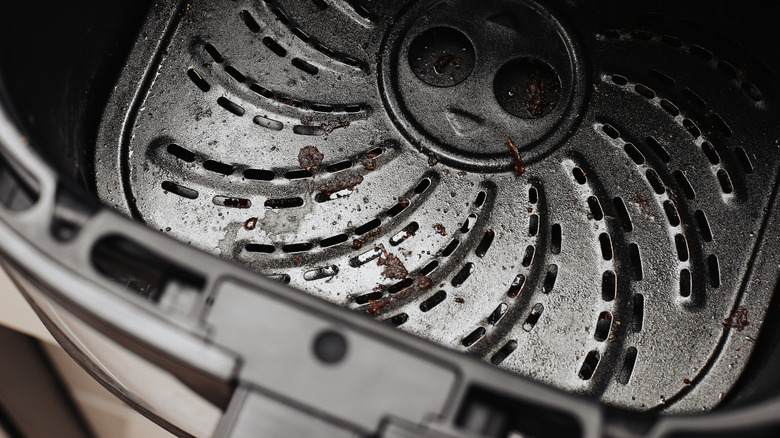
While most of the disadvantages of using an air fryer are relatively minor, one significant concern is the potential for this kitchen appliance to release toxic fumes as it cooks and blast them across your dinner with its built-in fans. No one wants to hear that your air fryer might be toxic, but unfortunately this may be true — at least to a certain degree. For starters, unlike conventional ovens, air fryers are typically constructed primarily out of plastic. There is a good reason that aside from those nostalgic childhood toy ovens, we don't generally bake in plastic. The materials are improving, but heating plastic can release some nasty substances you don't really want wafting over your dinner. In some cases, the plastic smell can even be quite pungent, particularly for the first few uses.
The other major concern is with the nonstick coatings used. Polytetrafluoroethylene (PTFE), also known as Teflon, is a PFAS compound commonly used in these devices. When overheated, this material breaks down and releases toxic fumes. Fortunately, that doesn't happen until about 500 degrees Fahrenheit, and most models don't allow temperatures to go that high. To be completely sure that this isn't a concern, however, the best choice would be to buy a PFAS-free air fryer, such as a ceramic-coated or glass model.
In the end, it is clear that air fryers are not the culinary panacea that they are so often made out to be. There are certain kitchen tasks at which they excel, but from tiny baskets to toxic gases, the popular appliances have plenty of downsides to them as well.