

Does Texas Roadhouse Actually Hand-Cut All Of Its Steaks?
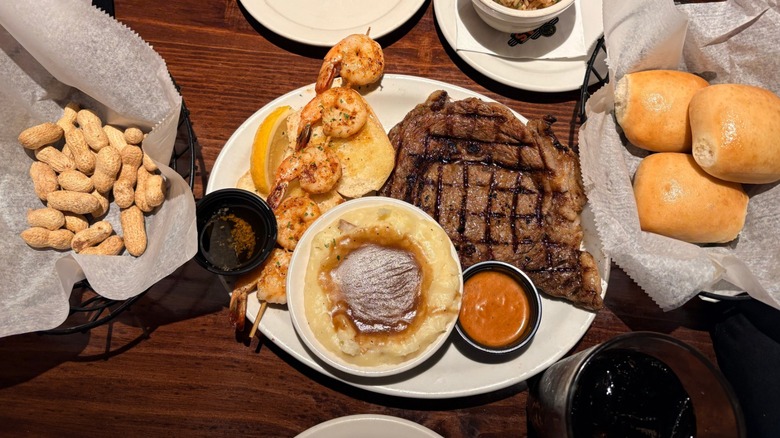
At Texas Roadhouse, guests can pick their own steak and get it freshly cut to order. Regardless of which steak they select, every slab has one mouth-watering thing in common: Texas Roadhouse chefs hand-cut every steak in-house from USDA Choice beef, the second-highest grade of beef you can buy. What sets hand-cut steaks apart from their pre-cut counterparts? It's all about attention to detail.
Even beyond the knowledge of different cuts of steak (ribeye versus sirloin, etc.), the restaurant's master meat-cutters must make each cut within a set of parameters and specifications. As they work, they must pay attention to thickness, width, the meat's unique fat marbling pattern, and the striation of its muscle tissues, all while keeping in mind the eyeball visualization for the restaurant's 12- to 14-ounce serving size standard with near-perfect accuracy. In the chain's high-volume dining concept, there is very little room for error.
In a small, cold room off the back of the main kitchen, these craftsmen move quickly and effectively with a samurai-esque level of comfort around large, sharp knives. Here, they clean off the tough silver skin, gristle, and tail fat, ensuring a 90% meat to 10% fat ratio per individual steak. Slicing huge quantities of meat, these concentrating cutters work undisturbed by the rest of the kitchen staff, who regard the butcher role as a kind of celebrity or Tenzo. Texas Roadhouse's meat-cutters work in a 38-degree walk-in cooler for around eight hours a day — both a feat of expert craft and mental prowess — cutting every serving of meat for an average of 7,000 to 8,000 guests a week.
Almost every steak passes through the hands of the master meat-cutters
Since 2001, Texas Roadhouse has hosted an annual nationwide steak-cutting competition amongst its chefs to celebrate that hand-cut craftsmanship. Butchers around the country compete for a grand prize of $25,000 as part of the Meat Hero program. In this multi-round competition, the restaurant's butchers are given one hour to break down three beef muscles — a top butt sirloin, a tenderloin, and a ribeye, roughly 30 pounds of meat total – into premium cuts of grill-ready steak, which get judged on quality, specs (dimensions, width) and yield (i.e. what percentage of the total meat they can slice into proper-sized steaks). Texas Roadhouse's meat-cutters practice for this competition (and its cash prize) all year long, honing their skillset and passing off the benefits to the hungry customers in the dining room.
In a write-up on Miguel Barragan, a Texas Roadhouse master butcher of 17 years and Top 5 Finalist in the 2024 meat-cutting competition, local outlet Lehigh Valley News paints the scene of Barragan clad in a heavy winter coat and gloves as he cuts, standing atop a piece of cardboard so his shoes don't freeze to the floor. In fact, to emulate the conditions of the walk-in cooler in which the butchers work on an everyday basis, Texas Roadhouse's annual meat-cutting competition is held on an ice rink. It's worth noting that there is one exception to the practice: The porterhouse T-bone is the only steak on the Texas Roadhouse menu that isn't cut in-house, and it's typically shipped frozen. But every other steak that arrives on a hot plate passes through the hands of these meticulous, prestigious artists behind the scenes.