

McDonald's Filet-O-Fish Uses The Same Fish As Burger King — So Why Do The Sandwiches Taste So Different?
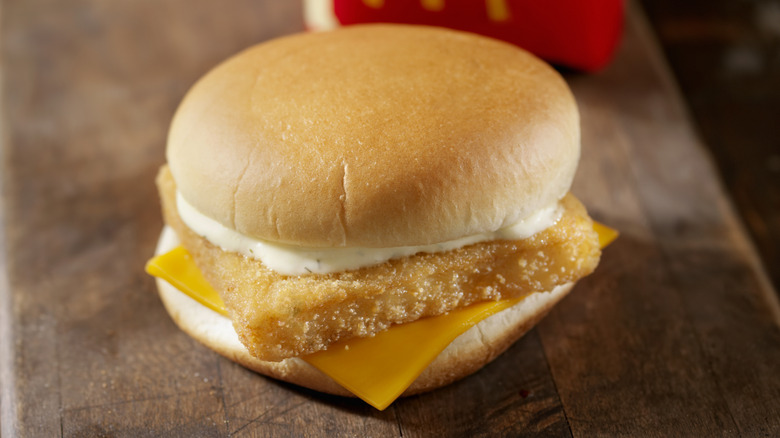
Even the same type of fish can take on a wildly-varying flavor profile depending on how it's prepared. Both McDonald's FIlet-O-Fish and Burger King's Big Fish sandwich start with a base of breaded and fried Alaskan pollock, formed into a square patty. But, otherwise, the two offerings taste quite different. It all comes down to their assembly accouterment: Type of bun, fish breading, and toppings.
Alaskan pollock is a delicate, buttery white fish prized for its mild, accessible flavor and flaky texture. McDonald's Filet-O-Fish tops its pollock patty with American cheese and a dollop of sweet-creamy tartar sauce, all served on a soft steamed bun. At Burger King, the Big Fish sandwich breads that pollock patty in a crispier panko breading. It shares the Filet-O-Fish's tartar sauce, but instead of cheese, BK's Big Fish is topped with lettuce and pickle coins, contributing an added crunchy textural element and a note of bright acidity rather than the savoriness of the cheese (as in the Filet-O-Fish).
For a final and crucial difference, BK's Big Fish sandwich is served on a toasted potato bun – which lends both a note of sweetness to the overall flavor profile, as well as a toothier structure than McDonald's softer steamed bun. This tougher bun vehicle also makes utilitarian sense, considering the aptly-named "Big Fish" is a slightly larger sandwich, clocking in at 570 calories and 19 grams of protein versus the Filet-O-Fish at 380 calories and 16 grams of protein.
Wild-caught Filet-O-Fish adds cheese where the Big Fish adds lettuce and pickle
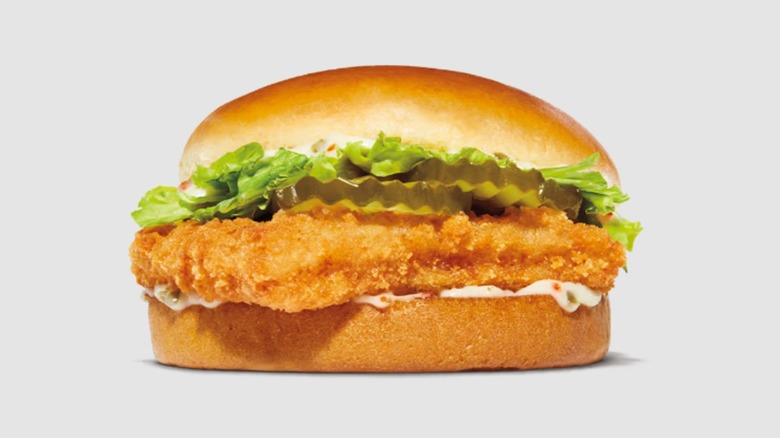
Another ostensible reason behind the flavor differences in these sandwiches is the source of their Alaskan pollock. At McDonald's, that pollock is wild-caught, while Burger King's website does not specify whether its Alaskan pollock is wild-caught or farm-raised. Even when it's the same type of fish, wild-catching versus farm-raising yield notable differences in flavor. Fish that have lived their entire lives in their natural habitats tend to eat a more diversified diet (i.e. crustaceans, algae, smaller fish) and contain higher omega-3 fatty acids, yielding what is generally considered a preferable taste and texture. Farm-raised fish, by comparison, are raised in highly-controlled enclosures, which facilitates a taste and texture centered around consistency.
Over the years, these longtime maritime rivals have both seen a few changes. When the original Filet-O-Fish sandwich debuted in the 1960s, it was made not from Alaskan pollock but from halibut. In fact, competitor Burger King released its own, now-discounted fish sandwich – the "Whaler" – in the early '70s to compete with Mickey D's fishy fan favorite. Over time, however, the Whaler was replaced by the Big Fish. Today, McDonald's Filet-O-Fish is arguably the more iconic menu offering, helping pioneer the fast food fish industry trend at large by making the sandwich a permanent menu fixture in 1965 (and who could forget the surreal earworm "Give me back that Filet-O-Fish" jingle of 2009?). Although, which sandwich is "better" ultimately comes down to individual preference.
Which sandwich is better?

In Tasting Table's definitive ranking of fast food fish sandwiches, Burger King's Big Fish sando narrowly trumped Mickey D's Filet-O-Fish for the latter's mild flavor (or lack thereof). Quoth our taste-tester, "Without the mask of cheese and heavily applied sauce, [the Filet-O-Fish] would fall flat." Meanwhile, even though Burger King's Big Fish is "nearly neck and neck with McDonald's," its thicker panko breading ultimately gives the Big Fish a leg up, creating a "slightly crispier bite." The extra toppings don't hurt, either.
Elsewhere online, one Reddit thread about BK's Big Fish posits, "I was shocked at how good their fish sandwich was. It totally blows away McD's fish sandwich." Another commenter chimes in, "And it does all this without cheese." On the flip side, other Redditors sing the praises of the Filet-O-Fish, writing, "The fish is very light and decently flakey. It's a bit unusual to have a slice of American cheese on fish with tartar sauce but it actually works and tastes good." To emulate the size and textural variety offered by BK's Big Fish, foodies can try customizing their McDonald's Filet-O-Fish sandwich by adding lettuce and pickle, or even a second fish patty. Still, these upgrades come at a price. At respective locations in Chicago, a McDonald's Filet-O-Fish sandwich currently costs $4.69 (or $5.89 for the double patty version), and Burger King's Big Fish sandwich runs for $5.49.