

I Priced Out A Week's Groceries At Aldi And Walmart — Here's Which Was Cheaper
Nowadays, when the time comes to replenish the house with groceries, many of us can't help but feel a little pang of anxiety. Food prices have skyrocketed in recent years and are expected to climb steadily as the years press on, leaving working families to constantly adjust their budgets and, in some cases, settle for cheaper, less nutritious food. Some blame inflation or conflagration, and others point the finger at greedy corporations. Whatever the cause, many are finding it harder and harder to stock their homes with the foods they've come to rely on as staples of their diets.
At a time when so many are on the hunt for affordable food, large chains that promise a bargain can be a lighthouse in a storm. Aldi and Walmart stand out as two of the country's major stores for affordable, non-bulk food when the grocery budget gets tight — but are they close enough in price to both be considered great deals?
I priced out a week's worth of nearly identical groceries at each store to see how they compare cost-wise. I chose groceries that I actually buy regularly for my two-person household and included sale prices for a real-world comparison of staples from both grocery chains. Both Walmart and Aldi are ubiquitous around the U.S. — but when the grocery budget is stretched to the max, which one will do a better job of helping you fill your pantry with affordable, nourishing foods?
Milk and dairy
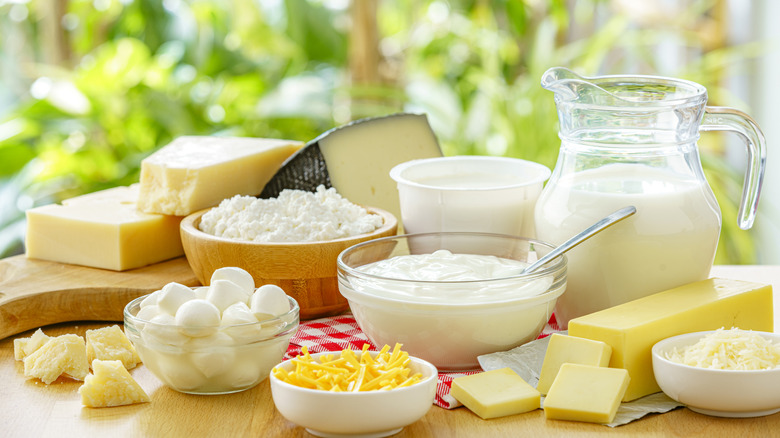
Dairy products aren't frequent flyers in my home, but there are a handful of items that I consider staples, including non-dairy alternatives. These items can cause the grocery bill to soar if you're not careful. But, thankfully, both Aldi and Walmart offer cheap alternatives to things like pricey plant-based milks and bougie cheeses.
One dairy product that I can't go without is plain Greek yogurt, which I use for everything from snacking to curries to smoothies to dressings. Great Value's 32-ounce option is priced at $2.94, while Aldi's is $3.09. However, it's worth noting that Aldi's yogurt ranked a bit higher in our ranking of Greek yogurt brands. Another must-have for daily smoothies is almond milk; Walmart's half-gallon size is $2.63, and Aldi's is $2.75.
When it comes to butter, you don't have to be a foodie to recognize that Kerrygold butter is definitely worth the price. Butter is one of those staples that you don't want to cheap out on, so I always grab Kerrygold from Walmart for $4.84 or Aldi's Kerrygold dupe for $4.39. Keeping a block of cheddar around for the occasional recipe is almost as crucial as having butter on hand, and this runs me $1.87 for an 8-ounce block at Walmart and $1.89 at Aldi. Finally, a half-gallon of regular whole milk is $2.33 at Walmart for the chain's house brand and $2.59 for Aldi's Friendly Farms store brand. My dairy and milk bill comes out to $14.61 from Walmart and $14.71 from Aldi.
Produce
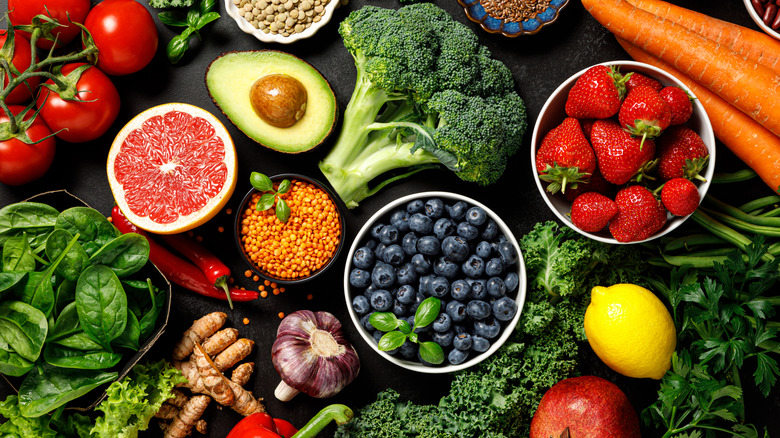
To create a dietitian-approved complete meal, you'll need at least one serving of fruits or veggies in each dish, so produce should make up a large portion of your grocery bill. Leafy greens are a must, and they tend to vary in my house, but I opted for spinach for this grocery list. Walmart's fresh spinach is $0.05 cheaper per ounce than Aldi's. At Walmart, three avocados are $2.34, 3 pounds of sweet potatoes are $3.36, and 3 pounds of onions are $3.24. The same amount of avocados, sweet potatoes, and onions at Aldi are $2.25, $2.19, and $2.19, respectively. At Walmart, 3 pounds of zucchini costs $4.38, and at Aldi, the price is $3.57. Here, we can see that fresh veggies are considerably cheaper at Aldi, outside of garlic, which is $1.87 for three bulbs at Walmart and $1.99 at Aldi.
It's a slightly different story when it comes to fruit. One bunch of bananas comes out to about $1.71 at Walmart and $0.97 at Aldi — that's nearly double the price for Walmart's bananas. However, a 3-pound bag of Gala apples is $2.58 at Walmart and $2.55 at Aldi, and a bag of frozen cherries and berries is $7.62 at the Waltons' grocery mecca and $7.15 at the German bargain chain. Frozen and canned veggies come out to roughly the same price at both stores, while ginger paste is about $0.50 more at Walmart. In total, my produce expenses at Walmart are $40.87 and $35.17 at Aldi.
Meat and other proteins
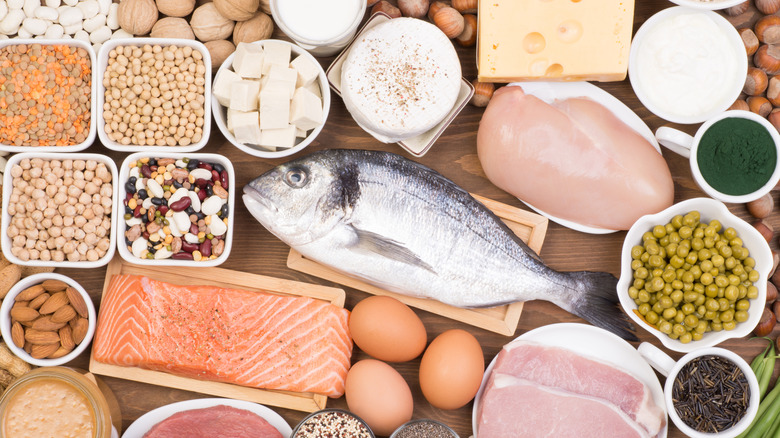
Meat and other proteins are a crucial part of any diet, despite making the food bill soar. However, Walmart and Aldi both offer reasonable prices on proteins, and if you put a little extra effort into scoring deals, you can eat high-protein meals without wasting money.
Let's start with meat: Chicken and beef are staples in my house since they both offer a steady, dependable price and are more versatile than other meats. I always opt for chicken thighs; they're tastier, cheaper, and better than chicken breasts in every way, according to Alton Brown. At Walmart, a 5-pound pack is $7.85, while the same size pack costs $7.75 at Aldi. When it comes to beef, I know I'm not alone in not being able to stomach the fatty, cheaper stuff. I always choose lean, grass-fed beef, which costs $8.71 per-pound at Walmart and just $6.59 per-pound at Aldi.
I usually opt for cheaper foods to make up the bulk of my household's protein, like eggs, tuna, and tofu. Pasture-raised eggs — which are said to be more nutritious than cage-free — from Walmart cost $6.46, while comparable pasture-raised eggs are $4.35 at Aldi. Two cans of albacore tuna cost $3.88 at Walmart, and $3.98 at Aldi, and tofu is $0.21 per ounce at the big-box store and only $0.12 per ounce at the tinier store (although I should mention that I much prefer Walmart's extra-firm tofu). The meat and protein section of my grocery bill cost me $30.32 from Walmart and $24.42 for the same items from Aldi.
Grains and legumes
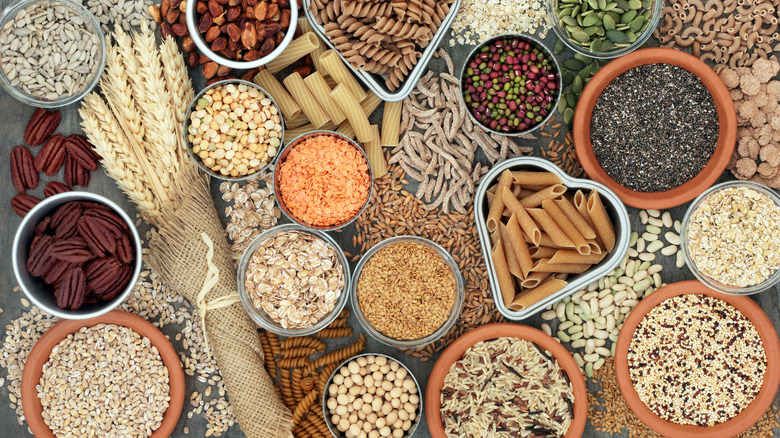
I think of grains and legumes as the inexpensive filler in a grocery bill. It's easy to make poor budget or health choices here, but with a little effort, you can choose inexpensive, health-conscious items to add to meals and snacks. Aldi and Walmart both offer cheap staples when it comes to beans, breads, pastas, and other grains, which are especially handy when you need to stretch your budget to the absolute max.
I always stock up with a couple of cans of chickpeas, which come out to $0.86 each for the Great Value brand. Dakota's Pride, one of Aldi's house brands, offers garbanzo beans for $0.95 per can, and the quality is comparable. Although a common myth about quinoa is that it's a grain (it's actually a seed), it falls into this category colloquially, ringing up at $3.44 per-pound at Walmart and $3.69 at Aldi. Lentils are exceptionally cheap and nutritious, so I never leave the store without a $1.96, 1-pound bag from Walmart or a $1.55 bag from Aldi.
Rice, pasta, and bread are perhaps the most iconic grains in the average American's diet. At Walmart, expect to pay $2.97 for 2 pounds of basmati rice and a whopping $4.29 at Aldi. I usually opt for protein pasta when I can, which costs $3.32 for an 8-ounce box ($0.42 per ounce) at Walmart and $3.45 for a 12-ounce box ($0.29 per ounce) at Aldi. My favorite multigrain bread at Walmart is $4.68 for a loaf, and a loaf of similar bread is $2.99 at Aldi, although the quality isn't as good. My bill for grains and legumes from Walmart is $19.09, and $17.87 from Aldi.
Drinks

Rounding out the shopping list, we have drinks — because most of us aren't scratching drinks off the grocery budget and settling for nothing but tap water to save a few bucks. I avoid soda for health reasons and instead opt for seltzer water and 100% fruit juice. When I buy a pack of seltzer from Walmart, I pay $3.68 for eight cans, which comes out to $0.46 per can. At Aldi, a dozen cans cost $4.85, or $0.40 per can. I like to throw a splash of juice into seltzer or add it to smoothies, with pineapple juice being my go-to. Walmart's name-brand pineapple juice (there isn't a store-brand option near me) is $4.66 for a 52-ounce container. The same size container is a lot more expensive at Aldi, which is surprising, since it's a generic store brand. The Nature's Nectar pineapple juice at the German grocery store is $5.95 for 52 ounces.
Even if you love gourmet coffee (guilty), it's far from budget-friendly to drink only the artisanal stuff, so coffee from the grocery store has to suffice sometimes. Aldi's standard breakfast blend costs $6.85 for a 12-ounce bag, while the New England breakfast blend at Walmart is $7.97 for 12 ounces of coffee. My drinks from Walmart amounted to $16.31, while my coffee, seltzer, and juice came out to $17.65 at Aldi.
Conclusion

At first glance, it's impossible to tell which budget-friendly chain offers the better deal overall. Prices are quite close in most categories, with each store coming out on top in some instances. The dairy products and alternative milks that I buy are practically identical in price from both chains, but in general, I prefer the quality of these items from Walmart, especially the almond milk. Produce, which ideally should make up the bulk of a grocery haul, is noticeably cheaper at Aldi, as is protein. In fact, the meat and other proteins accounted for the largest price discrepancy by category between the two chains. Aldi's grains and legumes are marginally cheaper than Walmart's, while its drinks wound up being slightly pricier than the big box store's.
Ultimately, my entire grocery haul was $121.20 at Walmart and $109.82 at Aldi — this is a difference of about 9.4%. Generally, I'd consider anything under 10% a marginal difference, but depending on how tight the budget is, that 10% can be crucial. Therefore, Aldi is the cheaper store in this mock grocery shopping experiment. However, I generally prefer the quality of Walmart's items.
Despite the grocery hauls being close in price, your shopping habits can make Aldi significantly cheaper than Walmart. For instance, if meat makes up an even larger portion of your food budget than it does for me, you could see much more significant savings by choosing Aldi over Walmart, since Aldi dominates in cheap meats and proteins. Or, if you eat even more veggies than I do, you're bound to save by shopping for your produce at Aldi as well.
Methodology

To construct this price comparison between Walmart and Aldi, I priced out items that I personally shop for on a regular basis from both stores. I focused on items that are standard staples in the American diet, with a particular spotlight on healthy, whole foods. Sale prices were included to get a real-world example of a grocery bill from each chain.
I chose items from both stores that are nearly identical to each other to get as accurate a price analysis as possible, comparing each store item-for-item, then by grocery category, and ultimately by their total bills. There are some minor discrepancies in product weights, although these are insignificant enough not to affect the total outcome of the comparison.
Price was the primary factor in deciding which store ultimately came out on top. However, since these are all items that I buy regularly or have purchased in the past, I attest to their quality throughout the comparison when applicable.
Some staples, especially sugar and cooking oil, are expected to go up in price due to the war in Iran, which is ongoing at the time of writing. These items were not included in this mock grocery shopping excursion in anticipation of potential surges in cost. All prices are based on those at my local Walmart and Aldi in Northeastern Pennsylvania and are accurate at the time of writing.