

8 Absolute Best Tips For Watering Your Fruit Trees
Fruit trees are truly wonderful to have in your garden, but before pursuing your dream of picking your own apples, you need to know how to care for them in the long run. Reliable fruit harvests require consistency and patience, and the last thing you want to do is make a watering error that results in all your hard work going to waste. While it's reasonable to assume that more water leads to better growth, it rarely works like that with any plant. In fact, overwatering can be just as deadly to your plants as underwatering. To ensure your fruit trees are being watered properly, you need to follow some important tips.
I run my own gardening business and have years of hands-on experience both growing my own fruit trees and maintaining them for customers. Not only has this allowed me to refine my own watering methods, but it's also shown me the consequences of watering mistakes. When done right, you'll have productive fruit trees that deliver bountiful harvests, year after year. Whether you have a tiny yard or you're aiming to plant your own orchard, brush up on the practical tips below, and you'll soon be equipped with all the knowledge you need for long-term success.
1. Water your fruit tree deeply every time
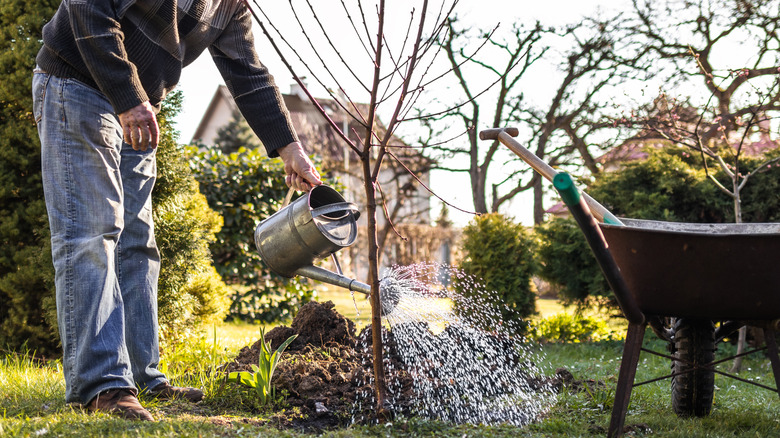
If there is a cardinal rule for watering a fruit tree, it's to always keep the soil moist. You may be thinking that this means watering your tree little and often to prevent the soil from drying out — it sounds intuitive, but it's not the solution. Watering your fruit tree for a few seconds at a time means the water is only going to permeate the first few inches of soil.
Instead, when you water the tree, do so as deeply as possible to ensure the water seeps down to the lower levels and encourages stronger root growth. This generally means that you should water your fruit tree less frequently but for a longer period of time. When I'm watering a fruit tree, I put the hose pipe on a low-pressure setting and lay it down by the tree for a few minutes. Even on a hot and sunny day, the soil will stay moist thanks to the water penetrating deeply into the soil.
2. Don't overwater your tree
This may seem contradictory to the tip above, but it's not. Remember, you want your soil to be consistently moist, not wet. If you're allowing the right amount of time between waterings, you'll see that your deep watering is absorbed by the soil rather than making it waterlogged.
You can think of the roots almost like a human. We need water to survive and thrive, but we still need to breathe. If the roots are waterlogged, they become starved of oxygen. This can cause root rot or disease which, in a worst case scenario, can kill a tree. If I'm ever in doubt about whether a fruit tree needs watering, I'll leave it alone for a day. It's always better for the soil to become a little too dry than remain wet. A little dryness can actually allow the roots to search deeper, which strengthens the tree over time. The downside to underwatering is that it can stress the tree and stunt growth, but in my experience, plants tend to recover a lot more quickly from having a lack of water than from having too much of it.
3. Remember the roots are much wider than the trunk
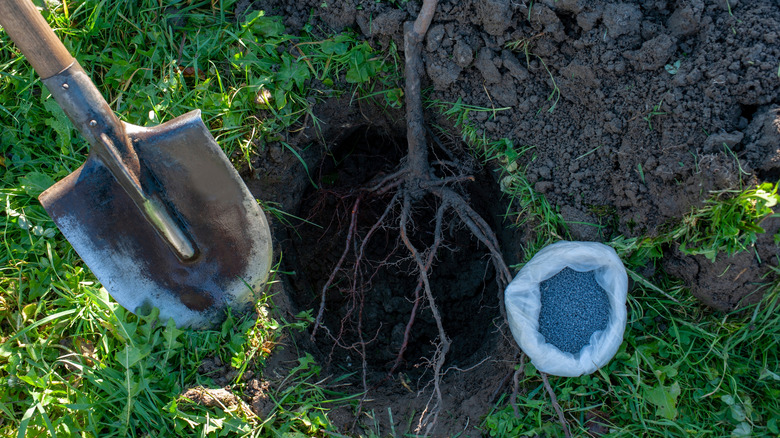
Over the years, I've noticed that many people forget that tree roots are much wider than the trunk. This fact may sound obvious, but it probably comes down to the simple fact that the roots are hidden beneath the surface. But remember that it's not the trunk, branches, and leaves that are responsible for the vast majority of the tree's water intake — it's the roots. Some people either spray the whole tree with water while others steadily water the base of the trunk, but these aren't the most optimal strategies.
Trees can have various types of root systems, but fruit trees in particular tend to have shallow, sprawling root systems. These can end up being two or three times the width of the canopy. As such, you should water the entire area of ground above the root system. Otherwise, you could end up having parts of the extended root system constantly dried out. Of course, this isn't a requirement for indoor trees, such as indoor olive trees, but you still want to ensure all of their soil is moist.
4. Water your trees in the morning
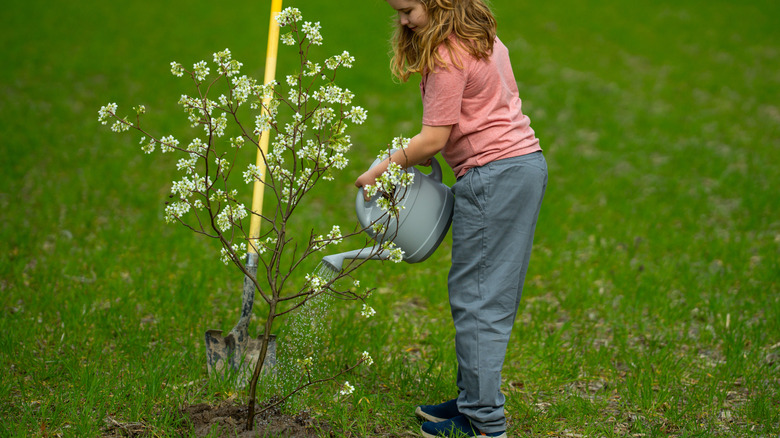
There is a prevailing myth that you shouldn't irrigate plants under the midday sun because the leaves may burn due to a magnifying effect. While any experienced gardener will tell you this is untrue, there are still genuine reasons for not watering during the hottest part of the day.
The main reason is evaporation. You want the water to soak deeply into the roots, but this is more difficult at high temperatures. By the time the heat comes, you want an even consistency of moisture throughout the soil. Mornings give your roots more chance to soak up the moisture before the sun steals it away.
Watering early also prepares your fruit tree for the rest of the day, almost like how we eat breakfast. As sunlight and temperature rise, your fruit tree will have access to the moisture it needs. Watering in the morning also means that moisture on the leaves will evaporate away quickly, rather than stagnating overnight and increasing the risk of disease. That said, if you miss the morning watering and your soil has dried out, a midday soak will be much better than skipping watering entirely.
5. Be flexible with your watering schedule
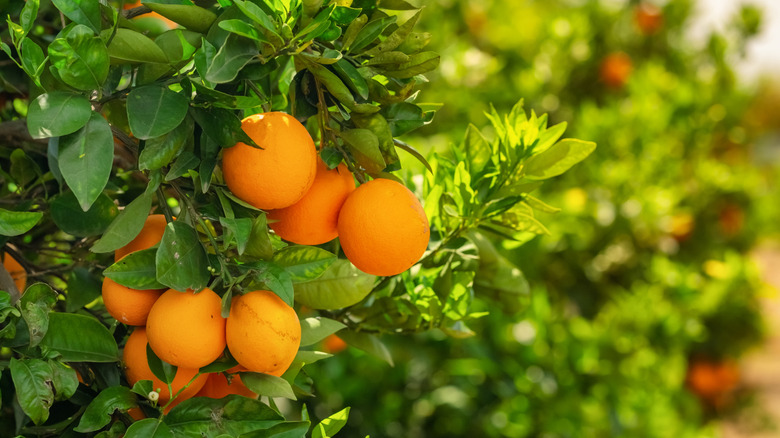
For consistency, it may seem like a good idea to follow a watering schedule. This can be both helpful and a hindrance — while it means you don't miss waterings, it can lead to overwatering. Instead of creating a definitive watering schedule, it's better to create a schedule for checking if your plants need watering. You should always be watering based on the needs of the tree above anything else.
In a temperate climate, you may experience weeks of cloudy skies and frequent rainfall, or brutal heatwaves. Factors such as wind and humidity can also affect how quickly soil dries out. I check on my plants each morning and decide which need leaving alone, and which may need some attention from the watering can. If any need a deep watering, the hosepipe comes out.
Also, don't presume that nature will do the job for you. A cloudy day with light precipitation may seem convenient, but that rainfall may not soak deep enough into the ground. The best solution is to mix routine with observation. Have a set time for checking your fruit trees, but don't assume they'll always need watering.
6. Spread mulch around your tree
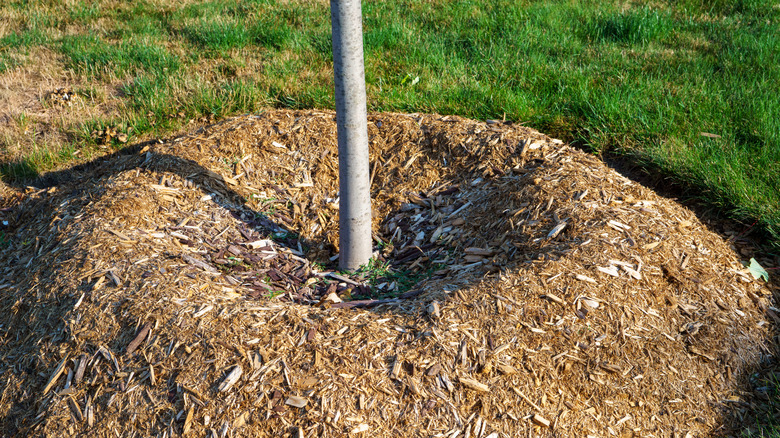
Mulch is the name given to any material that is spread over soil to provide a protective covering. This layer can help to suppress weeds, deter pests, add nutrients, and reduce the risk of disease, but forgetting about mulch is a common gardening mistake.
From a watering perspective, mulch can be a brilliant addition for fruit trees due to a natural phenomenon I already mentioned: evaporation. As the sun hits the base of the plant, it will dry out the mulch and not the soil beneath it. This helps the soil stay moist and keeps it in that balanced state of not being too wet or dry for longer.
Decorative mulch, like stone, can be effective, but I love to use organic mulch, such as bark or wood chips. You can even use food waste, such as corn husks. As organic material breaks down over time, it can help enrich the soil. You want to spread the mulch at least a few feet around the base of your fruit tree. As the roots spread out far and wide, you want to spread the mulch to at least reach the edge of the canopy (also known as the drip line). This mulch layer doesn't need to be too thick — just a couple of inches will be enough.
7. Adjust watering based on soil type
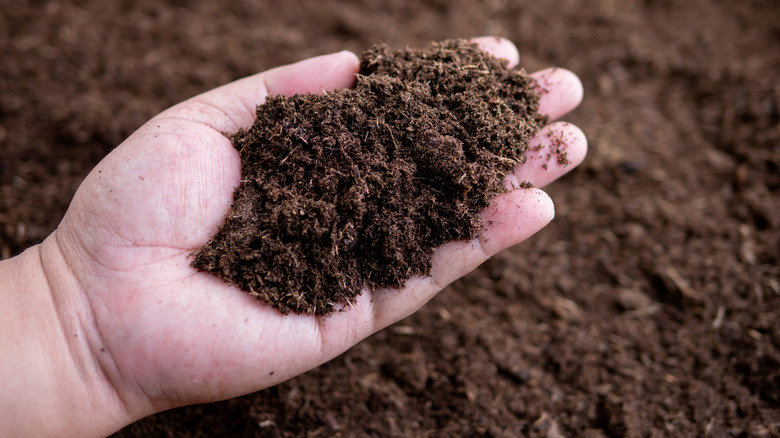
Not all soil is the same, and some types can hold a lot more moisture than others. Where I live, the soil is incredibly dense and clay-heavy. When I plant directly into the ground, I use a lot of compost. Even then, I know the ground is going to retain a lot of moisture, making it easy to become waterlogged. Therefore, I adjust accordingly. If the ground is still a little moist, or there is rain on the way, I'm typically inclined to leave the tree alone.
With sandy soil, the opposite is true. Water passes through easily, and you may need to use more than you think for the roots to fully absorb it. Loamy soil is ideal as it retains moisture but drains well, similar to compost. Understanding your soil type is usually fairly easy. Clay is sticky, heavy, and dense. Sand is grainy and loose. While your soil may not be ideal for growing fruit trees, unless you have the money and machinery to replace the soil in your entire garden, it's something you'll need to adjust to.
8. Consider the age of the tree
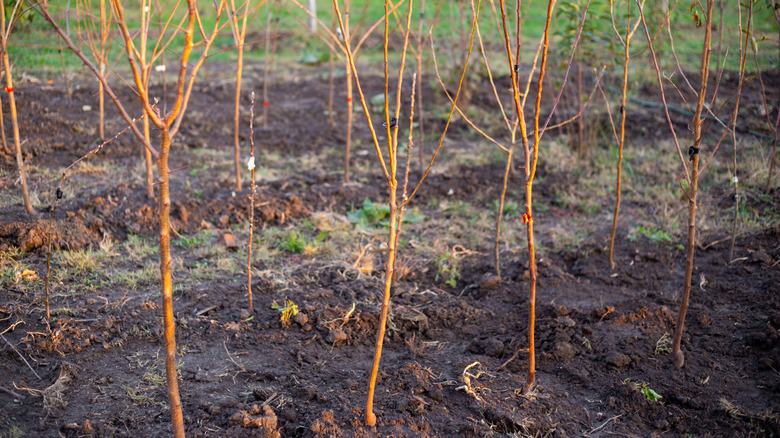
Whether you have a beginner-friendly fruit tree or something more challenging, the final factor that influences how you should water it is age. Generally, the younger the tree, the more reliant it will be on consistent moisture. Not only are established trees in a better position to cope with stress, but they also have deeper root systems. This means they can access lower water reserves that a young tree can't reach. Both young and old trees still need consistent moisture, but there is a difference in how crucial it is to their development.
Keep in mind that if you allow a young tree to dry out, its growth can slow and it may not establish properly. For example, if you're going on a vacation for a week, your established fruit tree should be able to cope with a brief dry spell until you get home. For a fruit tree that is only one or two years old, it's probably best to call in a favor and ask someone to water it for you while you're away.