

The US States With The Most And Least Expensive McDonald's Big Arch Burger
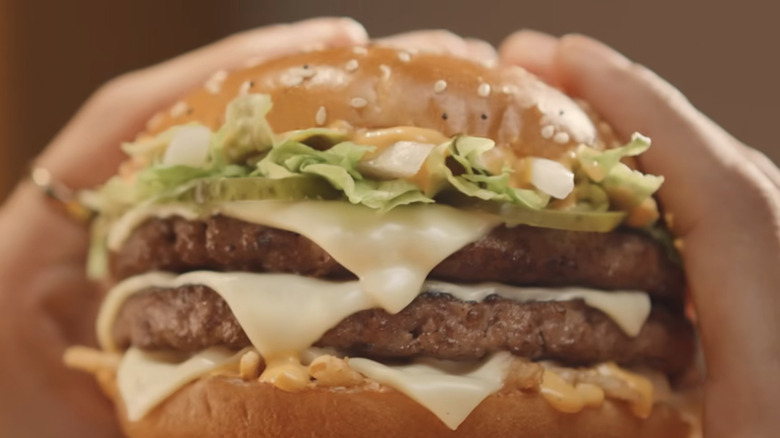
At the beginning of March, McDonald's released its Big Arch Burger in the U.S., to significant fanfare. The hefty burger consists of two quarter-pound all-beef patties, three slices of white cheddar cheese, lettuce, two types of onions, and a special Big Arch Sauce, which is not the same as the Big Mac Sauce though it isn't all that far off either. Despite being a limited-time U.S. offering, the Big Arch has drawn considerable attention online. First, McDonald's CEO, Chris Kempczinski, drew fire for an unenthusiastic video of himself sampling the burger with a tiny bite. Now, the wildly varying prices of the Big Arch are in the spotlight, with internet sleuths comparing nationwide costs.
Averaging prices across different locations in a single state, number crunchers have determined that Oklahoma is the best place in the U.S. to get yourself a Big Arch, with an average price of $8.05. The Sooner State is one of the states with the lowest fast food prices across the board, so this isn't much of a surprise. That said, the state with the most expensive Big Arch on average — coming in at $10.32 or about 28% more expensive — is someplace where food prices are often alarming: Alaska. But while the disparity between the average prices in these two states might seem significant, it is nothing compared to the gap between the cheapest and most expensive Big Arch Burgers overall.
Why McDonald's Big Arch Burger prices are so variable
In South Carolina, McDonald's customers can stop by for a Big Arch even cheaper than those in Oklahoma. The lowest price turned up for this limited-time burger offering was in Columbia, South Carolina, where the sandwich runs just $7.46. Of course, if the burger can trend cheaper in some places, it only makes sense that it would trend more expensive in others. Indeed, fans of the Golden Arches up in Lewiston, Maine pay almost 75% more than those in the South, at a whopping $12.99.
Unfortunately, Mickey D's is not among the most affordable fast food chains these days, and a look back at 2016 McDonald's prices can be either nostalgic or just plain upsetting. But the steep rise in prices doesn't explain the disparity between McDonald's locations in different states and cities. That, as it turns out, comes down to individual franchise owners. Roughly 95% of McDonald's restaurants are franchises, and the operators themselves are responsible for setting prices according to local market conditions such as real estate, food, and labor costs. These franchisees do work with a third-party pricing consultant, but in the end, it is their decision. Or, at least, it was.
In 2026, the overarching company will begin to dip its fingers into these stores' decisions in an attempt to create more consistent pricing across McDonald's restaurants. Still, even with firmer corporate guidance, there's no reason to expect that the price of a Big Arch (or the rest of the menu) will equalize much nationwide. The difference in food costs between Oklahoma and Alaska is not unique to McDonald's restaurants, after all.