

12 Ways To Make Frozen Chicken Taste 10x Better
We may receive a commission on purchases made from links.
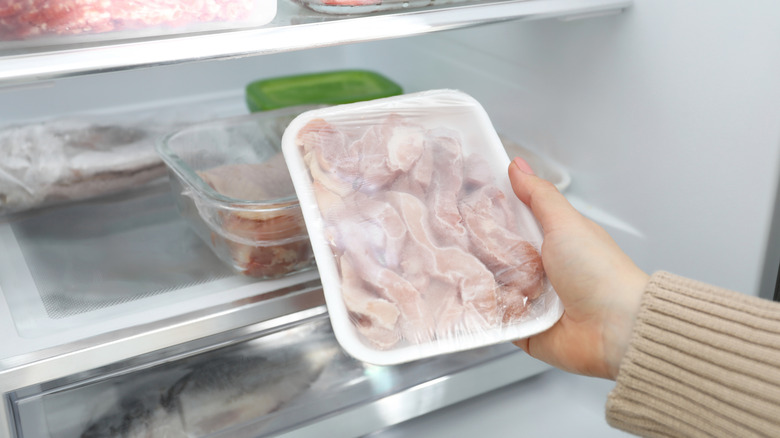
If you're concerned about the price of groceries, you might find yourself contemplating choices at the supermarket that you once wouldn't have. Frozen chicken, for example, which is often cheaper than fresh varieties. Plus, it's already frozen so you don't have to worry about using it up before it spoils; after all, freezing preserves food quite effectively if it's packaged airtight. Of course, frozen foods can vary in quality, and chicken is no exception.
Sometimes, you'll find its texture or flavor isn't quite what it should have been, or it might have a hint of "freezer taste" that needs to be hidden. Still, you can treat a case of frozen chicken as a strategic reserve of sorts when you don't want to splurge on fresh chicken. It doesn't necessarily mean a sacrifice in quality, either, because commercially blast-frozen foods tend to suffer less damage from freezing and thawing than home-frozen foods.
In my working life as a trained chef and restaurateur — in kitchens ranging from a multimillion-dollar venue to a one-man show in a scenic seaside location — and as a home cook before and after, I've worked with frozen chicken frequently, when budgetary or practical constraints made it my best option. Here are a dozen ways to amp up its flavor, when you need to.
Marinade the chicken to add flavors
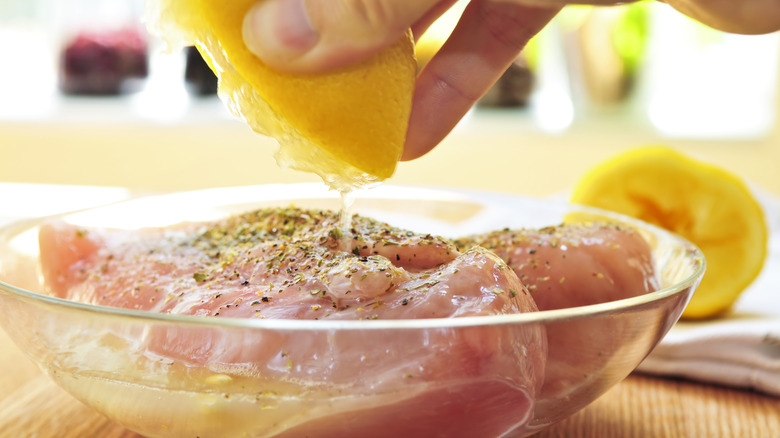
One of the simplest ways to make frozen chicken taste better is through a quick bath in a flavorful marinade. It takes very little time or effort, you can use whatever ingredients you have on hand, and it can add a big punch of flavor.
One of my Tasting Table colleagues has already written a beginner's guide to marinating chicken, so I won't go into a lot of detail, but all you usually need for a marinade is some combination of acidity and flavoring ingredients. Acidic ingredients could be fruit juice (often citrus), wine, buttermilk, or a mild vinegar. Flavoring ingredients might include soy sauce, fish sauce, herbs, spices, aromatic ingredients like onions and garlic, or broth. Worcestershire sauce is both acidic and a powerful flavoring ingredient, so it can be a marinade all on its own. Don't overthink, in short; arguably some of the best chicken marinades only require a few simple ingredients.
Even 30 minutes' marinating time is enough to add flavor to chicken, whether you immerse the pieces in your marinade or just brush it on. So even on busy weeknights you can start it when you get home, and still have dinner on the table quickly. An hour or two is better, but chicken doesn't need much longer than that. It's delicate, and can become mushy if it's in the marinade for too long (less than 8 hours is best, in my experience, and 12 hours is your practical maximum).
Brine the chicken
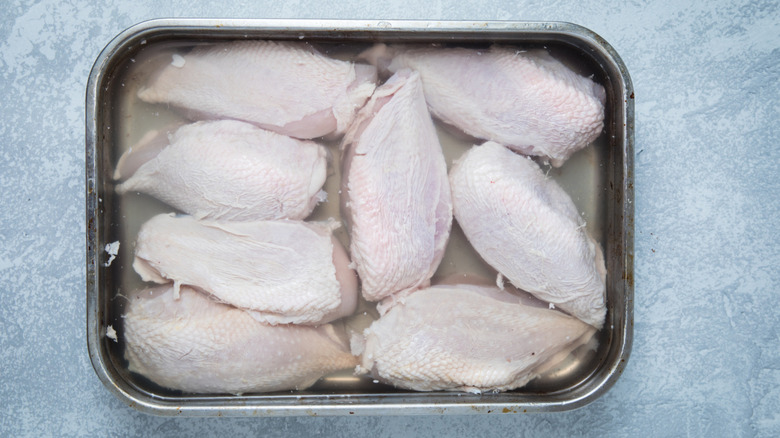
There are a lot of reasons for brining chicken, but in the case of frozen chicken, the big one is moisture. Because water expands as it freezes, the fluids that fill the muscle cells in a piece of chicken will inevitably make some of those cell walls burst, and allow those juices to escape. You won't get as much damage with commercially blast-frozen chicken compared to home-frozen chicken (the faster it freezes, the smaller the ice crystals and the smaller the damage), but it'll be there.
Brining helps trap moisture in the remaining intact cells — it's a matter of osmotic pressure, and it's why many cooks brine even fresh chicken — which means the chicken will retain more of its remaining juices as it cooks. You can either put your chicken pieces in a bag or container with the brine, or do a "dry brine" by simply rubbing it with coarse salt. Both options work just fine, but for skin-on chicken dry brining means you'll still be able to brown and crisp the skin.
You'll also have the option of adding flavoring ingredients to the brine, making it a sort of marinade as well. One caution: if the frozen chicken is already brined or "preseasoned," don't brine it again or it will be super-salty.
Poaching in a flavorful liquid
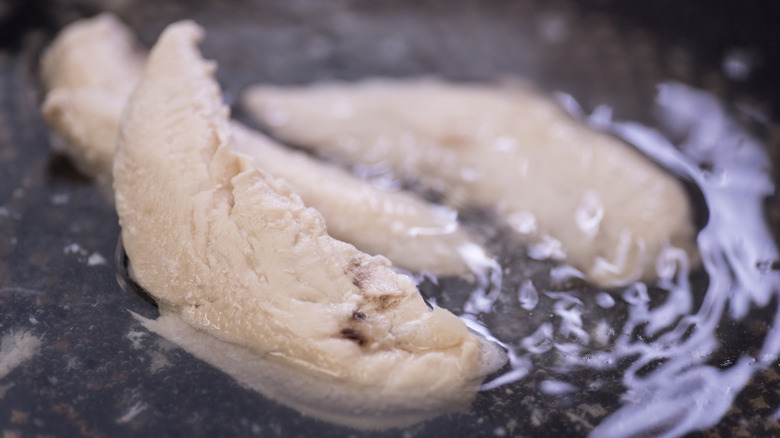
If you have a collection of old cookbooks, you might see recipes for what's called "boiled chicken." Often in those old books "boiling" actually means "poaching," and there's a big difference between them, which may be why poaching gets such a bad rap where meats and poultry are concerned.
Here's the thing: If you assume that "boiling means boiling," and crank the heat, that will make the proteins in its muscle fibers contract. The end result is chicken pieces that shrink badly while cooking, and get tough (and they'll need to simmer for a long time to be tender again). To poach chicken properly, you'll need to keep the water between 160 degrees and 180 degrees Fahrenheit(use a thermometer, until you master the technique), much lower than the 212 degree of water at a full boil. At that temperature the chicken will take longer to cook, but it will stay moist and tender.
To add flavor, instead of poaching in plain water, other liquids including broth, wine, lemonade, or prepared sauces will work just fine, alone or in combination with each other. Adding your choice of herbs or spices to the cooking liquid will also help.
Use infused oil or herbed butter as your cooking fat
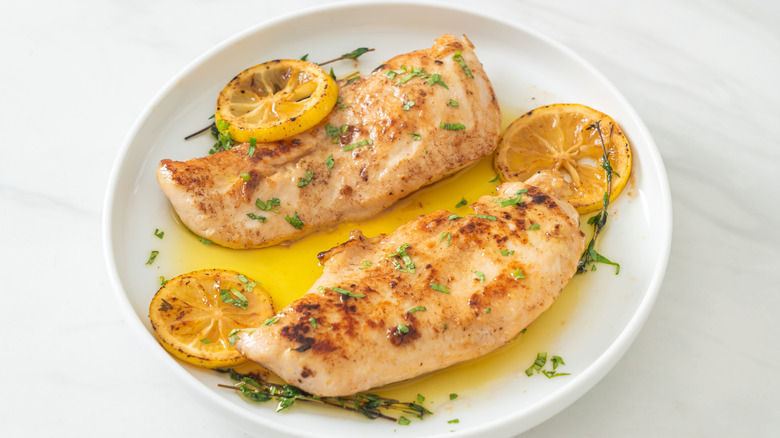
If you're going to pan-fry your chicken after it thaws (sauteing, not Southern-style fried chicken), the fat you use provides a vehicle for conveying flavors as well. For most people this will be oil or butter, but the principle still holds if you're an enthusiast for home-rendered lard, beef tallow, or even schmaltz (rendered chicken fat).
Fat has a happy ability to carry flavor molecules from herbs, spices, and other flavorings, and some kinds (like olive oil and butter) have a pleasing flavor of their own. To give your frozen chicken an even bigger flavor boost, you can start with a herb- or spice-infused oil — easily found online or in specialty shops — or make your own compound butter.
Compound butter is a staple of the classic chef's repertoire, but it's not complicated; it's just butter with flavoring ingredients kneaded into it. A high-end restaurant might add bits of truffle or lobster "coral" (eggs) to theirs, but at home I find compound butter to be the best way to use up the remainder of a big bunch of herbs. Just chop your herb of choice, work it into the butter, roll it into a log, and package it for the freezer. When you're cooking your chicken, pull out a pat or two of butter with a compatible herb (thyme, chives, sage, rosemary, etc) and add it to the pan when the chicken is mostly cooked.
Dry-rub your chicken with spices
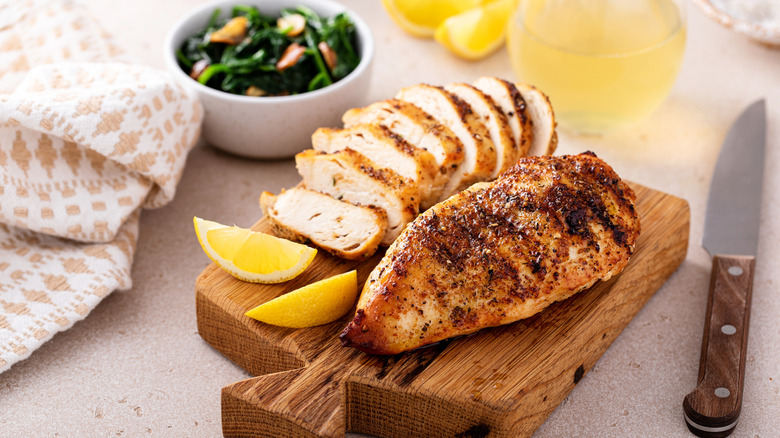
Okay, at first blush this one isn't exactly rocket science. For most cooks, using spices to add flavor is just about the first thing that comes to mind.
The difference here is that instead of just sprinkling your spices of choice on the chicken as it cooks, I'm going to suggest that you combine them into a dry rub, instead. It's not complicated, it just means that you're going to mix up the spices ahead of time and use them to coat the chicken pieces, then leave them to rest for at least an hour or two (and ideally, overnight) in the fridge. That extra time gives the spices a chance to get into the nooks and crevices of the chicken pieces, where they're more likely to stay in place during the cooking process, and add more flavor.
Any spices or dried herbs that go well with chicken are fair game, so use whatever flavors appeal to you, or just take your pick of ready-prepared store bought dry rubs for chicken. I suggest rubbing the chicken with oil first, then the spices, because it helps the spices stick. Also, don't go so wild with the spices that you can't taste the chicken anymore (a little restraint is a good thing!).
Give it the schnitzel treatment
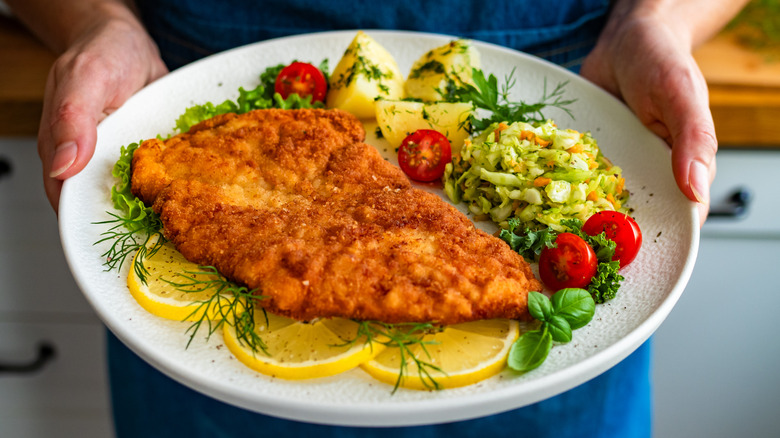
As I've mentioned before, frozen chicken can vary in quality depending on the producer. In a worst-case scenario, not only is the chicken's flavor diminished, it can also develop a weirdly chewy texture.
When I'm facing that particular issue, my go-to (immediately after making a note to never buy that brand again) is to prepare it schnitzel-style. If you've ever made chicken-fried steak, it's exactly the same process. You're going to pound the chicken — usually breasts, for schnitzel — until it's thin and flat, then dip it successively in flour, milk or buttermilk, and finally breadcrumbs. Then fry it in a hot pan, until the coating is crisp and golden on both sides.
Seasoning is up to you, but I usually use a relatively simple mixture of salt, pepper, garlic powder, and a little bit of dried thyme or sage. For really thick chicken breasts, you may want to slice them in half horizontally (like butterflying, except you cut all the way through) and make two single-serving schnitzels, instead of one plate-covering monster.
Pounding is an important part of the process, because it tenderizes the oddly chewy chicken, and the crisp coating masks its texture pretty effectively. The breading also adds flavor, above and beyond any seasonings you add, especially if you throw a pat of butter into the pan when the chicken is almost done. When you put it all together, this technique can elevate even the most meh of frozen chicken.
Add bright flavors with fresh herbs
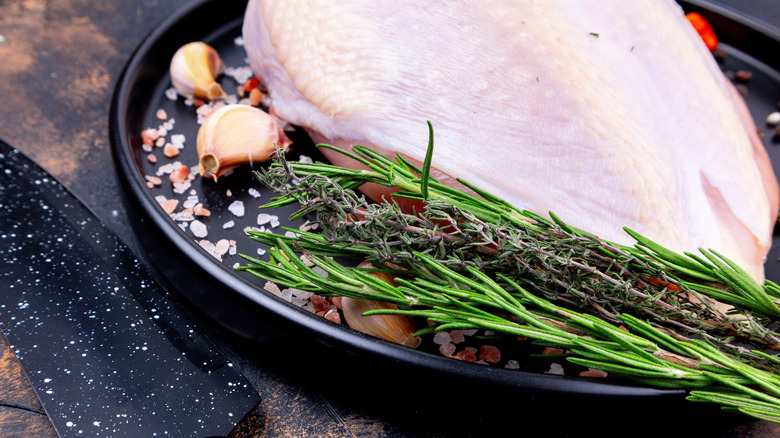
I've taught a lot of cooking classes over the years (really a lot), and one of the questions I'm frequently asked is what's the best way to learn about cooking with herbs. My usual recommendation is to stock up on chicken breasts, and try herbs one at a time with the chicken to see how they work together.
I make that recommendation for a couple of reasons. One is that chicken's flavor is mild and low-key, but very familiar. This makes it a natural canvas for herbs in general, and it's hard to think of any type of herb that doesn't go with chicken. Some that I've used repeatedly over the years include sage, thyme, summer savory (a terribly under-appreciated herb), rosemary, tarragon, and even culinary-grade lavender.
Combining herbs takes a little more practice and expertise, so start small by just combining two herbs at a time until you've got a sense of which herbs play nicely with each other and with the chicken. Aside from fixing your problem with the frozen chicken, this is a great way to use up excess herbs from your garden, or the leftovers from an oversized store-bought bunch.
Stuff your chicken
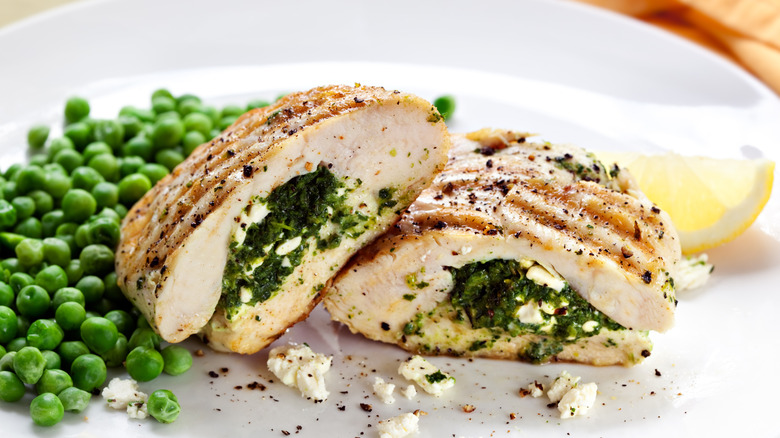
This is another one that requires a bit of explanation. Obviously, most of us have eaten whole chickens with stuffing at least occasionally, but that's not what I'm talking about. I'm talking about stuffing individual portions of chicken.
This isn't exactly novel, because most of us at some point have eaten Chicken Kiev or Cordon Bleu. Yet it's not necessarily something people often do at home, and I really recommend it. After all, if you want to add flavor to your chicken, this is a very direct approach. Butterflying the chicken and giving it a flavorful filling is simple, and gives you a big payback. There are lots of obvious and traditional options (garlic butter, broccoli and cheese, etc), but also less-traditional variations like peach, prosciutto, bay, and basil if you want to go all out.
It's also important to point out that breasts aren't your only stuffing option. I've often removed the thigh bone from a chicken leg quarter, and stuffed and roasted them. Heck, you can even debone and stuff chicken wings for an unusual appetizer or light meal.
Glaze the chicken as it cooks
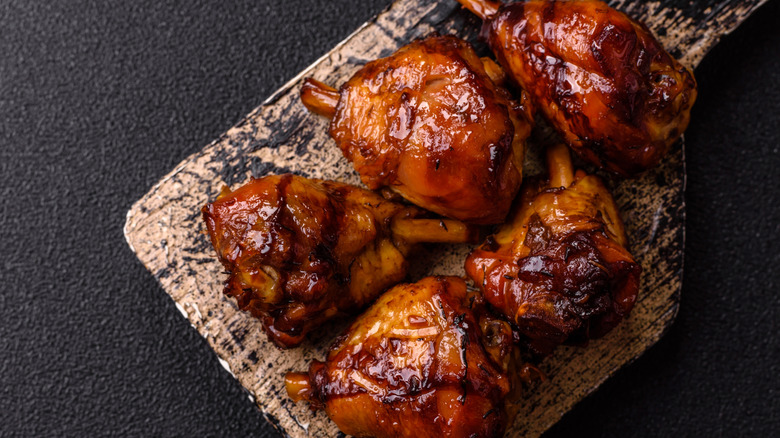
Brushing your frozen chicken pieces with a flavorful glaze, which clings to its surface and caramelizes, is a great way to add flavor. You're already familiar with this technique, because it's what you're doing when you brush barbecue sauce onto chicken on the grill.
Of course, barbecue isn't your only option for a glaze. Prepared teriyaki sauce, honey-garlic sauce or Korean kalbi sauce from a bottle will all work just as well. You could opt for just honey and herbs, or simmer a bottle of your favorite cola until it's thick enough to glaze the chicken with. I've even gone with left-field glazes like a bit of lightly-thinned fruit jelly or marmalade, though a purely sweet glaze means you'll usually want your side dishes to be extra-savory.
Glazing a piece of chicken is also very much in the classical French repertoire, though that's a very different approach to the topic. In that chef-centric version of the dish, the chicken is glazed just before serving with a heavily concentrated chicken stock, called glace de volaille. I've made it myself, professionally and at home: it's not hard, it just takes a long time to boil down the stock to its concentrated form. You can simulate the result by thinning Better Than Bouillon (or a similar product) with a bit of water, then brushing it onto the finished chicken. It adds a concentrated flavor that can elevate an otherwise-underwhelming piece of chicken.
Get a good, hard sear on the pieces
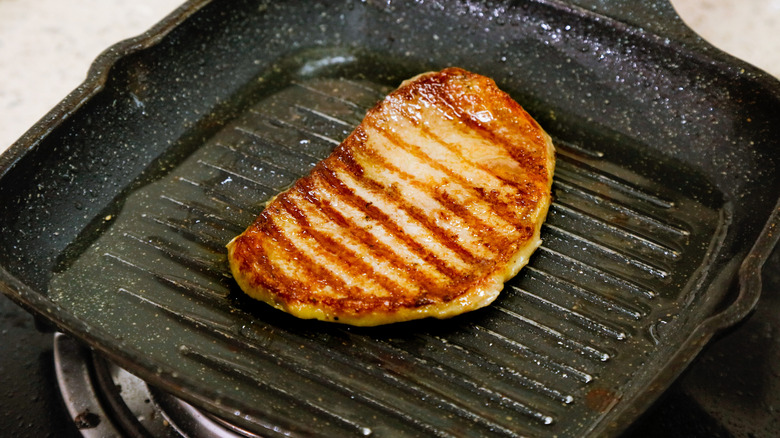
It's well known that browning adds flavor to meats and most vegetables, through what's called the Maillard reaction. Among the most serious of meat-lovers, getting a good sear on steaks almost amounts to a religion (I favor a thoroughly preheated cast-iron skillet for the best sear, but everyone has their own preference).
So, if you find your frozen chicken is disappointingly bland, getting a good, hard, sear on the pieces will go a long way toward improving what goes onto the plate. This is easiest to do with breasts, of course, either whole or cut up. Their relatively flat shape lends itself to a hard sear in a skillet, but it works just as well on the grill or under a broiler. If you're working with a skillet, or oiling the chicken pieces to aid browning and protect them from drying out, pick a high-temperature oil (avocado, grapeseed, canola, etc) that won't break down under the heat.
Chicken legs or wings are a bit harder to sear well in a skillet, though you can do it if you use enough oil to immerse the bottom half of each piece (shallow frying). If working with hot fat makes you jittery — I avoid it in my three-generation household filled with pets and grandkids — you're probably better off using your grill or broiler. Either way, searing will lay down a good base of flavor, regardless of what else you do to enhance the chicken.
Make skewers or meatballs
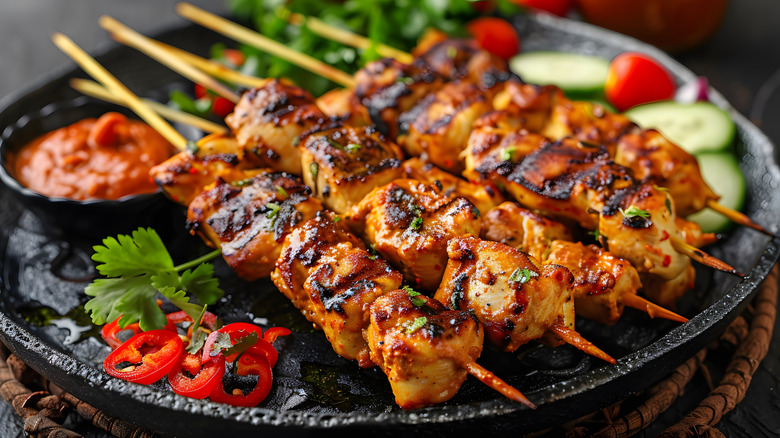
There's a point in the life of frozen foods where they aren't exactly freezer-burnt (or only in spots) but still have that indefinable, musty "freezer" flavor. This doesn't mean you need to throw it out, or feed it to the dog (sorry, Fido!), just that you'll need to be more creative.
The first step, always, is to remove any areas that actually are freezer-burnt. They'll be discolored and have a different texture, so just keep trimming it away until you've gotten off all of the bad parts. At this point, you can go two different ways. One is to cut the chicken into slices or cubes, which means you'll expose a lot more of its surface area to your choice of seasonings, glazes, or sauces. That, in turn, minimizes the amount of mediocre chicken in each bite, and stacks the deck in favor of your added flavors. Kabobs are the obvious direction to take things, but sauteing or stir-frying also works.
The second option, if you have a meat grinder or the grinder attachment for your stand mixer, is to grind up the frozen chicken (I find it's easiest when the pieces are half-thawed). That's the ultimate way to increase the meat's surface area, and therefore its exposure to seasonings. Plan to use the ground chicken in casseroles, sauces, meatballs or similar dishes, where you can add generous quantities of flavorings to mask that distinctive freezer taste.
Lean into the sauce
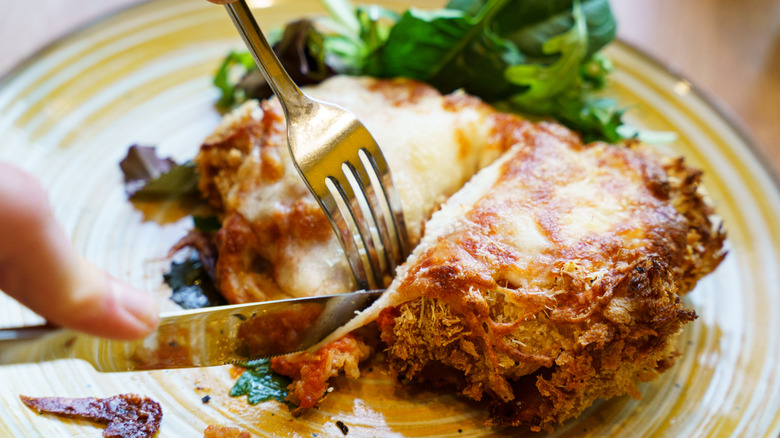
The ultimate answer for chicken that remains stubbornly mid — even after brining or seasoning — is to serve it with a sauce that's flavorful enough to hide the meat's deficiencies. It's the same basic principle as using an oversized batch of gravy to mask a holiday turkey that's dry and overcooked, except in this case, you're (mostly) distracting from the flavor rather than the texture.
So what kind of sauce should you be thinking of? Well, that depends on factors like your personal flavor preferences, and your personal skill level. Tomato sauce works well for masking flavors, for example, so you could lean towards making Chicken Parmigiana. Alternatively you could look to Asia for inspiration, and simmer the chicken pieces in coconut milk and your favorite curry paste.
If you don't have an especially adventurous palate, that's fine too. Something as simple as a rich, well-made chicken gravy works just fine, even if you don't have the drippings from a roasted bird as your starting point. This simple chicken gravy recipe works with either homemade or store-bought broth, and it'll bring enough flavor to the plate to hide the deficiencies of your frozen chicken.