

I Worked As A Barista For Years — Here's My Take On Tipping At The Coffee Shop
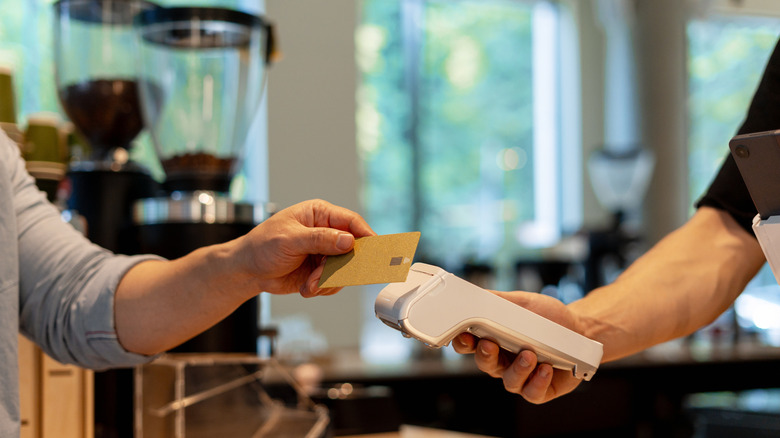
When inflation rises, it stings the working man indiscriminately. As discretionary spending budgets tighten, coffee shop patrons (even ordinarily-generous ones) start feeling the strain of "tip fatigue" more and more. Per a 2023 study by the Pew Research Center, 72% of Americans say tipping is expected in more places than it was just five years prior, a cultural-phenomenon widely referred to as "tipflation." Automatic service charges are unpopular, and getting confronted with a tip screen after a retail worker hands you a shirt or a record ... sucks, really. But, when visiting a coffee shop, it is (still) both appropriate and customary to tip. Baristas take an active part in assembling your order, and leaving an extra dollar or two is a crucial part of tactful consumerism — even against the backdrop of a recession.
I was a shift leader at a small local café for four years, and have moonlighted at several other coffee shops over the course of even more years (something, something, "financing an English degree"). I've also worked as a bartender — and while the roles are different in several key ways (i.e. accidental coffee spills happen, but no one's ever puked on themselves in my café or taken bunk substances in the bathroom), one central aspect of service labor remains the same: Like bartenders, baristas rely on your tips to take home a livable wage.
Decent tips supplement the below-the-poverty-line federal minimum wage rate

In the interest of being realistic, allow me to address the wealth-disparity elephant in the room: Many folks' decision to deny service workers a tip stems from a fundamental lack of understanding about the reality of the modern world's economic landscape. "But I made $1.60 an hour at my minimum wage job in 1968," posits a common Boomer-generation argument. For your consideration: A note on minimum wage, and how violently it has lagged behind the rate of inflation.
Federal minimum wage is currently $7.25 per hour, and has been since 2009. According to a study by GOBankingRates, a person working 40 hours a week at minimum wage would pull just $15,080 a year, before taxes. Respectfully, I dare anyone claiming "tip fatigue" to try to live on this sum in the year 2026. As that same study reports, "The minimum wage's purchasing power peaked in 1968 [...] [and] If the minimum wage had kept pace with both inflation and productivity growth, the Economic Policy Institute estimates it would sit around $23 to $24 per hour today," more than 3X the $7.25 per hour that folks are legally allowed to be paid by an employer in America. In short, the gravy train has left the station — and that handcrafted matcha latte is going to cost you an extra dollar. Don't make it a scene.
In ages past, tipping was a "sometimes" act, symbolizing an expression of gratitude for truly exceptional service. In some countries around the world, it's still that way (which is why tipping at some European restaurants can be a faux pas). But, in America, those days are well over now.
Baristas play as active a role in assembling your drink as a bartender, whom it is customary to tip
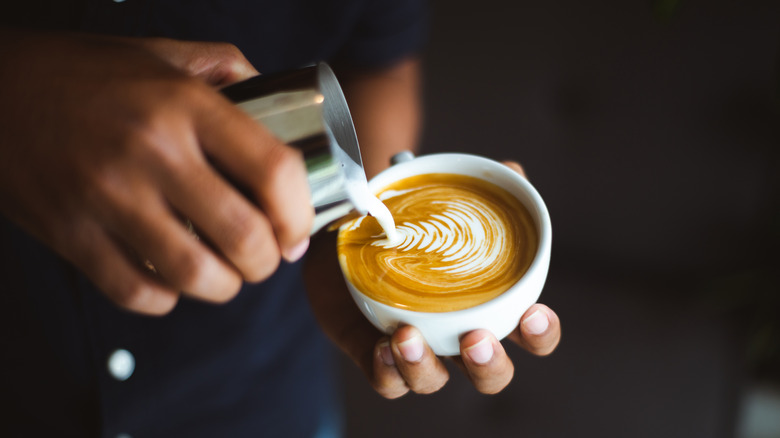
Socioeconomic climate aside, let's take a look at the matter of employee labor. It's no secret that sliding your bartender a $5 bill for a $5 Modelo is tacky. Word to the wise: The unspoken rule is generally $1 tip per bottle or can, and at least a $2 tip per cocktail. In the barista world, cracking a beer is roughly the labor-equivalent of pouring a mug of drip coffee. "I'm not going to tip someone for just flicking a spout open," protests the stingy café-patron (who should have stayed at home for their morning cuppa Joe). But, cast in the light of the mandatory $1 tip on a bottle or can in the bar environment, it's easy to see how these economical interactions are (gasp) the same thing.
This is especially pertinent if you're ordering a craft beverage. If I have to tear my rotator cuff shaking your Amaretto Sour, or (worse) whip-shake a Ramos Gin Fizz while a half-baked frat guy shouts "Jame-o!" at me from across the bar in a hail of loose spit, you'd better fork over two singles for this drink, man. Like a shaken or stirred cocktail, assembling a craft espresso drink requires training and practice. "Yippee" for your friend who has an espresso machine appliance and can pour a really good heart shape. But, when coffee-lovers hit the café, they expect another level of mastery from the professionals. If your soy cappuccino arrives with clean latte art, you can be sure that your barista has been honing their craft for a while.
More behind-the-scenes work goes into your craft beverage than what you see behind the counter
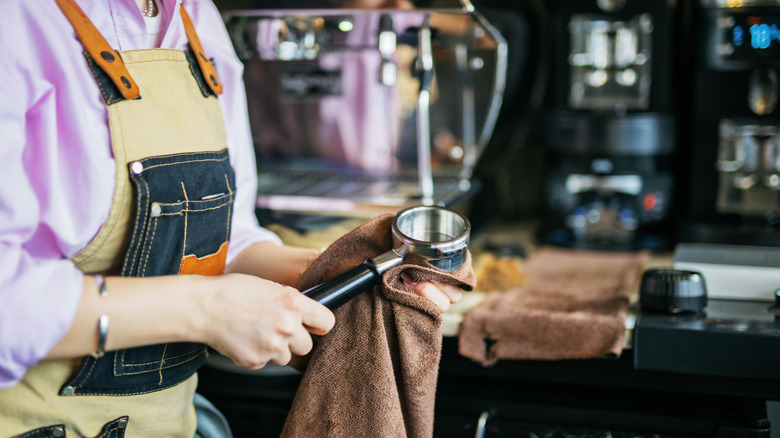
The reason folks patronize third-wave cafés at all is because the workers behind the stick are able to deliver a better product than what people can make at home. That espresso shot is pulled at the exact right second, the grind size is dialed in, the steamed milk in that steel pitcher is neither scorched or under-aerated. Premium craft comes at a "premium" price — meaning, if you can't afford to hit that "15%" suggested tip button on the screen, then you can't afford to order coffee out (sorry).
Beyond drip coffee, even drinks that might not immediately appear to require "much effort" often demand behind-the-scenes prep work. Just as a bartender might come into work an hour early to batch Bloody Mary mix before a brunch rush, in the coffee world, your barista is in a basement straining gallons of cold brew concentrate through a piece of cheesecloth. A lot more work goes into your beverage than "they're just pouring it out of a pitcher, I'm not tipping."
It isn't just a generational issue. In a Reddit thread dedicated to the "Boomers never tip" issue, one commenter points out, "Boomer here. My experience is that good tippers have worked jobs that relied on tips." Indeed, age notwithstanding, a person who has never worked a tip-reliant job before might be more likely to underestimate how greatly the decision to withhold a tip affects another person's bottom line. Never slung java before? Pony up the extra buck. Fellow service industry worker, pinching pennies? We understand the struggle ... but you should know better, man.