

The Not-So-Hidden Links Between Hot Dogs And Bologna
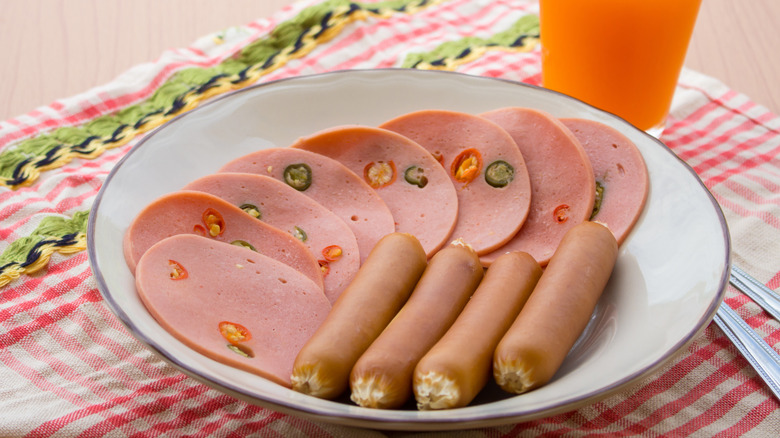
Bologna is a deli meat. Hot dogs are a tube. One is named after an Italian city. The other is ... well, we aren't exactly sure what it is, to tell you the truth — and we aren't sure we want to find out. Whatever the case, hot dogs are a distinctly American meat tube. Hot dog stands stretch from coast to coast, from Papaya King in Manhattan to Pink's in Los Angeles. But, just as many U.S. foodies dig bologna — and the reason why might have something to do with the fact that, apart from their shape, theses two meats are fundamentally the same thing.
Bologna and hot dogs are both highly-processed, cooked sausages that use salt and curing agents as preservatives (often sodium or potassium nitrite). Hot dogs are made from beef or pork (sometimes turkey or chicken) trimmings, which get blended smooth and stuffed into a cylindrical casing made from pig or sheep intestines. These miscellaneous, low-cost meat trimmings typically include muscle, but can also include organ meats, as well as added fat, water, and stock for moisture. These steps and ingredients are also how bologna is made.
According to The National Hot Dog and Sausage Council (NHDSC), which is a real thing, "Bologna fits into the USDA definition of cured, cooked sausages which also includes hot dogs, cooked bratwursts and knockwurst, made from different kinds of chopped or ground meats which have been seasoned, cooked and/or smoked."
Bologna and hot dogs share the same meaty base and near-identical processing
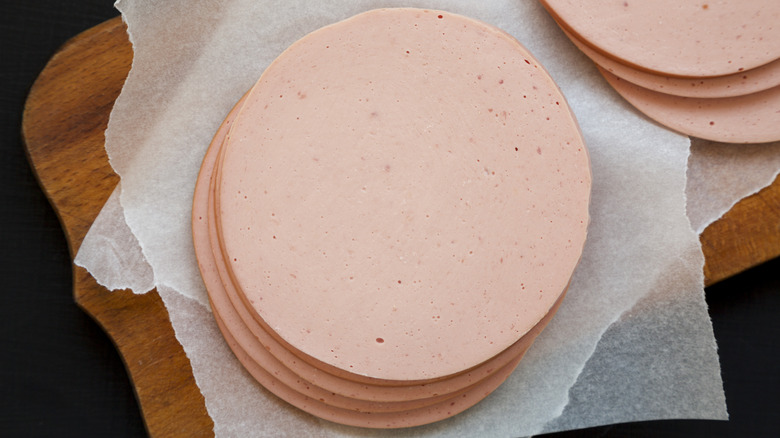
Like the smooth, uniform texture of hotdogs, U.S. requirements dictate that bologna be ground so finely that no chunks of visible fat remain. From there, things somewhat diverge. Some hot dogs brands use beef collagen or synthetic cellulose casings; others also incorporate sugar, garlic, paprika, nutmeg, coriander, white pepper, or mustard for flavor. Bologna, on the other hand, can be cooked or smoked, packaged whole or sliced, and common spices include nutmeg, coriander, pepper, and myrtle berry. Still, beyond spices, the differences are nuanced.
One Reddit thread inquires, "What's the difference between a hotdog and bologna besides shape?" (the answers aren't particularly academic). In another post dedicated to the realization that "bologna and hot dogs are basically the same thing," the top comment points out, "Kinda funny how cold hot dogs are 'raw' but people are fine with cold bologna sandwiches." The post also inspires more categorically-inspired discourse, in the same vein as "is a taco a sandwich?"
As one commenter writes, "[This] is why I always boggle at the Chicago hotdog snobbery around condiments [...] I don't understand the gatekeeping around tubed meat." Another chimes in, "It's all just wurst, people" — and they're right. Perhaps fittingly for these not-so-distant cousins, bologna and hot dogs share a similar history and rise to prominence.
Both processed meats share similar come-up stories
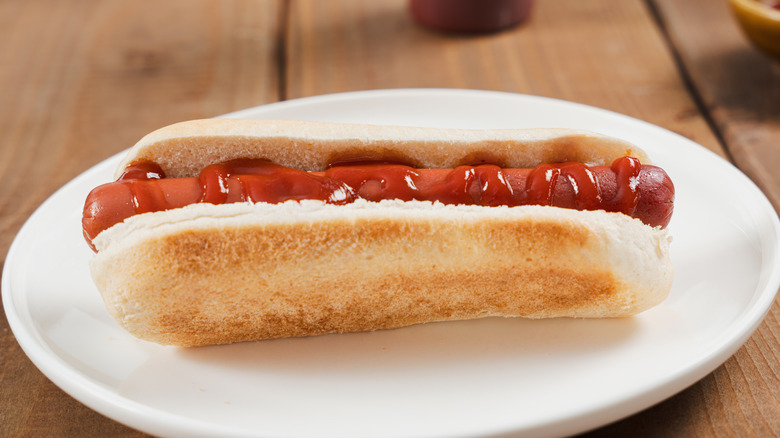
Britannica calls "hot dogs" a "sausage, of disputed but probable German origin," hence the colloquial nickname "ballpark franks," a nod to its ostensible birthplace in Frankfurt, Germany. The hot dog's other debated birthplace is Vienna, Austria — enter, an alternative nickname: "wiener." Whatever the case (casing pun intended), like many other types of sausages, hot dogs arrived in New York during the late-1800's European immigration boom, and by 1892, the name "hot dog" was being spoken and recorded across the U.S.
Bologna's origin dates back to its eponymous Italian city in the mid-1600s (evolving from mortadella), and its path to the U.S. follows the same European immigration story as hot dogs, its sausage-adjacent cousin. The low-cost, shelf-stable cured meat gained major popularity during the Great Depression, and nowadays, Americanized bologna deli meat is especially popular in the Midwest.
The fried bologna sandwich is a southern classic (don't forget the mustard and mayo). Here at Tasting Table, we like to add egg and cheese to our fried bologna sandos. Pickled bologna slices are a Michigan thing, bologna slices get smoked and BBQ-slathered in Memphis barbecue tradition, and in Baltimore, hot dogs are even served wrapped in a slice of bologna. Like bologna, hot dogs share just as many scrumptious, regional enjoyments, from NYC's dirty water dogs to Chicago's fully-loaded signature frank (although, West Virginia eats the most hot dogs of any state in the U.S.).