

Ireland's Pubs Have A Long History As Morgues
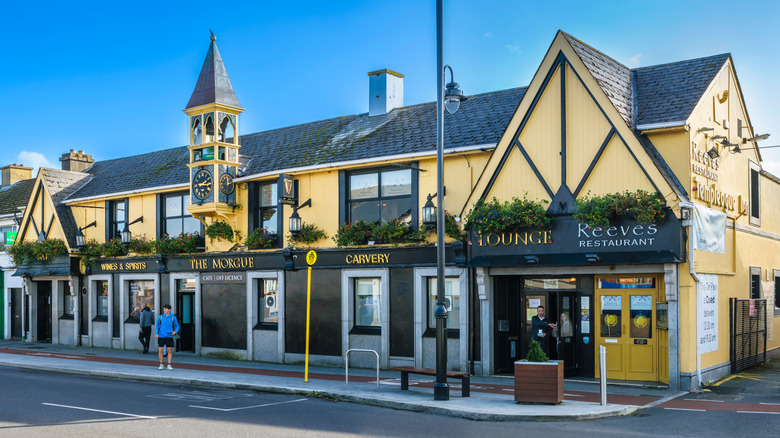
There are a number of incredibly old Irish pubs in the U.S., but nothing can compete with the history of those in Ireland. For decades, pubs have been about more than kicking back with a pint. Go back to the 19th century, and you'll find that many were also a grocery store — specifically, a spirit grocer. Popping in for a drink meant you could also pick up some provisions while you were there.
And plenty of pubs had even more going on, especially in certain areas. Head out to rural Ireland and you might wonder how a place might do enough business to keep the lights on, and the answer to that is they provided a range of services. It wasn't uncommon to find a pub selling its own house-made sodas and sandwiches, doubling as the area hardware store, china shop, baker, draper, and serving as the place to go if you needed to arrange transportation, whether that was via a horse or a bike. It was also where you went if you needed to arrange a funeral.
Ireland's pubs have long served as undertakers and morgues: Publicans were often the ones arranging funeral services for their longtime customers and the community as a whole. It seems completely at odds with the fun atmosphere we think of pubs having, but it makes a lot of sense. Some pubs continue this tradition, so let's take a look at why it came about, and a few pubs that are still doing it.
It began in the Great Hunger, when there were so many dead to deal with
To understand the need for pubs to double as morgues, we're going to have to start with a quick history lesson. The English oppression of the Irish goes all the way back to the 12th century, and one of the darkest periods was between 1845 and 1850. In just a few short years, millions of people starved after the complete failure of the country's potato crop that coincided with continued English exploitation. Even as huge portions of the population succumbed to starvation and disease outbreaks, thousands of ships filled with food and livestock were sent to England. To say that conditions were dire would be a massive understatement.
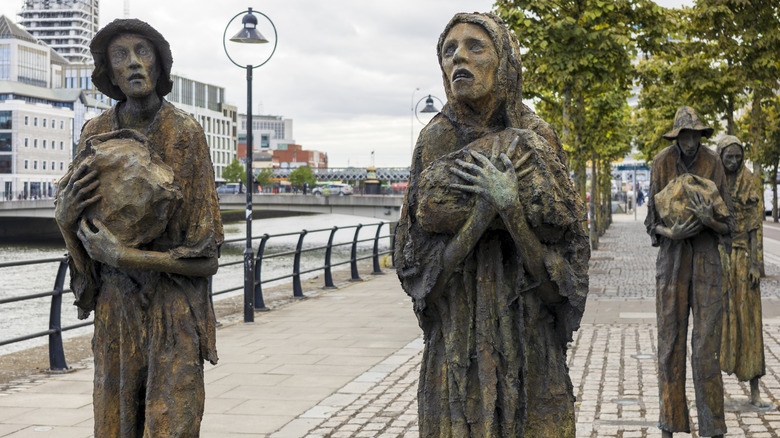
All across the country, you'll find memorials and mass graves, the final resting places of hundreds and thousands of people. (Pictured is the Famine Memorial in Dublin.) At the height of the tragedy, there were simply too many bodies for the country's established infrastructure to handle — and that's where pubs stepped in to help.
The practice started with storing the remains of the dead until they could be properly buried. It wasn't just starvation claiming lives. Diseases like cholera, dysentery, and typhus were rampant, and dealing with the dead became vitally important in an attempt to stop the spread of infection and illness. Unfortunately, some publicans succumbed to disease themselves, as they tried to care for the dead.
Pubs had cold storage facilities and were legally obligated to store the dead
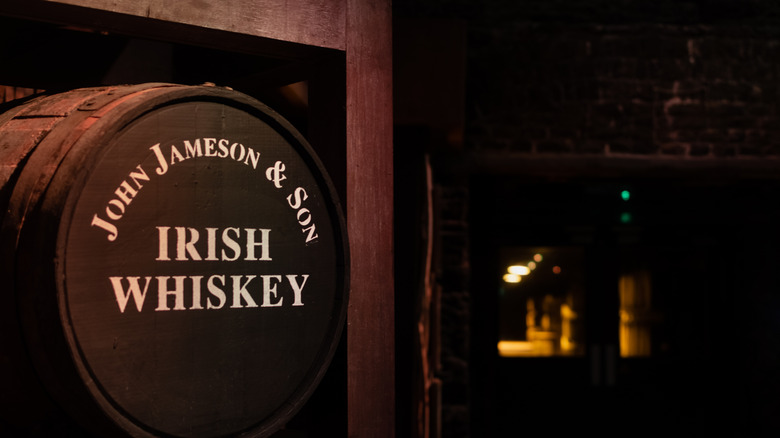
So, why were pubs the ones to step in and try to help alleviate the burden of caring for the dead? Not only did cool basements used to store beer and liquor work really well for keeping the bodies of the dead cool, but they also offered protection against the elements and animals.
And pubs didn't really have a choice in the matter, either — not initially, at least. Midway through the Great Hunger, Ireland enacted a law that required pubs accept and hold bodies until they could be properly attended to. It was written into the Coroners Act of 1846, which also dealt with the establishment of dividing counties into coroners districts, election of coroners, and the payment they would receive.
It wasn't until the act was rewritten in 1962 that the entirety of the 1846 law was repealed — including fines for refusing to take in the dead. Although there was no more need for pubs to act as emergency services, some publicans had rolled mortuary and funeral services into the standard they provided, continuing to operate these dual businesses side by side.
Pubs are communal places, and logical places for mourners to gather
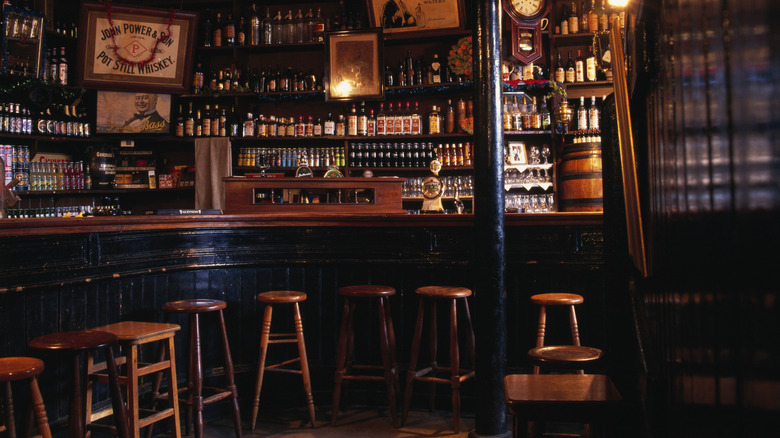
The idea of pubs offering funeral services isn't actually too much of a leap to make. Irish funerals are a little different than what you might find in the U.S. For example: In Ireland, wakes and funerals have long been attended not only by the immediate family of the deceased, but by acquaintances, friends of the family, and their friends. Rituals like the smoking — then breaking and burying — of clay pipes were once deeply ceremonial, and you could arguably think of an Irish funeral as being about celebrating the life and supporting the bereaved.
That included serving beer and whiskey, which you'd source from the pub. Having a publican that can supply everything from traditional clay pipes and tobacco to whiskey and port while also supplying caskets and coffins just made things easy. Also, later on, publicans had telephones at a time when they weren't relatively common. That meant they could take care of things like phoning the newspapers, and getting death notices published.
As pubs have always been at the very heart of community in Ireland, it wasn't uncommon that if a family couldn't afford services, the local publican/morgue would often loan the money to help cover those expenses. Of course, the understanding was that after the ceremony and burial, all the mourners will head to the pub.
The Dropping Well became an emergency, riverside community morgue during the Famine
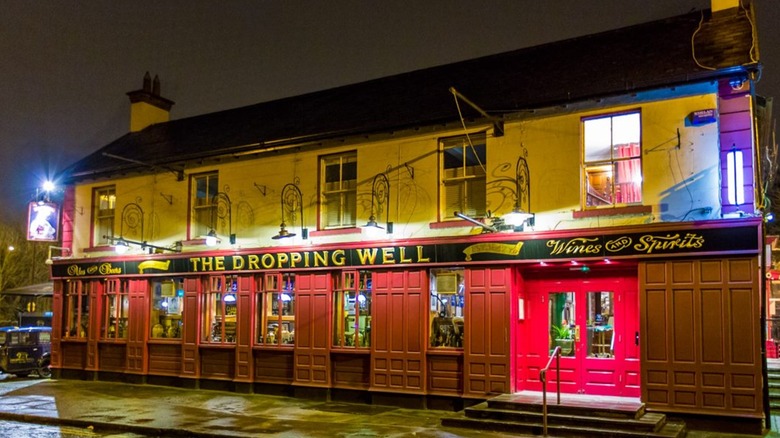
There are still a number of very old Irish pubs that are still serving up pints, and many of them have incredibly fascinating histories, such as The Dropping Well, a pub that traces its roots back to the 1840s. Besides being one of the mortuaries that served the casualties of the Great Hunger, this was actually the reason why it was initially established.
Sitting alongside the River Dodder, it opened in 1847 — the year that saw somewhere around half a million deaths and would later become known as Black '47. The pub's official history suggests that the mortuary side of the business was initially more important than the pub, as publican and owner John Howe oversaw the care of the many who died along the river. His wasn't a happy ending: In the course of his duties, he contracted an unspecified disease and died in 1850.
Although the pub looks much different these days after subsequent owners have renovated and updated it, it still pays tribute to its history and the dead that were cared for within its walls. There's a memorial statue with a plaque that reads, in part, "The premises provided shelter, sustenance, and aid to countless famine victims during these years. A community morgue station, located in this yard, housed before burial the sad and unfortunate casualties of Ireland's darkest days."
The Morgue cared for those killed by nearby tramway lines
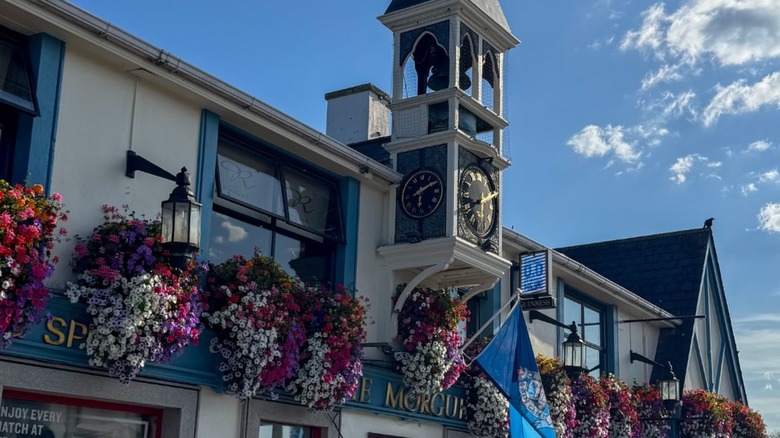
One of the differences between Irish and English pubs is in the naming conventions. Irish pubs tend to have a family name on them, and there's a chilling reason for that: It was easier for the English to keep tabs on things if a pub bore the name of the family who owned it, and in 1872, it became a legal requirement. The Morgue pre-dated the law, opening in 1848 as The Templeogue Inn. And yes, it did act as a morgue.
Like many other pubs, The Templeogue was drafted into service as a morgue during the Great Hunger. For a long time, it serviced the areas on the outskirts of Dublin as a mortuary, and even after the end of that dark chapter in Irish history, there was still a need for this pub to tend to the bodies of the dead. As the pub sat along tramway lines, deaths were common. High hedges blocked surprisingly quiet and surprisingly fast steam-driven cars from view until it was too late, and not only are there records of pedestrians being struck and killed, but at least one conductor died after being thrown from the tram. Today, the pub's clock tower still sports a model of a tram like the ones that once ran just a few feet from the pub's door — and claimed a number of lives until the tramway was shuttered in 1932.
Gateway to Glasnevin Cemetery: John Kavanagh, The Gravediggers
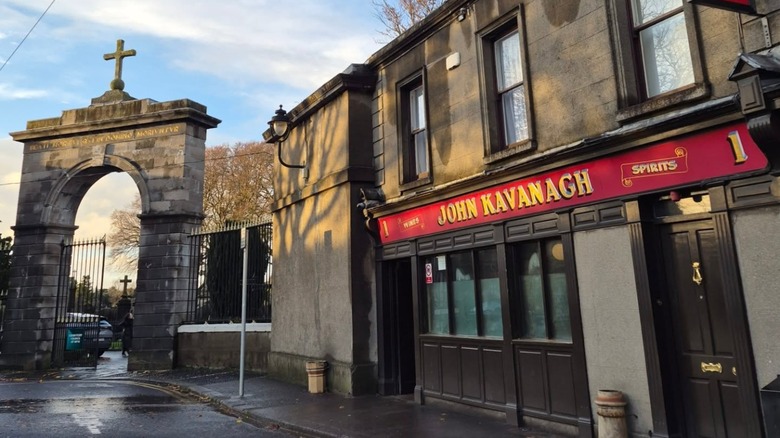
A visit to Dublin might involve a stop at the Guinness brewery and getting your face on a pint, but don't overlook the city's rich history. Other pubs have a long connection with the dead and the grieving, which brings us to John Kavanagh. It's commonly known as The Gravediggers, and you'll find an impressive archway just a stone's throw from the pub. That's the entrance to Glasnevin Cemetery, and the pub gets its nickname from the fact that it's long been the place for mourners to retire to after a funeral, but it also counted the cemetery's grave diggers among its regulars.
It was like that for a long time — that archway was the main entrance for around 140 years. Some publications confirm that it's still the local haunt for cemetery workers, and surprisingly, it's still in the hands of the same family that's been managing it since it was given to John Kavanagh as a wedding gift in 1833, albeit seven generations down the line and counting.
Given the history and the location, it's not surprising The Gravediggers has a reputation as being one of the world's most haunted restaurants. Employees and members of the family report animals acting strangely and becoming terrified of apparently nothing, with some even saying they've seen apparitions — including a girl in period clothing and a ghostly man in tweed sitting at the bar.
The practice still continues in modern pubs
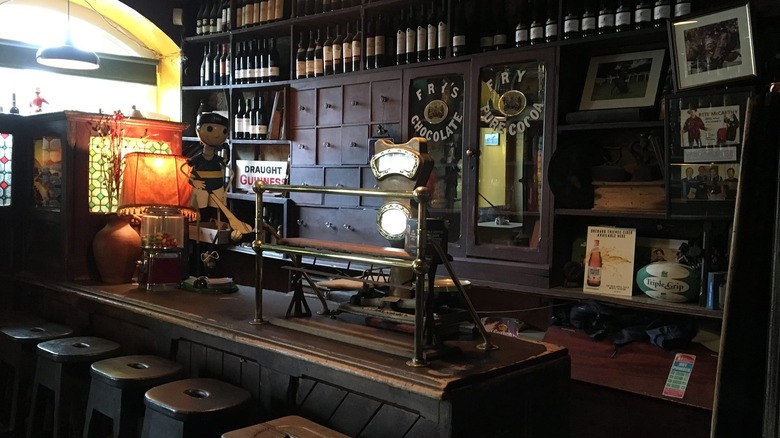
Even though it's no longer required that pubs offer up some space to care for the dead, some still do. McCarthys of Fethard, located in Fethard, Co. Tipperary, opened in the 1840s, and in addition to offering pub and mortuary services, it was also a restaurant, grocery, and had horses for hire, among a laundry list of other things. Fast forward to the 21st century: Not only does it look much the same as it did when it opened, it's still got an undertakers' business attached to it. It's such an important part of the business that it's become part of the pub's slogan: "We wine you, dine you, and bury you."
McCarthys isn't the only example. McDonnell's Bar in Co. Mayo is a popular name and one of the favorite pubs in the country that also functions as an undertaker. Interestingly, it only opened in 1942, and it still prides itself on being an integral part of the community it serves. Those who go there are greeted at the door and go in to find music, a warm handshake, and learn quickly why it's called The Lobster Pot — once you're there, you just kind of want to stay. Guinness tastes better in Ireland, and we think that it might have something to do with the rich history and sense of community you're surrounded by.