

Korean Kimbap Vs Japanese Sushi: What's The Difference?
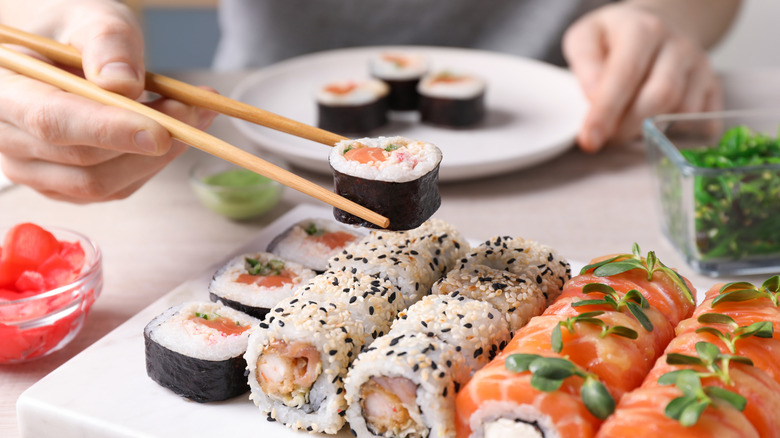
A seaweed-and-rice roll by any name would taste as all the same... or, would it? Despite their visually similar appearances, Korean kimbap and Japanese sushi have more differences than they share similarities. Both kimbap and sushi wrap sticky short-grain white rice and fillings inside of a nori seaweed sheet, using the same assemblage technique of cylindrical rolling in a bamboo mat. But, from there, these flavorful, tightly-packed rolls diverge — offering different fillings, different rice, and different accouterment.
Word to the wise: Kimbap can be a perfect fit for foodies who like the idea of sushi, but aren't as keen on the taste of raw fish and wasabi. While Japanese sushi stars raw fish as its star ingredient, raw fish (or any other type of fish or seafood) does not belong in Korean kimbap. Instead, kimbap typically features fully-cooked meats and pickled vegetables. Also, whereas simple sushi rice is seasoned with sugar, salt, vinegar (the eponymous ingredient for which "sushi" gets its name), and sometimes kombu, kimbap rice is seasoned with salt and sesame oil.
Emblematic of these different flavors, the word "kimbap" itself breaks down into "kim" (seaweed) and "bap" (rice), while the name "sushi" means "sour-tasting." As such, these different tasting profiles are better suited to different accouterment elements: To serve, kimbap is customarily paired with kimchi or danmuji pickled radish. By contrast, sushi is served with wasabi, soy sauce, and pickled ginger slices (shoga).
Kimbap features fully-cooked fillings and sesame oil rice
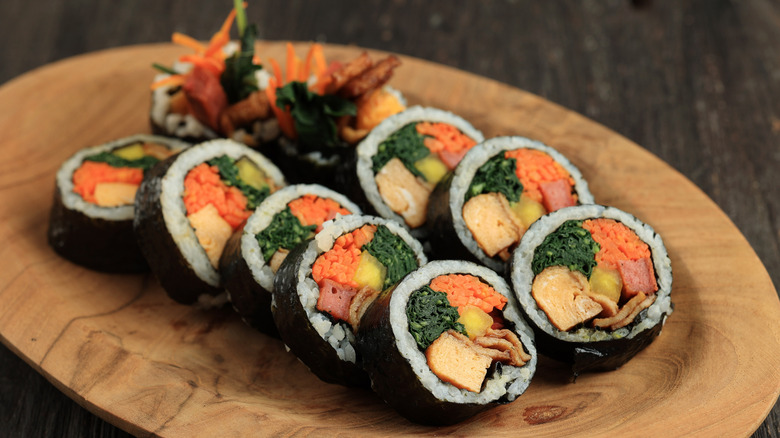
Korean Kimbap follows a basic formula of rice and fillings, all rolled together in a seaweed sheet. There are three main types of kimbap: traditional, nude or French, and samgak. Within these types there are also endless styles of kimbap, including mayak, chamchi, and chungmu. Mayak kimbap are unsliced, miniature rolls that get dipped into flavorful sauces. Chamchi kimbap are larger, toothier rolls stuffed with more filling and less rice; these typically get sliced into bite-sized coins to eat. Chungmu kimbap is also left unsliced, but its only filling is rice — resulting in thin, long rolls.
Kimbap fillings showcase multiple diverse elements side-by-side, yielding colorful, well-stuffed, ½-inch-thick pieces with different textures and a range of flavors. Expert-approve kimbap fillings and combonations include smoked salmon and cucumber, pork belly and kimchi, along with common ingredients such as cooked beef, spinach, avoado, picked danmuji, matchstick carrots, and more. If any seafood is to be spied tucked inside a kimbap roll, it's typically imitation crab meat or fishcake, while more recent adaptations have come to include cooked tuna and fish eggs. Toothier, fully-cooked meats like Korean fried chicken, bulgogi beef, or donkatsu fried pork cutlet are commonly used as kimbap fillings, too.
The sesame oil used to season its rice gives kimbap a sweeter, nuttier taste compared to sushi rice's distinct acidic kick. For its outer layer, kimbap is rolled in laver nori — a chewy, thicker mouthfeel compared to sushi's thinner, crispier hoshi nori. This proves useful considering kimbap pieces are generally structurally larger than sushi rolls. For the tastiest pairing, we recommend pairing Korean kimbap with beer and serving it alongside other Korean foods like spicy tteokbokki or a bowl of kimchi sundubu jigae.
Sushi stars raw fish and rice seasoned with acidic vinegar
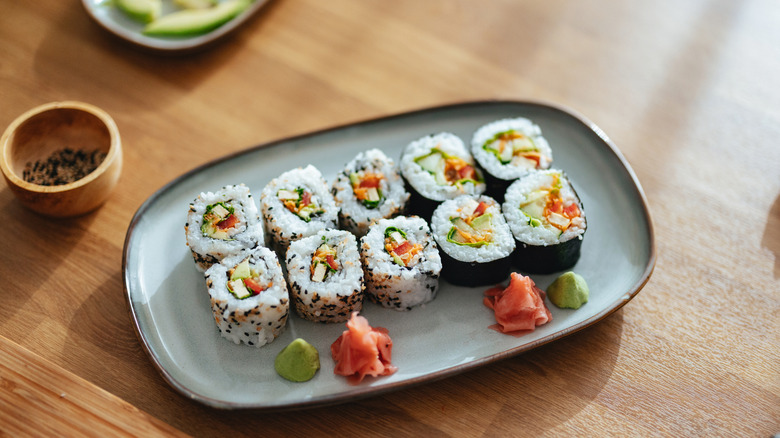
Arguably the most globally famous pillar of Japanese culinary tradition, sushi artfully embodies the five color dining principle. According to the principle, meals should include five different colors – and multicolored sushi often ticks every tonal box. Sushi fillings most commonly feature raw fish or other seafood, namely Atlantic salmon, salmon roe, yellowtail, Pacific bluefin tuna, sea urchin, Black tiger prawn, Yesso scallop, and Conger eel, among others. Although, sushi can also be made vegetarian with other fillings like vegetables and egg. Indeed, Western versions have also emerged, like the California roll and the Philadelphia roll.
Alongside the sharp wasabi and umami soy sauce, the sushi vinegar with which sushi rice is seasoned imparts a tangy bite that's notably different from and more distinctive than the sweet-tasting sesame rice of kimbap. Also, unlike traditional kimbap's cylindrical rolls and larger coin shapes, sushi can come in a myriad of forms — from nigiri (a thick slice of raw fish atop an oblong rice patty) to rolls (maki-zushi) and sashimi. While spinoffs such as salmon sushi bakes, sushi burritos, and onigirazu sushi sandwiches do exist, traditional sushi is commonly enjoyed with simple foods like edamame and miso soup. It's also served with drinks like green tea and sake to preserve the pure flavor of the fish.