

I'm A Former Restaurant Server, And These Are My Biggest Pet Peeves With Customers
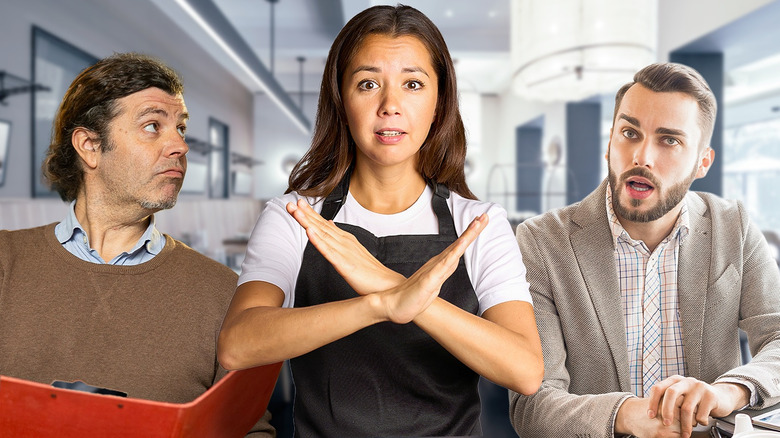
I strongly believe working in a restaurant should be a character-building requirement. When chatting with friends who are fellow servers, some joked that the top thing they wished customers would stop doing was coming into the restaurant. Like many fast-paced gigs, it's a love-hate kind of job. You have to think on your feet and problem-solve like a boss, but you're also constantly on display. Anyone in the industry has their server alter ego, complete with a signature customer service voice. We put our smile on for every table, but sometimes the phony grin disappears the moment we turn around.
I would hope no one wants to be "that" customer — the one servers beg their coworkers to take over. These types of tables seem hellbent on having a bad time, and they really test the staff's patience. Every day is a challenge in the restaurant biz, and servers can handle it in stride, but customers should know what really vexes us servers. The more you know, the better off you are. As Anthony Bourdain always pushed, if you want a great experience, be polite to your server. Here are just some of the many things servers wish customers would stop doing.
Snapping your fingers, or trying other rude ways to get our attention

The mind of a server mid-rush is a terrifying place to be. We're moving a mile a minute with an overwhelming list of backlogged tasks, all with a beaming smile still on our faces. Whether it be a soda refill, dropping a check, grabbing that extra side of ketchup, or greeting the latest two-top, there is never a lull on the floor. We're constantly scanning, accessing, and prioritizing to balance the very delicate game of time management. Despite this universal understanding, plenty of diners still seem to think their time is more valuable than everyone else's.
For some unknown reason, there's a generation of people who think the best way to get a server's attention (in a loud restaurant, mind you) is by snapping your fingers or flailing your arms in the air. This gives off the energy that you are the most important person in the room, and wherever you need to be is far more important than the plans of every other person in the restaurant.
I would hope this action is a thing of the past, but sadly, I still see folks snapping their fingers for attention. If you want our assistance, go for a more humane approach rather than treating us like dogs. Try making eye contact, politely raising your hand, or an age-old classic: Simply saying "excuse me" as we pass. Going out to eat is a luxury and patience is a virtue. If you're tight on time, then it might not be the smartest choice to sit down at a busy restaurant for a "quick" meal.
Moving tables around without asking
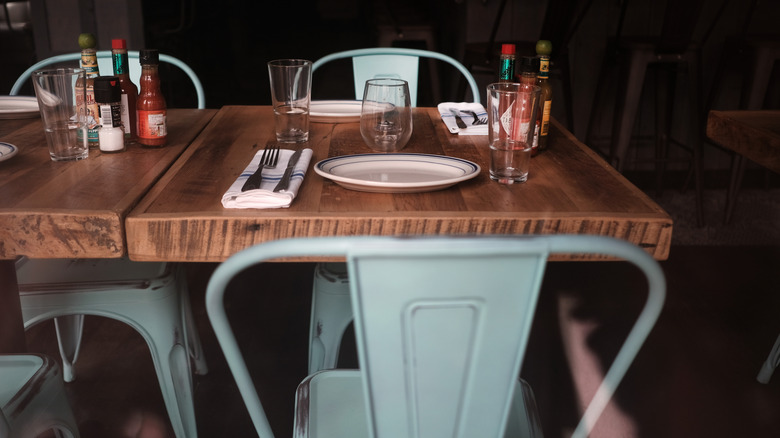
For those who have never been fortunate enough to work in a restaurant, it's understandable to be confused by the chaotic seating patterns. We'll often hear frustrated parties proclaim, "Hey! We were here first!" when a group half their size squeezes in at the counter. What they don't know is that the large group of bachelorettes at the favored corner table is about to settle up, which will be 10 times more comfortable for the diners. Believe it or not, that's all we want as servers.
Rude remarks and demands are just part of the job, but when folks take it upon themselves to not only seat themselves, but push tables together and shuffle chairs around like it's their own private dining room, we have to step in and intervene. There are a million reasons not to rearrange the dining room, one being liability. If anything happens to you, even as little as stubbing your toe, we could be on the hook for the accident. Secondly, seating is not a free-for-all. It's actually an insanely meticulous process that takes as much precision as juggling. Most importantly, just because a table is empty does not mean it's available. If there isn't a sign by the front door offering seating instructions, just wait for the host. Your instinct should never be to just seat yourself, especially if you're in a large party.
Letting your kids run wild
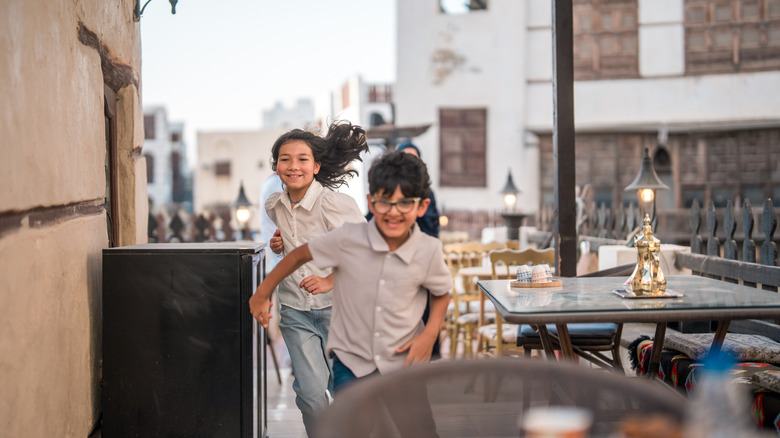
From five stars to dive bars, I've worked in every type of establishment, and while there are hundreds of stark differences (some obvious and some not so obvious) between them, one thing rings true: It's not a daycare. I'm not one of those people who think parents should leave their rambunctious kids at home, and I don't even mind families bringing snacks for the little ones, but if you're going to tote the whole family out to brunch, the very least you can do is a routine head-count at the table. It's shocking how many times I've nearly tripped over a literal baby crawling across the dining room. Oftentimes, I'll see a kid, or even a herd of them, scheming around the restaurant for over 10 minutes, and I can't even pinpoint who they belong to.
Sometimes it feels like tables will come in and assume the entire restaurant is their playground. They let their kids run wild and expect staff to wrangle them. Even spaces dedicated to kids' entertainment, like museums and arcades, aren't a drop-off, so it's always baffling how some chaperones will check out the moment they're seated.
Restaurants are practically obstacle courses for adults, dodging trays of hot coffee and slippery floors like Indiana Jones, which makes them death traps for unsupervised children. As a child-free woman, I don't have parenting advice to bestow upon anyone, but I think it's safe to say that parenting duties don't stop when other adults just so happen to be around.
Saying you're ready to order when you aren't (and insisting we stand there waiting for you)
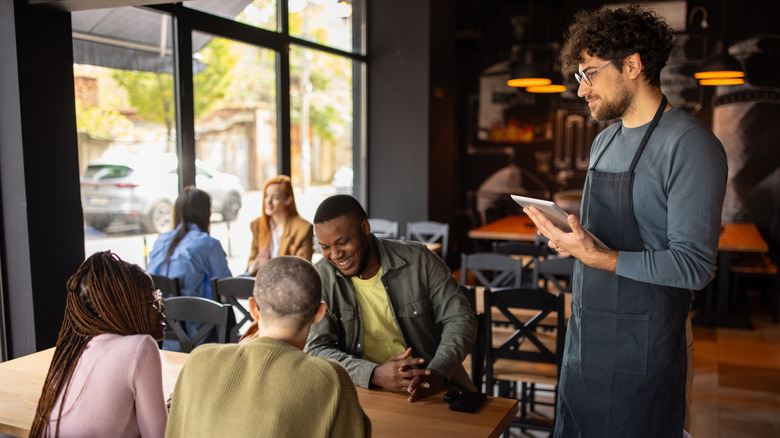
A lot of these all-too-common taboo customer foibles share a common theme: entitlement. All too often, parties will confidently declare they're ready to order, only for one out of six patrons to actually be prepared. It's one thing if guests respectfully request the server linger for just a minute and are quick to throw an order together, but those who flag down a server only to scratch their heads and look over the menu for over five minutes deserve jail time.
As made evident by the chaotic energy in a busy restaurant, servers have things to do. Monopolizing their time won't make your food arrive any sooner; in fact, it's more likely to slow things down. Every second counts in the kitchen and on the floor. The time servers spend standing around waiting for an indecisive diner to pick their poison is just time wasted. It's so hard to stand there smiling politely when we feel the piercing tension coming from our other tables and can see all our looming tasks out of our peripheral vision.
Sometimes, the customer will reach out their arm as if to say, "Wait, this will only be a second," when they first pick up the menu. There is a line to draw here, as there's no issue with taking your time to peruse the menu and ask all the questions you need — we don't need to be standing there watching you read. If you think you're ready to rumble (order) but second-guess your choices during crunch time, just let your server know you need a few more minutes and they'll happily circle back.
Coming in 10 minutes before the kitchen closes
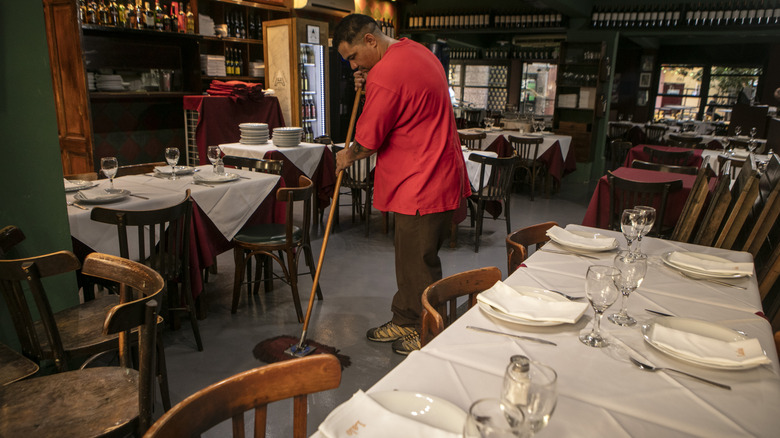
At this point, this is a universal no-no in the restaurant industry, but there still seems to be a community of folks who aren't aware of this social norm, or, even worse, who are aware and simply don't care. Breaking down the restaurant is the most taxing part of the whole night, especially for the kitchen. Consider how messy your kitchen looks after making an elaborate dinner for four, and then multiply that by 50 — there's your end-of-day cleanup. In restaurants, breakdown starts hours before close; shutting down stations, cleaning equipment, and prepping for the next day. Back of house will gradually check other sidework off the list as the evening goes on, depending on how busy it is.
Servers get a jump on sidework too, from restocking stations, sweeping, and shutting down the till. Folks may be pushing 10 hours on their feet, and the only thing standing between them and their pillow is that last pesky table. Those who linger at their table for hours after they finish fall into this category as well. If you must come in that late, order quickly, settle up when you get your food, and tip your server well. At the end of the day, it's all part of the job, and there's really no animosity towards respectful diners who understand they're putting the kitchen out and make up for it.
Blaming servers for issues and delays
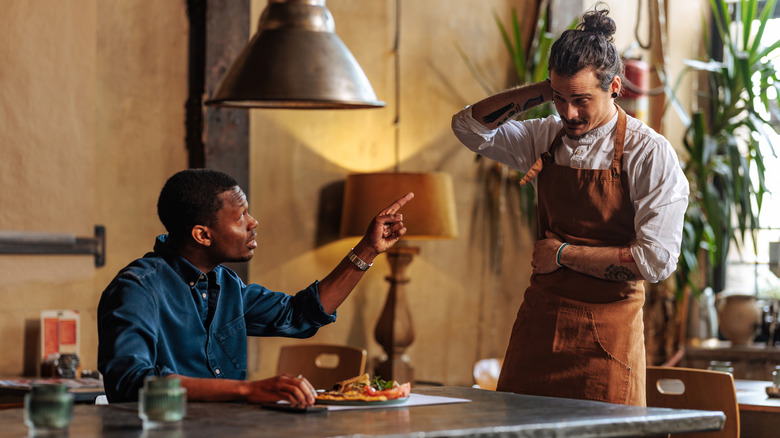
Servers are essentially the face of the restaurant. We're the middleman between the meal and the table, and we make sure everything goes swimmingly. Guests don't see the mayhem that goes on behind the scenes, and it's the server's job to make sure of it. That means that any delay and all qualms become our problem. Our job description doesn't include prepping, cooking, or plating food, yet some customers will put all their effort into making us feel like it does. Once you work on the other side of the restaurant, your dining perspective is permanently altered. A server can always suss out another server by their understanding demeanor and patience.
Sometimes it can feel like a customer's main goal of the day is to berate you. It takes a certain je ne sais quoi to talk an enraged patron down and end with a happy customer, but we have zero control over cook times, what's stocked in the kitchen, or whether the grill cook is having a bad day. We hate saying, "Sorry, your food should be out any minute now" just as much as you hate hearing it. Work with your servers, not against them. Another thing guests don't see is our painstaking attention to detail and all the things we catch between the kitchen and the table. A little credit where credit is due, please.
Asking what a server's real job is
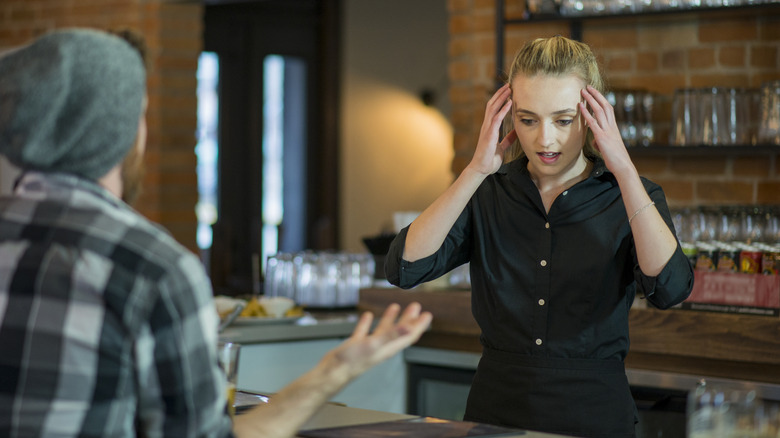
This is an all-too-common, particularly insulting, irk of mine. There's a preconceived notion that servers and bartenders are creative people stuck behind an apron. Given the flexibility and often high hourly rate, it does attract a lot of freelancers and aspiring what-have-yous, but it's also a job. Just like your project management position, your sister's real estate career, your neighbor's stationery business, serving is a job that pays the bills. Serving, bartending, and other food industry work have notoriously had a suggestion of bourgeoisie ever since the days of medieval servitude. But today, serving is a flexible, rewarding career that usually pays far more than minimum wage.
A server will likely describe themself as a "people person." You sort of have to be to put up with a day's worth of small talk and banter with strangers, but that doesn't mean they owe customers their life story. To be clear, there's nothing wrong with chatting. Kind engagement is always encouraged, especially in a time when human connection is so fraught, but there's a (rather thick) line between curiosity and pushy interrogation.
Going on about how you know someone like the owner or head chef
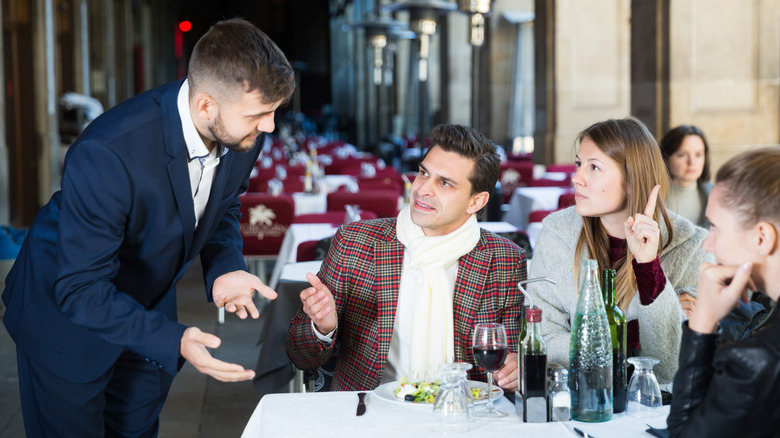
If you are name-dropping within three minutes of sitting down at your table, you're doing too much. Guess what? We know them too. The most important people don't feel the need to announce themselves. Reminding the server about who you know in the industry, or even worse, who you are, is only going to result in an eye roll the moment they turn back toward the kitchen.
A great restaurant treats every customer like a VIP, so there's no need to loudly whisper about your self-proclaimed star status. Similarly, pestering the server to deliver messages back to the kitchen will just prompt another eye roll. Passing notes back and forth is the last thing we have time for in the heat of the dinner rush. Being respectful stands out way more than anything else, so that's all you really need to do to be remembered.