

16 Ways Ice Cream Is Eaten Around The World
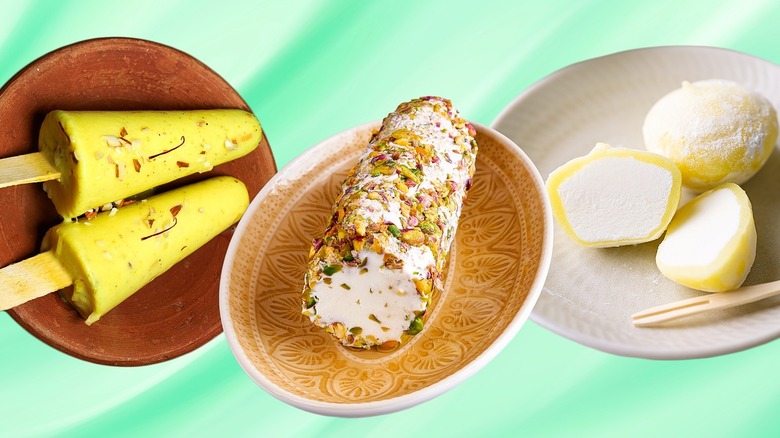
There are few things tastier on a hot day than a scoop or two of refreshingly cold ice cream. Truthfully, most people would likely argue that the weather has little impact on the enjoyability of the frozen delicacy. While there are plenty of foods that are beloved the world over, many of them have only been available globally in the last few hundred years or so. Ice cream, however, is a different matter.
The earliest form of ice cream — albeit without the cream — likely originated around 2,500 years ago, when ancient Persians started flavoring snow with concentrated fruit juices. It took a bit longer for dairy-based varieties to make an appearance, but even that kind of ice cream likely dates back to 7th-century China, or perhaps even earlier. Some countries and cultures invented their own versions of frozen treats without external influence. However, even when ice cream recipes crossed borders, it was long enough ago that the way it's served today can vary hugely from one place to the next. With that in mind, let's take a look at some of the uniquely fascinating ways ice cream is eaten around the world.
1. Dondurma (Türkiye)
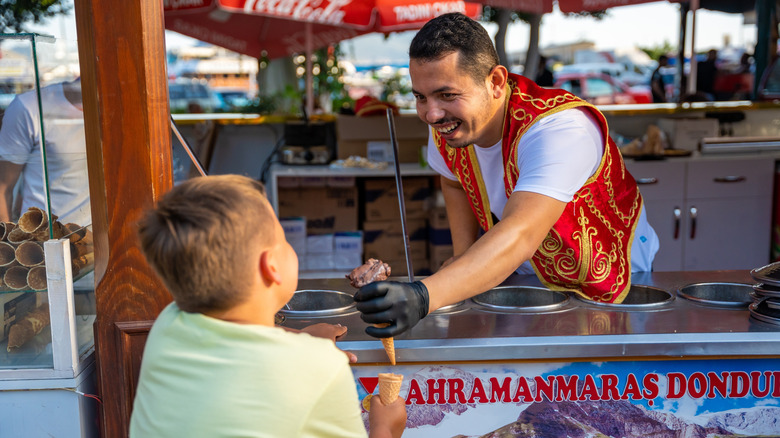
While "dondurma" technically just means "ice cream" in Turkish, outside of the country, it's used to describe a particular variety, called mastic ice cream. Traditionally made by hand, dondurma is created by slowly heating a sweet, goat milk-based mixture until it thickens. Then, it's kneaded and folded with long-handled paddles in a chilled metal vat. Dondurma also contains one or two unique ingredients — a powder made from orchid root, called salep, and a natural resin, called mastic.
Both the production method and those extra ingredients produce an ice cream with a famously chewy texture. Dondurma can even be eaten with a knife and fork, as it's highly resistant to melting, and some restaurants slice up the ice cream and serve it on a plate. You'll also see dondurma served in cones, especially by Turkish street vendors who are famously theatrical in the way they present the frozen treat to customers.
2. Booza (Middle East)
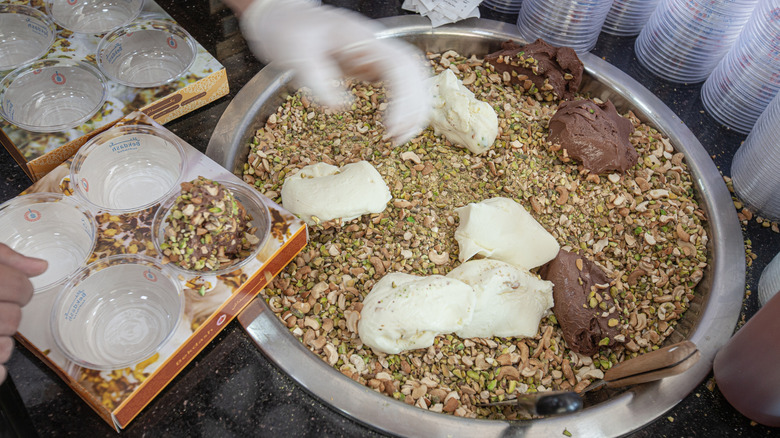
Invented in the region that's now considered modern-day Syria, booza is an extremely traditional type of ice cream enjoyed across the Middle East and parts of the Mediterranean. It dates back to around 1500 A.D. and is often considered a precursor to Turkish dondurma. Both ice creams are known for their elasticity; however, booza is slightly creamier and less stretchy than dondruma.
Booza is also made with salep and mastic, but the base mixture is pounded with wooden mallets in a cold metal drum. It typically has a notably floral taste thanks to the resinous mastic, and traditional flavors include rosewater and pistachios. That said, you'll also find an assortment of more modern flavors as well. There are even specialist ice cream parlors in the U.S. that specialize in creating modern takes on the historic delicacy. Nowadays, you can find the likes of hazelnut, mint chocolate chip, or even salted Oreo booza.
3. Kulfi (South Asia)
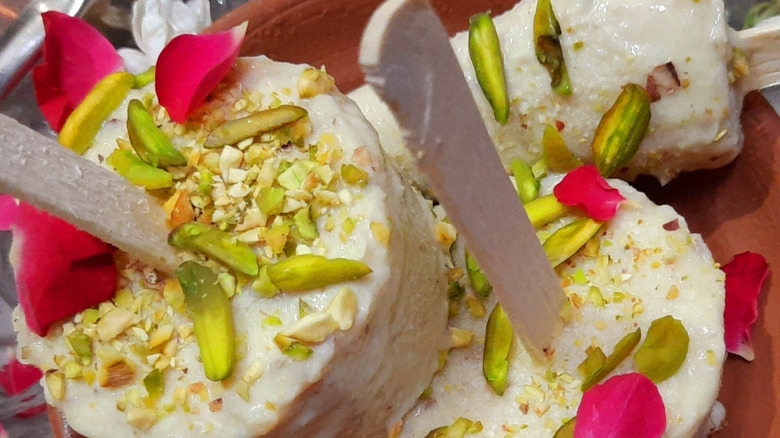
Although it's possible that kulfi was inspired by Middle Eastern ice creams, it originated in Delhi, India, sometime during the 16th century. The region's occupants at that time — the Mughal Empire — discovered an innovative way to freeze evaporated seasoned milk into cones, which is extremely impressive considering the local climate. Even today, the jury's out on just how the Mughals managed to freeze kulfi. Some suggest it was made with ice transported from the Himalayas, while others believe potassium nitrate — also known as saltpetre — was the secret.
In some ways, kulfi is more of a frozen custard than an ice cream, as it's often made with malai, a regional form of clotted cream. The sweetened mixture is thickened through slow cooking and cooling before being frozen in cone-shaped molds. Modern kulfi can come in all sorts of familiar flavors, but traditional varieties include the likes of pistachio, rose, saffron, and cardamom. It's also gained huge popularity outside of India, with Pakistan, Bangladesh, and Sri Lanka all considering kulfi a part of their national cuisine.
4. Bastani (Iran)
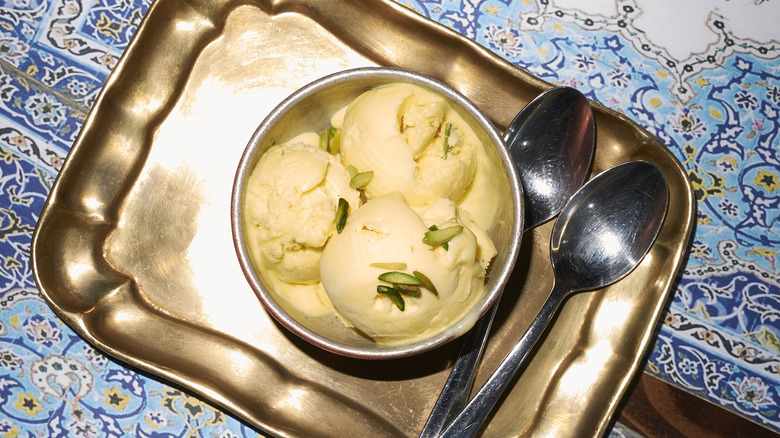
Commonly known as Persian or Iranian ice cream, Bastani can trace its heritage back to the earliest frozen treats. Ancient Persians had a unique ability to make and store ice thousands of years before freezers were invented, thanks to some incredibly innovative feats of engineering. First, they channeled water into shallow pits during the winter, creating ice overnight that could be easily collected. They stored the ice in domed structures called yakhchāls. These half-underground chambers had extremely thick walls made from a highly insulating type of mortar, and were surrounded by wind catchers that channeled cool air into the structure to keep the ice from melting.
While they started by flavoring ice with syrups, Persians soon graduated to making faloodeh, a frozen starch-based, sorbet-like dessert made by combining thin noodles with rosewater syrup. Much later, the cream-based bastani was developed, probably influenced by the likes of booza. Bastani often contains sulep or mastic, and is traditionally flavored with rosewater, vanilla, saffron, pistachio nuts, and chunks of frozen cream.
5. Gelato (Italy)
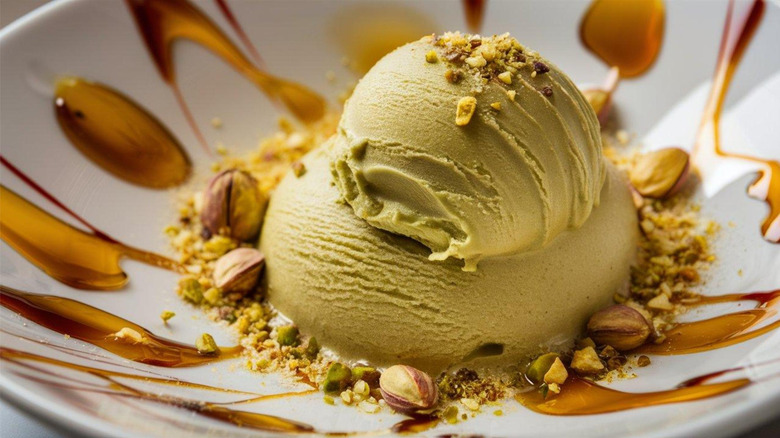
Similarly to how the Turks use "dondurma" to refer to all ice cream, many Italians use "gelato" as a broad term. However, for the rest of us, gelato is a specific type of ice cream famed for its dense and creamy texture. While its true inventor is up for debate, most foodie historians agree gelato arose during the Italian Renaissance, proving the time period gave us far more than masterful paintings and stunning statues.
The first thing that sets gelato apart from your everyday ice cream is that it contains about half as much fat. However, it's also churned more slowly, which incorporates less air into the mixture and results in that denser mouthfeel and a more intense flavor. Gelato is also served at a warmer temperature, which makes it easier to appreciate its rich flavor. Often, you'll find that gelato commands a higher price than regular ice cream; however, this is justified by the fact that it takes longer to make, and it's usually made with higher-quality flavoring ingredients.
6. Halo-halo (The Philippines)
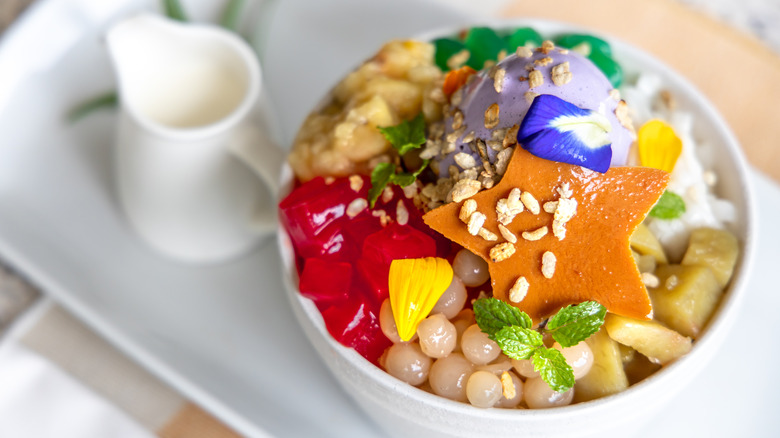
At first glance, you'd be forgiven for thinking Filipino halo-halo was a regular ice cream sundae. It's a layered dessert served in a bowl or tall glass with a wide variety of toppings, with a base made from shaved ice and evaporated milk or coconut milk. On closer inspection, you'll notice the additions are pretty unusual.
Filipinos might top their halo-halo with candied palm seeds, mung beans, sweetened chickpeas, tapioca pearls, or a combination of the lot. Some add coconut sport, diced mango, jackfruit, or taro. Ultimately, the final combo comes down to regional and personal preferences. It's also common to see halo-halo topped with a scoop of ube ice cream. Native to Southeast Asia, ube is a variant of purple sweet potato that can be used in all sorts of recipes and is famed for its creamy texture and vivid purple hue. If you're feeling really adventurous, you can even top your halo-halo with cheese-flavored ice cream – another Filipino favorite.
7. Es puter (Indonesia)
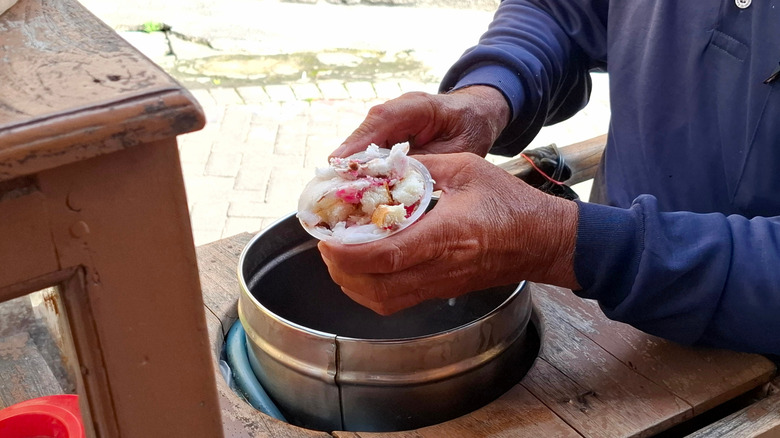
Traditional Indonesian ice cream is known as "es puter," a name that translates to "stirred ice." It gets its moniker from the way it's made, which involves hand-spinning the ice cream mixture in a metal drum placed in a bucket of salt and ice to chill it.
Like halo-halo, es puter is typically adorned with a range of locally enjoyed toppings. Common fruit additions include durian, jackfruit, and avocado. Some people add sweetcorn, black sticky rice, or cubes of bread, and others even add candied mealworms to their frozen dessert. While es puter is often presented in a bowl, it's not uncommon for street vendors to serve it in a slice of bread, producing a very literal version of an ice cream sandwich. Es puter is also made with a base of coconut milk rather than animal-derived milk, making it a dessert that's even suitable for those with dairy-based dietary restrictions.
8. Akutaq (Alaska, USA)
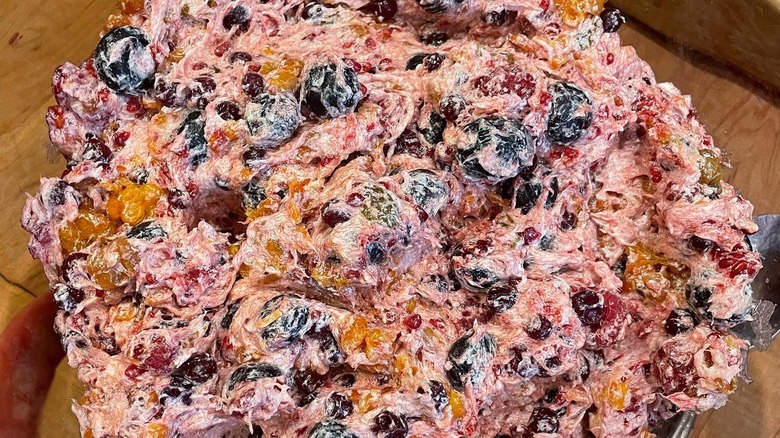
The Indigenous peoples of Alaska have had their own version of ice cream for as far back as anyone can remember. It's impossible to trace akutaq's precise origins because the recipes are passed down orally and can vary widely from family to family and place to place. However, we do know that native Alaskans have been making akutaq for thousands of years, and that it's just as much a survival food as it is a cultural delicacy. Although akutaq is certainly eaten in celebration, its biggest advantage is that it's a naturally preserved, nutrient-dense food. This meant hunting groups had reliable sustenance while braving the extreme climate in search of their quarry.
Akutaq is made with a base of fresh snow, local berries, and animal tallow, which is whipped together into a creamy, frozen concoction. The source of the tallow typically depended on whichever animal the Alaskans were able to hunt, whether it be reindeer, seals, or even polar bears. Some groups add fish, sweet roots, or greens to their recipe, too. It's easy enough to make at home, but feel free to omit the fish and use store-bought shortening if polar bear fat is in short supply.
9. Helado de paila (Ecuador)
South America is no stranger to ice cream, in part due to centuries of European influence. However, that's not to say they were strangers to frozen desserts before colonial conquests. Like the ancient Persians, the Incas were known to flavor ice or snow with fruit syrups hundreds of years ago. Today, many South American countries are also renowned for their uniquely flavored ice creams, such as Peruvian lucuma or Colombian mamey. That said, arguably the most interesting ice cream on the continent is Ecuador's "helado de paila."
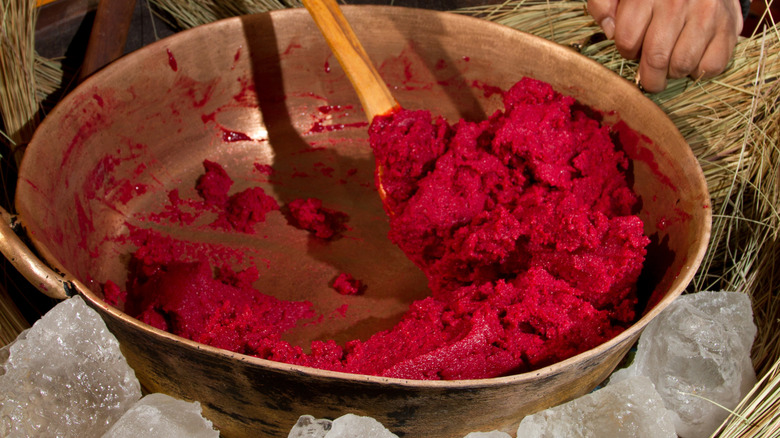
Some might consider helado de paila to be more of a sorbet than an ice cream, as it's made without cream, but its unique cultural standing makes it a worthwhile addition to this list. The dessert was invented in 1896 by a teenager named Rosalía Suárez, when she discovered a handy way to produce a new frozen treat. Suárez found that stirring fruit juice in a copper wok placed in a basin of snow, ice, and straw produced a thick and tasty dessert. Genuine helado de paila is still made the same way today as it was back then, although modern flavors now accompany the traditional fruit options.
10. Ice cream chimney cake (Central Europe)

Although the ice cream enjoyed in places like the Czech Republic and Hungary might not differ much from what you're used to, it's frequently served in a way that puts the classic wafer cone to shame. Rather than a typical cone, many in Central Europe eat their ice cream out of a chimney cake instead.
In the Czech Republic and Slovakia, chimney cakes are known as trdelník, while Hungarians call them kürtőskalács. The hollow, cylindrical cakes are made by wrapping strips of sweetened, yeast-based dough around a spit, which rotates while the cake bakes. The chimney cakes are basted with butter as they cook, and frequently sprinkled with sugar that caramelizes with the heat of the charcoal below. Cinnamon and crushed nuts are other common additions to the cake. The ice cream can be added in scoops, or the cake can be filled soft serve-style, before it's garnished with the usual fare, like sprinkles, sauce, and wafers.
11. Plombir (Russia)
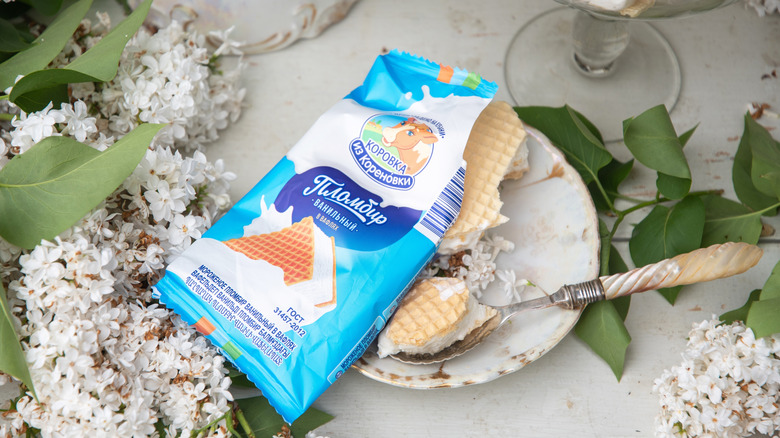
Plombir is a Russian style of ice cream that dates back to the Soviet era, when strict quality controls ensured it lived up to its reputation as a premium product. It was inspired by the French dessert, "glace plombières." However, the French version has candied, kirsch-soaked fruit pieces stirred into the vanilla ice cream, which the Russian variant omits.
In some ways, plombir is similar to gelato because it's churned slowly, incorporating less air to create a denser, creamier ice cream. That said, while gelato is known for having a lot lower fat content than regular ice cream, plombir goes the other direction, and must contain more than 14% sugar and between 12% and 20% fat. Like regular ice cream, it often contains egg yolks, too, which boosts the extremely rich flavor profile. While plombir might not be the healthiest type of ice cream, it's certainly worth trying the favored Russian style if you want to experience the treat in its most decadent form.
12. Mochi ice cream (Japan)
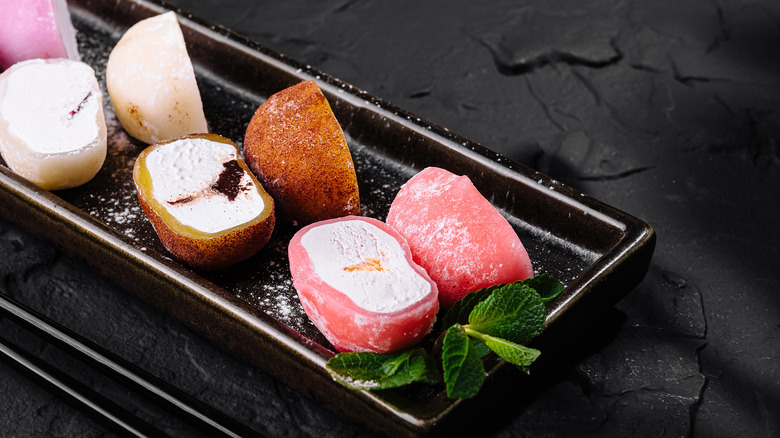
One of Japan's most famous sweet nibbles is mochi, a traditional rice cake made from balls of flavored glutinous rice dough. The soft, chewy treat is considered a cultural delicacy, being revered in ancient times, and enjoyed all over the country at times of celebration. Interestingly, mochi ice cream was actually conceived in the United States.
The precursor to mochi ice cream was something called "daifuku" — a red bean-filled mochi ball that was created in 1981. Mochi ice cream, however, was invented by Frances Hashimoto, the Japanese-American CEO of Mikawaya. Mikawaya is an American company that specializes in Japanese desserts and pastries, and when the company launched mochi-wrapped ice cream in Hawaii in 1994, it became an instant hit. Despite starting out in the U.S., mochi ice cream became extremely popular in Japan, and in recent years, it's become something of a global phenomenon. Mochi ice cream can come in all kinds of delicious flavors, both modern and traditional, and the recipe allows for switching up both the ice cream and mochi types for uniquely tasty combos.
13. Bingsu (South Korea)
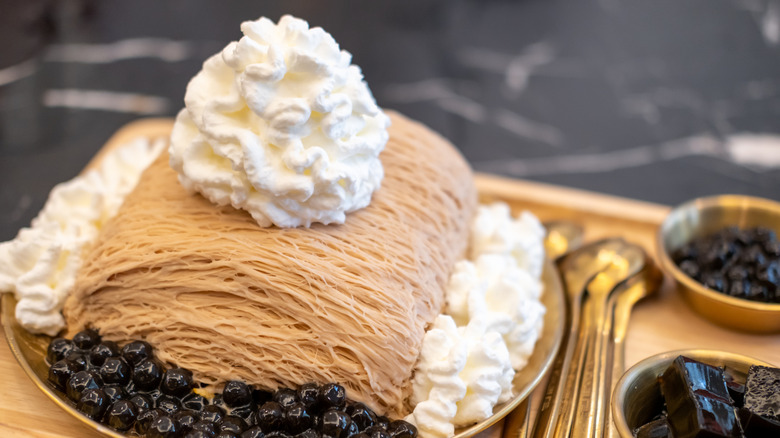
Korea has a long history of making frozen desserts. We know the ancient Chinese were using snow to create milk-based treats thousands of years ago, and it's almost certain that some of these recipes spread through the Korean peninsula. The first records of Korean ice-based desserts date from the Joseon era, a period that spans the 14th to 19th century. These recipes consisted of shaved ice, topped with fruit and sweet red beans, but they've evolved significantly over time.
When the Korean War broke out in the 1950s, foreign influence — particularly from the United States — introduced more elements to the dessert known as bingsu. Additionally, Korean immigrants were inspired to create new twists on bingsu while living in America. The most notable addition is that of condensed milk, which brings the dessert closer to ice cream than sorbet, but toppings like nuts and syrups also became more popular. The most traditional version is still made with red bean paste, rice cake, and ground nut powder, but modern twists are just as varied as your everyday ice cream.
14. Fried ice cream (China & Mexico)
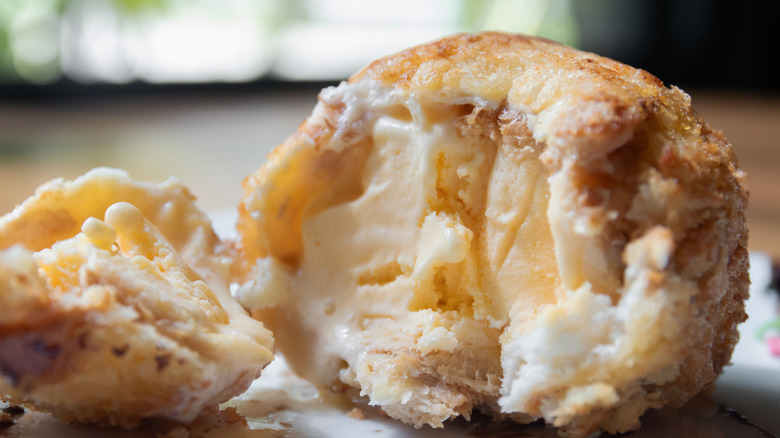
The concept of fried ice cream might have you scratching your head, but the science checks out, and it's entirely possible to batter and fry ice cream without it instantly melting. Which is just as well because fried ice cream tastes incredible. It's a regular feature of both Mexican-American and Chinese cuisines, but the origins of fried ice cream are a bit murky.
There are reports of fried ice cream being introduced in both Chicago and Philadelphia in the late 1800s, but some claim the Japanese were already using a tempura-style method to create some form of the dish. The restaurant chain Chi-Chis added Mexican fried ice cream to its menu in the 1970s, leading many to believe it to be a Mexican creation. Plus, its popularity in China lends weight to the idea that it was invented over there, albeit without solid proof. It's not unlikely that versions of fried ice cream arose independently in different places, given that both ice cream and battering techniques are widespread across the world.
15. Ai-tim phat (Thailand)

Commonly known as rolled ice cream, ai-tim phat is a Thai invention that surfaced in 2009 and has taken the world by storm. The base is a pretty simple two-ingredient batter made with cream and condensed milk, which is poured on top of a freezing cold metal plate. Additional flavoring ingredients are added, which can range from things like fruit to Oreo cookies, and these are diced into the mix with a pair of metal spatulas.
Everything's stirred together, and the batter soon thickens and hardens. Rolled ice cream is sometimes referred to as stir-fried ice cream due to the way it's made. Once the batter has solidified into the right consistency, the spatulas are used to scrape the flat disk of ice cream off the metal plate in strips, which roll into tight cylinders. The cylinders are then wedged together in a tub before sauces and garnishes are added. Toppings vary massively, but you'll tend to see the classics, like sweet syrups, chocolate chips, sprinkles, and wafers.
16. Spaghettieis (Germany)
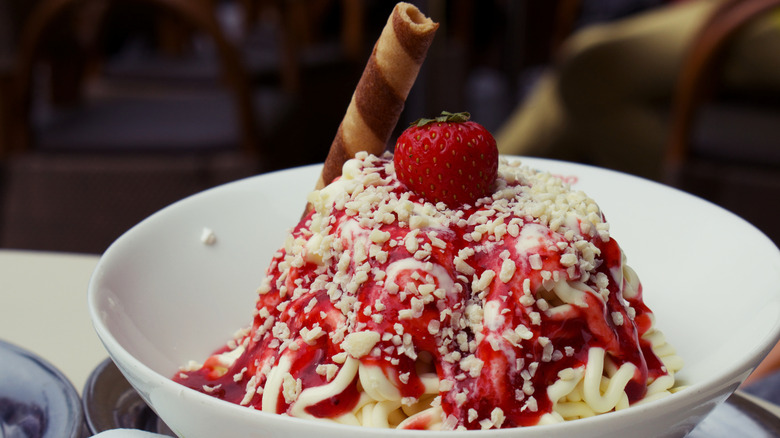
While spaghettieis doesn't exactly reinvent the wheel, it's certainly unique enough to be worth mentioning. The dessert was created by 17-year-old Dario Fontanella, the son of an Italian immigrant who was descended from a long line of ice cream makers. Inspired by a trip to France, he invented the fun concoction in 1969, before joining the family business.
Spaghettieis is essentially ice cream disguised as a pasta dish, and it's made by pushing ice cream through a potato ricer to create long, thin, noodle-like strands. These are heaped onto a plate of whipped cream, before strawberry coulis is added to emulate tomato sauce. Finally, white chocolate is shaved on top to give the appearance of Parmesan cheese. While spaghettieis might sound like a cheap gimmick, it's still hugely popular in Germany. Around 40 million servings of the stuff are sold every year, so it would seem that it's here to stay.