

What Eating At Arby's In The '60s Was Like
In 1964, successful food-service equipment business owners Forrest Raffel and Leroy Raffel saw an opportunity to expand the fast food industry beyond burgers and fries. More specifically, they envisioned a restaurant whose core dish was a roast beef sandwich. And with that, Arby's was born. It is often incorrectly stated that Arby's got its name from the initials for roast beef: R.B. Well, the R.B. part is correct, but it's actually called Arby's because it's short for "Raffel Brothers." It's just a happy accident that it works both ways.
Wondering what it was like to eat at an Arby's in its first few years? As with almost any restaurant chain that has been around for over 60 years, the Arby's experience of today is much different than that of its early days. But Arby's was indeed a whole new kind of fast food when it first debuted, from menu to pricing to overall ambiance. Keep reading to get an inside look at what the restaurant, which is now a veritable fast food giant, was like in its early years.
The original menu consisted entirely of roast beef sandwiches and potato chips
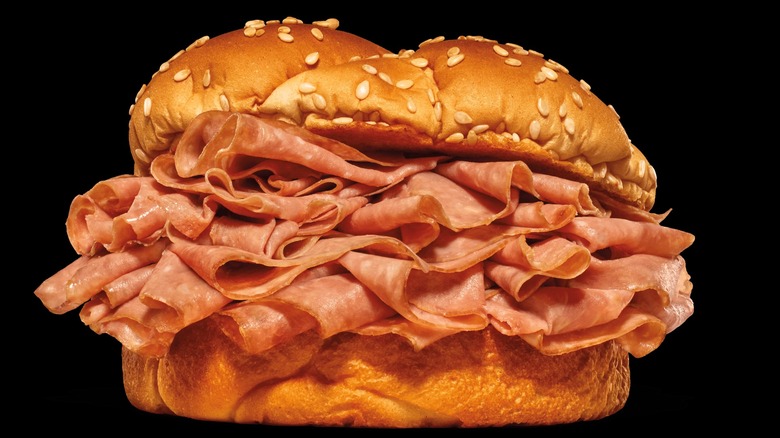
Today, the Arby's menu is so expansive that some of its vast array of sandwiches don't even contain roast beef at all. But back in the '60s, there was only one sandwich on the menu: the roast beef sandwich. It wasn't unusual for a fast food chain of the era to be built around a single core item, but to have an entire restaurant that featured only a roast beef sandwich still felt unique.
As for sides, Arby's wouldn't have its iconic curly fries until 1988. And the first Arby's restaurant didn't have fries at all — the only side on the menu was potato chips. It made sense given that potato chips are a standard side offering for a deli sandwich, but fast food eaters tend to expect something a little more. Still, in its effort to stand out from other fast food places, Arby's didn't go straight to standard french fries. Instead, when it transitioned from a single restaurant to being an actual fast food chain, Arby's offered Potato Cakes: essentially miniature bite-sized hash browns.
The buildings were made to resemble Old West covered wagons
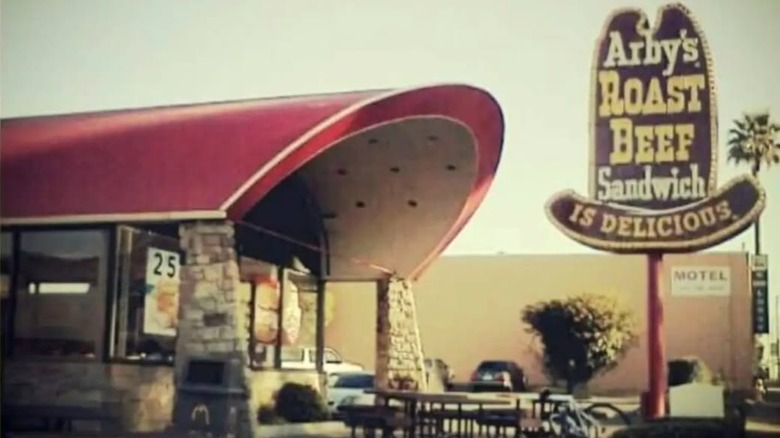
Continuing in its mission to stand out from the other fast food chains of the time, Arby's also leaned into a sort of American Old West branding when it started opening additional locations. Roast beef is indeed a meal that you would've found in an Old West saloon, although maybe not deli-sliced and on a bun. Either way, Arby's played off of that, not just with its classic signs shaped like massive 10-gallon cowboy hats but also with the design of the restaurant itself.
The roofs of '60s-era Arby's restaurants were red and had a severe curvature to them, with the idea that they were meant to loosely resemble a classic Conestoga wagon — also known as a covered wagon or a chuckwagon. Chuckwagons were essentially the food trucks of the Old West, a place for cowboys to gather and have a meal, some coffee, and stock up on essential supplies. Adults in the '60s had grown up with movie and television Westerns, so a chuckwagon-shaped restaurant was an instantly recognizable sight that almost instinctively triggered a hunger for some beef.
Arby's was considered expensive for its time
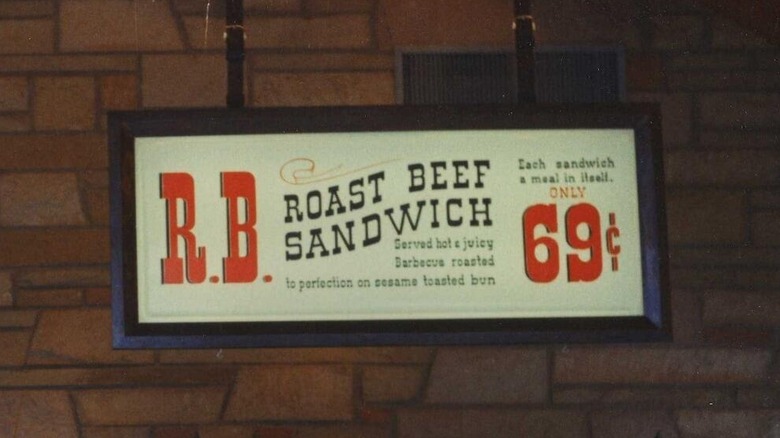
One of the most surprising facts about Arby's roast beef sandwich is that it was way more expensive than other fast food burgers of the time. In 1960, typical fast food burger prices ranged from 12 cents for a White Castle slider to 37 cents for a Burger King burger. So when Arby's sold its roast beef sandwich at 69 cents in 1964, it was significantly pricier than its competitors. By contrast, that same year, you could get a burger, fries, and even a milkshake from McDonald's for less than 50 cents total at some locations.
In Arby's defense, however, making its roast beef sandwich required an entirely different process than just grabbing a hamburger patty and frying it up on a grill. According to one Facebook user who remembers that era of Arby's, "Back then you ordered. Dude turned around, grabbed a knife, and carved off slices of actual beef off of the bone. There was a giant hunk of meat just behind the counter." And several people corroborated that recollection. So while 69 cents might have seemed like a tough sell on paper when you could get a hamburger for a quarter of the cost down the street, at Arby's you were getting sliced-to-order roast beef. With that in mind, 69 cents actually sounds like a steal.
Staff wore chef uniforms and hats
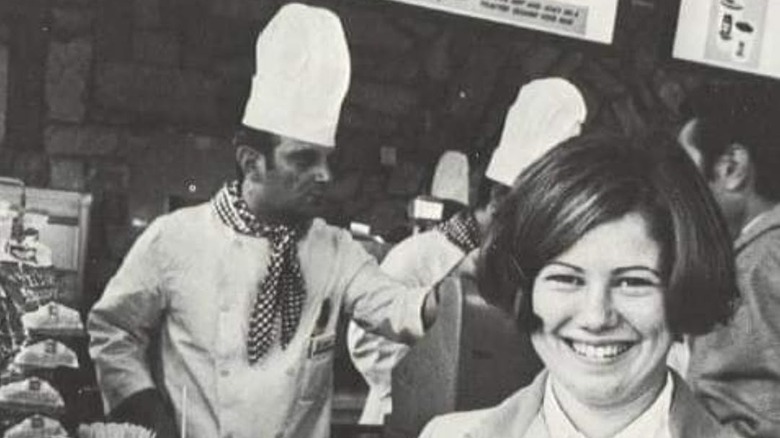
If you're going to have staff carving beef for each order, you might as well have them dress the part. And Arby's did exactly that in its early days, with its staff fully decked out in a chef's uniform, scarf, and tall hat. This contrasted with other fast food employees of the era, who did dress a bit more chef-like than you'll find with today's fast food worker attire, without taking things quite to the extreme that Arby's did.
However, Arby's uniforms actually weren't white as is typical of chef's outfits. Instead, to further double down on the Old West aesthetic, they were actually light yellow in color. This evoked cowboy hats and the dusty frontier, and the aesthetic matched the overall visual branding that was present in the signage and the decor of the restaurant itself — but more on that later.
Interiors were more upscale than the typical fast food place
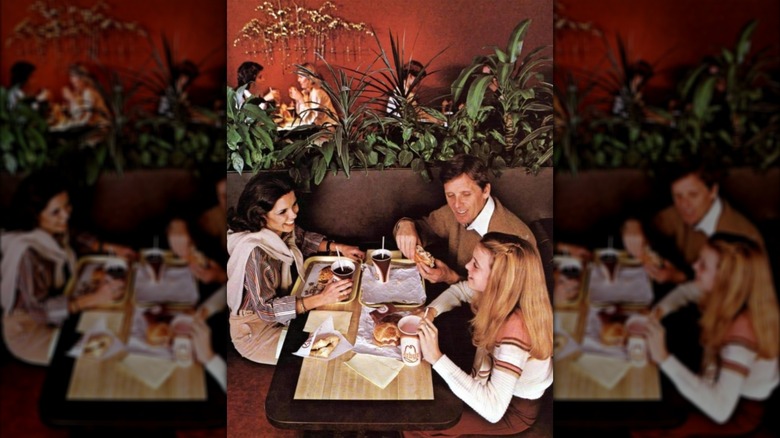
We've already talked a bit about how Arby's was trying to offer a higher-end experience than other fast food chains, and that was evident as soon as you entered an Arby's restaurant in the '60s. You didn't see clowns or cartoon animals in any of the signage. Instead, it felt more like an actual restaurant, aimed more at adults than children, which was very much the intention of Arby's founders.
As co-founder Leroy Raffel explained in an interview with Metro Monthly in 2014, "We felt that if you were going to get a higher price for a higher-quality product, the building had to be in accordance with that concept." He went onto describe the upscale interiors of those early Arby's locations, with natural sandstone walls, recessed lights in the curved ceilings, and glass rotisseries that allowed customers to see the unsliced beef roasts in all their glory, all set to the soundtrack of music playing from the restaurant's speakers.
Those iconic cowboy hat signs still shone bright into the night
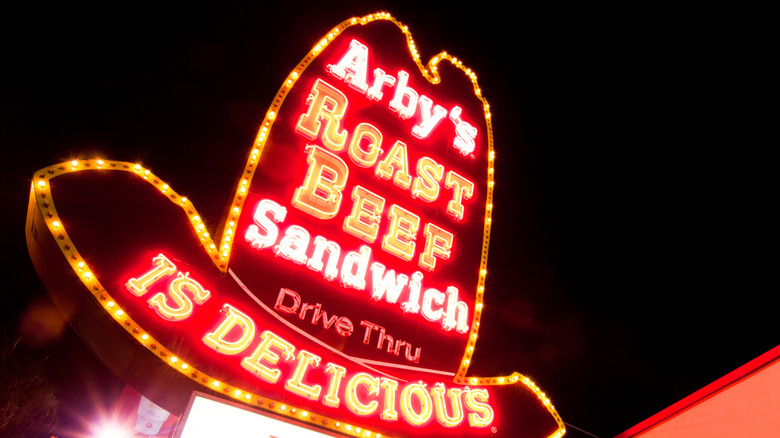
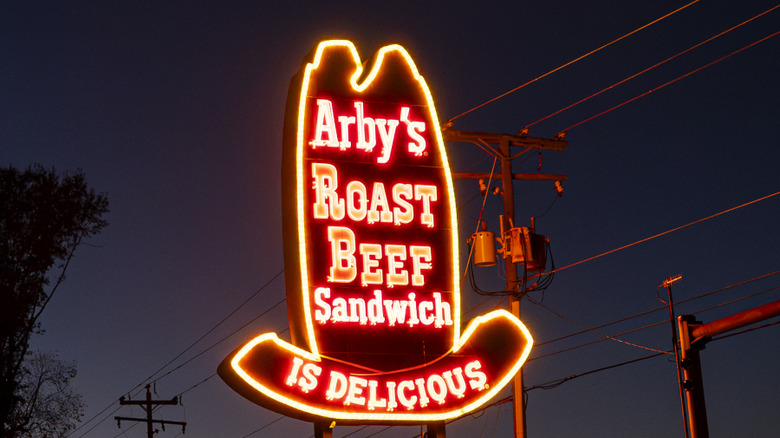
As you drove down the boulevard in the '60s, long before you laid eyes on those curved red roofs, you'd spot that legendary sign. At a towering 40 feet, the sign was shaped like an oversized cowboy hat and outlined with blinking lights. In eye-catching neon were the words, "Arby's Roast Beef Sandwich Is Delicious." And back in the '60s, all those blinking lights and all that neon were still fully lit.
However, those signs likely didn't remain in their full glory for very long. While light bulbs are easy enough to replace — though less so on a 40-foot-tall sign — neon is notoriously expensive to maintain. So as the years went on, fewer and fewer original Arby's signs were fully lit, if at all — especially the neon elements. As of 2024, it was estimated that less than 100 Arby's locations still had the cowboy hat sign at all, to say nothing of how many of the lights in those signs were still functional. But for those first few years, there was nothing quite like a brand new, gloriously illuminated cowboy hat Arby's sign.
The '60s was almost Arby's entire lifespan
The way things were going for Arby's going into the 1970s, this very easily could've been one of many articles about chain restaurants boomers miss visiting. Not only did Arby's change after the '60s, it almost ceased to exist entirely after the '60s. Like many businesses that get very successful very quickly, Arby's overextended itself in its rapid expansion and subsequently struggled to pay back the loans it had taken out to aid in that expansion. The company was forced to file for Chapter 11 bankruptcy in 1970.
Fortunately, the Raffel brothers were able to reassert some of the control they had previously relinquished to other partners, and were subsequently able to right the sinking Arby's ship. By the mid-'70s, Arby's had already rebounded, gotten out of bankruptcy, and doubled its number of locations. Today, Arby's brings in $4.5 billion in global sales annually across over 3,000 locations.
Historians have been fighting to save one of the last remaining '60s-era Arby's
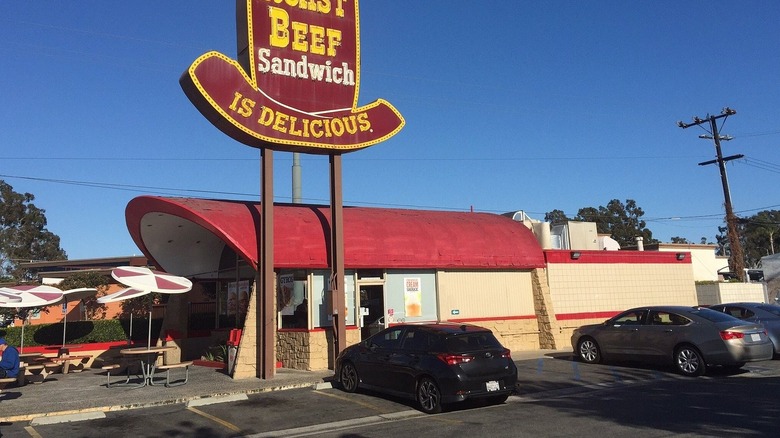
As hard as it is to come by an Arby's that still has the cowboy hat sign, it's even more rare to find one that retains the original covered wagon-style roof. And when one of those is set to be demolished, people rally around it in an effort to save it and preserve yet another piece of history that is set to disappear — like what happened with the Arby's location on Edinger Ave. in Huntington Beach, California.
In 2024, it was discovered that a demolition permit had been submitted for the location, which still has both its cowboy hat sign and red chuckwagon roof. Several journalists and historians reported on the news, flocking to the location to take interior and exterior photos for preservation in case the demolition proceeded as planned while also calling on the community to push against the demolition.
As of writing, the original building still stands as-is, but it's unclear if it is due to the outcry or if it's just a matter of the typical slow-moving bureaucracy of such plans. If you're in or near Huntington Beach — or any other area that still has an intact '60s-era Arby's — we suggest you make a pilgrimage and take lots of pictures before the inevitability of modernization relegates yet another piece of fast food history to photos and memories.