

8 Ways Domino's Innovations Changed Pizza Delivery
Sure, there are several different pizza chains out there to choose from for those nights when you just don't feel like cooking, or even a delicious frozen pizza just isn't going to do the trick. However, there are few of these chains that are quite as iconic as Domino's. Of course, it's a Goliath in the pizza chain landscape, with over 22,500 locations across the world. But Domino's also stands out from the competition due to the fact that it's been such an innovator in the industry. In fact, many pizza delivery conventions that may seem standard to you are thanks to this popular chain.
We're taking a closer look at some of Domino's innovations that have shaped pizza delivery over the years ... and those that are still pushing delivery forward. In an era where you can get basically any kind of food delivered to your doorstep, Domino's commitment to continual innovation in this space is unique and often creative. And yes, you should totally order a pie to enjoy while reading up on how Domino's has changed pizza delivery.
The chain is behind those iconic car-top signs
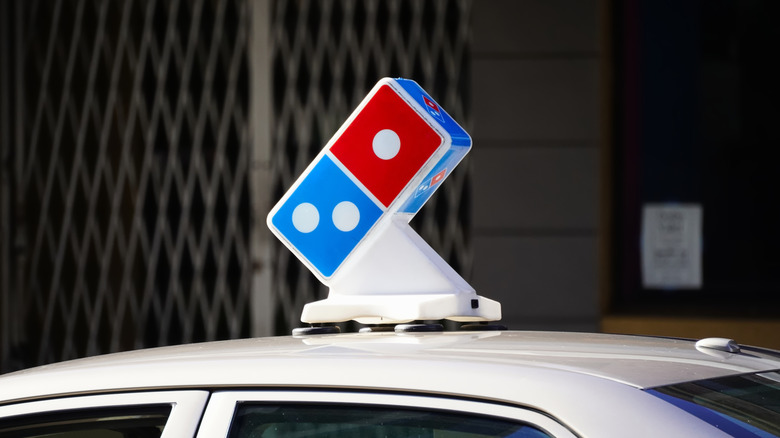
When you order from DoorDash or Uber Eats, the delivery driver is generally just using their own, unadorned car. But when you order from Domino's, you'll notice that it has that iconic 3D sign on the top of the car that delivers your food. And perhaps you've seen these car-top signs elsewhere, like on taxis. You may not have known that Domino's was actually the first to do this. The company invented that 3D sign, and it hasn't just changed pizza delivery — it's changed multiple industries that now use it for advertising. If you're like us, then it might come as a surprise that a form of advertising that seems so ubiquitous now was actually a brainchild of a pizza chain.
Domino's rolled out this innovative form of branding back in the 1980s. Throughout the years, there have been a variety of different styles of car-top signs, but one thing is for sure: When you see one, you know you (or your neighbor) are about to dig into a hot Domino's pizza.
Domino's created Heatwave Hot Bags to keep pizzas at hot as possible
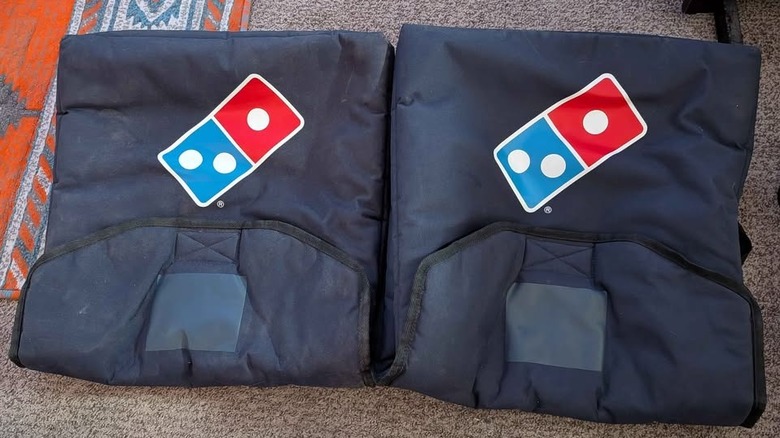
There's nothing worse than ordering food delivery and waiting seemingly forever for it to arrive, only to realize that it's already cold by the time it's at your door. This is a bummer with basically any type of hot food, but it feels particularly egregious when it comes to pizza. Although, yes, you can technically reheat a pizza, pies taste the best and freshest when they're straight out of the oven. While Domino's delivery drivers don't exactly have a pizza oven in the trunk, they are working with technology designed to keep your pizza as hot as possible.
Back in 1998, Domino's rolled out its Heatwave hot bags, designed to keep pizzas hot while drivers were out doing their deliveries. Early versions of the bags had to be plugged in at the store, while newer versions don't require electricity at all. Domino's was one of the very first companies to utilize this kind of technology at such a large scale, helping to set a precedent for hot delivery food. If you've ever had a cold, soggy pizza delivered to your home, you'll know why this innovation is so revolutionary. And if you haven't? It's likely because of Domino's use and embrace of these patented bags.
The chain created the corrugated cardboard box that's now standard for pizzas
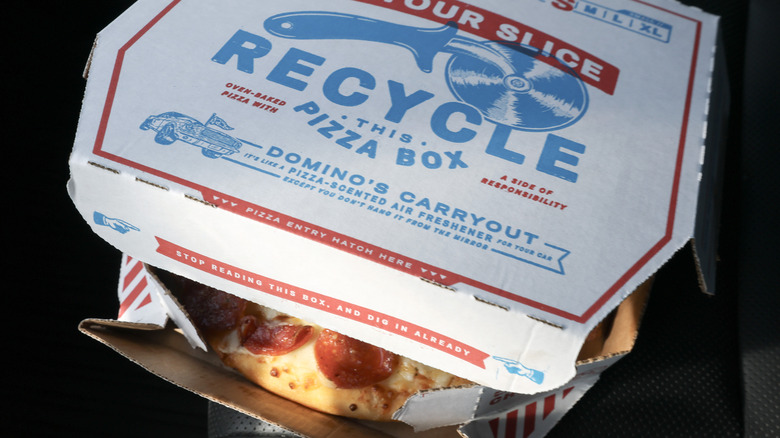
When you order a pizza from basically any restaurant, you know how it's going to come packaged: in that iconic cardboard pizza box. In fact, you might not have even considered the possibility that a takeout or delivery pizza could be packaged in anything else. But those corrugated cardboard boxes that are now synonymous with pizzas weren't always used — it was actually Domino's that invented and rolled these boxes out and are responsible for making them as ubiquitous as they are.
The founder of Domino's, Tom Monaghan, struggled to build a box that could be folded but was still strong enough to hold up to the weight of a steaming hot pie. After trying different designs, though, Monaghan finally settled on the pizza boxes we're familiar with today. These boxes were originally produced by Triad Containers, a box company located in Detroit. They're now referred to as "Michigan style" boxes, and they've basically become a standard packaging decision in the entire industry. Whether you're snagging yourself a takeout or delivery pizza from your nearest Domino's or a local family-owned pizza place, you can bet it's going to be served in the box that Domino's originally invented.
Domino's is the first pizza chain to offer mobile ordering
These days, it's pretty common to place a mobile order for food. This is true whether you're picking up your favorite coffee from a chain coffee shop as you're going into work or you're ordering a pizza to your home for a cozy Friday evening meal. But once upon a time, ordering food from a cell phone was totally unheard of. If you wanted to place an order, you'd actually have to go into the restaurant in question or call to place your order. That all changed in the pizza landscape in 2007, though, when Domino's became the first company in the industry to offer mobile ordering.
The press release for this announcement informed customers that they could now order pizza on their "web-enabled cell phones," pointing to the fact that not everyone's mobile phone had access to the internet at that point. And no, you couldn't order from an app — instead, you had to manually type in the Domino's website URL to take advantage of this service. Things have changed now, and you can mobile order from most restaurants out there. We shouldn't forget, though, that Domino's was on the cutting edge of this technology.
Domino's rolled out an innovative pizza tracker
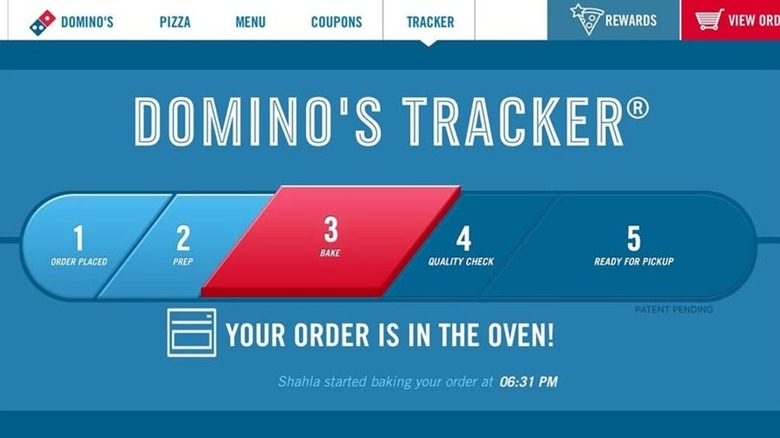
It can be annoying to be waiting for a delivery not knowing when it's going to arrive. This is why most food delivery apps these days will give you near-constant updates. They'll let you track when the restaurant finishes making your meal, where your driver is on a map, and if they have a stop before they drop the food off at your location. But before delivery apps were as common as they are today, you'd just have to sit there and wait for your food to arrive, clueless to any of the details.
But in 2008, Domino's apparently wanted to change that. The company rolled out its Domino's Tracker, which lets customers know where their pizza was in the delivery process. Not only do you know when your driver leaves the store, but the tracker also tells you when your pizza is being prepped and baked. Domino's was the first pizza chain to use a tracker like this, and it set a precedent for food delivery that arguably still exists today.
The chain has embraced delivery via e-bikes
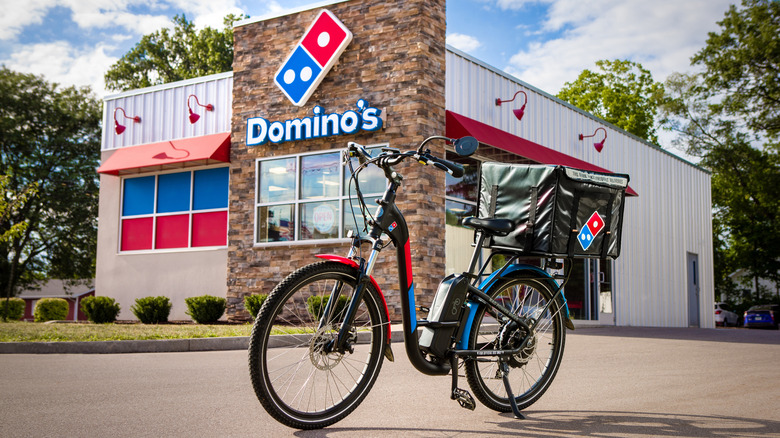
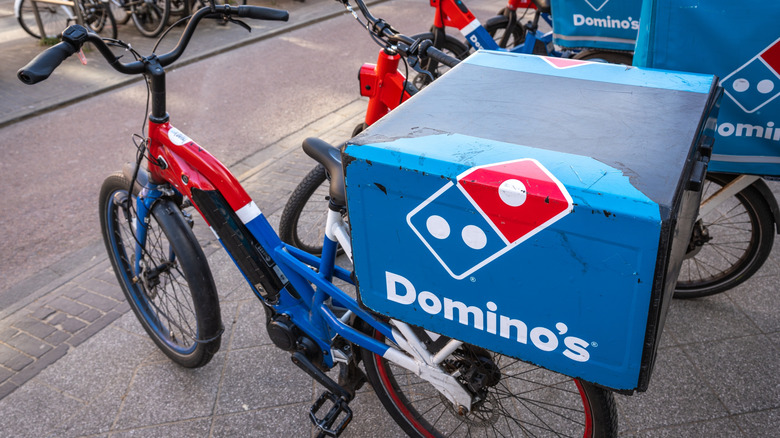
If you live in an urban area, then you know that parking is no joke. Often, there aren't many convenient places for a delivery driver to pull over for enough time to drop off a pizza. It only makes sense, then, that Domino's rolled out e-bikes in 2019. There were a few reasons for this. First of all, it allowed the company to offer better, faster service. This was a big deal to Domino's because at that point, food delivery apps were taking over the delivery scene, and the pizza chain still wanted to compete. Bikes can bypass a lot of the traffic that keeps cars stuck, and they don't have the same parking struggles as cars do. By using e-bikes to offer quicker and better service than these apps could, Domino's continued to secure its place in the delivery landscape as a trusted brand.
Using e-bikes wasn't just about improving the customer experience. This also allowed a wider pool of applicants to be considered at Domino's. Those who don't have a driver's license or car, for example, can still be eligible to do deliveries for Domino's via e-bike. Although Domino's is far from the first brand to offer delivery via e-bike, this innovation has still kept the company relevant during a time of major changes in the food delivery scene ... and e-bikes aren't even the most unique vehicles Domino's has used to deliver pizza.
In the '90s, Domino's rolled out a pizza 'hotline' for easier ordering
If you're ordering from Domino's these days, there's a good chance that you're going to use the mobile app or at least place an order from your computer. But once upon a time, ordering a pizza wasn't quite so simple. Customers had to call the pizza shop, explain exactly what they wanted, and then either wait for delivery or pick it up themselves. This involved actually looking up the phone number of the pizza shop they wanted to get food from, a process that wasn't always convenient if customers didn't have easy access to a phone book.
But in the early '90s, Domino's wanted to simplify this process, so it came up with a "hotline" for customers to call when they wanted to place an order. Instead of having to look up a different phone number for every different Domino's location in town, customers could instead dial one specific, set number all throughout the country and reach their local store. They didn't need an area code — they'd just automatically be connected to the closest location. The New York Times described the hotline as "the pizza version of dialing '911.'" Although this innovation might not be as useful as it once was, we can still admit that it was a smart way to make the chain's pizza even more accessible to customers.
Domino's developed voice-ordering technology
When you want the ease of ordering that comes with using an app but don't actually want to have to go through all of the pages and questions required to build the pizza you want, Domino's voice-ordering technology can make things a lot simpler. This technology, which came out all the way back in 2014, made it possible for customers to use their voice to interact with "Dom," the digital voice that can help you create and place your Domino's order. At the time, it was an innovation that hadn't yet been seen on the retail scene, making it truly groundbreaking.
By 2018, Dom wasn't just being used on the app — Domino's also started employing it for inbound calls, giving customers yet another way to order their pizzas with more ease. Admittedly, many of us would actually prefer to just speak with an actual human instead of having AI pushed on us even more than it already is. But in 2018, the AI fatigue that now plagues us hadn't really struck yet, so the rollout of this innovation just seems pretty cool for the era.