

Some Filet-O-Fish Fans Say 2 Things Keep It From Being The Perfect Fast Food Sandwich
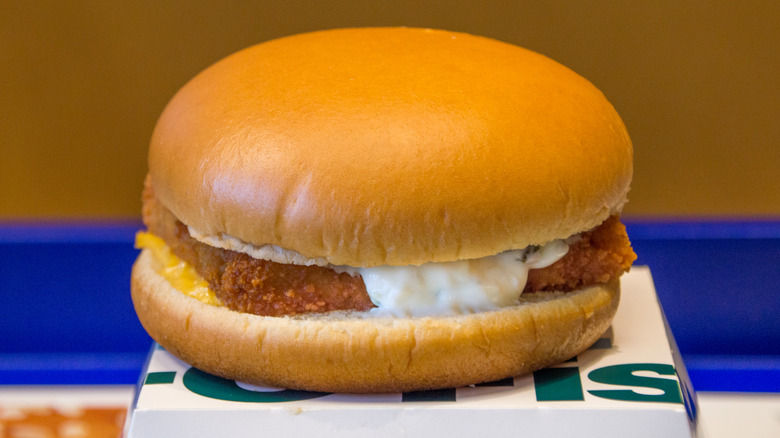
In the six-plus decades since it first graced McDonald's menu boards, the Filet-O-Fish sandwich has acquired a legion of dedicated fans. For many of them, the combination of fried Alaska pollock, American cheese, and tartar sauce on a steamed bun is just about fast food perfection. Recently, however, complaints about the Filet-O-Fish have been growing, with two characteristics drawing the ire of customers. According to some fans, the sandwich would be perfect if it were a little bit larger and a little bit cheaper.
The most frequent complaint about the Filet-O-Fish is related to its size. There have been many allegations of "shrinkflation" around the sandwich in recent years, customers accusing McDonald's of reducing the size while keeping the same price. "It does seem smaller," writes one Redditor. "Ounce for ounce it might be the most expensive thing on the menu." Despite widespread accusations of shrinkflation on social media, however, McDonald's insists that the sandwich has not changed size for many years.
For other customers, the size of the Filet-O-Fish isn't a problem. "I think the daintiness of the sandwich is part of what makes it so tasty," shares another fan on Reddit. "I would keep the size but I wish they would lower the price." And they might have a point. Despite the fact that the Filet-O-Fish hasn't changed much since its introduction, the price has gone up quite a bit — even adjusting for inflation.
The Filet-O-Fish might not have the same value it once did
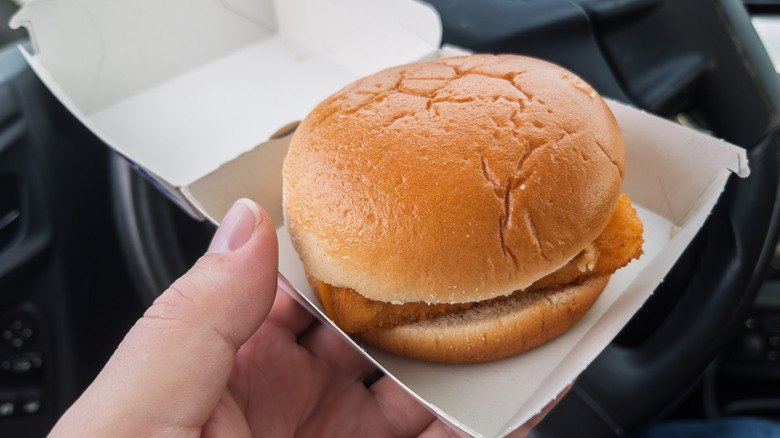
However you break down the changes in McDonald's signature seafood sandwich over time, it doesn't look great. The Filet-O-Fish cost just $0.29 when it was first introduced in the 1960s. Adjusting for inflation, that would be about $3-3.10 today. Even just looking back to the cost of a Filet-O-Fish in 2001, $1.89, there is a significant discrepancy with the rate of inflation. In today's money, that $1.89 would be more like $3.52-3.60. Prices vary between McDonald's locations, but $4.59 is on the lower end for this sandwich, and it is quite common to see it listed for upwards of $6 — both steep departures from the expected cost.
It may be that the increased cost has reduced the sense of value, thus changing customer perception of its size. "They've always been pretty small," writes one Redditor. "I always had to get at least two for a decent meal. But now everybody else's fish sandwiches are larger." When the prices were lower, or one of those old Filet-O-Fish deals were on, buying two sandwiches for a meal might've seemed perfectly reasonable. Nowadays, not so much.
Occasionally, the complaints about shrinking sandwiches also shoot themselves in the foot. "It's noticeably smaller from both a width and thickness perspective," writes one Facebook user, "and now only receives half a piece of cheese." Famously, though, the Filet-O-Fish has always been served with just a half-slice of cheese. If that memory isn't clear, it's hard to put much stock in the customer's judgment of the size of the sandwich. The expected size may simply have shifted over the years, as the price rose.