

11 Gas Station Food Red Flags That Should Send You Running
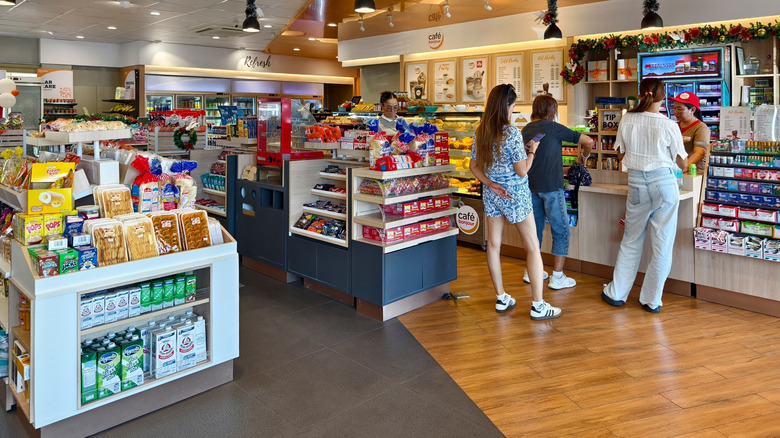
They won't be winning Michelin stars any time soon, but gas stations play a pivotal role in the food world, providing weary road trippers with a quick meal and busy workers with an easy snack or lunch. From hot dogs and pizza to a whole host of desserts, Ding Dongs, and energy drinks, the variety at convenience stores is pretty staggering. But there are also reasons to feel a bit nervous about buying any of it. Where restaurants sometimes let you see cooks working in the kitchen, gas stations often don't even have kitchens. At rural locations, it's reasonable to wonder how long the food has been sitting there and whether the many steps that went into transporting and serving the products have been compliant with food safety regulations.
We reached out to two food safety experts to get the lowdown on what shoppers should be concerned about, even when purchasing what you think is the best gas station food. Dr. Mario Hupfeld is the co-founder and CTO of NEMIS Technologies, where he develops rapid diagnostic tools for food safety. Dr. Vanessa Coffman is the Alliance Director for Stop Foodborne Illness, a national nonprofit public health organization dedicated to preventing foodborne illness.
"Gas stations and other convenience stores are subject to the same fundamental food-safety regulations and principles that apply to other food retailers," Dr. Coffman tells us. Ultimately, she adds, food safety "depends on how well those requirements are understood, implemented, and consistently followed." Here are some signs that they might not be.
Cold food that isn't cold
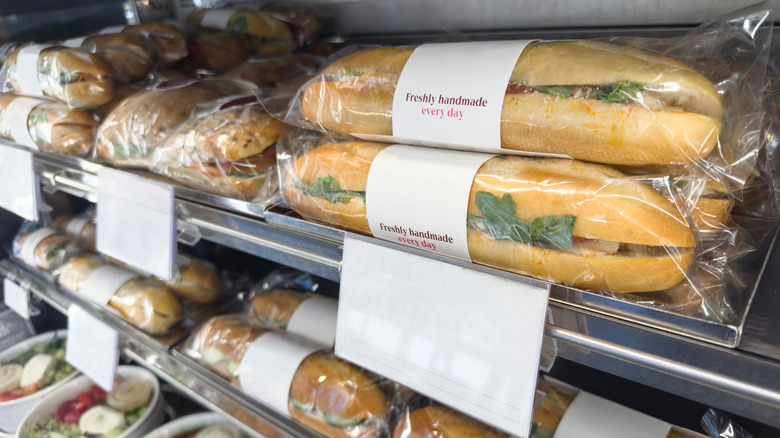
One of the most obvious signs that you should avoid purchasing something from a gas station is food that isn't sufficiently chilled. For example, if you're hankering after a tuna sandwich, but it's in a refrigerator that feels suspiciously room temperature, avoid it at all costs. "Pathogens that can cause foodborne illness can multiply rapidly in the 'Temperature Danger Zone, between 40 degrees Fahrenheit and 140 degrees Fahrenheit," Dr. Vanessa Coffman says. "For retail food establishments, cold food should be held at or below 41 degrees Fahrenheit."
The clearest example of this is when an item that should be refrigerated is not being stored in a refrigerator, but that is a mercifully uncommon occurrence. The more likely scenario is that you'll find that the fridge doesn't feel particularly cool. Although it's impossible to know the exact temperature by feel alone, you will often be able to find a digital display somewhere on the appliance that will tell you precisely how cold it is.
Dr. Mario Hupfeld also has a trick for packaged foods. "I'll look at any condensation on the packets that they store because that tells me the temperature isn't as low as it should be," he says, explaining that it would raise the possibility of Listeria and Salmonella growth. He tends to avoid refrigerated food altogether. "There's no cooking step before you eat them," he explains, "And if they've been sitting at the wrong temperature for long enough, you don't necessarily get any obvious warning from the food itself."
Hot food that isn't hot
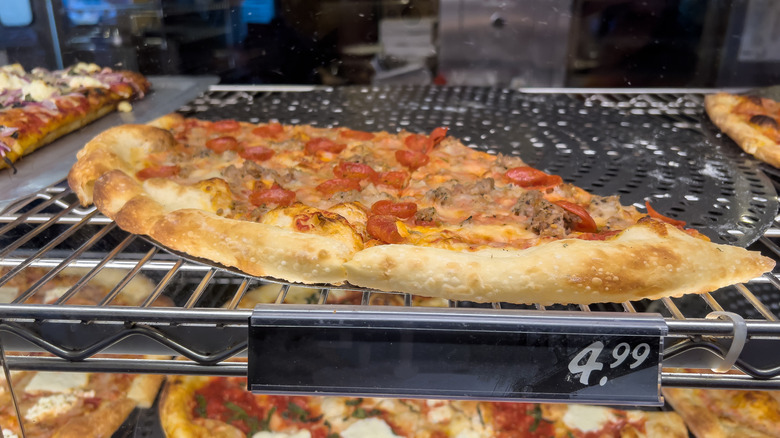
Improperly heated hot food is also a concern. This isn't simply a matter of whether something is fully cooked; even overcooked meat can become a health hazard if it's stored within that aforementioned danger zone between 40 degrees Fahrenheit and 140 degrees Fahrenheit. As Dr. Vanessa Coffman explains, hot-held foods (ones that need to be kept hot) pose a higher risk than other meal options, because they must be carefully temperature-controlled throughout the full handling process.
Timing is also a factor. According to the USDA, perishable food should not be kept in the danger zone for more than two hours, and only one hour if the ambient temperature is over 90 degrees Fahrenheit. Since you have no way of knowing how long food has been left out at a gas station, it's best to play it safe and assume it's over the limit.
Unfortunately, reheating food that has been in the danger zone will not make it safe, either. You can kill off some harmful bacteria through cooking, but others, such as Staphylococcus aureus (known colloquially as staph) can still stick around and continue to produce toxins. If you've been on the road for a while, any type of hot food can feel like a miracle, but don't get too excited until you've determined the temperature at which it's being stored. If the heat lamp isn't working and the hot dogs and pepperoni pizza are hovering around room temperature, you'd be much better off eating trail mix for dinner.
Dirty food prep areas
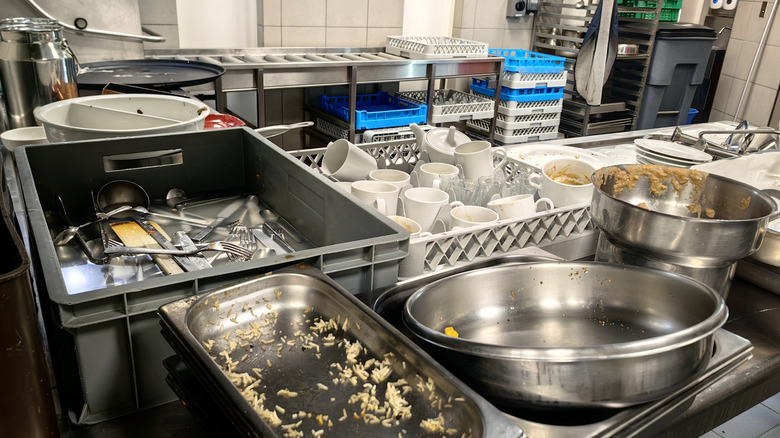
If you're at a gas station where food is being prepared, not just brought in, take note of the prep areas. Are the surfaces grimy? Is the space cluttered? Are there crumbs or other signs of food build-up that have not been properly cleaned? All of these visual cues suggest that the workers there are not sufficiently cleaning the space and that cross-contamination could be a concern. Dr. Mario Hupfeld reveals this was one of his major red flags. "Surfaces need to be clean and wiped down often," he says. "And that's a bare minimum."
There are, unfortunately, many ways that harmful bacteria, viruses, and toxins can spread, and dirty food prep areas are one of the big ones. Even if you see the employees washing their hands or wearing gloves, Salmonella, E. coli, and Cyclospora (among many others) can be transferred between foods through everything from equipment and utensils to surfaces and containers. If you walk into a gas station and it appears that the area where the food is being made or packaged is poorly cleaned, it's a sign that harmful pathogens are being given ample opportunity to move around and proliferate.
Uncovered food
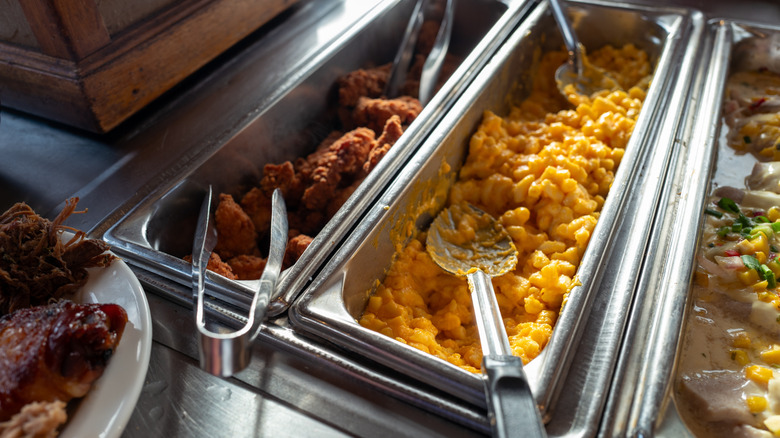
If you've ever been to a buffet and wondered why there were glass shields over the food, it's not just because it helps contain the heat. Those shields are mainly there to keep germs out. In fact, they're called sneeze guards, rather than heat guards, which tells you what they're primarily used for. If you see self-serve food on display at a gas station without them, you should probably find something else for dinner. It doesn't matter if you don't see anyone actively sneezing or coughing onto the food while you're in the store. Depending on how long the food has sat there, it will have had ample opportunity to be contaminated throughout the day by other gas station shoppers.
Coughing and sneezing aren't the only concerns, either. Air itself can be full of bacteria and viruses that settle on uncovered food. Even if the food is sufficiently heated (or cooled), it's best to avoid it if it's exposed to the ambient air. Food that is completely covered, such as hot dogs packaged in paper, rather than just under a heat lamp or sneeze guard, is even better.
A grimy store

If you go to a gas station that doesn't seem to prepare its own food (there's no kitchen or visible prep areas to be seen), you might assume that the condition of the store is irrelevant to food safety. Sure, the floor might be a little sticky and the refrigerator doors might be covered in handprints, but that shouldn't automatically make the pre-packaged food unsafe, right?
None of these factors conclusively prove that the food is contaminated, but it does indicate a generally lax approach to cleanliness and hygiene from the store's employees. The cleaner the store, the more confident you can feel about eating the food there (provided the proper temperatures are maintained, of course). As Dr. Vanessa Coffman notes, some foods require careful handling at every stage of the process, from the farming of the raw ingredients to the moment you take it off the convenience store shelf. If you feel that the gas station you're in isn't maintaining basic hygiene standards, the best course of action is to wait to purchase food from a different establishment.
Signs of pests

There are certain parts of the world where insects are pretty much unavoidable. But while insects outside might simply be an indication of climate and the time of year, insects inside — especially in an establishment serving food — are a big red flag. Even people who live in Houston, the city with the most cockroaches in America (per Pest Gnome), do not expect to see cockroaches in their restaurants, no matter how hot and humid it is. The fact is that keeping pests out can be difficult, especially in places that sell fresh food, but doing so is crucial to avoid foodborne illness. Cockroaches, as well as flies and rodents, are carriers of dangerous pathogens that are distributed on whatever surfaces the pests move across. If you see any of these unwanted guests at a gas station, do not eat the food there.
Pests aren't always hanging out in the broad daylight for all to see, so they may still be present even if you don't catch even the most fleeting glimpse of them. There are clues, though, that the environment might be vulnerable to them. Look for out for open garbage cans, food debris on floors or surfaces, and food that is exposed to the air. They don't automatically mean that pests are lurking in the shadows, but they do mean that the risks are higher.
Unusual smells or appearance
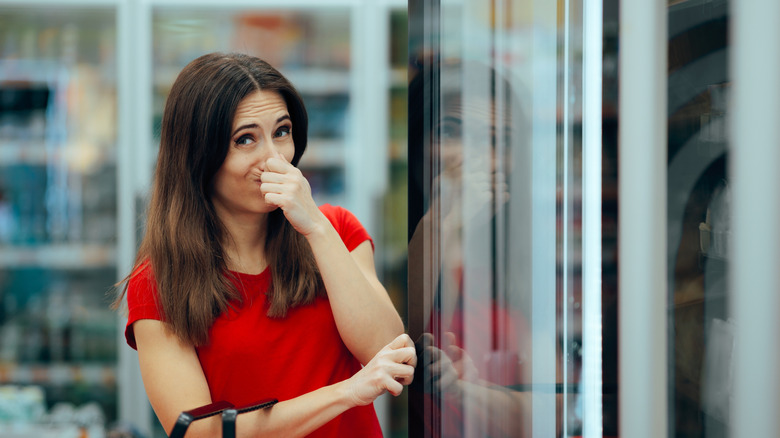
Both Dr. Vanessa Coffman and Dr. Mario Hupfeld were quick to tell us that sight wasn't the only untrustworthy sense when it comes to detecting dangerous food. "You can't even be 100% reliant on your sense of smell because smell, color, and texture will tell you when something is obviously spoiled, but they're not a good way of ruling out pathogens," Dr. Hupfeld explains. "It could be a breeding ground for Salmonella without the food looking or smelling any different." Some of the worst types of bacteria, such as E. coli, don't change the taste or smell of food at all.
That said, if something does look off or smells funny, that is a clear sign that it might be growing harmful bacteria. For example, deli meat can start to smell sour, and it may look slimy or have a slightly gray tinge. This is, counterintuitively, one of the best-case scenarios for food safety, because it means that you will be sure that something should be avoided. The trickier cases are when the smell and appearance give no clues to the harmful pathogens growing there.
Fresh fruit or vegetables with bruises or mold
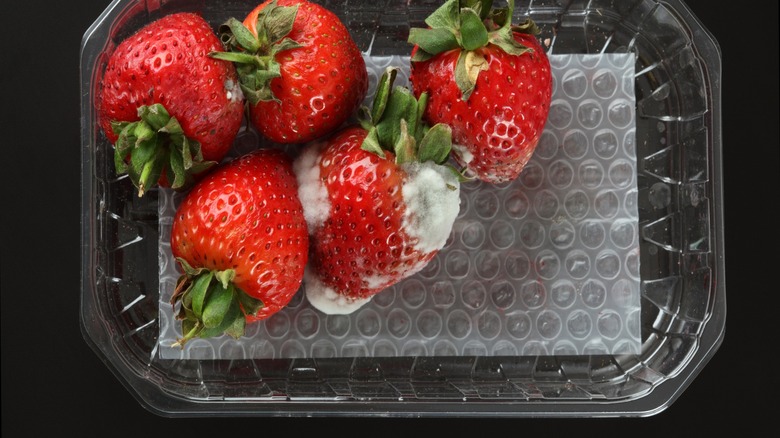
Gas stations rarely have extensive produce sections, for obvious reasons. They tend to serve food that is easy to eat on the move, and fruits and veggies aren't exactly big money makers. But don't get too excited if you do find a rare gas station with produce. Where grocery store fruits and veggies have a high turnover and are checked regularly for freshness, gas station produce is a different matter. The turnover will probably be much slower, for one thing, since most people are doing their weekly ingredient shop there, meaning that it might have been sitting there for a while.
Some of the telltale signs that produce is going off are visual, including bruising and mold. Bruising itself is often harmless, but it can lead to invisible bacterial growth that isn't. Mold is more concerning, since its spores can grow deep into certain foods and become impossible to cut out the way you can with bruises. There are some foods that you can salvage after they've grown mold, but produce isn't one of them. There may also be bacteria growing around the mold that you can't see.
Some pathogens on produce are invisible, and since washing food can be tricky when you're on the road, it's best to avoid the main offenders. According to the Ohio Department of Agriculture, lettuce (especially bagged lettuce) poses a higher risk for foodborne illness, as do melons, tomatoes, and spinach.
Many products are out of date
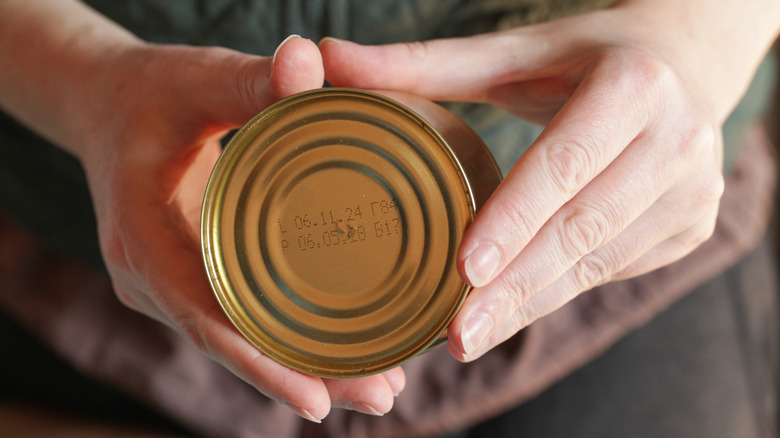
There is a lot of confusion around expiration dates, "sell-by" dates, and "best-before" dates, and while there are certainly some ingredients that you can use past their expiration date, the labeling shouldn't be ignored altogether. According to the USDA, manufacturers apply dates to help customers and stores ascertain when the food is at its best, not when it's safe. Unless it's baby formula, none of the labels, whether it's "best before," "sell by," or even "use by" indicate safety, but stores do use them to determine when to discard and restock items based on their own storage conditions.
Because of this, date labels can be an excellent indication of a store's turnover and attentiveness to its products. If you wander through the aisles of a gas station or peruse the shelves of its fridges and find a lot of products that are past their recommended sale or use dates, it suggests that the store isn't paying very close attention to their food. This is not sufficient evidence to hit the road without purchasing anything, but it is a subtle sign that you might want to choose your food more carefully. Look for items that are less perishable, such as shelf-stable packaged foods, rather than hot or chilled ones, and be vigilant about other red flags that might be lurking in the store.
Damaged packaging
Some food travels a very long way to get to its final destination. If you're visiting a convenience store in rural Alaska, for example, some of the products might have traveled many thousands of miles to get there. It's difficult to maintain pristine packaging across such an enormous distance, especially for products that are in flimsy cardboard boxes. But according to Dr. Vanessa Coffman, we should all be avoiding damaged or compromised packaging, because it could pose a food safety issue.
This is especially true with perishable items, since they spoil much more quickly than dry, shelf-stable snack foods that are full of preservatives. If you see meat packages that are bulging, you might want to skip them. They are sometimes intentionally filled with gas to preserve freshness, but bulging can also be a sign of bacterial growth. Bulging cans should always be thrown out, as it is a clear sign of contamination. But even dented cans should be approached with caution. Although there might not be any visible signs of a breach in the metal, a large dent (one that you can fit a finger into) or a sharp dent can damage the metal enough to allow bacteria to get in.
A lack of employee hygiene
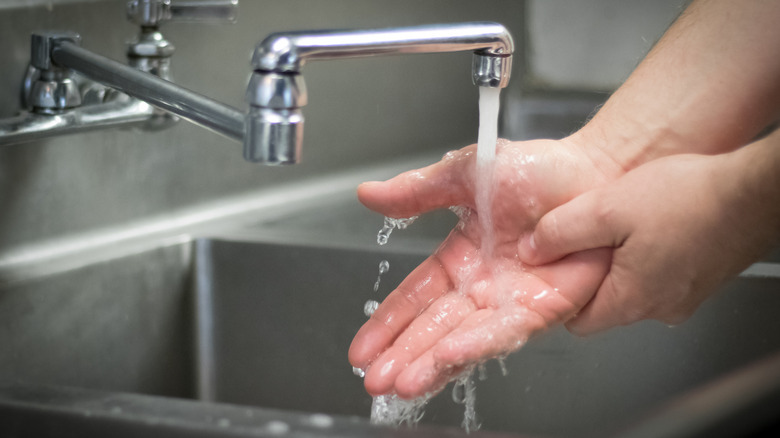
Food worker hygiene is one of the leading causes of foodborne illness, according to the CDC. The main issue is when a worker is sick on the job, so if you see anyone coughing, sneezing, or sniffling when you stop at a gas station, you may want to hold off on buying any food. The workers themselves shouldn't be blamed for this. With staffing shortages and poor to non-existent sick leave, some workers simply can't afford to not turn up to work.
Illness isn't the only potential vector, either. Inadequate handwashing is linked to foodborne illness, especially (though not exclusively) in establishments that handle raw meat and poultry. You may not see employees actively washing their hands depending on where the sinks are, but if you see them handling food directly after handling cash, tapping their phone, or touching their hair or face, the hygiene is not up to snuff. Gloves are not an indication of safety, either. According to the multi-year study by the CDC, one of the biggest contributing factors to bacterial outbreaks was gloved contact with food, right up there with bare hand contact, cross-contamination, and inadequate temperature control.