

7 Things You Need To Know About Canadian Sandwich Chain Mr. Sub
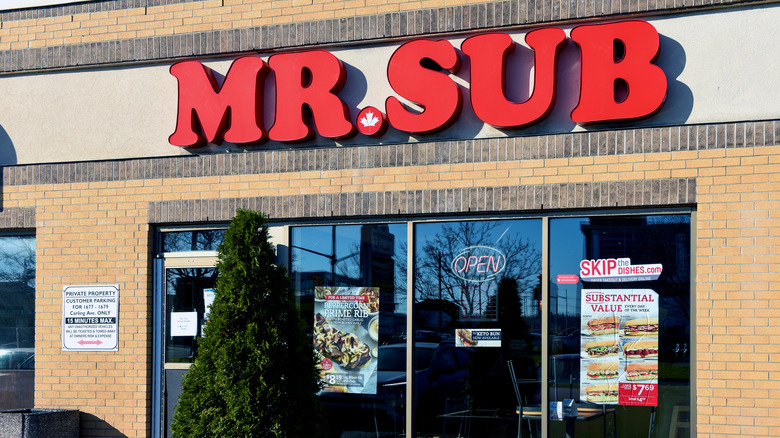
It's a hoagie if it's cold and stacked with assorted meats and cheeses (and served in Philadelphia). It's a grinder if you're in New England and the sandwich in question is toasted –– think meatball sub or chicken Parm. Or it's a hero if you're looking to grab a bite in New York. In Canada, however, you'll find it all listed under the simple, all-encompassing "sub" or "submarine sandwich." And, for a truly Canadian take, you'll want to visit Mr. Sub, the original in the Canadian culinary scene when it comes to long sandos.
The Canadian sandwich chain is likely a new one for Americans, who have plenty of options when it comes to the sandwich scene. Firehouse Subs, Jersey Mike's, Potbelly, and Jimmy John's all have their loyalists, as well as the ubiquitous Subway. At the time of its inception, however, Mr. Sub was the only name in the game for Canadians, and its legacy has lasted since 1968, making it older than most of its competitors. If you're hankering for a sandwich and are looking to try something a little different on your next trip up north, you might want to consider popping in the nearest Mr. Sub location for a taste of Canadian hospitality between a soft sub roll.
It began in a converted house
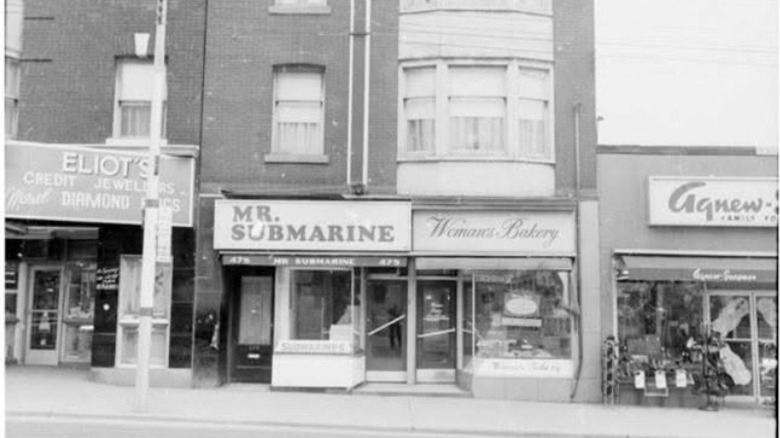
Once upon a time, Mr. Sub (then known as Mr. Submarine) wasn't the sandwich chain Canadians know it to be today. All the way back in 1968, the hoagie shop was actually working out of the first floor of a house. Based in the Yorkville area of Toronto, Mr. Sub got its start as a shop based in a Victorian-style row house, with the large bay window offering potential customers a sneak peek at what was going on in the newest spot on Toronto's culinary scene.
These days, we're plenty used to spotless shops with gleaming, industrial-style hardware and interiors, but, when Mr. Sub first began, its humble roots are downright charming. There was a large sign out front advertising that submarine sandwiches were available and, on the crumbling stoop in front of the house, another sign urging people not to sit on the steps and loiter (which was promptly ignored). The house/restaurant was working within a six-month lease, just to see how business panned out, with no real aspirations as to what the future might bring.
It was started by two friends
Another aspect of Mr. Sub's humble beginnings was the fact that it was the brainchild of two friends. Jack Levinson, a gym teacher, and accounting clerk Earl Linzon began the business with a mere $1600 in start-up cash (a little over $14,000 in today's money, when adjusted for inflation). There are plenty of successful co-founders who transformed friendship into a business partnership. Notable names would certainly be Apple (Steve Jobs and Steve Wozniak), Microsoft (Bill Gates and Paul Allen), and, of course, Ben & Jerry's (Ben Cohen and Larry Greenfield).
The concept of the restaurant venture was simple: make good food, make it fast, make it fresh, and make it cheap. While the row house restaurant location was locked into a six-month lease with no real plans to expand, the first Mr. Sub was so successful that Levinson and Linzon decided to open a second location just five months later. A few short years after that, in 1972, Mr. Sub sold its first franchise and has continued to grow to this day.
It had a small menu until the 1990s
At its inception, Mr. Sub only offered seven sandwich varieties on the menu. The concept of a sub shop was new enough that a bloated menu wasn't a requirement for success, and so Mr. Sub kept things pared down while it found its footing. The seven sub options were: assorted cold cuts, Italian salami, ham, cheese, spiced loaf, tuna, and the "Super Sub." The "Super Sub" was the chain's largest offering that stacked on the meats and cheese at double portions, retailing for a modest $1.38 (or $12.41 in 2026 Canadian money).
As the only sub chain in the game at the time, a smaller menu was also easier for Mr. Sub to manage. The menu remained bite-sized until the 1990s, when American chains like Quiznos and Subway began to find footholds –– and market share –– in Canada. To keep its Canadian clientele, Mr. Sub expanded the menu to offer 18 submarine sandwiches, as well as salads and desserts. A quick look at the chain's website today, however, shows even more sandwiches available for hungry customers –– an impressive 26, including vegetarian and seafood options. (The salads and desserts remain, as well.)
It's almost entirely located in Canada
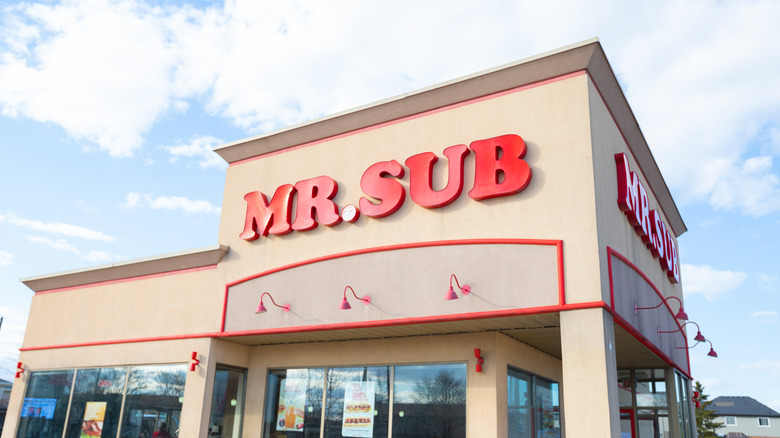
While plenty of Canadian restaurant chains have shifted ownership and expanded into the United States –– Canuck icons like Tim Hortons spring to mind –– Mr. Sub is unique in that it is located almost entirely within the confines of Canada. The sandwich chain boasts over 200 locations within Canada alone, with only a handful outside its borders. There are seven Mr. Sub restaurants in India, one in Dubai, and one in Saudi Arabia –– and nowhere else.
Compared to submarine sandwich juggernauts like Subway, Mr. Sub feels like small potatoes. For reference, in 2005, there were 500 Mr. Sub locations in Canada, while there were a staggering 2000 Subway locations. The proudly Canadian-owned and -operated company has definitely seen some shrinkage when it comes to their market share, especially in the wake of new American chains that have migrated into the country. While Mr. Sub once owned the space, as the first submarine sandwich chain of its kind in the country, it now has to share with more than just Subway and Quiznos: Firehouse Subs and Jersey Mike's are also on the scene (although Potbelly didn't do quite as well here, with all its Toronto-based shops closing in 2019).
It lost a case at the Supreme Court
If you cast your mind back to 2008, there was plenty happening in the world that made it feel like a precursor to 2020, disaster-wise. (The Great Recession, the Writer's Strike, etc.) If you were Mr. Sub in 2008, the listeria outbreak was one of the worst things the year had to offer – and franchisees went to court about it.
Franchise owners of the sandwich chain launched a class-action lawsuit against Maple Leaf Foods, the Canadian supplier of packaged meats.The listeria outbreak at the company left Mr. Sub locations in the lurch, with a shortage of meat products for six to eight weeks. As a submarine sandwich chain, running out of one of the major components of your entire product line can be absolutely devastating. To recoup their losses both economical and reputational, the franchisees sought to make Maple Leaf Foods pay. The case was escalated to the Supreme Court of Canada, who determined that the company did not owe franchisees for financial damages. While a duty of care was owed to diners in Mr. Sub restaurants who may have fallen ill from eating contaminated meat, the Court ruled, that duty didn't extend to franchise owners who bore the financial brunt of the outbreak.
One location was the source of a drug scandal
While Canada has long since legalized the recreational use of marijuana among its citizens, that privilege comes with very strict regulations. Back in 2009, however, marijuana was not legal and, as such, a Mr. Sub location was the source of local scandal when it found itself embroiled in some illegal activity.
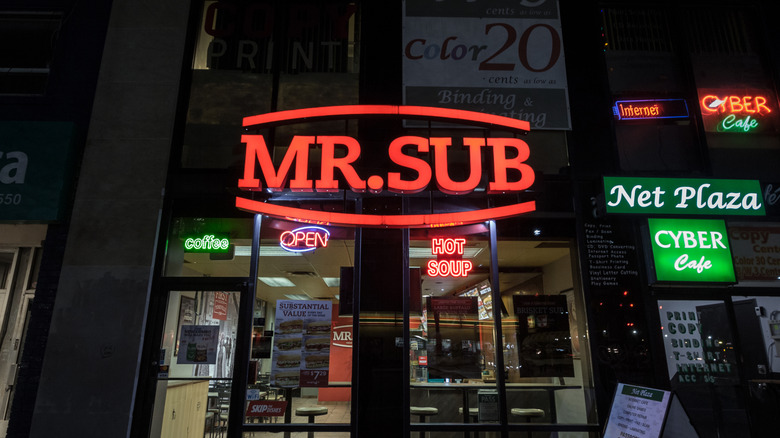
A Toronto Mr. Sub location was the scene of a drug bust in 2009 when an undercover investigation revealed that the owner of the shop was openly selling marijuana and other drugs to customers. While the shop wasn't at first revealed to the public, a quick address search of the provided information showed internet sleuths that it was, indeed, a Mr. Sub restaurant that was raided, with $11,500 worth of drugs, including marijuana, hashish, and ecstasy. The shop owner's personal address was also raided, where even more drugs were discovered, amounting to an overall estimated value of $112,000. Beyond the Mr. Sub location owner, multiple others were charged with drug trafficking and similar crimes, putting a bit of a shadow on this Canadian chain's legacy.
The chain was accused of homophobia
2008 and 2009 were not good years for Mr. Sub. In addition to the previously mentioned class-action lawsuit and drug bust, the sandwich chain also had to combat complaints of homophobia following an online commercial that aired in 2009.
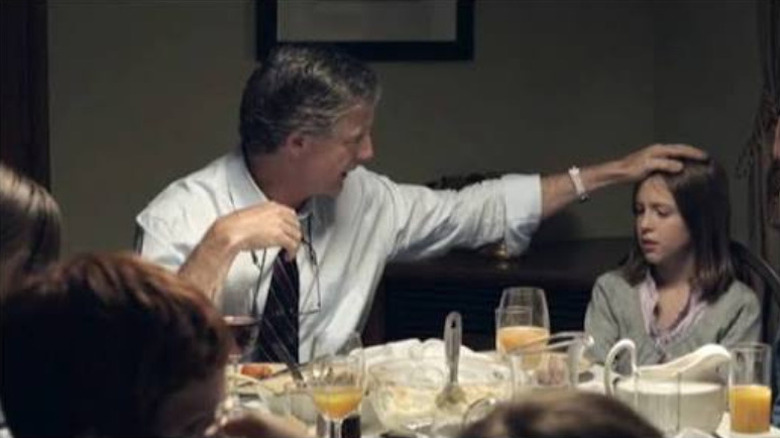
A series of commercials that aired on both TV and online played on the idea that "not everyone likes surprises." Helmed by Mr. Sub's advertising agency BOS, the online spot showed a family sitting down to dinner with the father coming out and announcing that he's gay to everyone seated at the table. The commercial was considered unfunny and inappropriate, and an odd choice for a submarine sandwich chain. The execution of the spot got lots of angry responses from viewers, and a letter writing campaign began to get the advert pulled.
Mr. Sub, for its part, acted swiftly, and not only did everything in its power to pull the ad and scrub it from the internet, but also fired the agency responsible, stating that the campaign "did not meet the objective of positively engaging with our customers."