

9 Burger King Facts Everybody Should Know
The second-largest fast-food burger chain in the world, Burger King, is known for its signature flame-grilled stacks and easily customizable menu. The beloved Whopper has long been a bestseller, and other fan favorites include the classic cheeseburger and the Original Chicken Sandwich. This chain has been delighting customers for decades, and it might be somewhere you visit on the regular without a second thought. However, there's more to Burger King than meets the eye.
There are also plenty of lesser-known details behind some of Burger King's most familiar offerings, from underrated orders to inventive secret menu hacks. Despite ever-changing customer tastes and food trends, Burger King has managed to preserve its loyal following, and its growth shows no signs of slowing. So, if you're a longtime Whopper fan who's curious to learn more about the chain behind your favorite burger, these BK facts are well worth knowing.
1. It wasn't originally called Burger King
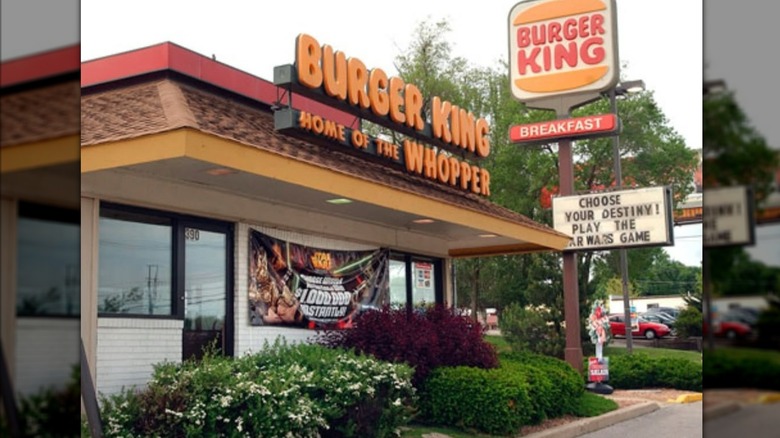
The first official Burger King restaurant opened in Miami in 1954, but it was actually an evolution of a restaurant concept launched in Jacksonville the previous year. Insta-Burger King, founded by Keith G. Cramer and Matthew Burns, got its name from an innovative new cooking device at the time—the Insta-Broiler. This was a conveyor-style oven with 12 baskets that could cook 400 burgers per hour while simultaneously toasting the buns. It was a fast-food game-changer, but the device was not a success for the restaurant.
After quickly running into financial difficulties, Insta-Burger King was sold to franchisees David Edgerton and James McLamore. The new owners gave the restaurant a major revamp, including a subtle name change. Thus, Burger King as we know it was born. The Insta-Broiler, which proved to be somewhat unreliable, was also dropped in the late 1950s, not long after the introduction of the chain's now world-famous Whopper burger. In the decade that followed, Burger King underwent rapid expansion. By 1967, the chain comprised over 250 locations, and this was just the beginning. Growth continued to accelerate, and today there are a whopping (excuse the pun) 19,700-plus restaurants worldwide.
2. It once tried to be a sit-down restaurant
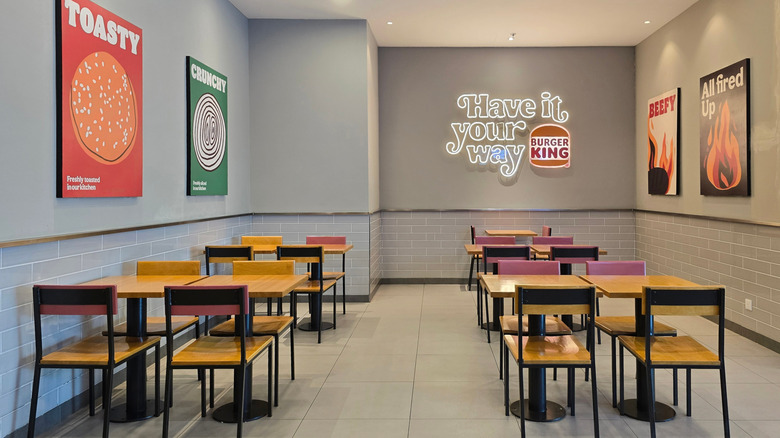
Like most fast food chains, one of Burger King's biggest priorities is speed of service. This isn't somewhere you'd typically visit for a slow dinner with friends, but it's the perfect option if you're after something budget-friendly and satisfying without the wait. It's an approach that's undoubtedly played a major part in the chain's success, but Burger King hasn't always been so firmly associated with quick, casual dining.
Back in 1992, Burger King began experimenting with a whole new restaurant concept. In an effort to elevate its dining experience, the chain introduced table service and new menu items called BK Dinner Baskets. Options included the Steak Sandwich, Crispy Chicken Filet, and Fried Shrimp, all of which arrived at your table with a side of fries or baked potato, plus some coleslaw or salad.
Between 4 p.m. and 8 p.m., customers could skip the lines and take a seat. Many who experienced this more leisurely version of Burger King recall tables clad with checkered tablecloths, and some remember being served popcorn while they waited for their meals. Sadly, table service was a short-lived venture for Burger King, and by 1994 the chain had reverted to its traditional fast-food format.
3. There are plenty of delicious secret menu items to try
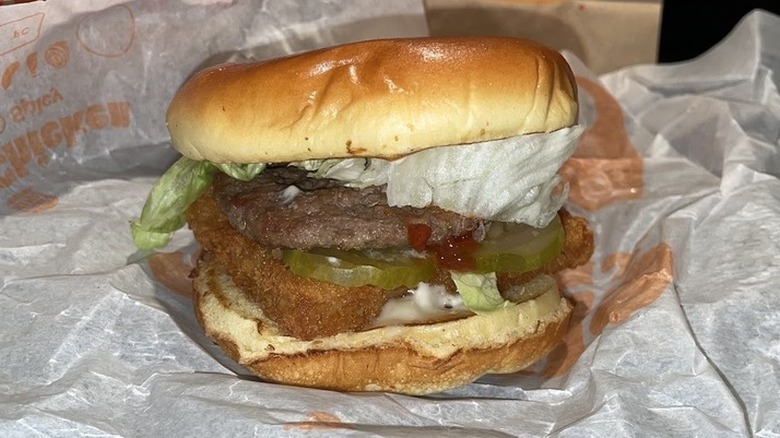
There are countless tempting choices on the Burger King menu, but you don't necessarily have to stick to what's listed when ordering. The chain also has an extensive secret menu, offering plenty of inventive options you won't find on the traditional burger lineup.
Burger King prides itself on the customizability of its meals, so it's no surprise that fans have discovered an array of creative ways to mix and match its offerings. As you'd expect, many of these hidden gems are Whopper-centric. There's a Mustard Whopper, which, as the name suggests, replaces the usual mayo and ketchup with a generous swipe of mustard, and the BLT (essentially a Whopper with bacon). Or, you can combine the Whopper with BK's Big Fish sandwich for a surf-and-turf-style stack.
However, the Whopper isn't the only menu item that can be transformed into something new. Other secret menu favorites include the Bird N' Beef — an amalgamation of the double cheeseburger and Jr. Chicken — and the Quad Stacker, which features four hamburger patties, four slices of cheese, bacon, and burger sauce. You can even customize your sides, too. Ask for "frings," and you'll get a mixture of fries and onion rings in one container, typically for the same price as a portion of fries.
4. The flame broiler was invented because other equipment kept breaking down
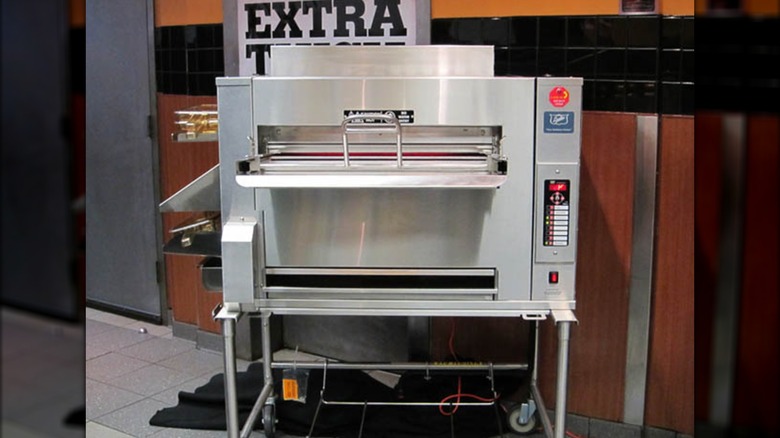
What sets Burger King's patties apart is their signature smoky, charred flavor, achieved through the chain's famous flame-grilling technique. Things kicked off with Insta-Broiler back in 1954, but this device didn't stick around for long. It was allegedly so temperamental that after one particularly frustrating malfunction, Burger King franchisee David Edgerton smashed the machine with a hatchet. Thankfully, this forced him to seek out a new, more reliable approach.
After less than a year of cooking burgers with the Insta-Broiler, the restaurant switched to a continuous-chain broiler, specially designed by Swedish mechanic Karl Sundman. This proved to be much more effective, and the added gas grill created that all-important flame-broiled flavor that would soon become one of Burger King's defining characteristics.
While the machinery has evolved over the decades, Burger King still uses flame broilers to cook its patties today. The modern-day broiler is an upright, enclosed, conveyor-operated model, designed to safely and efficiently cook large batches of burgers at once. In some BK kitchens, the broilers are powerful enough to cook 20 burger patties in just four minutes.
5. The Whopper is actually older than the McDonald's Big Mac
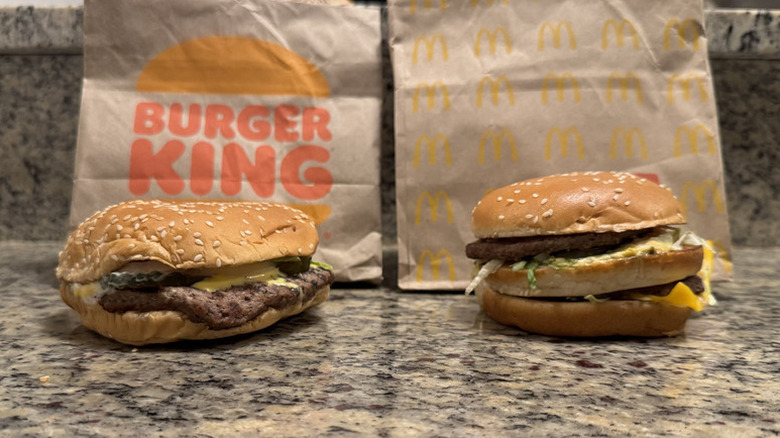
Two greats of the fast food scene, the Burger King Whopper and McDonald's Big Mac, have both earned legendary status in the burger world. Many assume that the Big Mac came first and served as the inspiration for BK's most famous burger, but this is far from the truth.
The history of the Burger King Whopper dates back long before the Big Mac. In fact, there was a whole decade between their launches. In 1957, Burger King franchisees David Edgerton and James McLamore set out to create a burger that was bigger and better than anything available at competitor restaurants. They piled a giant, flame-grilled patty into a fluffy bun with tomatoes, lettuce, mayonnaise, ketchup, pickles, and onions, and the resulting creation was christened the Whopper. The burger was a hit and would keep customers coming back for decades.
It wasn't until 1967 that McDonald's released the Big Mac, which leaned into the "bigger is better" theme while taking a different approach with its double-stacked design and signature three-part bun. The two burgers have enjoyed a playful rivalry ever since, but there's no denying which one got there first.
6. There are over 200,000 ways to customize a Whopper
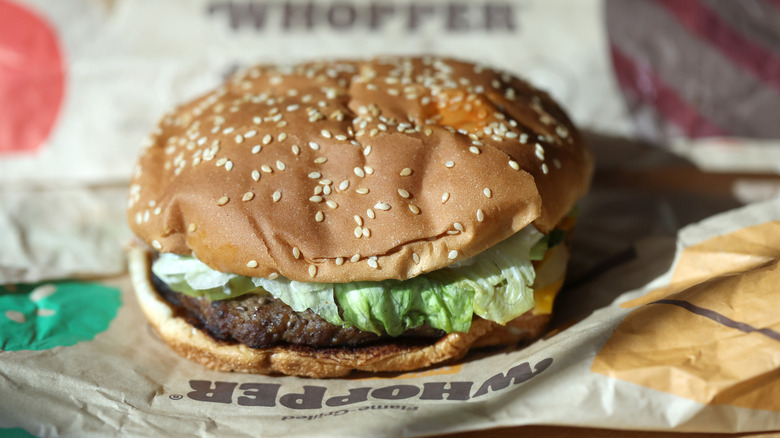
"Have it Your Way" is a slogan Burger King has used since the 1970s, perfectly reflecting the chain's philosophy of putting customers in control. Each burger on the menu can be customized with various toppings and sauces. You can add extra patties, bacon, or cheese; remove elements that don't take your fancy; and even ditch the bun altogether. Burgers can also be ordered "hot off the broiler," ensuring an ultra-juicy patty and melty cheese.
To highlight its flexible ordering process, Burger King has used the Whopper as an example in various promotional materials over the years. According to the chain, the iconic burger can be customized in more than 200,000 ways. It might sound ludicrous, but when this claim was fact-checked by keen-eyed customers on Reddit, some people ended up with even bigger numbers. Each topping, such as lettuce, tomato, and pickles, can be removed or added in light or heavy quantities.
This is also true of BK's array of sauces. Plus, there are plenty of other additions you can ask for if ordering in person that won't show up on the online ordering system. When you consider every small iteration, this equates to a pretty staggering number of possibilities, which is undoubtedly part of the Whopper's enduring appeal.
7. It was the first fast food chain to offer a vegetarian burger nationwide
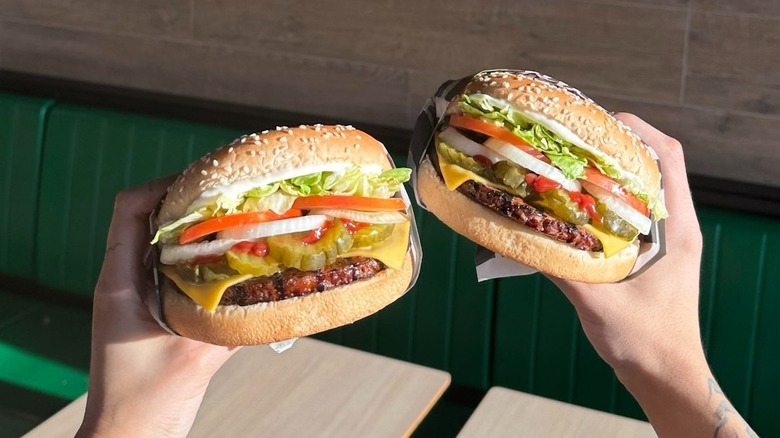
Plant-based burgers are commonplace on the modern-day food scene, but this hasn't always been the case. In 2002, Burger King launched a vegetarian-friendly burger. Not only was this a first for the chain itself, but also for the American fast food industry as a whole. Burger King made a pioneering move that helped pave the way for plant-based fast-food options on the market today.
The chain's original vegetarian burger featured a soy- and grain-based patty paired with the classic Whopper toppings. Unfortunately, it failed to make much of an impression with customers, but it certainly sparked a trend, with McDonald's launching its own meat-free burger just a year later.
Fast-forward to 2019, and after taking some time to hone its craft, Burger King partnered with Impossible Foods to launch the plant-based Impossible Whopper. This was a welcome addition to the menu for those avoiding meat. Made with soy protein, the patties offered a juicy bite and umami-rich flavor, designed to replicate that of real beef, and they went down a treat. The Impossible Whopper has been a staple on the Burger King menu ever since, and it comes with all of the customization options you'd expect from any of Burger King's meat-based offerings.
8. The chain was bought by Pillsbury for 18 million dollars
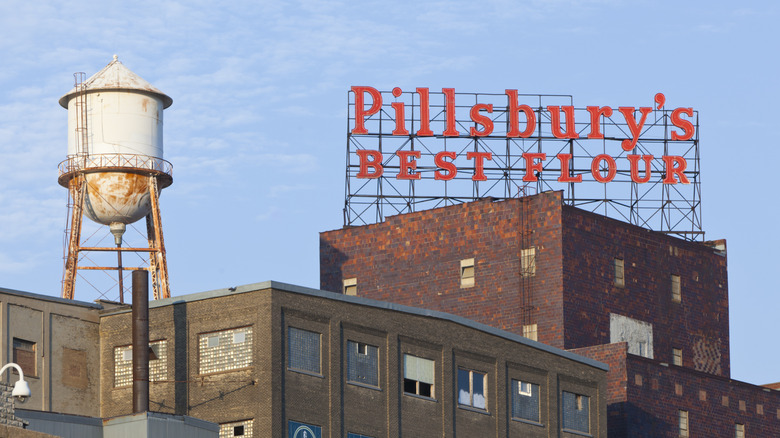
Burger King has come a long way from its humble beginnings as a small, standalone burger restaurant in Miami. After opening the first restaurant in 1954, David Edgerton and James McLamore oversaw Burger King's expansion across the country. By 1963, the company had ventured beyond the continental U.S., opening two new restaurants in Puerto Rico. And just four years later, the chain would be acquired by Pillsbury, an American flour miller and food manufacturer, for no less than 18 million dollars.
When Pillsbury took over, Burger King had 274 locations and 8,000 employees, and these figures only continued to rise. Over the next decade, the brand established its presence in Canada, Australia, and Europe. Then, in 1988, Pillsbury itself was sold to Grand Metropolitan PLC for a staggering $5.79 billion. Burger King has changed hands multiple times since and is currently owned by Restaurant Brands International Inc. (which also owns Tim Hortons, Firehouse Subs, and Popeyes). The chain is now reportedly worth over $20 billion and operates approximately 19,000 restaurants globally. It also recently overtook Wendy's to become the second-largest fast-food burger chain in America, behind only McDonald's.
9. The Burger King mascot was fired for being too creepy
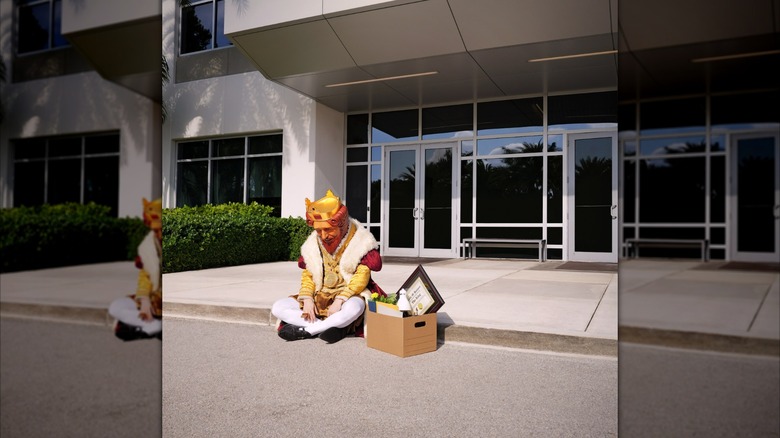
Burger King's mascot has been around since the chain's beginnings in the mid 1950s. Aptly named "The Burger King", this regally-clad character began as a simple drawing, and this evolved into a more playful, cartoonish format by the late 1960s. Over the years, the mascot grew more human-like in appearance, particularly after its rebrand to the "Marvelous Magical Burger King" in 1976. By 2004, the character was portrayed by a human actor in a costume featuring a giant plastic head and a golden crown. But it was here that the mascot's downfall began.
Now referred to simply as "The King", the character appeared in various marketing materials, but he now lacked the fun-loving persona that the public had grown to love. The King was typically silent in adverts and, admittedly, rather strange-looking; hence the public soon nicknamed him "The Creepy King."
At first, Burger King attempted to lean into the mockery of its mascot, using him to create increasingly absurd advertisements. However, after sales dwindled in 2011, the marketing team finally gave in. After suspecting that the King's creepy demeanor had driven customers away, they temporarily axed the mascot. He made a brief reappearance in 2015, and it wasn't until March 2026 that Burger King officially retired The King once and for all. An ad campaign titled "There's a New King and It's You" showed the character being fired, making way for customers to take the crown instead.