

10 Foods That Were Practically Unheard Of In The US Until The '60s
The 1960s brought major change to all corners of America. Socially, politically, economically — there's no doubt that this decade was one of transformation. And with these changes, Americans started eating differently, too.
In fact, the 1960s introduced the U.S. to many new foods. It might be hard to believe, but some beloved staples we might take for granted in modern times were virtually unheard of before this decade. Belgian waffles, loaded with ice cream, maple syrup, and chocolate sauce? No, not a thing. You couldn't even grab a falafel wrap for lunch, or drizzle your grilled chicken with teriyaki sauce. We know, it's baffling, right?
Here, we take a closer look at some of the foods that most people in the U.S. had not tried — or even heard of — until the 1960s. Without giving too much away, we have to admit, it seems like Julia Child and the 1964 New York World's Fair really did some heavy lifting during this era. And, we're grateful.
Beef Wellington
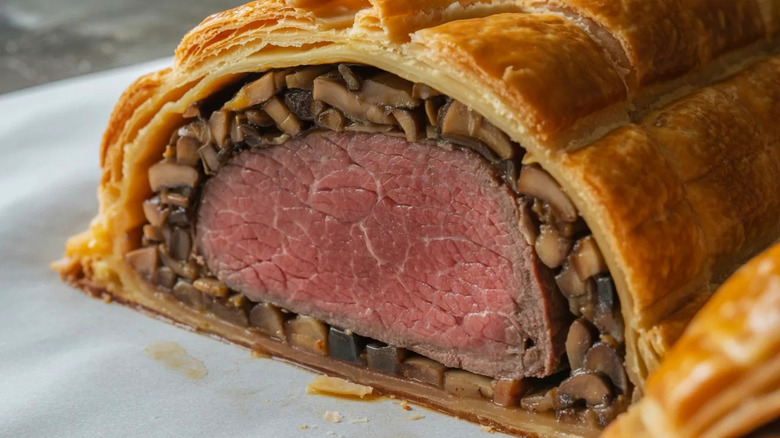
Back in 1815, Arthur Wellesley had much to celebrate. The English general and Duke of Wellington had just led the English to victory over the French at the Battle of Waterloo. So, of course, he did what any 19th century nobleman would do, and he held a banquet. The duke apparently loved French food, so maybe filet de boeuf en croute was served. And maybe, that dish, with the mix of sirloin, puff pastry, and duxelles that Wellington adored, was renamed beef Wellington in his honor.
If this were the case, the noble history behind the U.K.'s beloved beef Wellington would make for a neat story, but the truth is, there are different theories about how this dish got its name. Food history is often a little hazy, but there are some certainties. For example, we know that beef Wellington wasn't widely familiar in the U.S. until a very long time after that famous battle. And in turn, it actually wasn't until the 1960s, when Julia Child chose to feature it on her television show "The French Chef," that the U.S. truly fell in love with the dish.
Decades later, beef Wellington is still a favorite on menus across America. Gordon Ramsay even offers a pro-tip for a perfectly-shaped beef Wellington, and serves it in Hell's Kitchen locations across the country. And when American Airlines celebrated its centennial in 2026, to the delight of many passengers, it chose to serve beef Wellington in honor of the occasion.
Beef bourguignon
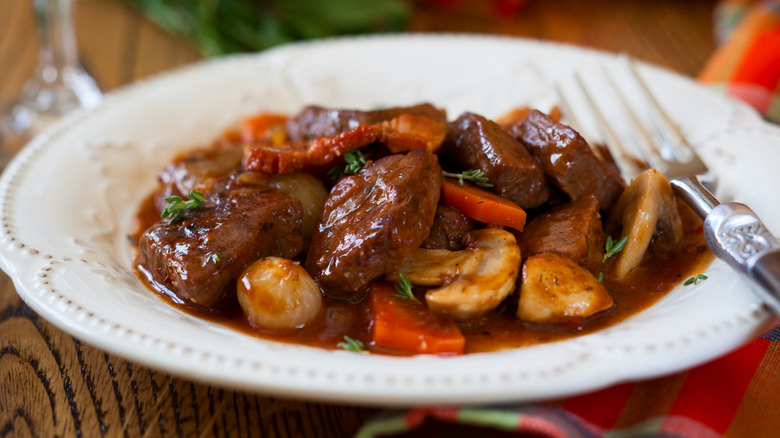
Before Child decided it was time to introduce American palates to the wonders of beef Wellington, the popular chef had already inspired many home cooks across the country to experiment with plenty of other dishes. Right off the bat, during the very first episode of "The French Chef" in 1963, Child had Americans learning about boeuf bourguignon, for example.
Child considered this classic French stew one of the world's best beef dishes, and she sure seemed committed to raising the American public's awareness of it. Before she took to the screen, Child had already featured a recipe for the hearty stew — made with ingredients like lean beef, bacon, red wine, and tomato paste — in her 1961 cookbook "Mastering the Art of French Cooking."
Child didn't invent boeuf bourguignon, however. The dish has its roots in Burgundy in eastern France, and has been made across that country for centuries — Pierre Larousse featured one of the first recipes for the dish in his 1867 cookbook "Grand Dictionnaire Universel du XIXe Siècle". But people across the U.S. seem to continue to choose Child's version of the French classic. "Her recipe is also the best thing I've ever made," said one Reddit user. "Worth the effort if you have the time!" Another added, "We make this once or twice during the winter months. It's so good, and even better the next day!"
Cool Whip
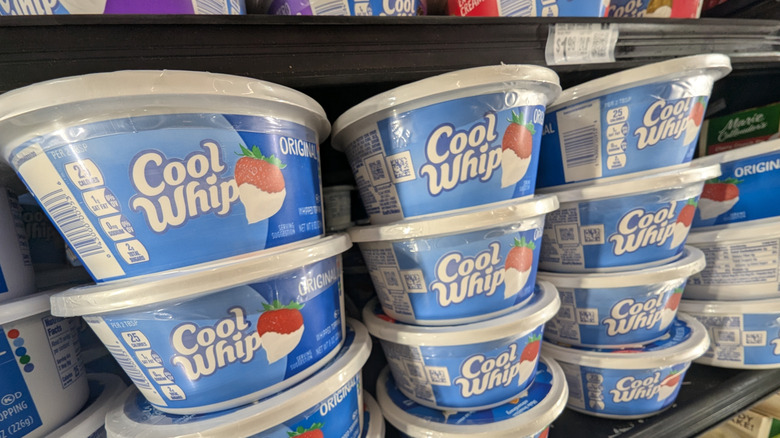
Sometimes, food history is messy and complicated, and other times, it is clear-cut. Cool Whip, we're pleased to say, falls into the latter camp. Americans weren't aware of this fluffy, whipped cream alternative before the 1960s, because it didn't exist until 1966.
Back then, food scientist Dr. William A. Mitchell created the product for the General Foods Corporation out of ingredients such as hydrogenated vegetable oil, high fructose corn syrup, skim milk, and artificial flavoring. Now, the ultra-processed and ultra-cautious among us would run a mile from Cool Whip. However, at the time, this whipped cream alternative was marketed to health-conscious consumers, with commercials and print ads focusing primarily on its lower-calorie content over conventional, homemade whipped cream.
Cool Whip is of course, still around, and while some balk at the ingredients list, it has plenty of fans. "Cool Whip is better than both vanilla ice cream and whipped cream," reads one post on Reddit.
Chocolate fondue
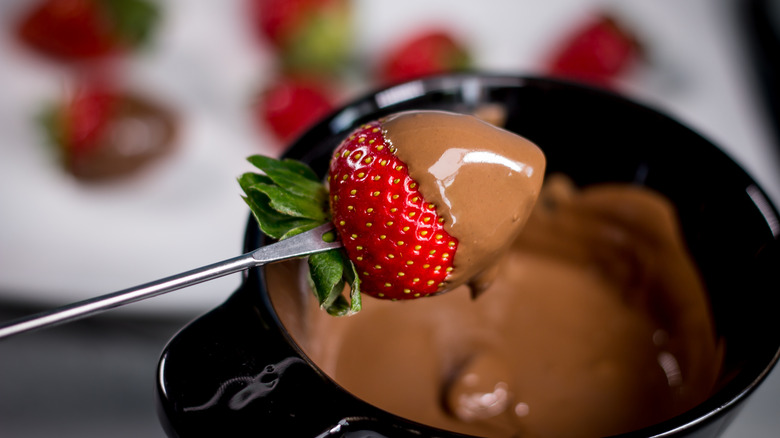
Remember when we said that the history of food can be messy and complicated? Well, traditional cheese fondue is the perfect example of this. It's one of those dishes that has evolved over a very long period of time — there is evidence of a version of it in 17th century Swiss cookbooks, for example, but similar foods were likely eaten much earlier than that, perhaps as far back as 800 B.C.
Modern fondue took shape around the 19th century, and then in the early 20th century — to the delight of sweet-toothed dessert lovers everywhere — people started making it with melted chocolate. Food historians note that there is evidence of chocolate fondue recipes in the 1930s, but the idea didn't really pick up steam in the U.S. until the 1960s. One of the first printed recipes, for example, appears in "The Swiss Cookbook," written by renowned food writer Nika Standen Hazelton and published in 1967. The recipe, made with Toblerone, heavy cream, and brandy, was based on a dessert served at a popular New York spot called Chalet Suisse. Konrad Egli, the chef at Chalet Suisse, is widely credited as the pioneer of chocolate fondue in the 1960s.
A trend was born during this decade, and the chocolate fondue recipes just kept coming. The dessert is still popular today, of course. And in case you were wondering, the best type of chocolate you should be using for perfect fondue is Guittard (a professional chef told us so).
Red velvet cake
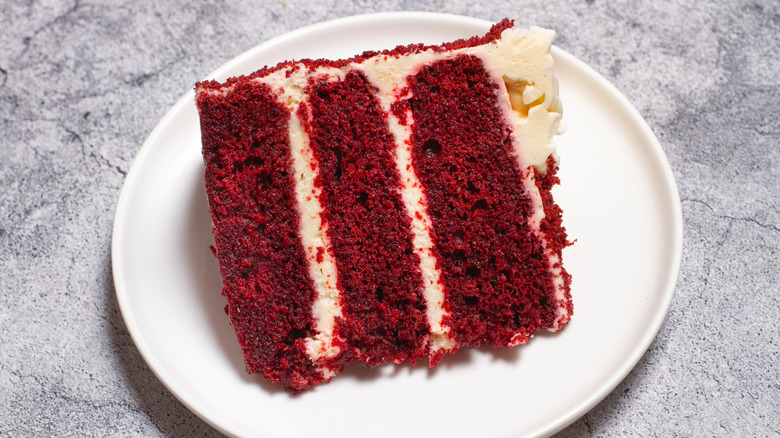
The history of red velvet cake isn't actually all that red — the earliest iterations of this cake were pure velvet. Well, not exactly. Back in the 1800s, Victorians started using the term "velvet" to indicate a cake that was soft, moist, and fluffy. These cakes were delicate, not dense, like many other cakes of the era.
In the early 1900s, cake recipes were blended together. Velvet cakes were combined with chocolatey devil cakes, and buttercream and cocoa powder were added to the mix. The resulting cakes were slightly more red, sure, but they were hardly the vivid color we see in some modern versions. Apparently, some folks didn't think the cake was red enough. So, in the 1940s, bakers started playing around with red food coloring, and by the 1960s, the stage was set for the red velvet cake boom.
Red velvet cake recipes really took off in the summer of 1960. And chefs continue to play around with recipes in the modern era, transforming it into everything from dot cakes to vegan brownies, to heart-shaped cupcakes — the possibilities seem endless. If you want to try your hand at your own, we suggest this classic and decadent red velvet cake recipe.
Belgian waffles
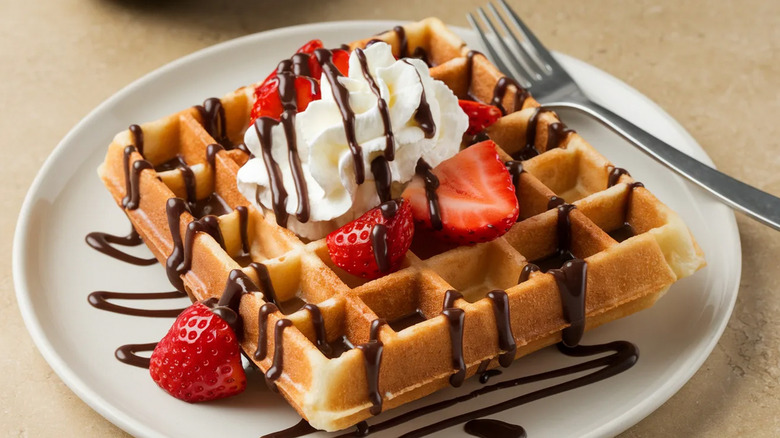
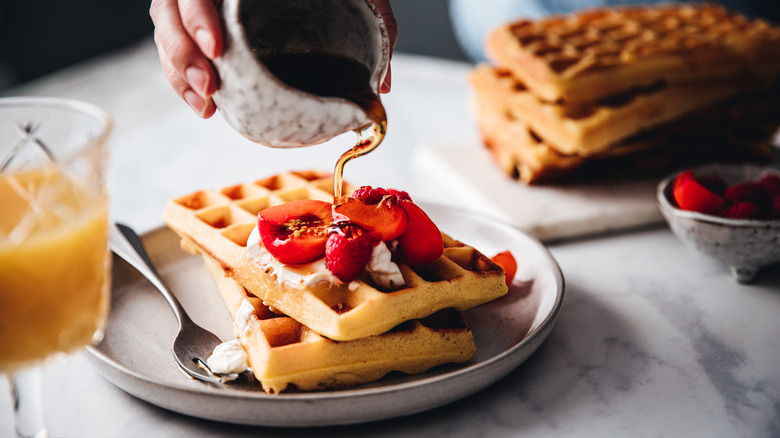
Before waffles were popularized in the U.S. in the 1960s, they had fed people across Belgium for centuries, sustaining everyone from medieval peasants to 18th century royalty. In 1962, a Belgian baker named Maurice Vermersch decided it was time for Americans to understand the comfort of this simple food from his homeland. So, he headed to the Seattle World's Fair, and started selling Brussels waffles — a very thick, deep-pocketed, fluffy version of the classic Belgian waffle.
But, while people may have enjoyed them at the event, waffles were hardly a nationwide success. Most hadn't heard of them, unless they'd had the privilege of traveling to Belgium. But two years later, Vermersch tried again, this time, at the New York World's Fair in 1964, labeling them as Belgian waffles rather than Brussels waffles. Well reader, what do you know? They were a big hit, and just like that, the 1964 World's Fair helped popularize the Belgian waffle. You might have even enjoyed one for breakfast this morning, as they are considered a classic breakfast item in the U.S.
Falafel
The 1964 New York World's Fair was, quite frankly, huge. With more than 110 restaurants and 140 pavilions, the idea behind the event was to showcase the very best of culture, innovation, and technology. And people were enthralled — in the end, it attracted more than 51 million visitors, all who had to eat, of course. Some found and fell in love with Vermersch's Belgian waffles, while others discovered falafel for the very first time.
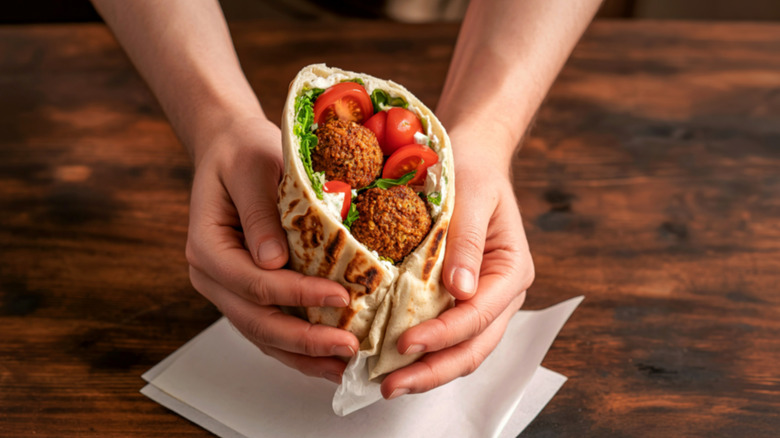
It might sound odd, considering New York is known to be quite the paradise for falafel lovers, but there was a time when this Middle Eastern street food was barely known in the U.S. At the 1964 World's Fair, it was sold in the American-Israel pavilion, and described as a spicy, vegetable patty eaten in soft bread. Of course, the falafel is a little more than that.
Falafel was likely invented in Egypt during the 19th century, and from there, its popularity spread across the Middle East — to Lebanon, Turkey, Palestine, and Israel. Different cultures have different recipes: in Egypt, it's made with fava beans, herbs, garlic, and onions; while in Lebanon, it's made with chickpeas, and served with fresh tomatoes and pickled turnips. In the U.S., you can find different types of falafel in restaurants, from street vendors, and in delis and on grocery store shelves. You can even try out some store-bought falafel mixes, if you've got a craving.
Surf and turf
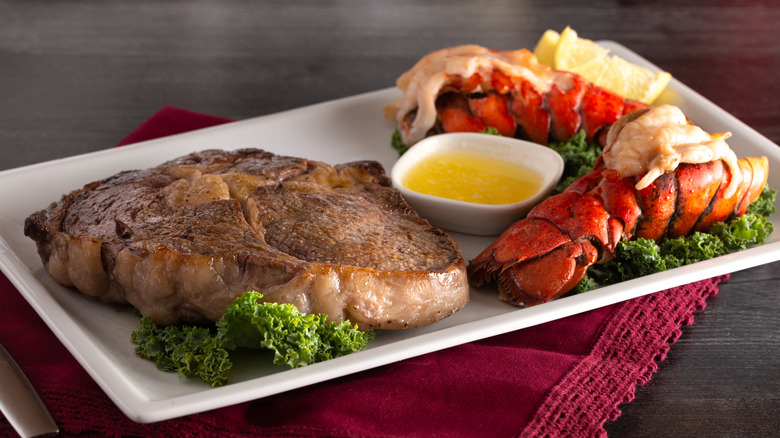
The combination of meat and seafood isn't new. People have been pairing ingredients from the land and sea for centuries — rich ancient Romans, for example, would season meat with garum, a sauce made with fermented fish innards. But the specific combination of lobster and steak, sold under the name of "surf and turf," was a uniquely American invention. Surprise, surprise, no one can agree on exactly who had the bright idea to call it that; however, most people do accept that surf and turf originated in the 1960s.
The first theory takes us back to the Seattle World's Fair in 1962. Yes, while Vermersch was doing his best to make Brussels waffles happen, the Eye of the Needle restaurant was apparently making history by combining seafood and steak. Another theory, however, attributes the dish's creation to the other side of the U.S., in Lowell, Massachusetts. But a third story suggests it might have been created in Portland, Oregon, where experts found one of the earliest print references to the term "surf and turf."
Wherever it was created, we know that surf and turf meals probably weren't offered at restaurants until the 1960s. But over the subsequent decades, the dish would evolve into a staple that unites steakhouses and seafood shacks, all across the country.
Teriyaki sauce
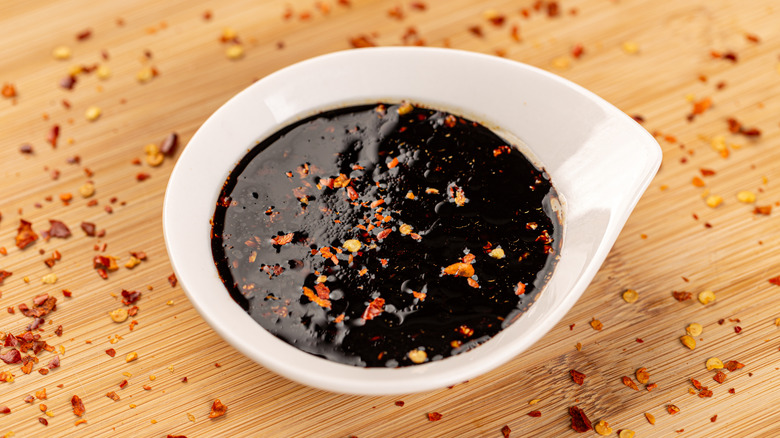
Teriyaki sauce is considered to be one of America's favorite condiments. Per YouGov, it's only disliked or hated by 14% of Americans, while 56% say they either like it or love it. With its unique balance umami and sweet flavors, the sauce is complementary to everything from meat and seafood, to vegetables and tofu. Interestingly, though, teriyaki didn't start out as a sauce at all. The word actually refers to a Japanese cooking method; yaki means grilling, and teri means gloss, referring to the shine that ingredients get after they've been marinated and grilled.
Teriyaki sauce didn't originate in Japan, as it was Americans that took the term and gave it a new meaning. Probably through a lack of understanding, in the 1950s, publications and brands used the word "teriyaki" to describe a spicy Japanese sauce. Then, in 1961, the condiment went mainstream in the U.S., thanks to Kikkoman. Seeing the interest, the Japanese food manufacturer released the first bottled teriyaki to market. And the rest, as they say, is history. The condiment took off, and not just in the U.S., but around the world. The entire teriyaki sauce industry, led by North America, is valued at more than $643 million (per Coherent Market Insights).
Grape jelly meatballs
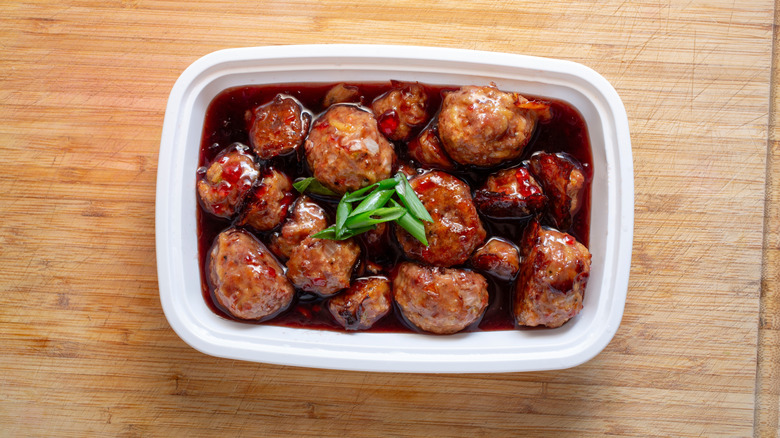
The idea of pairing meat with a sweet, fruity side isn't unique to the U.S. In Sweden, for example, people have enjoyed meat with native lingonberries for centuries, which is why you often see Swedish meatballs served with a side of lingonberry jam (you've probably ordered the dish from IKEA's food court menu after picking out furniture). But grape jelly meatballs, made with barbecue or tomato sauce, are different — they're an American creation.
Again, we can't give you a grape jelly meatball inventor, because it seems they don't exist. This was a dish that evolved over time, but most agree that it really came to prominence in the 1960s. One particularly popular recipe of the decade was printed in the 1960 cookbook "Elegant But Easy." When co-authors Marian Burros and Lois Levine reissued the cookbook in 1998, the authors referenced just how popular the dish was back in the 1960s in the recipe's headnote.
Burros and Levine also imply their recipe for grape jelly meatballs is somewhat dated in the reissued version of the book, but actually, the dish has stood the test of time. In fact, a quick search on TikTok brings up many new versions from popular recipe creators, including vegan alternatives and seasonal versions with pumpkin butter.