

8 Non-Alcoholic Low-Calorie Beers, Ranked
We may receive a commission on purchases made from links.
One of the fastest-growing trends in alcoholic beverages is beverages with no alcohol at all. It may be ironic, but at the same time, it's refreshing to watch a historically stubborn market evolve in new and exciting ways.
The zero-proof and mocktail movement is here to stay. In the U.S., it's expected to grow to a $5 billion business by 2028, per 2025 IWSR data. This takes into account everything from non-alcoholic wines and spirits to ready-to-drink beverages. But the sector that continues to lead the charge is non-alcoholic beers (which our taster tried and ranked). These brews make up about 87% of non-alcoholic sales according to data from the Beer Institute, and each year the options become more abundant and, more importantly, better tasting. Long-standing legacy brands like Budweiser and Coors have joined the fray, alongside picks from smaller craft breweries that focus exclusively on no-booze beers.
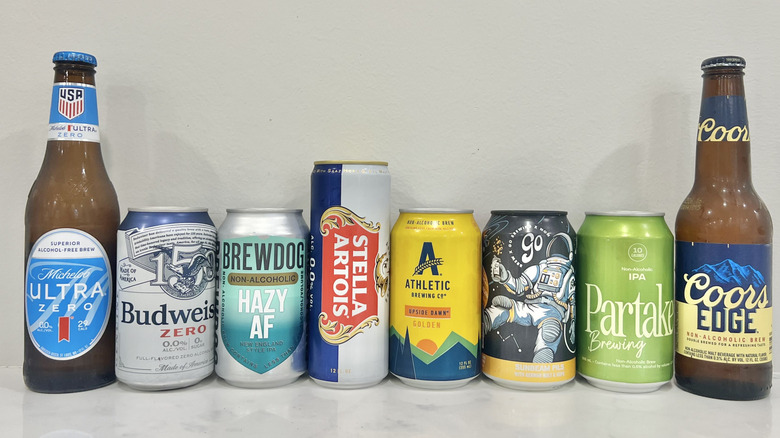
They all claim to scratch that itch of drinking a true beer, whether it be a lager, golden ale, or hazy IPA. But I decided to be the judge of that in a taste test that not only focuses on beers with 0.5% alcohol by volume or less, but also with a low calorie count — another trend influencing brewers. I picked up an array of different non-alcoholic beers, all with 60 or fewer calories. I noted the body, flavor, finish, and overall quaffability to uncover the offerings that will make you forget you're drinking a zero-proof brew.
8. Budweiser Zero
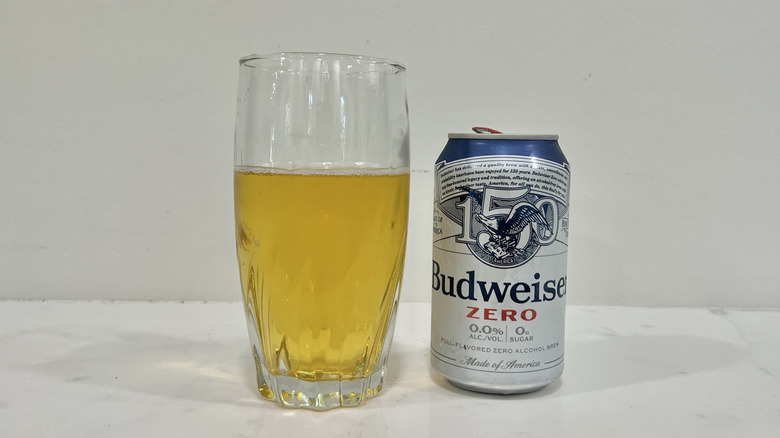
This beer smells like college, and the taste may be even less appealing. Budweiser didn't miss its opportunity to jump on the NA bandwagon. It rolled out Budweiser Zero in 2020, in the midst of the better-for-you drinks and functional beverages craze. Fittingly, it boasts zero sugar to match its 0.0% ABV, and it weighs in at just 50 calories per 12-ounce can.
I typically opt for Bud Light rather than a classic Budweiser (affectionately known as Bud Heavy). I get that from my dad, who disregards any beer that isn't Bud Light straight from a glass bottle. However, I didn't find Budweiser Zero to be a worthy ode to either flagship brew, despite its promises of packing the "full flavor and refreshment of Budweiser."
The coloring and the head are reminiscent of a true Budweiser. But in the taste, almost all resemblance is lost. The malty backbone is there, yet it's largely washed out. The entire beverage is thin and washed out, almost like it was made up of equal parts pale lager and water. A touch of almost citrus-like sourness in the finish didn't help its case. I also think the metallic taste of the aluminum can was more prominent than ever because of the weaker flavor of the beer. That was the final straw that sent Budweiser Zero to the bottom of the barrel.
7. Michelob Ultra Zero
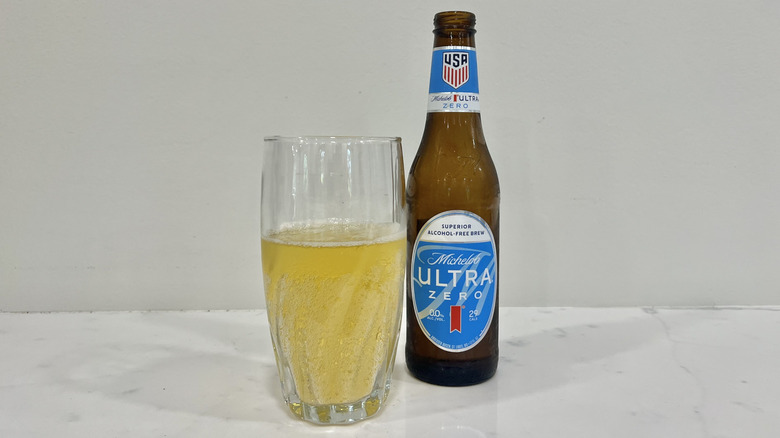
When Bud Light isn't an option for light sipping, or I'm just looking to mix things up, I will happily opt for a Michelob Ultra. There's something about its clean, quaffable flavor that seems to pair well with anything. I was hoping for the same kind of experience from its non-alcoholic counterpart.
Michelob Ultra Zero, introduced in 2024, is a very recent addition to the Anheuser-Busch lineup. But it's somehow already become the top-selling non-alcoholic beer in America according to Circana (via Forbes). I can certainly see why beer drinkers would like it more than something like Budweiser Zero. It has a fuller yet still approachable flavor. But, that being said, the 0.0% ABV, 29-calorie brew could still use some work.
It has an almost fruity edge to it that makes it a bit more sour than bready. There's also the faintest bit of artificiality in the aftertaste that makes you question whether or not you want to go back for another slug. I also would have liked to see a bump up in carbonation. It's kept very light, which makes the beer seem more diluted than it actually is. Ultimately, it's missing that signature Michelob crispness and it doesn't quite nail the essence of any true light beer. So, I probably wouldn't reach for it again. It may be the most popular NA option, but in my opinion, it's not the best-tasting.
6. Go Brewing Sunbeam Pils
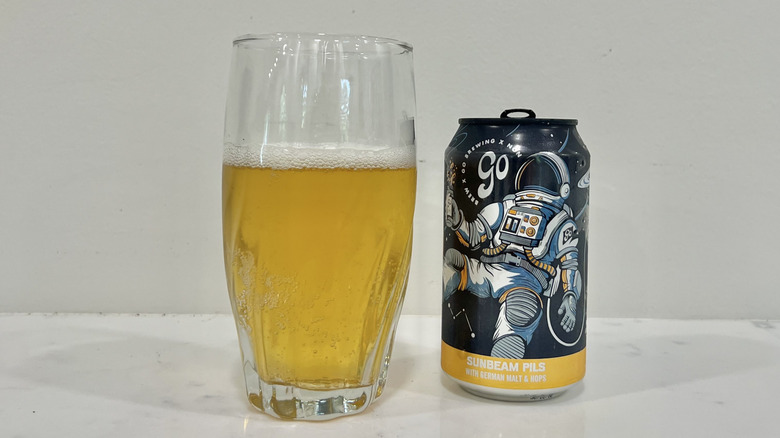
A craft beer enters the chat. I was fully prepared for Go Brewing's brew to shine among these other zero-proof domestics. Why? For starters, because the brewery is solely focused on churning out non-alcoholic beers. It's not an afterthought or an attempt to keep up with the trends. It feels much more intentional. That, and this particular beer is called the Sunbeam Pils, for crying out loud. It elicits visions of sunshine and easy drinking.
I picked the Pils out of the Go Brewing options because it happened to have one of the lowest calorie counts at just 43 per can. It's made with German malt and hops and has an ABV right around 0.5% (the limit for non-alcoholic beers). It has that golden hue that's typical for a pilsner, but I was expecting more from the flavor. In terms of body, it's just a small step up from the Budweiser and Michelob, and it leads heavily with cereal notes — just like a bowlful of Wheaties. My husband, who tried it with me, also picked up on the earthiness, which didn't land particularly well on the palate. He compared it to herbs, and, more specifically, the taste of parsley.
Even though it comes much closer to a full-alcohol beer than the lower-ranked brews, it's still not satisfying enough to earn a spot in my rotation. Perhaps Go Brewing's other higher-calorie options, like its IPAs, fare better.
5. Coors Edge
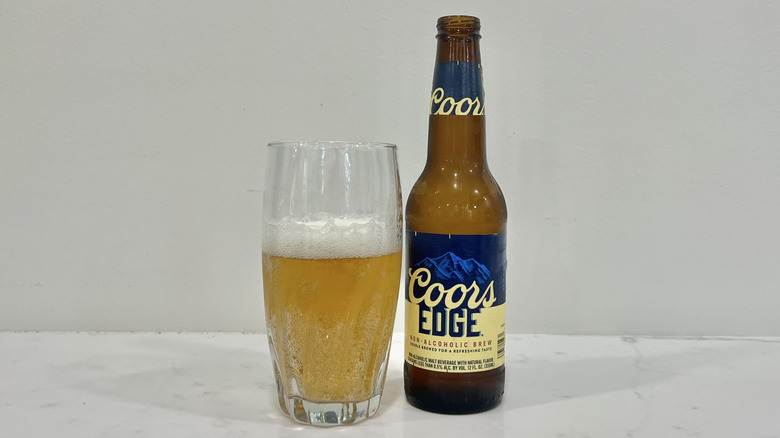
It's diet-friendly, budget-friendly, and surprisingly not too shabby. Coors Edge is the brewing company's own take on a NA beer. It was actually one of the earlier ones on the scene, released in Canada in 2018 and in the U.S. the following year. It's said to be "double brewed for a refreshing taste" and comes in at 41 calories with less than 0.5% ABV.
I found it to be far more drinkable than the Sunbeam Pils and the other previous options. On the nose, it smells just like a light beer. On the palate, it's more obvious that you're drinking a non-alcoholic beverage, but the taste isn't offensive by any means. It still has those sweet corn notes. They're just not quite as strong or prominent. I've heard some people say they detect hints of banana in this beer. I didn't pick up on that, but I did feel that some tangs of citrus could be at play. It's almost like a blend of Coors Light and Coors Banquet — just milder versions of both.
What I do appreciate is that there's still a good amount of bubbles here, especially as it pours out of the bottle. It at least gives the illusion of a classic beer, in both its appearance and its mouthfeel. It might not fool you into thinking it's the real deal, but it's definitely one of the better mainstream NA beers on the shelf.
4. BrewDog Non-Alcoholic Hazy AF
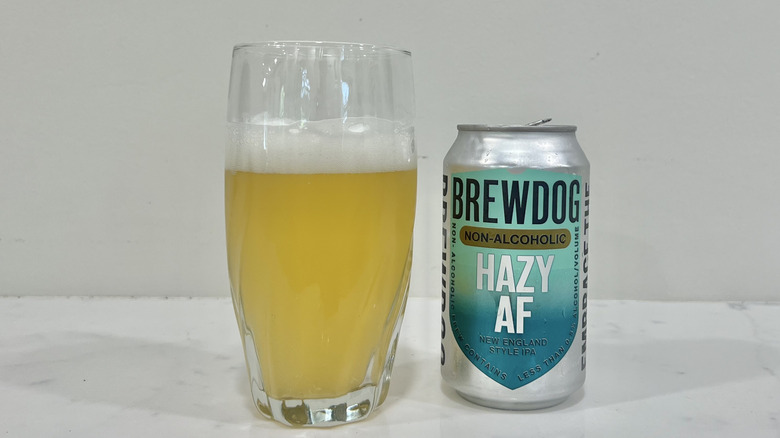
I was rooting for BrewDog's non-alcoholic beer. The brewery holds a special place in my heart because of its presence here in Ohio. And my fondness only grew after visiting one of its European locations in Ireland (it wasn't the company's home country of Scotland, but the experience still felt more authentic.) I've always liked BrewDog's beers and I get along particularly well with its Elvis Juice and Hazy Jane IPAs. I wanted more of the same from the Hazy AF, which is a non-alcoholic version of the Hazy Jane with less than 0.5% ABV and 20 calories per can. After trying it, I can report it's good, just not great.
It smells just like a full-force India Pale Ale, and the taste starts off really strong. All of that fruity juiciness that defines a classic New England-style IPA is there. I picked up on notes of grapefruit, maybe orange and pineapple as well. So, it captivated me in the beginning. The problem is that this initial rush of flavor fizzles out quickly. The rest is very watery. The earthy hops don't fully come through, and it doesn't have the thicker creaminess of a traditional hazy. This left it feeling more like a hops-infused sparkling water than a proper IPA. It surpasses most macro-brewed light beers, but just doesn't have the staying power to land at the top of the rankings.
3. Stella Artois 0.0
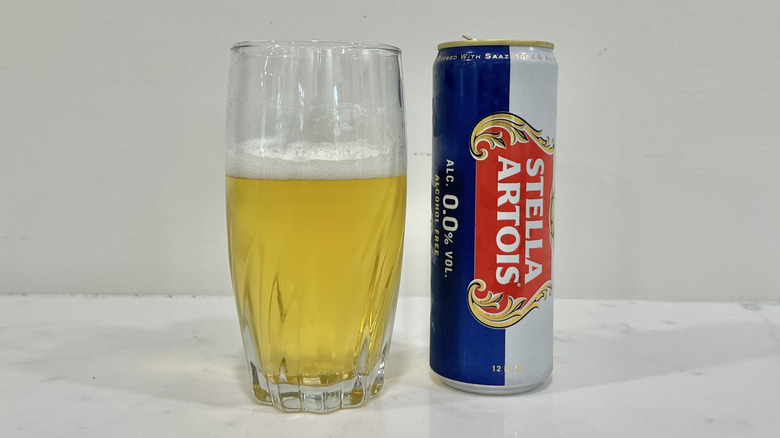
In her classic state, Stella and I are more so acquaintances than we are close friends. I'll entertain a pint of the Belgium-style lager, but it's never been my first pick. Other beers better tickle my fancy, I suppose, and better suit my palate.
However, pour me a glass of the Stella Artois 0.0 non-alcoholic brew, and I'm suddenly intrigued. This is the first option I tried that could have been mistaken for a full-alcohol beer. I probably would have caught on after just a few sips, but it has many of those characteristics and flavors you would want in a pilsner. I think most of this can be attributed to the fact that it's brewed with Saaz hops and all malt (aka brewed using 100% malted barley) — the same way normal Stella is made. It's very smooth to start, and it balances those toasty malt flavors with a light crispness. It ends with a very manageable hoppy bitterness. With more substance and a decent amount of effervescence, it easily beats many of the other beers on the list. Plus, the can I sipped it from doesn't have the skunkiness that's sometimes associated with Stella.
In terms of calorie count, this is the heaviest beer in the taste test, coming in at 59 calories. But I still think it's worth it for more flavor and higher quality.
2. Partake Brewing IPA
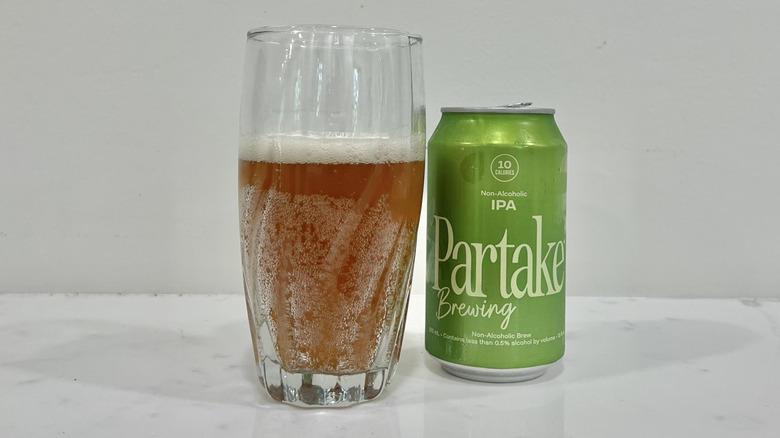
I thought there was no way an IPA could have no booze (or at least less than 0.5%), only 10 calories, and still manage to taste good. But Partake Brewing has done it. The Canadian brand wasn't lying when it said it doesn't compromise. Arguably the most impressive part of its business model is that every single one of its beers comes in at under 30 calories. That means I had the pick of the litter when it came to this low-cal taste test, but ended up with the traditional IPA. Needless to say, I was happy with this decision.
The brew pours out of the can with a deeper amber shade. It mimics many of those same flavors of a traditional India Pale Ale. It leans more earthy than malt-forward, and there are brighter tastes laced throughout as well. I couldn't pick out any specific citrus fruits. But that punch is certainly there, as well as that signature IPA bite — the most authentic part of the entire can.
I just wished it carried a bit more weight. The flavor is there, but it's extremely light in terms of mouthfeel, which may have something to do with the low calorie count. It could stand for a pinch more body and carbonation as well. After sitting in a glass for just a few minutes, it flattens out significantly.
1. Athletic Brewing Co. Upside Dawn Golden
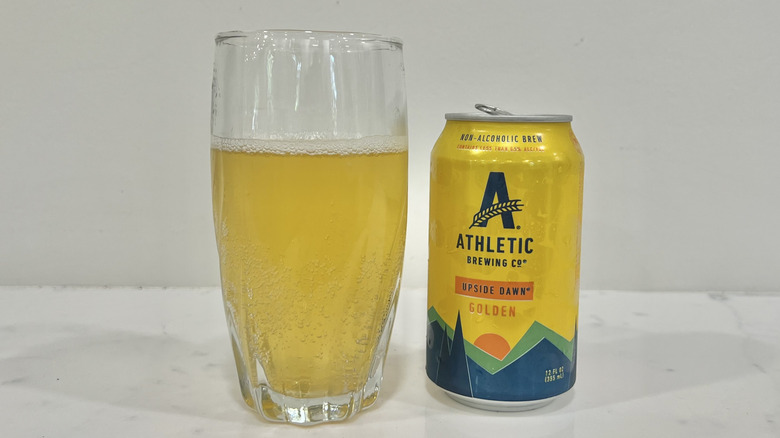
Much like Go Brewing and Partake, Athletic Brewing Co. is another craft brewer dedicated solely to the production of non-alcoholic beer. It's actually the largest manufacturer to do so, with operations on both coasts in order to serve its growing fanbase nationwide. Its variety speaks for itself. But I decided to cozy up to the brand's Upside Dawn Golden, which carries just 45 calories per 12-ounce can and less than 0.5% ABV. It's said to be a bestseller, and is decorated with a slew of accolades from the World Beer Awards and the European Beer Challenge. I can see why.
This is a great alternative beer. It's meant to be a light-bodied brew with flavors of citrus, herbs, and earthy hoppiness, which is achieved by blending together water with malted barley, oats, hops, wheat, and yeast. It lives up to these promises. It smells refreshing and follows it up with a flavorful, fuller base of wheaty notes paired with what tasted to me like a burst of orange zest. It could perhaps be perceived as more of a blend between a golden ale and a pale ale, two of the most popular types of beer, rather than a true golden because of its stronger hoppiness. The taste lies mostly dormant throughout, but does pop up in the aftertaste as a bolder bitterness. I don't mind this extra splash of personality, though. If anything, it was just one more reason why Upside Dawn took home the gold.
Methodology
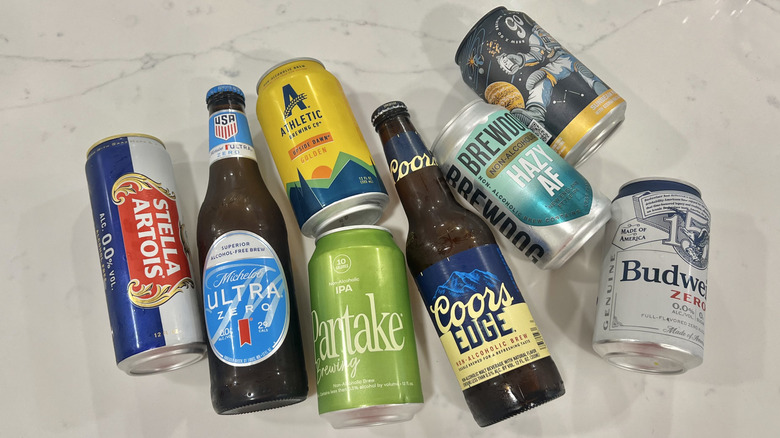
Nowadays, it's not hard to find a non-alcoholic beer among the classic brews, both at breweries and at the grocery store. At the store, they typically have their very own designated section in the cooler. However, the options become slimmer when we're talking about low-calorie beer. For this specific taste test, I aimed for beers that kept the calorie count to about 50 or less. All met this threshold with the exception of Stella Artois, which sits at 59 calories. Once I picked up beers from local grocery stores — including ones that tended to have a better beer selection, like Walmart and Giant Eagle — I took them home to try.
I did a bit of research into each brewery and beer for background info, but focused the rankings on taste and experience. This started with taking note of each beer's coloring and look. Then, I dug deeper into the aroma of the beer and how it pours into a glass. Next came the all-important flavor notes. I evaluated whether or not each brew was smooth to drink and if it delivered on its flavor promises. If it was an IPA, for example, I expected a level amount of hoppiness. As for well-known domestic brands, it was inevitable that I would also compare them to their full-alcohol counterparts. Overall, I was looking for the beers that offered a lot by way of taste and body. I was looking for NA beers that offer the beer-drinking experience, just without the alcohol and extra calories.