

The Reasons Why So Many Sit-Down Chain Restaurants Wrestle To Stay Afloat In 2026
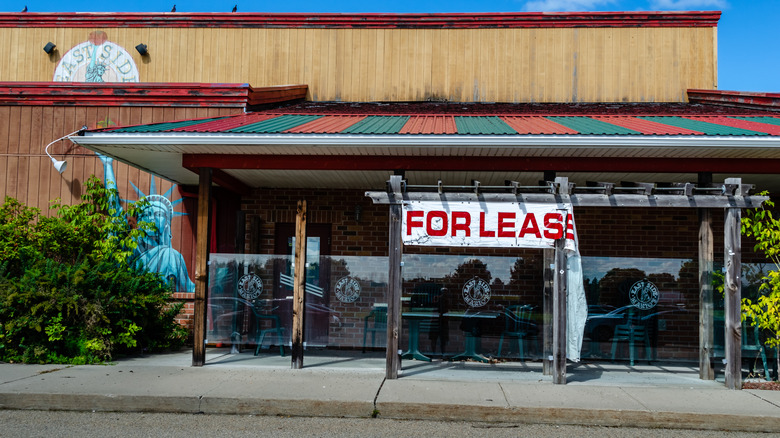
With each decade, it's not surprising to see chain restaurants rise and fall, but 2026 has been a particularly hard year to be a sit-down chain. Red Lobster and TGI Friday's are only the two biggest restaurant chains that have declared bankruptcy in the last few years, as they were joined by Buca De Beppo, Hooters, Bar Louie, and others. While a few spots like Chili's have bucked the trend, it's clear we are living in an unusually tough time for sit-down chains, in particular. So, what is actually happening? Unfortunately, there is no simple answer.
In some cases, it's that management of certain chains simply made poor (and costly) strategic decisions, but it's also true that the whole industry is still plagued by inflation as well. Just as customers are trying to cut back, costs have driven up. Inflation hits restaurants from every direction, cutting into their bottom line. Of course, it also cuts into revenue as well, as customers balk at the higher menu prices needed to cover those high costs. Thus, sit-down chains are stuck in a catch 22. Lose money on each sale or raise prices and risk losing customers.
Those cost increases have become very real in recent years. The cost of labor and ingredients has soared with inflation, rising over 35% between 2020 and 2025, according to the National Restaurant Association. Those two costs are the majority of any restaurant's expenses. Even for chains, the profit margin at a sit-down restaurant is very small, usually 3% to 5%, so basically even a modest increase in costs has to be covered by rising prices or the establishment risks going out of business.
Customers are switching to budget options as prices increase
Many of these chains had little choice but to raise prices, but obviously customers are going to react. A late 2025 YouGov survey on dining habits shows that 37% of Americans went out to eat less often last year due to high prices, and even when they did go out, around 54% choose to spend less by selecting cheaper restaurants or ordering less food. It's particularly bad for lower- and middle-income consumers, who are casual dining's primary target customer base.
That is certainly some of the story, but sales data proves that customers cutting back doesn't have to mean decline. Americans are still spending about as much eating outside of the home as ever, though they have largely changed where. Fast casual dining rose as casual dining sales dropped in 2024, and, in 2025, casual dining sales actually jumped quite a bit. However, it turns out that the bulk of that growth came from just three chains: Chili's, Olive Garden, and Texas Roadhouse.
If you know what's been going on with these chains, particularly Chili's and Texas Roadhouse, it helps clarify the state of the industry. Texas Roadhouse is famous for offering superior affordability compared to other steakhouses while still maintaining a baseline of quality and Olive Garden has long been popular with budget diners. Chili's wasn't always so popular, though it has experienced a massive resurgence in the past few years upon offering better deals and improving the quality of its food.
Customers are becoming more sensitive to sit-down chain restaurants cutting corners
So, Americans aren't dining out that much less, but they are becoming more discerning with where they spend their money. Customers understand restaurants sometimes need to hike prices, and folks want to go out to eat but only where they feel like they are getting a good deal. Nobody wants to feel ripped off by poor quality food either. The success of chains like Chili's and Texas Roadhouse reveals that many casual dining chains have lost track of the fundamentals. That may have been forgiven pre-pandemic, but inflation-weary Americans have since made these chains pay.
Many of the struggling chains failed in that contract with customers by cutting quality, raising prices too, or relying on gimmicks instead of consistent value and service. Red Lobster was plagued by mismanagement from cost-cutting owners even before its infamous endless shrimp debacle. Outback Steakhouse has struggled compared to Texas Roadhouse due to its higher prices. Likewise, private equity owners saddled chains like TGI Fridays and P.F. Chang's with massive amounts of debt, while having no larger strategic direction and trying to squeeze money out of the restaurants.
Casual dining chains in the U.S. are far from dead; they are just going through a period of transition. Rising costs have made it tough for any kind of restaurant right now, but big corporate chains are learning the hard way that you cannot simply rely on past goodwill and brand recognition if you want diners to show up.