

The '60s-Era Retro Beverage Trend We (Almost) Forgot About
We may receive a commission on purchases made from links.
Usually, when you hear about a forgotten drink from the past, it's a vintage cocktail or an old-school soda fountain beverage. It's rare to be reminded of a retro beverage trend that isn't technically even a liquid. But Fizzies Drink Tablets are a blast from the past that was all the rage in the mid-'50s.
Fizzies were invented by Lem Billings around 1954. Billings was the head of advertising at Emerson Drug Company, famous for its headache remedy, Bromo-Seltzer. At the time he was hired, Billings was trying to figure out how to make its tablets more competitive with Alka-Seltzer. But Billings soon discovered that customers didn't love the salty flavor of Bromo-Seltzer tablets and thought adding fruit flavoring would make them more palatable. That idea later led to his invention of Fizzies. The small tablets would dissolve in water to create a fun, colorful, kid-friendly drink.
The tablets were launched regionally in Pennsylvania in 1956, and were originally available in sugar-free cherry, lemon-lime, grape, and orange flavors. The primary selling point (beyond a kid-friendly appeal) was that the dry tablets could be used to make drinks on demand, and the boxes didn't take up much space in kitchen cupboards. The novelty beverage quickly took off, and in 1962, when Emerson was acquired by Warner-Lambert, the brand expanded to eight flavors sold nationwide, eventually becoming a 10-million-dollar industry. Fizzies eventually became a popular after-school snack that kids loved throughout the '60s, but were discontinued due to fears about one of its key ingredients.
Why Fizzies was discontinued in the late '60s
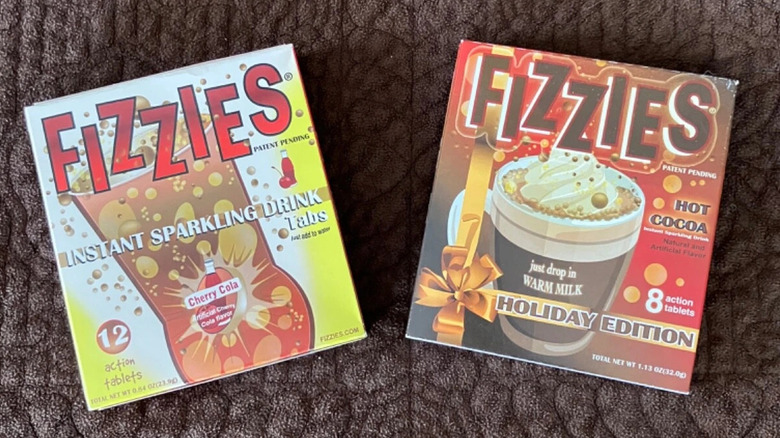
Fizzies was a sugar-free drink tablet that contained cyclamate. This zero-calorie artificial sweetener was invented in 1937 and used for cooking and baking. In the 1950s, it was introduced as a healthy alternative to white table sugar that was 30 times sweeter. It became incredibly popular as a diet-friendly sugar substitute in sodas, jams, jellies, and baked goods. In the late 1960s, two scientific studies were made public that demonstrated a link between cyclamate consumption and tumors in lab rats. In 1969, the Secretary of Health, Education, and Welfare banned its use in U.S. consumer products, effective February 1, 1970.
Warner-Lambert, the company that manufactured Fizzies at the time of the ban, quickly pulled the product from shelves. Though the company looked for alternatives to cyclamate, it couldn't find an acceptable alternative, so the product was discontinued.
In 1996, Fizzies were resurrected by Premiere Innovations after a group of innovators spent years figuring out how to revolutionize its formula with a safer artificial sweetener. The new Fizzies were made with NutraSweet and came in berry, cherry, grape, orange, and root beer flavors. Unfortunately, the company went out of business in the early 2000s. The product was brought back to life again in 2005 by Amerilab Technologies, this time sweetened with Splenda. By 2016, it was gone again, making Fizzies yet another popular drink that has disappeared from store shelves.