

Everyone Ate It In The '50s — Now You Likely Won't See It On Popular Restaurant Menus

When foodies think of the 1950s food scene, retro fare like malted milkshakes and burgers at the soda fountain might come to mind. But, dining out was only one part of the decade's culinary footprint, and often a small one. The American fast food industry had yet to pop into the easily-accessible entity it is today, and dining at restaurants was considered a special occasion treat for many (if not most) U.S. households. On a regular weeknight, folks were making dinner at home. The decade was characterized by old-school appetizers like deviled eggs and cheese balls, which still hold up today. But, one of the 1950s' best-known dishes doesn't share such a strong fanbase in 2026: liver and onions.
The dish was traditionally prepared by pan-frying thinly pounded, flour-dredged beef liver with caramelized onions, and it was a common fixture on 1950s dinner tables. A Facebook post in the wildly specific "Born in the '40s, grew up in the '50s, started a family in the '60s" group shares that liver and onions was "yet another 1950s regular meal at our house," adding, "Today my wife Glenda doesn't like liver and onions, so if I don't cook it for myself I'll never have it from one year to the next." The post prompts impassioned comments from other apparent longtime fans, who write "I haven't had liver and bacon as a meal for years" and "That's what I'm having tonight!"
Liver and onions isn't a hit with younger generations of gourmands
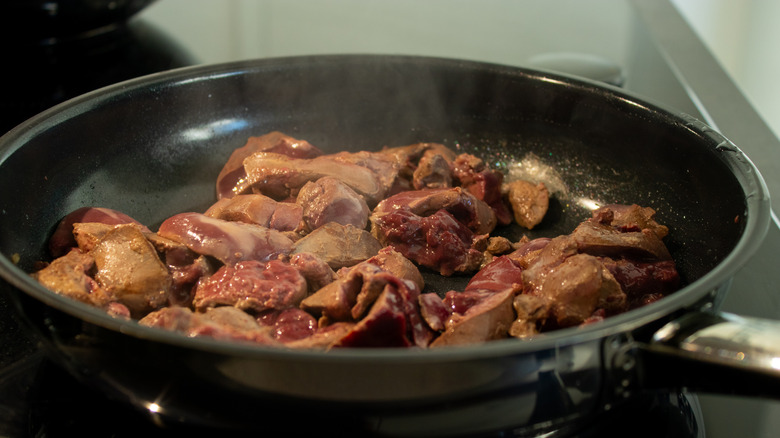
As one Facebook commenter notes, "If I want liver and onions I have to cook it myself, I tried to get my daughters to eat liver but they didn't want to." Indeed, younger generations don't seem to share Boomers' affinity (or even interest) in liver and onions. Meanwhile, other types of non-traditional offal — like monkfish liver and foie gras — are downright fashionable in the modern culinary world, and an oft-spied menu fixture at fine dining establishments in metropolitan centers from New York to Chicago.
Although, admittedly, perhaps it isn't consumer squeamishness as much as beef liver's signature intense, metallic taste that has turned new generations of consumers off of the dish. Other stronger-tasting, old-school game meats like rabbit and venison have yet to catch on in the contemporary food scene, as well, which seems to be cautiously opening the door to milder forms of offal.
Regardless of exactly why this dish is not so popular anymore, and definitely not something that modern-day restaurants are likely to serve, it can still certainly be made at home — and, according to online forums, many folks are. Another Facebook post shares similarly fond memories of liver and onions, with the caption, "I remember Liver and Onions as a Healthy Food we had in 50's." Commenters agree, chiming in "Luv me some liver and onions," and "Still one of my favorite meals."
This rustic and retro dish can still be made at home
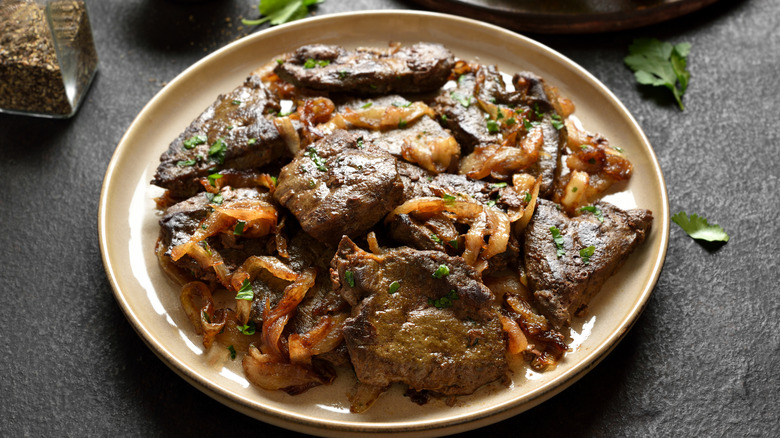
Liver and onions exemplifies the 1950s trend toward budget-friendly dishes that could feed larger households with multiple children, such as casseroles, chipped beef on toast, and meatloaf, which stretched ingredients further. More specifically, liver was inexpensive and also nutrient-dense, providing a rich source of iron, protein, and vitamin A.
Home cooking of the 1950s was also largely colored by the nation's recent emergence from the Great Depression of the 1930s, which prompted a "waste nothing and use everything" epicurean mentality. This thriftiness and ingenuity is evidenced by our classic liver and onions recipe, which requires just five ingredients and comes together in 20 minutes. With flour, salted butter, a yellow onion, a splash of beef stock, and a pound of beef liver, foodies have all they need to serve a family of four. That beef stock is key for balancing the dish's strong flavors, with even just ¼ cup able to temper pungent onions and metallic liver for a more approachable flavor profile.
For an even bolder upgrade, many fans online also mention adding a strip of bacon into the pan. As it cooks down alongside the butter and onions, the bacon grease imparts a major kick of smoky, savory saltiness that gives the liver and onions more dimensionality. While it has effectively disappeared from weekly dinner rotations — not to mention from popular restaurant menus — liver and onions remains nostalgic, hearty, and (to many foodies who grew up during the '50s) timelessly comforting.