

7 Underrated Pizza Topping Combinations To Try On Your Next Slice, According To Chefs
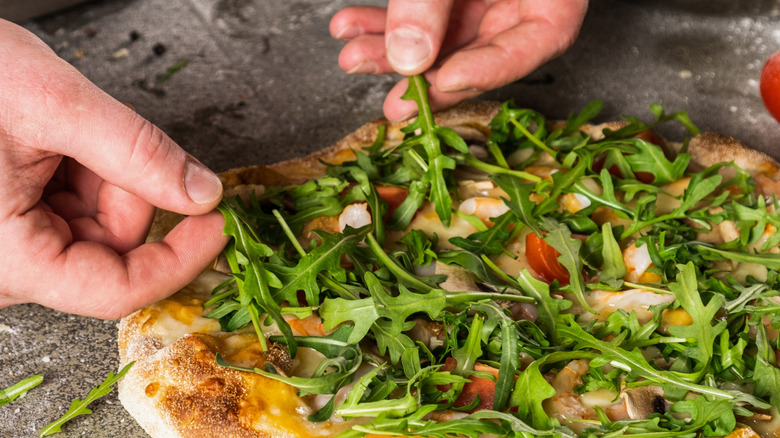
Pizza may never get old, but having the same toppings repeatedly can certainly get monotonous. If you're ready to switch up your go-to order or want to experiment with different flavors at home, you're in the right place. We've gathered suggestions for underrated pizza topping combos from four pizza experts: Laurent Tourondel, executive chef at New York's L'Amico; Bryan Donaldson, executive chef at Portland's Nostrana; Christina McKeough, executive chef at Philadelphia's High Street; and Tony Gemignani, the award-winning pizza maker behind Tony's Pizza Napoletana.
Pizza purists might feel a certain amount of pride when ordering, say, a Margherita or quattro formaggi. However, pizza is always evolving; Gemignani told us that grain types, hydration ratios, maturation periods, and baking techniques have all evolved over time. So, rather than marrying yourself to the idea of eating "traditional" pizza, make space for trying more innovative combinations every once in a while.
That said, don't dismiss the attention to detail required in crafting an excellent pizza. "Respect the foundation: dough," says Donaldson. "It's not the place to get too clever ... If the dough technique is sound, the more modern ideas don't feel forced." McKeough agrees, saying that "really, anything goes when you have a truly well-made dough cooked to perfection."
Finally, read our top tips for making the best homemade pizza before trying any of these combinations yourself, and don't hesitate to branch out on your own. Each of our experts encourages you to layer your pie with well-balanced textures and flavors of your choice.
Crab and crème fraîche
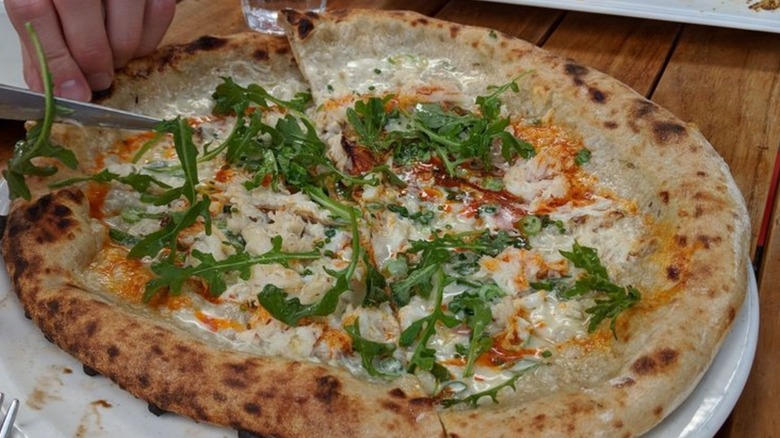
If you're a regular customer at pizza parlors in Maryland, then you're likely already familiar with crab dip being one of the most unique pizza toppings in the country. Crab pizzas often feature a subtly sweet and creamy béchamel sauce, so it makes sense that crab and crème fraîche (a cultured, tangy cream famously used in France) would prove to be an excellent combination as well.
Executive chef Bryan Donaldson loves matching Dungeness crab with crème fraîche, paprika butter, arugula, green onion, and lemon. This combination has pleased his customers for years, he says. You won't need any red or white sauce to create this pie; instead, let the crème fraîche dazzle you with its nutty, somewhat sour flavor profile. Crème fraîche will balance out the crab's sweetness, and it's not so heavy that you'll feel like a balloon for the rest of the day. "A pizza should be eaten clean even if it's indulgent," Donaldson says. "We want another slice, not a nap."
Crème fraîche, bacon, and onion
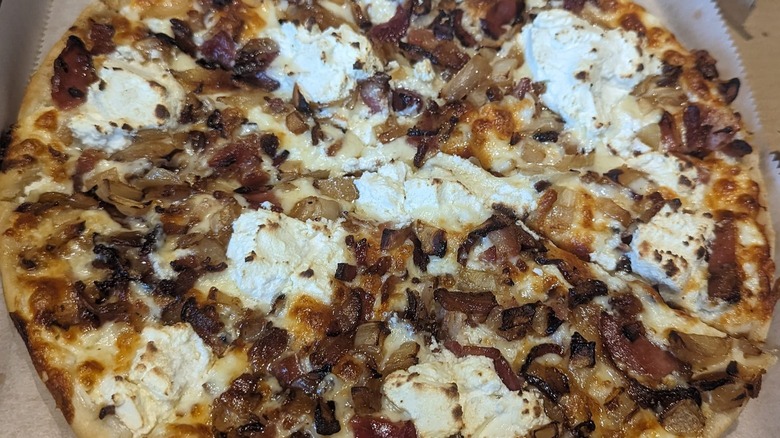
Executive chef Laurent Tourondel appreciates the combination of crème fraîche, bacon, and onion on a pie; although none of those ingredients are bizarre, he says they balance one another wonderfully. To make his version, Tourondel begins with blanched bacon, ensuring that the meat's salty, smoky flavors are kept in check and that each strip also remains moist. He then adds a concoction of crème fraîche, egg yolk, nutmeg, and seasoning before rounding it all off with raw onion.
The crème fraîche provides a burst of tanginess, the bacon lends smoky depth, and the raw onion is both astringent and sharp. If, like Tourondel, you are using nutmeg or another warming spice, a lovely hint of sweetness will pervade each slice, too.
Depending on the supplemental ingredients you use and the style of your crust, you might end up with a dish similar to flammkuchen, a German-French pizza with a fascinating history. However, despite the shared ingredients of bacon, onions, and crème fraîche (which can be swapped for fromage blanc in flammkuchen), many would consider the German-French specialty to be more akin to flatbread than pizza.
Salad greens and more salad greens
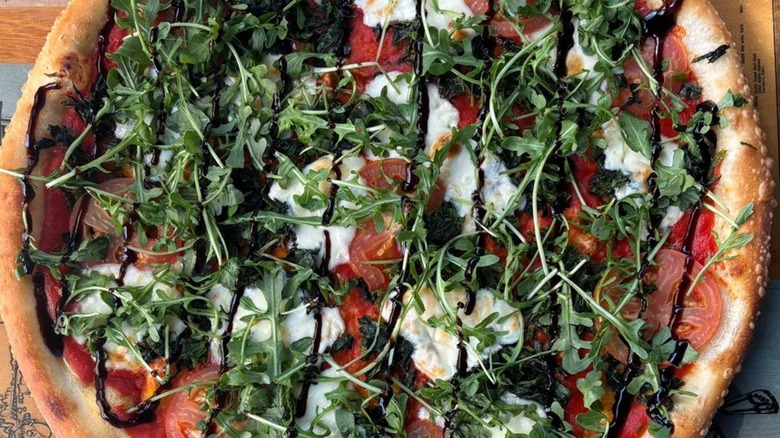
Ever make a series of impulse buys at the farmers market resulting in a crisper drawer full of salad greens you don't know how to use? Bryan Donaldson and executive chef Christina McKeough are fans of throwing them on pizza. Rather than play into viral trends, Donaldson pays close attention to what's in season. "The garden tends to have better ideas anyway," he says.
Though arugula and basil are obvious choices, the sky is the limit. For example, McKeough says that gem lettuce and radicchio are strong contenders. Make sure to pair your greens with other garden veggies, too. Donaldson favors fava beans in conjunction with pea shoots and tendrils, calling it "a salad that decided to improve its life."
McKeough further explains that a perfect summer pizza might incorporate a crunchy, briny salad mix atop a sourdough base slathered in tomato sauce. When complemented by the pungency of garlic, a drizzle of grassy olive oil, and a sharp, aged cheese, this pie can satisfy your belly and taste buds while also helping you meet your daily vegetable quota. "Pizza's high heat and rich toppings need something alive and funky to keep things bright and fresh," McKeough says. So, you might also capitalize on an acidic ingredient like pickled green garlic or black garlic for extra pizzazz.
Although you don't necessarily need to be picky about which greens go with which (experimentation is everything!), you should avoid going overboard. Use a light hand, says Donaldson, and let the ingredients speak for themselves. "Two or three toppings is almost always better than six," says McKeough.
'Nduja and hot honey
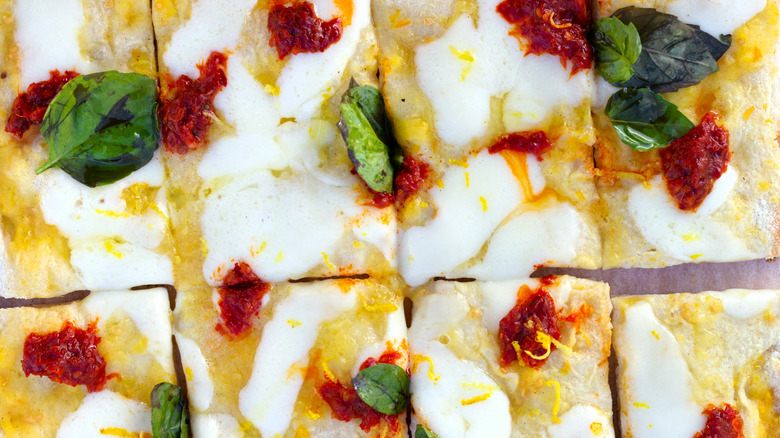
We've said it before, and pizzaiolo Tony Gemignani just confirmed it for us: 'nduja is a pork paste that will level up your next pizza. And while this Calabrian specialty pairs well with olives, other meats (like bacon and chicken), and vegetables (like broccoli and roasted eggplant), we love Gemignani's suggestion to complement it with hot honey.
Hot honey is an ingredient popping up on menus all over the country, and its fame is well-deserved. The "swicy" nature of hot honey makes it more palatable to those who are typically spice-averse, allowing folks to appreciate its peppery flavors without necessarily feeling like their mouth is on fire.
Meanwhile, 'nduja is a spreadable meat featuring Calabrian chili peppers and a remarkably high fat content. In the states, you might find it at an upscale grocery store like Whole Foods or a specialty shop. Chefs should spend time learning how to use 'nduja correctly, shares Gemignani. "It's a topping that is best added after the bake rather than before, and when used correctly it's absolutely delicious," he says. Its savory nature will make that hot honey seem even more delectable.
Cheeses like Parmigiano-Reggiano, Provola, and mozzarella also shine alongside 'nduja, shares Gemignani, as do vibrant ingredients like arugula, Peppadew peppers, and basil. You could even swap out hot honey for hot agave.
Fig preserves and prosciutto
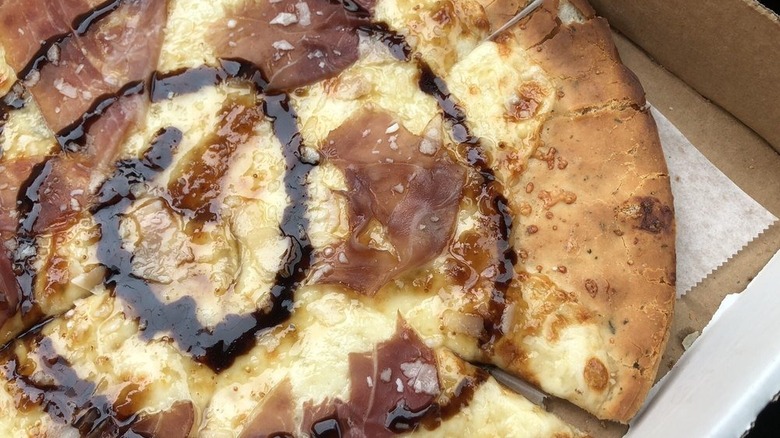
Though certainly not available at the majority of American pizza parlors, the combination of figs and prosciutto is nothing new. Prosciutto-wrapped figs are an Italian specialty, and the two often appear alongside one another in salads and pizzas, often in conjunction with goat cheese. However, Tony Gemignani specifically recommends using fig preserves rather than raw figs on pizza.
In most regions of America, the season for figs is short, and these delicate fruits don't last very long in the refrigerator, either. Shelf life is part of what makes a jar of fig preserves so appealing — well, that and the condiment's sweet, thick nature. The sweetness of a fresh fig can vary drastically based on variety and season, and many figs offer an earthy flavor. However, when cooked with sugar, figs can more reliably balance out the savory, spicy, and tangy flavors of other pizza ingredients (and if you're looking for a way to empty the rest of a jar, fig preserves temper the tanginess of blue cheese burgers, too).
Gemignani recommends pairing Croatian fig preserves with several ingredients imported from Italy: Gorgonzola Dolce, Parmigiano-Reggiano, and prosciutto di Parma. Products from other origins will work just fine; experiment to see how they change the flavor profile of your pizza. Gemignani also suggests adding mozzarella, Asiago, and balsamic glaze to this pizza.
Delicata squash, honey, and red chili peppers
We love taking long drives to ogle at the trees' colorful foliage each fall. But what excites us equally as much is the squash selection at roadside produce stands and local farmers markets. Acorn squash, kabocha squash, buttercup squash, and more — all just waiting to be blended into soups and cooked into pies. And by pies, we mean both the sweet and savory kind.
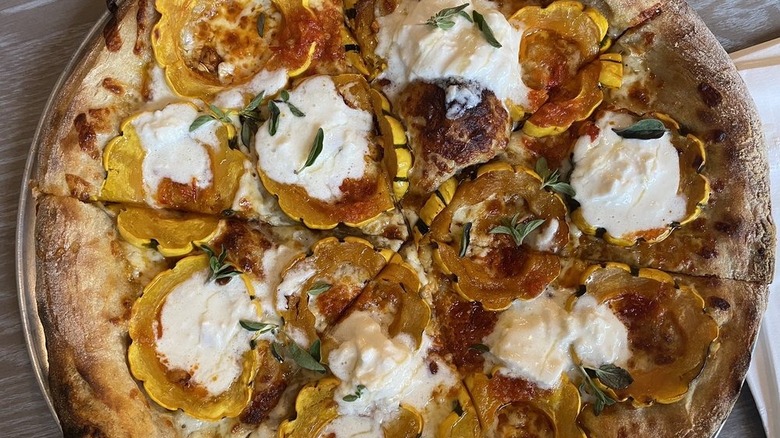
Delicata squash is one variety that Christina McKeough especially favors when making pizza. She amplifies its sweetness with buckwheat honey while adding a spicy contrast with Calabrian chili. This sweet and spicy combination can be achieved in other ways, too; for instance, in lieu of chili peppers, you might use hot honey.
Bryan Donaldson notes that it's crucial to give ingredients time to cook and caramelize in the oven. Squash is a prime example of this, so make sure to pre-roast your cubes or slices, waiting until the edges of each piece begin to brown before pulling the tray out of the oven. Then, add the pre-roasted squash to a pizza crust alongside other toppings and let them broil in the oven for a few more minutes before digging in.
Deli meats and cheeses
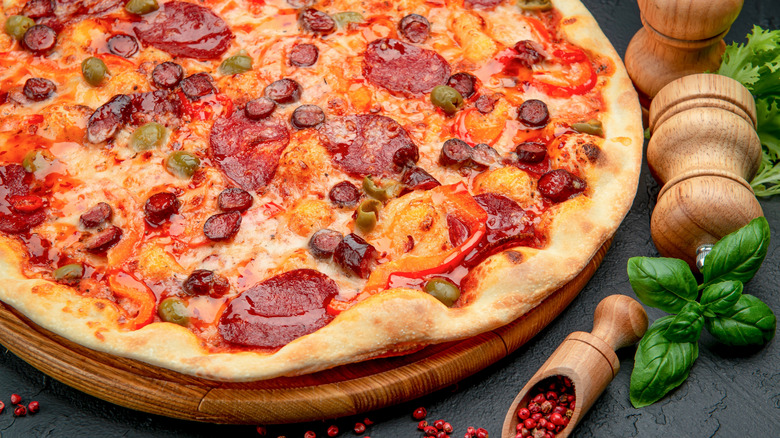
Despite its modern ubiquity, pepperoni has only been with us for about a century. Indeed, this spicy spin on salami was invented in the early 20th century by Italian immigrants, and it wasn't until the mid-20th century that it was added to pizza. But don't for a minute think that pepperoni is the only deli meat that belongs on pizza. In fact, a wide range of deli meats can be added to homemade pies. Whether you like your pizza spicy or mild, there's a deli meat out there that can please your palate. Plus, vegans and vegetarians can turn to plant-based deli meat alternatives made from ingredients like soy, seitan, pea protein, mushrooms, and jackfruit.
Laurent Tourondel is particularly fascinated with the concept of a grinder pizza, starring various deli meats and cheeses that would typically be found on a sandwich. A pizza inspired by the Italian grinder sandwich, for instance, might include capicola, prosciutto, and Genoa salami. Alongside a handful of seasonings, you can make this pizza even more sandwich-like by adding raw ingredients like lettuce, onion, and tomato after baking.
Other deli staples, like Cuban sandwiches and Philly cheesesteaks, can also be transformed into pizzas. So, what are you waiting for? This is your sign to skip the sandwich and start topping your pizza with pastrami.