

How Much Tequila Can Actually Be Made From One Agave Plant
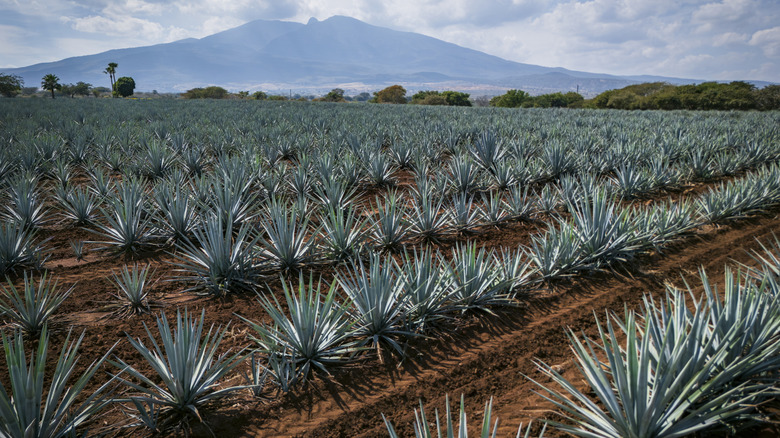
If you've seen agave plants in people's gardens, you aren't prepared for just how big the ones used to make tequila are. There are actually hundreds of different species of agave plant, but by law in Mexico, tequila can be made from only one: Blue Weber agave. That's because like Champagne in France, Prosciutto di Parma in Italy, and other historically significant products, tequila is governed by strict laws to protect the purity of its origins and flavors. Blue Weber was the agave first used to distill the spirit in the town of Tequila hundreds of years ago, and gives it a unique taste due to a level of sweetness well above most other agave plants. But because tequila is strictly limited to being made from Blue Weber, the amount that can be produced is governed by the peculiarities of the plant. Luckily for tequila lovers everywhere, Blue Weber agave can grow to massive sizes, and produce anywhere from five to 10 bottles of tequila on average.
The wide range of tequila yields from a single agave plant comes from the huge range of size differences they can grow to. Blue Weber can grow leaves that reach heights of up to six feet tall, although by maturity they are usually shorter because the leaves start to droop from the weight. But what really matters to tequila yield is the piña. This is the center ball of the agave plant that the spiky leaves grow from, and it gets that name because once it's trimmed of leaves to be processed for tequila, it resembles a massive pineapple.
One Blue Weber agave plant can produce up to 10 bottles of tequila
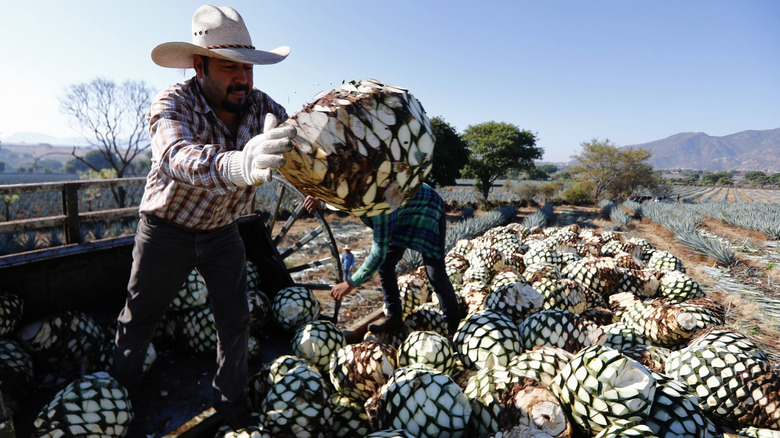
The piña, or the heart, represents about 50% of the mass of the whole agave plant, and at harvesting time they can weigh anywhere from 20 to over 200 pounds. The piña must be cooked to concentrate the sap into sugars, which can then be extracted for fermentation and distillation. The way piñas are roasted can also determine the final flavors of the tequila. While agave syrup is obviously sweet, it isn't that concentrated in the piña, so even those massive yields only produce a moderate amount of juice. In the end, it takes around 15 pounds of piña to produce a liter of tequila. However, a typical 750 milliliter bottle contains less than a full liter, so it only takes around 11 pounds to produce a bottle.
While piñas can grow to 200 pounds or more, the average yield from an agave plant is around 70 pounds, so an average Blue Weber will end up producing between six and seven bottles of tequila, while agave plants that are on the smaller side will produce three or four. This is assuming the tequila you are drinking is 100% agave. By law, tequila is only required to be made with a minimum of 51% agave, and many more affordable tequila brands are filled out with things like corn syrup or cane sugar. That means the amount of tequila they can squeeze out of a plant is theoretically higher, but if you are sticking with the 100% version, and ideally the additive-free options that many people consider true tequila, a half-dozen bottles is standard.
Despite limits on how tequila can be produced, Mexico still makes hundreds of millions of bottles
While size is the primary determining factor of tequila from a single Blue Weber agave plant, there are many other factors limiting tequila production. Blue Weber is actually a relatively fast-maturing agave, part of why it's the favored choice, but it still takes a long time to reach harvesting age. On average, it takes five to seven years for one to mature to the point of making good tequila. And there are also limits on where tequila can be made. Not only can tequila only be legally produced in Mexico, the country limits production to five states. Jalisco, Guanajuato, Tamaulipas, Michoacán, and Nayarit are the five tequila-producing states, although Jalisco is by far the dominant one. The area of production is limited because just wine grapes, the taste of tequila is highly tied to the type of geographic region it's produced in, like highland and lowland tequila, so only proper growing conditions produce proper tequila.
Despite these limits, Mexico still manages to make a massive amount of tequila due to the popularity of the drink. It currently produces over 500 million liters per year, or more than 650 million bottles worth. While not all of that would be 100% agave tequila, that is still around 100 million agave plants worth. Considering that most agave for tequila is harvested by hand, it puts into context the massive amount of work it takes to get a bottle to your local liquor store. And all that comes from one very special plant.