

How Costco Is Able To Keep Kirkland Signature Products Affordable
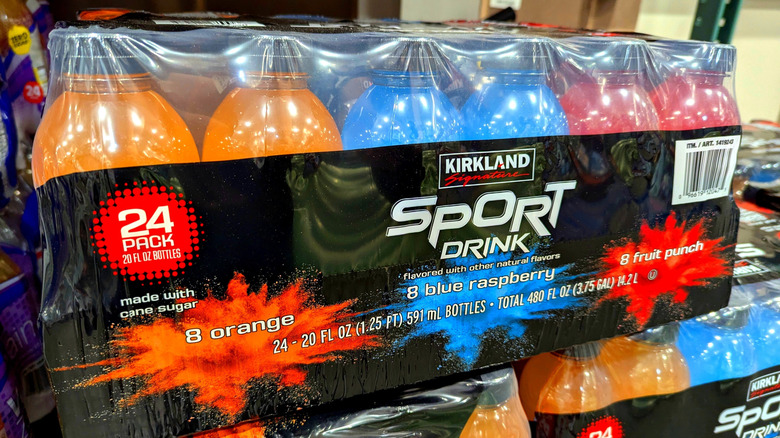
What's your favorite Kirkland Signature product? If you're struggling to answer, we totally get it. After all, the brand offers hundreds of items under this label, ranging from canned tuna and different cheeses to various types of whiskey and beyond. Heck, you can even buy Kirkland Signature hair regrowth treatment.
The variety is unmatched. But, of course, aside from variety, there's another big plus to the Kirkland Signature range: the prices. Its private label range is often significantly cheaper than the other branded items on the shelves, which makes it even more appealing.
But how, exactly, does Costco manage to keep its Kirkland Signature products so affordable? It turns out it has more than a few tricks up its sleeve. Read on to find out more, but spoiler alert: It's one of the big reasons why Costco stores aren't that exciting to look at (sorry, Costco, but you know it's the truth).
Membership fees
If you want to grocery shop at, say, Walmart, you can just walk through the door and do your thing. Not at Costco. If you want to browse the warehouse chain's aisles, you'll need a membership card. There are a few exceptions, of course, like going along with a paid-up family member or using a Costco Shop Card, but for the most part, you need to be a member to shop at Costco. And of course, you need to pay for that privilege.
Costco charges membership fees for good reason. They help the whole chain turn a profit, and this, in turn, helps to keep the items on the shelves (including Kirkland products) priced competitively. When you buy a Costco membership, you basically pay for access to the warehouse chain's cheaper items, but you're also actually helping to subsidize those prices, too.
Costco has two membership options, Gold Star (which, at the time of writing, is $65 a year) and Executive (which is $130 a year). As you'd expect, the Executive option comes with more perks, like early shopping hours and monthly credit for deliveries, but Gold Star still gives you access to several benefits, including the ability to shop its Kirkland Signature lineup.
Bulk purchasing
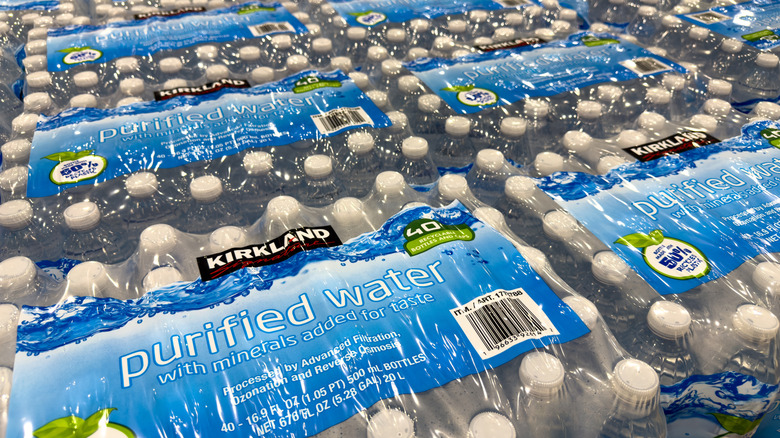
Need more bottled water? How about fabric softener? Maybe some trail mix snack packs? You'll find it all at Costco sold under the Kirkland Signature brand, but there's a catch: You can't just buy one of each; you need to buy in bulk.
Bulk purchasing is central to Costco's business model for many reasons. Firstly, it allows the company to negotiate good deals with its suppliers. It works like this: Costco agrees to buy multiple products and sell them with the Kirkland Signature branding (yes, many popular brands are hiding behind that private label), and in return, the supplier gives the chain a lower price. Costco then doesn't have to hike up its own prices to turn a good profit, and customers feel like they're getting a good deal.
That said, it's important to be mindful when shopping at Costco. The warehouse chain's model also relies on a little bit of psychological manipulation (which is not uncommon in retail). You feel like you're making a saving on everything by buying in bulk, and so you buy more, and more, and more. Then you walk out spending far more money than you would have at a different retailer. Are the deals worth it? Only you have the answer to that question.
Strong relationships with manufacturers
Costco wouldn't be able to negotiate good deals if it didn't have strong relationships with its manufacturers. To nurture and build those relationships, it has to offer its partners good long-term benefits. And fortunately for its manufacturers, it's very good at doing that.
Firstly, Costco is in it for the long haul. If a manufacturer becomes a Costco supplier and performs well, they can expect repeat business. Secondly, Costco offers its long-term, trusted manufacturers rewards. If they produce for Kirkland Signature and it goes well, they might be able to offer their branded products in the store in future, too.
Thirdly, when you're in with Costco, you have access to a huge audience. In the U.S. alone, it has over 600 warehouses in nearly 50 states and territories. It's also actively expanding. By the end of 2026, for example, it aims to have more than 940 locations around the world.
Keeping operational and overhead costs low
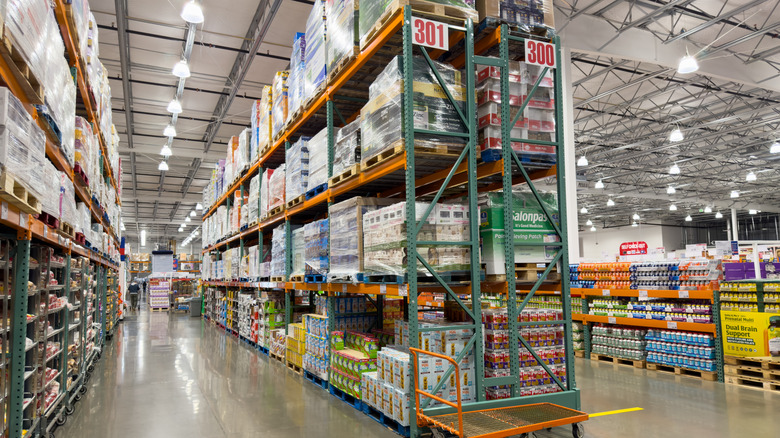
Have you ever heard the phrase, "you've got to spend money to make money"? In many cases, that's 100% true. Running a retailer, for example, can be seriously expensive. You've got to pay for things like labor, equipment, utilities, rent, security, distribution, and stock warehouses, for example. It all adds up. In many cases, the costs can translate to the consumer, meaning the higher the costs, the higher the product prices need to be. Costco, however, does everything it can to save on these costs, so it doesn't have to crank up the prices of its private-label items so it can pay its bills.
One key example of how Costco keeps its prices low? Its very simple approach to aesthetics. Costco isn't about looking pretty; it's a warehouse, and it looks very much like a warehouse. On that note, the chain isn't paying to keep its stock anywhere else. Everything is taken straight from the truck and into the store, where it's kept on pallets above the shelves until it's ready to be put out.
Another example of where it might be reducing its operational costs is its slightly later opening times. It often opens around 9 a.m. for Executive members and 10 a.m. for everyone else. That's a full three hours later than most Walmarts, and it inevitably means it's saving on utility bills.
Zero advertising spend
Speaking of saving on business costs, Costco doesn't spend anything on advertising. Seriously, zilch. You might be thinking: But aren't I reading about Costco, like, all the time? That's true, but it's not paid marketing, it's organic, genuine content. Those food influencers you see on TikTok? Also not paid by Costco. They do it because they love it. Okay, that's not strictly true. The chain does have an affiliate program, but all that means is that Costco pays the influencer a percentage of sales — it doesn't pay them directly.
By choosing not to spend on advertising, Costco could be saving, quite literally, billions. That's not an exaggeration. Chains like Walmart and Target spend billions every year on it. Instead of marketing, Costco relies on selling good quality products and memberships that guarantee its shoppers good value. Inevitably, word gets around, and more and more people want in. At the time of writing, Costco has more than 145 million cardholders. Advertising schmadvertising.
Keeping card transaction fees low

If you've been caught out at the Costco checkout trying to use a Mastercard or American Express card, you're not alone. On Reddit, many Costco workers complain about having to explain to customers continuously that the store only accepts Visa. But while it might be inconvenient for customers (and a little frustrating for employees), there's a good reason why Costco only accepts one particular type of card payment. You guessed it: It has a lot to do with saving money.
Ultimately, if Costco were to accept American Express cards, for example, it would have to pay more in merchant fees, which it is not interested in doing. One, because it would cost the company more, and two, because it would cost the customers more (because it would have to increase its prices to make up for the fees). So next time you're at the checkout being asked to use Visa over Amex, remember: This is all for the greater good. And by the greater good, we mean budget-friendly Kirkland Signature products.
Keeping variety to a minimum
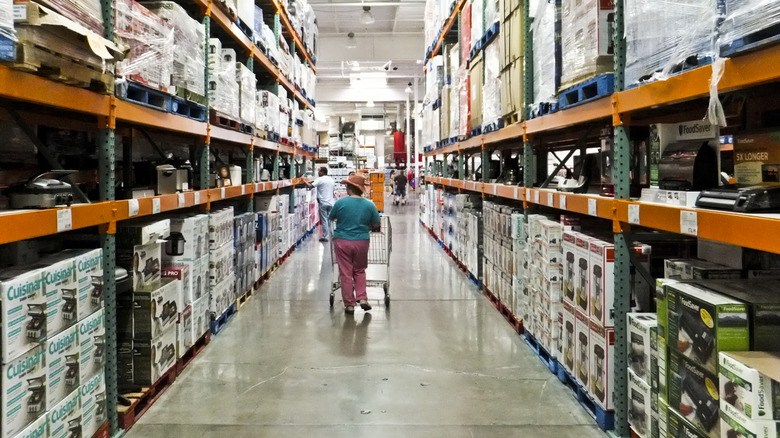
There's no harm in being picky. If you need proof of that, just look at Costco. The retailer is notoriously selective with its products and which manufacturers it chooses to partner with, but in the long run, this helps it prioritize quality without sending prices through the roof.
In fact, Costco stores only offer customers around 4,000 products, while other grocery stores offer around 30,000. But it can be far more. Walmart, for example, sells millions. In 2025, the retailer's website had around 420 million live listings. Kroger has significantly fewer products than Walmart, but far more than Costco. In 2024, for example, it had around 70,000 live listings.
Costco's smaller product selection doesn't impact its sales, though. In fact, Kirkland Signature generates more revenue than major brands like Nike, United Airlines, and Coca-Cola. Say it with us: Quality over quantity.