

What Went Wrong For A 1990s Themed American Restaurant Now Down To 22 Locations
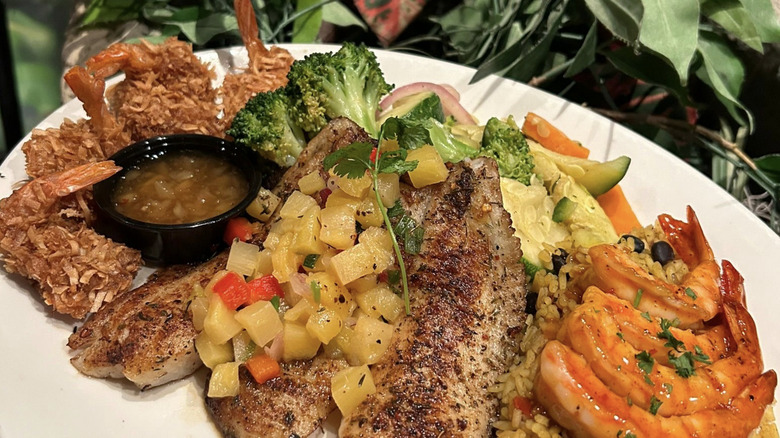
There's no doubt that themed restaurants had a moment in the '90s, back when whimsically minded foodies could dine surrounded by a dense menagerie of faux jungle greenery and eccentric animatronic rainforest animals. We are, of course, talking about the quirky Rainforest Cafe, perhaps one of the most immersive experiential chain restaurants of all time. Wide-eyed wanderers dine to a thematic, ambient soundtrack of parrots screeching, monkeys chattering, and rainfall. Servers dressed like safari guides greet each table with the words "Your adventure is about to begin," and simulated thunderstorms roll in every half hour, misting the canopy of the dining room with water. So, what happened to the once well-known eatery? Here's how the brand fell from prominence.
At its peak, the jungle-themed eatery had over 40 locations. Nowadays, there are only 22 remaining Rainforest Cafes where foodies can still get a taste of the beloved phenomenon — but it's a far cry from the chain's technicolor heyday. The first-ever iteration of the eatery was constructed by electrical engineer Steve Schussler inside of his own 3,000-square-foot home in a Minneapolis suburb, complete with custom-made rock formations made from concrete, two 600-gallon fish tanks, a greenhouse filled with butterflies, robotic gorillas, two 150-pound tortoises, and a full-sized waterfall feature. The $400,000 investment initially struggled to find investors, but after a few years of searching, Schussler's imaginative concept paid off in spades.
The Rainforest Cafe's all-out concept struggled to stay afloat
When the Rainforest Cafe opened its first official location inside the wondrous Mall of America in October 1994, it cost $1,000 per square foot to construct due to the densely detailed, functional decor. Fans waited in line for hours at a time to get a table. Three years later, the venture expanded to six locations, each of which pulled an annual average of over $8 million by the end of the decade, sometimes grossing up to $15 million in a single year. Even Disney World's Animal Kingdom picked up a location. Incidentally, the Disney location remains open today, along with a second location in Disney Springs.
At its peak, the Rainforest Cafe even saw visits from "it" '90s celebrities like actress Kate Beckinsale and Michael Jackson. But, by 1998, revenues began to dip, a denouement expedited by the gradual fade of mall culture. In 2000, Rainforest Cafe changed hands to Landry's (the company that also owns Morton's The Steakhouse), and it was never really the same again.
The Rainforest Cafe concept demands costly maintenance, which isn't possible without consistently high foot traffic. Beyond the pricey initial restaurant construction, a single robotic elephant can cost over $20,000 to build, not to mention the cost of regular animatronic repairs. No more of the live birds and tropical fish of yore either, which require handlers and animal care specialists. Reduced operating budgets have resulted in a doggedly enduring Rainforest Cafe that remains gimmicky, but not exactly nostalgic.
A doggedly enduring nostalgia play
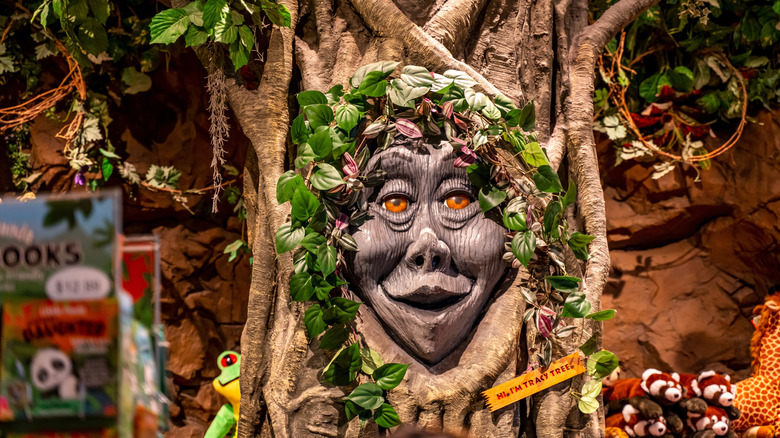
Today, the Rainforest Cafe's 22 remaining locations seem to be a good place to bring young children, but that's about it. For grown-up, original fans of the chain, a visit offers more of a shadow of the past than an opportunity to relive it. Currently, Rainforest Cafe restaurants remain primarily in the U.S., with two in the United Arab Emirates and one each in Ontario, Canada; Paris, France; Tokyo, Japan; and St. Julian's, Malta.
Illinois' last Rainforest Cafe resides in a Chicago-based shopping mall and features a 2.8 out of 5-star Yelp rating — neither exceptional nor exceptionally bad. "Rainforest Cafe was something made of MAGIC in the 1990's and early 2000's and unfortunately, 1999 is exactly where this cafe has stayed," wrote one hopeful-yet-disappointed reviewer. "The animatronics are outdated, and the quality of sound was absolute trash." The review also lamented the lack of fish tanks and the low quality of the food. Enduring fans' fond recollections come from the chain's vibrant, eclectic design concept, not the food. Yet, over the years, that concept has lost its liveliness.
To some, Rainforest Cafe remains a playful escapist dream — and, notably, not wildly different from other immersive "eatertainment" concepts like Hard Rock Cafe (the largest being in Orlando), Dave & Busters, or Margaritaville, which also have their own gift shops. It's just expensive to maintain, and adults — the ones holding the wallets, at the end of the day — aren't its target audience.