

Need A New Microwave? Here's How To Pick The Best One For Your Kitchen
We may receive a commission on purchases made from links.
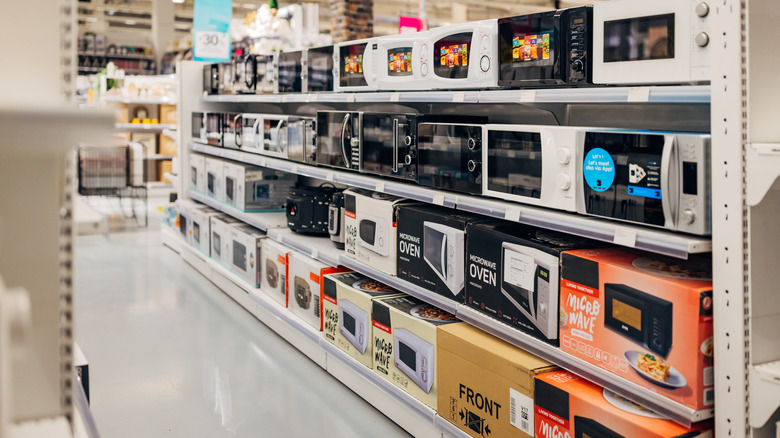
Microwaves have come a long way, from bulky commercial units in the 1950s to the variety of compact, efficient models we see today. In fact, a majority of American households have at least one. My home has three: one in the kitchen, one in my office, and an emergency backup in storage.
But the sheer range and variety of options can become an issue when you're trying to pick the best microwave for your kitchen. Here's a quick overview of modern models, and a guide to figuring out what's right for you.
Why should you care about my opinion? Well, as a trained chef and former restaurateur, I've worked a lot of microwaves over the years, in venues ranging from restaurant and commercial kitchens to teaching kitchens, church and community kitchens, upscale homes where I've done private catering, and of course in my own home. That's given me insight not just into features and styles, but nuances like how your microwave affects work flow in the kitchen. So with that in mind, let's get started.
The two broad categories of microwaves
If you look on any major retailer's or manufacturer's site, you'll see a lot of different styles of microwave. Each company can choose its own set of categories, depending which segments of the market they're targeting, and which features they want to promote, but that just tells you their priorities. I'm going to focus more on how they fit into your priorities, so I'll simplify by lumping all microwaves into two broad categories.
First, we have free-standing microwaves. Those include conventional countertop microwaves and combination microwaves that incorporate additional capabilities, such as convection microwaves and newer multi-purpose units that combine some amalgamation of convection, broiler, toaster oven, and air fryer features.
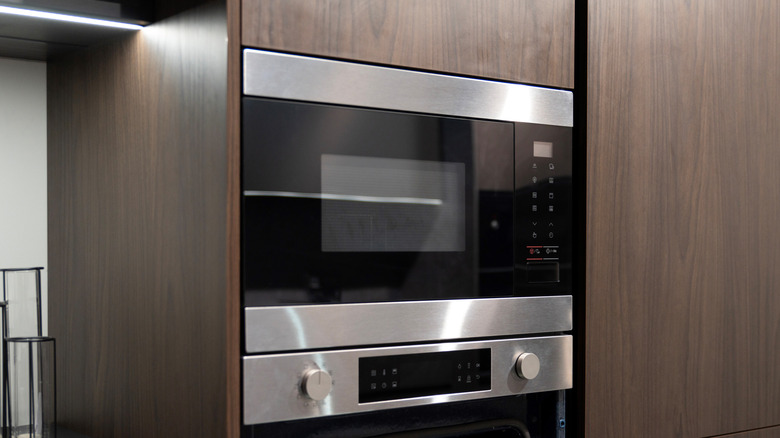
My second category is built-in or "installed" microwaves. These don't sit on your counter, but instead are mounted permanently in a designated place in your kitchen. They include over-range units with an integrated vent fan, low-profile, over-range or under-cabinet models, under-counter or in-drawer models, and all-oven microwaves, whether alone or in combination with a conventional oven. Both categories have their pros and cons, which I'll touch on shortly, and of course some popular microwave brands simply offer better quality than others.
Free-standing microwaves give you the most choice
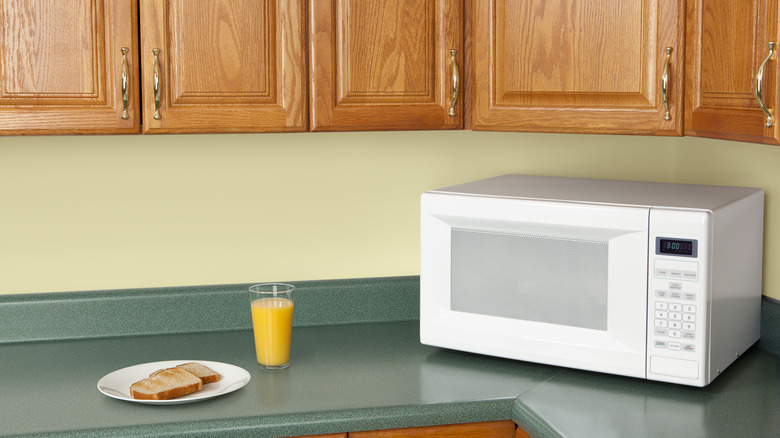
The vast majority of microwaves are freestanding countertop models, so if that's your preference you'll have as many options as you could possibly want. They range from tiny dorm-room units (we'll ignore those, since we're picking a kitchen unit) to jumbo, full-featured models at 2 cubic feet or more, and in a dizzying variety of features, colors, and styles.
Variety and availability are big plusses with countertop units. Depending on your needs, it's perfectly possible to walk out of a store with exactly what you want, right now (or order it online for immediate delivery). You'll also have the widest possible range of prices, so countertop units are where you'll typically get the best value for your dollar.
The big downside to countertop models is that, well, they take up a hefty chunk of counter space, or floor space if you give one its own stand or cart, like this unit from the ThreeHio brand. For those with space constraints, which is most of us, there are also shelves to go over your microwave, like this one from Herjoy, so the space on top is usable for other things. My own main microwave lives where the kitchen meets the dining area, on a fixed stand that gives us some much-needed extra storage.
Built-in microwaves are stylish and space-efficient (but at a price)
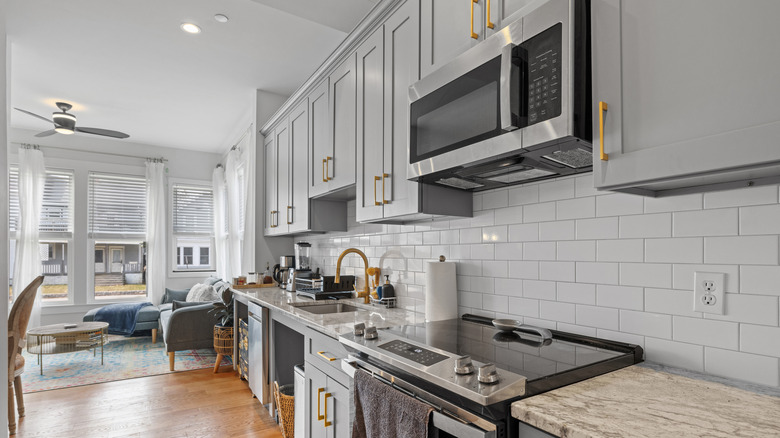
Some kitchens I've worked in have built-in microwaves, and there's a lot to like about those. The right built-in gives your kitchen a higher-end look, and it can be extremely practical. An over-range microwave unit saves space and does double duty as a hood, and a wall-mount microwave — with or without the matching wall oven — can make for a highly efficient workspace in your kitchen. Under-counter or in-drawer units, which put the microwave at waist height or below, can be a real convenience if you don't want to stretch to put dishes in or take them out.
The cons? Well, you can expect to pay more up-front for your microwave, compared to countertop units with similar features. Then you'll need to think about installation costs, plan around longer delivery times, and the fact that you can't just drop one off at the shop (so you'll pay for a tech to come to you). It's often most practical to have one installed as part of a larger kitchen remodel.
Also, bear in mind that microwaves don't last especially long: Typically just 5 to 10 years, with 8 being about average. Improper installation (usually inadequate venting and air circulation) can shorten that, and do you really want to tear up your cabinetry on a regular basis? It's something to think about.
Settle the big-picture questions first
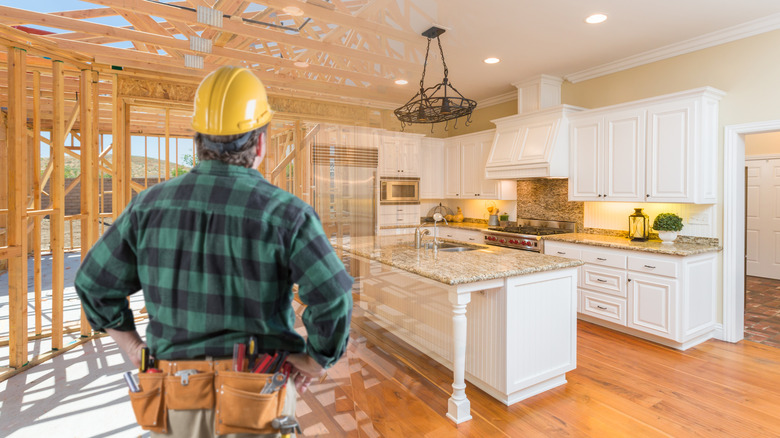
In any big project or purchasing decision, I'm a fan of settling the big questions before committing to the details. Once you've settled what you want, functionally and esthetically, you can start comparing specific models.
It's easiest if you're just picking a like-for-like replacement for your old unit, because anything that's comparable in size, features, and appearance will work. Alternatively, you could take the opportunity to upgrade, thinking hard about the pros and cons of the old one, and looking for something that ticks the right boxes for you. If you're starting fresh, asking yourself "where am I gonna put that thing?" is surprisingly important. Something as simple as a door that opens the wrong way can really be irritating.
When replacing a built-in, you'll also need to know whether its size and venting requirements match your old model. For a new built-in, be sure you can get the features and style you want within your budget before you commit. Lead times are longer for built-ins, especially as part of a full remodel. Your designer and contractors need time to plan the wiring and venting before they start the installation (making them do it on the fly is a mistake to avoid when renovating a kitchen). Additionally, built-ins often need to be special-ordered weeks, even months, in advance.
How to choose the features you want in a microwave

The features on microwaves are always changing, as manufacturers try to gain an edge on the competition, so yesterday's top-tier highlights are today's table stakes. For example, 1000-watt microwaves used to be high-end, but now they're routine and many models offer even more power (to be clear, 1000 watts is a good wattage for most households unless you're getting an oversized model that needs more oomph).
It's not hard to find the features of the models you're looking for, because they're proudly emphasized in the manufacturers' marketing materials. Chances are, there are a lot of features you're not using on your microwave already, so think hard about what you really want. Some features you may want to consider include programmable cooking/defrost settings, smartphone/app integration, multi-stage or sensor cooking (which helps with more complicated dishes), inverter technology (microwaves heat unevenly, but inverter technology mitigates that), and oversized interior space (2 cubic feet or more), so your microwave can handle larger items. Remember to be clear about what's a "gotta have" feature, and what's just "nice to have." Then, get as many of them as you can, given your space and budget constraints.
Think about how you work in the kitchen
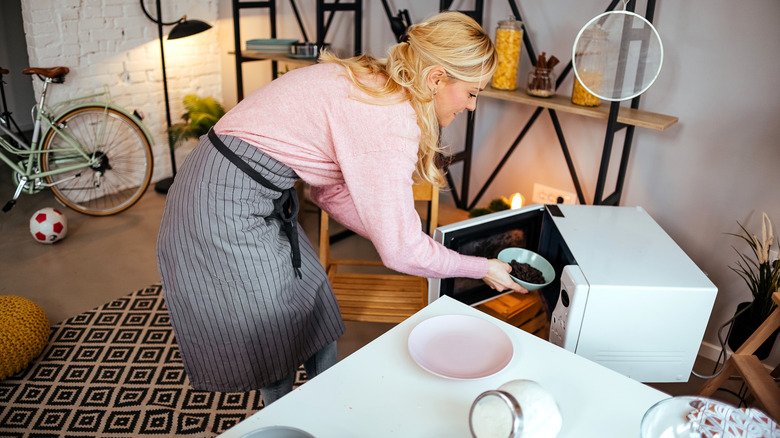
Another thing people sometimes overlook is how you're going to incorporate the microwave into your regular cooking pattern. An old-school rule of kitchen design called for an efficient "work triangle" between the sink, stove, and refrigerator. I personally find my prep space more important than the sink, so I favor the more modern rule of clustering appliances, storage, and work spaces into "zones" of related activities.
So as long as your microwave will fit into a space that's reasonably convenient, you should be fine in broad terms. Think it through, though: If you're short, do you want an over-stove model that you'll need to stretch for? If you're tall, do you want an in-drawer unit you'll need to bend down to? Would a wall-mount microwave need to be inconveniently far from your main workspace? Would putting one on a stand or cart turn into a space-hogging irritation for you? Would the esthetic value of hiding it in an appliance garage be nullified by your kids just leaving it open all the time?
Again, while the best places to put a microwave will vary between kitchens, you shouldn't get hung up on rules. There are no right or wrong answers, just things to think through. In my own case, putting the microwave outside the kitchen itself wasn't ideal, but it's close enough, it added storage, and being able to reheat things in the dining area is a convenience in its own right.
Got space constraints? Think about a microwave combo unit
Hi, my name is Fred and I hoard kitchen gadgets, welcome to Clutter Anonymous! In my defense, I'm pretty selective. I collect either top-tier appliances (like my Zojirushi Rice Cooker and Warmer and Zojirushi Home Bakery Supreme Breadmaker), or vintage appliances (like my old Sears waffle iron), whenever I find them at a good price. The problem is that they all take up storage space or counter space, neither of which are plentiful at my house.
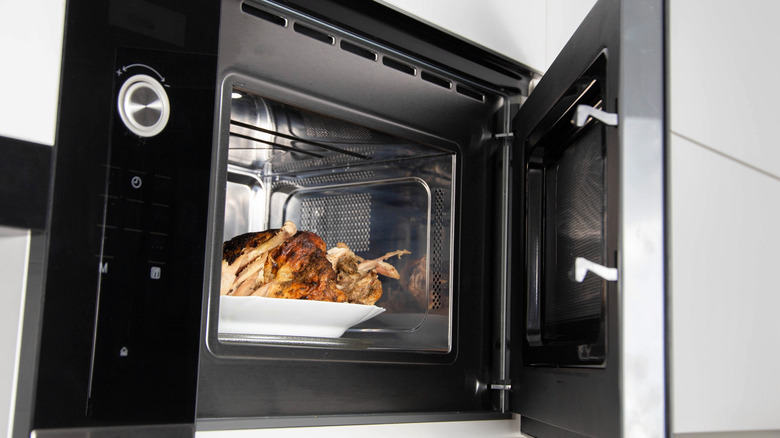
Built-in microwaves make space on your counter, but they're costly, as I've already established. You might find that a combo microwave is the simplest way to get all the functions you want, in a small space. Basic combo microwaves might incorporate convection heating, for example, to brown baked goods and crisp bacon (I had one in one of my own restaurants). Modern units might have conventional countertop or toaster oven capability, broiling, air frying, or even give you the nostalgic bonus of under-microwave workspace lighting, aside from their core microwave functions.
There's some debate over whether these multifunction appliances are worth it. They may not serve any of those additional functions as well as a separate standalone unit, and of course the added complexity means there are more things to break. Worse, one breakdown might take away all of your daily-use cooking options. Still, they can be a real game-changer, in small kitchens especially.
Gas stove users should be wary of over-range microwave/hood combos
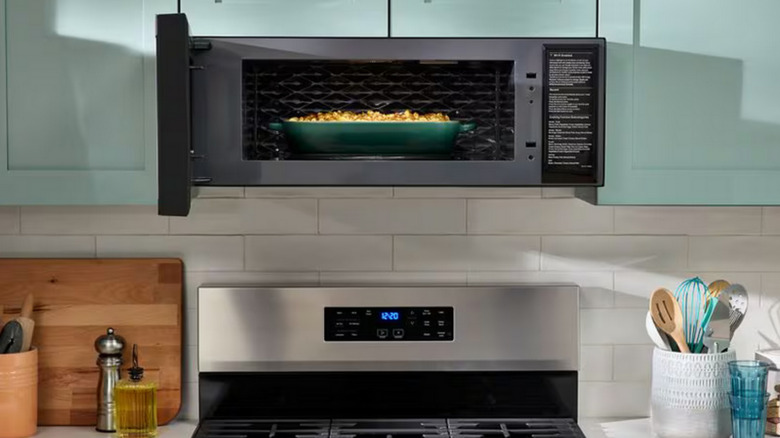
One thing I miss about restaurants is industrial-strength range hoods. I really appreciated how they suck smoke and spatters out of the air. Not only does it literally "clear the air," it means a lot less grease to scrub off, and I've done enough of that for one lifetime. It's especially important when you have a gas stove, because that range hood plays a bigger role than you'd think in your kitchen.
Gas has come under fire recently on environmental grounds, but research shows it can also have serious impacts on indoor air quality and your family's health. If you love cooking with gas, the best case is a hood that vents to the outdoors, moves enough air (measured in cubic feet/minute, or CFM), and also has a big enough opening to effectively inhale the grease and pollutants (capture efficiency, or CE).
Over-hood microwaves often don't measure up, because they can't capture air like a big hood. For gas, 250 CFM is a good minimum but 400 to 600 CFM may be more appropriate (or even higher, if you have a big, commercial-style range). Add another 100 to 200 CFM if your stove is on an island, where there's no wall to help steer air to the vent. It's hard to get a microwave with that kind of venting power, so you may be better off buying a hood separately and putting the microwave somewhere else.
A few crucial points about microwave safety
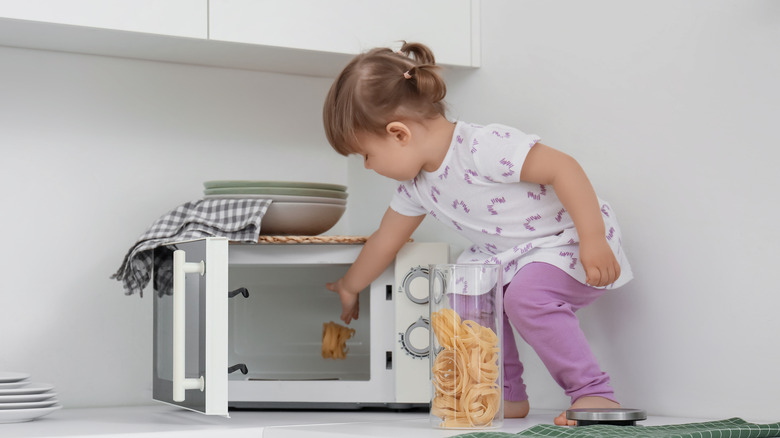
Microwaves can fly under the radar, where safety is concerned. They don't have sharp blades or an open flame, so we forget how dangerous they can be. I've personally seen (and experienced) enough accidents to be wary of them, so I know it's something to think about. That goes double if you have kids in the house, or anyone with physical or cognitive issues. Safety factors can play into your choice of microwave, and where you choose to set it up.
In the case of an over-range or under-cabinet microwave, for example, it might be too high for a child or short person to safely remove hot foods or liquids, without a risk of spillage. That can cause nasty burns, especially if that liquid is superheated. The worst burn of my working career happened that way, in fact. So if your kids are old enough to use the microwave unsupervised, you might want to place it at a height that's safe for them, if a bit low for you.
On the other hand, having an under-counter or in-drawer microwave (or one placed on a low shelf on an island or rolling cart) puts it squarely within the reach of kids who might not yet be old enough to use one safely. If that's where you plan to put your microwave, and you have kids of a vulnerable age, prioritize getting a microwave with a child-lock feature.
Choosing the best microwave when you have special needs
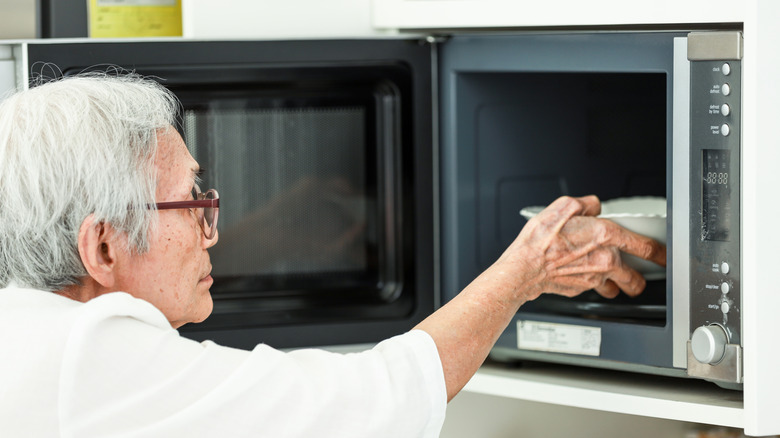
Selection and placement of a microwave are more complicated when someone in the home deals with physical or cognitive issues, like my own girlfriend and mother (and I'm not getting any younger myself). This may not be top-of-mind for you right now, but the CDC estimates that about 1 in 4 Americans have some form of disability (higher among the elderly), and even the healthiest person is one accident away from at least a temporary disability.
So selection and placement are important. An in-drawer or under-counter unit, for example, or one on a low shelf of a rack or island, is more accessible for wheelchair and scooter users. You might also consider whether there's a place for someone with only one good hand, or a cane or walker user, can safely set down a hot dish once it's out of the microwave.
Then there's the design of the microwave itself. Does the door open with a push button, or a large and easily-grasped handle? Does it have lots of one-button presets for cooking modes? Those can be a boon for someone with dexterity issues or mild cognitive impairment. When my mother could still live independently, she relied on them to help her cope with her limitations. And, if someone in your home is not cognitively capable of using the microwave safely, a child lock is — again — a make-or-break safety feature.