

How Food Traditions Vary Across Asia During Lunar New Year
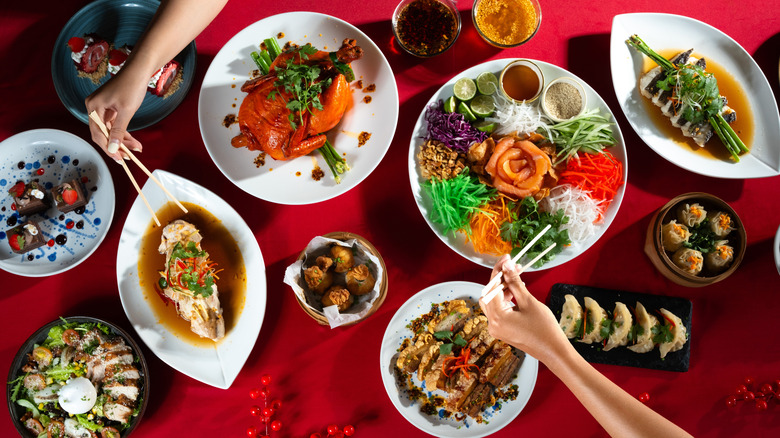
Lunar New Year, also known as Chinese Lunar New Year and Spring Festival, is one of the world's biggest holidays. The 15-day celebration is not only observed in China, Singapore, Malaysia, and other Asian countries but by 2 billion people worldwide. That said, there are other Asian countries with their own, distinct Lunar New Year traditions, and like China's, they've been around for thousands of years.
Lunar New Year is actually just a general name for the celebration of the arrival of spring, which, according to the lunar calendar, starts on the second new moon after the winter solstice. Across Asia, it marks the beginning of a new year and is a period in which people honor ancestors and deities, practice traditions, and spend time with family, among other joyous activities. At the heart of the celebration, however, is a wide assortment of delicious foods that carry symbolic meaning, serving as the glue, or rather, vessel through which these traditions continue to pass from generation to generation.
While it is impossible to cover the full range of diverse foods enjoyed in each country, there are, in fact, specific dishes with more symbolic importance than others. Here is how food traditions vary across Asia during Lunar New Year celebrations.
China
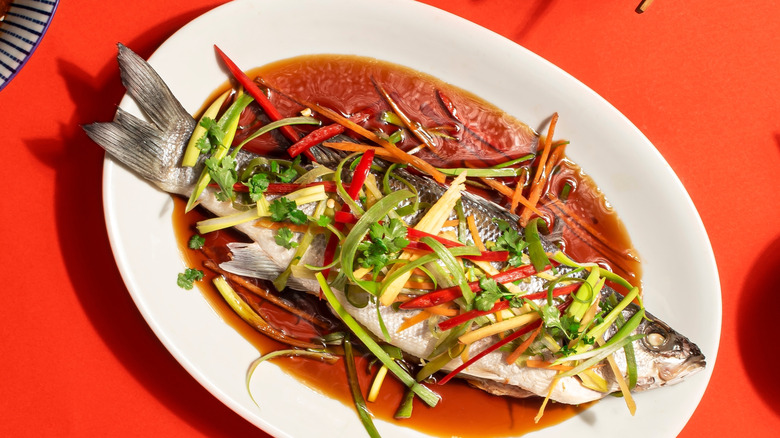
The cities are quieter than usual during the Lunar New Year in China, as many people depart for their grandparents' or parents' hometowns. While traditions vary somewhat throughout the country, the big feast is typically reserved for New Year's Eve as a reunion for families who live apart. The three main foods on every table include steamed fish, long noodles, and dumplings.
Fish, or "yú" in Mandarin, has a pronunciation that sounds similar to "yù," the word for abundant or surplus. As such, fish is served whole because it symbolizes abundance. However, people always leave leftovers as a wish for an abundant new year. While many types of fish are enjoyed, the crucian carp and the Chinese mud carp are considered the luckiest types to serve at your feast. The latter is pronounced "líng yu," which sounds like "liyu," the Chinese word for gift. Catfish is also popular.
Changshou mian, or longevity noodles, is a traditional dish that features very long, uncut noodles that can sometimes reach a foot in length. It symbolizes the hope for a long and healthy life. Dumplings, which resemble an ancient Chinese currency called sycee, represent prosperity. The belief is that the more you eat, the more money you'll make. Other symbolic foods include whole chicken, leafy greens, citrus fruits, turnip cake, a sweet rice ball soup called tangyuan, fried spring rolls, and nian gao, a sweet sticky glutinous rice cake that's also given as a gift.
Taiwan
A large number of Chinese have lived in Taiwan since the 1940s, and today, they make up over 95% of the population. The celebration of the Chinese Lunar New Year in Taiwan has many similarities to that of China. Fish, sycee-shaped dumplings, rice cakes, and citrus fruits are still popular, among other foods. That said, a closer look reveals that Taiwan is actually a cultural melting pot composed of Han Chinese subgroups and people from throughout Southeast Asia, so the spread can look decidedly different.
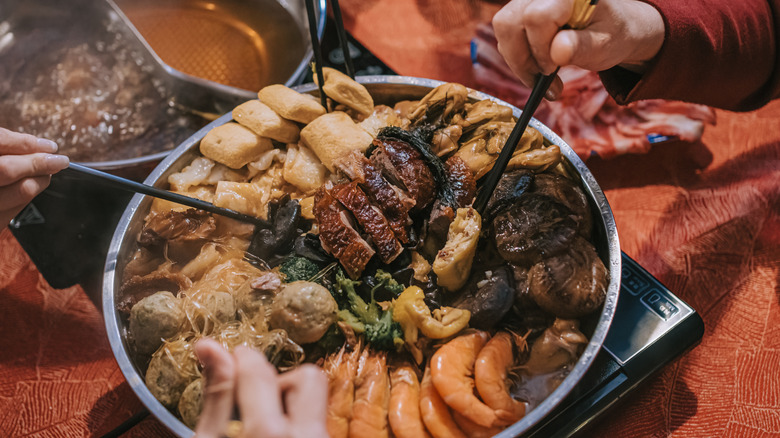
On the first day of the New Year, people eat zhu jiao mian xian, otherwise known as braised pig knuckles with noodles. Carp is still a go-to fish variety, but locals enjoy steamed grouper and marble goby just as much, along with horsehead tilefish served with stuffed tofu. Taiwanese dinner tables are round, so hot pot is fairly common as well. People typically purchase excess hot pot ingredients as a way of honoring the symbolism of abundance and surplus. "Buddha Jumps Over the Wall" is one such hot pot dish, consisting of squid, scallops, winter bamboo shoots, chicken, and ham. Dried mullet roe is another must-have delicacy.
A sweet treat you won't find in China is Taiwanese pineapple cake. Pineapple is called "ong lai" in Taiwanese Hokkien, and when spoken, it's phonetically similar to another word that loosely translates to "fortune comes." Interestingly, pineapples may have been introduced to Taiwan via what is now called Malaysia in the present day.
Vietnam
In Vietnam, the Lunar New Year is referred to as Tết Nguyên Đán, and it's the biggest holiday of the year. Unlike China's two-week-long celebration, it typically only lasts between 5 and 7 days. While there are similarities between the two — like spending time with family, exchanging gifts, and eating symbolic foods — Vietnam's Lunar New Year is a separate indigenous holiday that's connected to the agrarian culture. And, it may even predate the Chinese Lunar New Year.
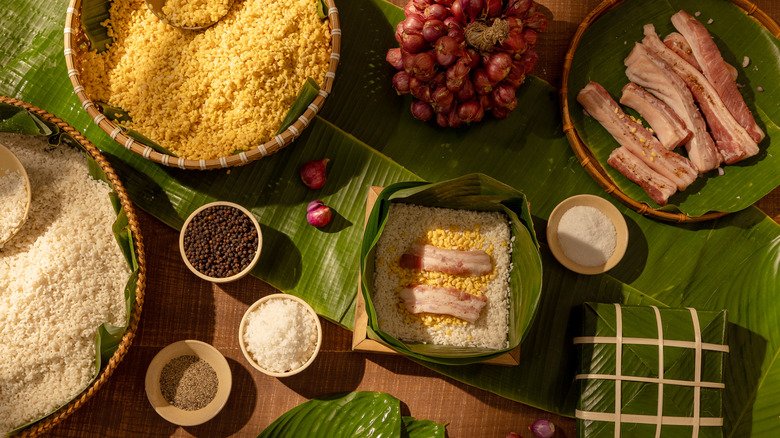
The centerpiece of the table is a five-fruit platter called mâm ngũ quả. It consists of kumquats, oranges, pomelos, persimmons, and bananas, and symbolizes a prosperous new year. Rice cakes are also popular in Vietnam, but instead of nian gao, people make bánh chung, a savory glutinous rice cake blended with green beans and pork, wrapped with phrynium leaves, and served with pickled onions. It's most commonly found in the North, and it represents an homage to the ancestors. In central Vietnam, however, people prefer "bánh tét," a cylindrical rice cake that can be made sweet or savory.
Other popular dishes include braised pork with egg, stuffed bitter melon soup, boiled chicken, gio lua, which is another leaf-wrapped dish filled with minced pork loin, and thit dong, otherwise known as meat jelly, a dish that represents the wish for strong and loving family bonds. Each of these dishes has its own symbolic meaning, along with other foods enjoyed during Tết.
North Korea
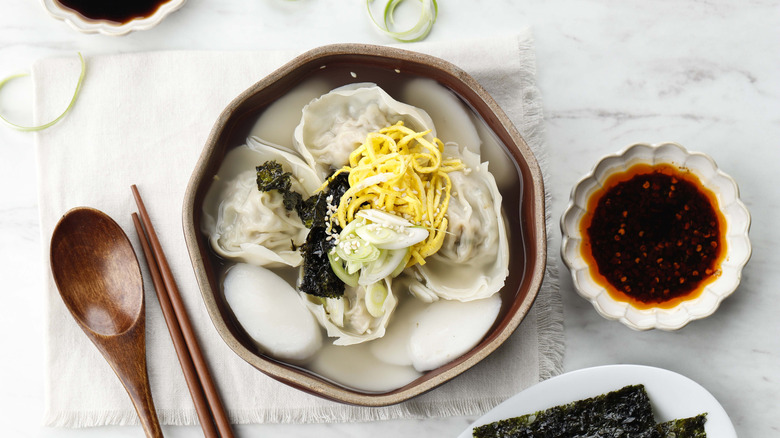
The Korean Lunar New Year is referred to as "Seollal" in North and South Korea. It takes place over three days, during which people take off from work to participate in activities, observe ancestral traditions, and spend time with loved ones. Both countries also enjoy many of the same symbolic dishes. For example, a rice cake soup called tteokguk is an important dish in North and South Korea that celebrates aging another year. Instead of asking someone's age, it's considered more polite to ask, "How many bowls of tteokguk have you eaten?" Many North Koreans, however, refer to it as chomsaebyeong, or "age-adding rice cake."
In the city of Kaesong, a variation called jorangttok is served that includes small cocoon-shaped rice cakes. Glutinous rice cakes, which are called chalttok and are offered to elders as a show of respect, are popular, too, particularly those coated with soybean powder, while the version known as somorittok resembles sliced cow head meat. Another North Korean variation called tteok mandu guk is made with beef broth, kimchi-stuffed dumplings, and topped with seasoned beef.
South Korea
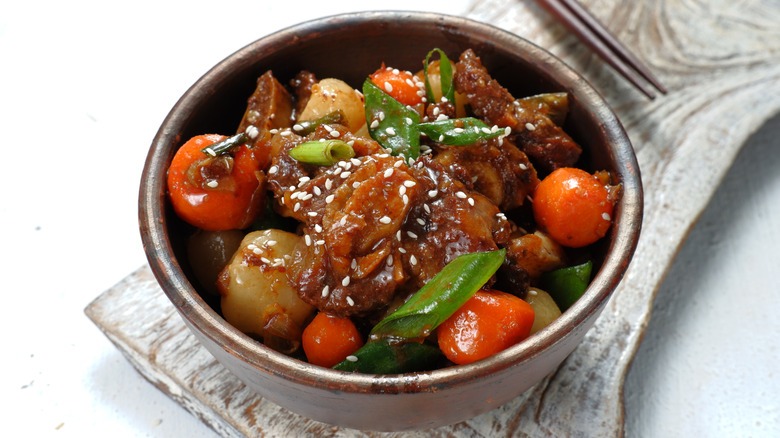
The South Korean celebration of Lunar New Year revolves around many of the same traditional foods and drinks as its northern counterpart, including the digestive beverage sujeonggwa, which North Koreans spell as sujonggwa, along with sikhye, a sweet fermented drink made of white rice and barley, and the aforementioned tteokguk.
The biggest difference between the two countries when it comes to cuisine boils down to regional variation. There are many twists of tteokguk in South Korea that you won't find in North Korea, like in South Gyeongsang Province, where people use oysters, or Gangwon Province, where the city of Gangneung makes use of tofu and dumplings. Chungcheong is another province with its own regional variation, where, in place of rice cakes, locals use flour dough. Aside from tteokguk, tteokbokki, which are spicy, cylindrical rice cakes commonly sold by street vendors, is a Lunar New Year dish that was banned in North Korea in 2024.
In general, though, the differences boil down to regional variation and climate, which determines the availability of ingredients. North Korean food tends to be milder compared to the strong, spicy flavors found in the South, and it uses less meat due to scarcity.
Singapore
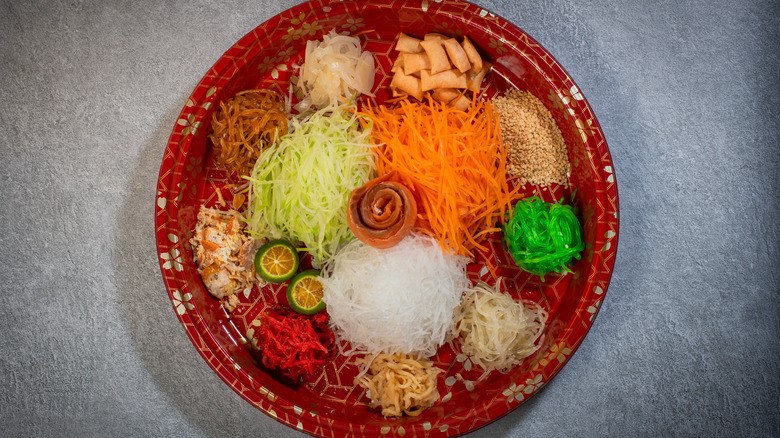
Fish is a prominent feature in all countries that celebrate the Chinese Lunar New Year. However, yu sheng (or "yee sang") is a popular fish salad that's more commonly associated with Singapore and Malaysia. Served on a large platter, yu sheng is comprised of sliced raw fish, shredded radish, peanuts, carrots, pickled ginger, and several other ingredients, and is typically eaten on the seventh day of the Lunar New Year. Singaporeans traditionally prepare it with longevity and good luck in mind, followed by shouts of "lo hei," which in Cantonese means "tossing up good fortune."
Like Taiwan, Singapore is a multi-ethnic country that's primarily composed of Chinese, though it also includes Malay, Indian, and other Southeast Asian racial groups. The mixture of diverse culinary traditions has reshaped the Lunar New Year feast into one that, in many ways, is uniquely Singaporean. For example, you might be served Indian-style chicken curry and nasi biryani, or beef rendang from Indonesian cuisine. There's also pen cai, a one-pot dish with an elegant layering of seafood, meat, mushrooms, and vegetables cooked in broth. While it is also found in China during the Lunar New Year, it's mostly prepared in the south.
The symbolic Chinese dessert, tang yuan, is a common sweet staple. But, you'll also find kuih kapit (love letter crepes), which is credited to Southeast Asia, by way of the Dutch. Pineapple tarts and cookies of various shapes and sizes are pretty popular, too.
Malaysia
Millions of Chinese call Malaysia home, which is why it comes as no surprise that the Chinese Lunar New Year is one of the country's biggest holidays. The celebration is very similar to that of China's, but there are some notable differences, especially when it comes to food. Along with the family reunion dinner held on New Year's Eve, friends and even strangers are invited to "open house" dinners on the days that follow.
As it is in Singapore, yu sheng is one of the main celebratory dishes in Malaysia during the Lunar New Year. In fact, there is an ongoing debate between Malaysia and Singapore over which country deserves credit for inventing the dish's modern variation. Something both countries can agree on, however, is that pen cai is a must-have addition to the festivities. That said, a reunion dinner isn't complete without chap chye, or braised mixed vegetables in English. The dish represents a bountiful harvest and includes cabbage, dried black fungus, dried beancurd, shiitake mushrooms, and other ingredients atop glass noodles.
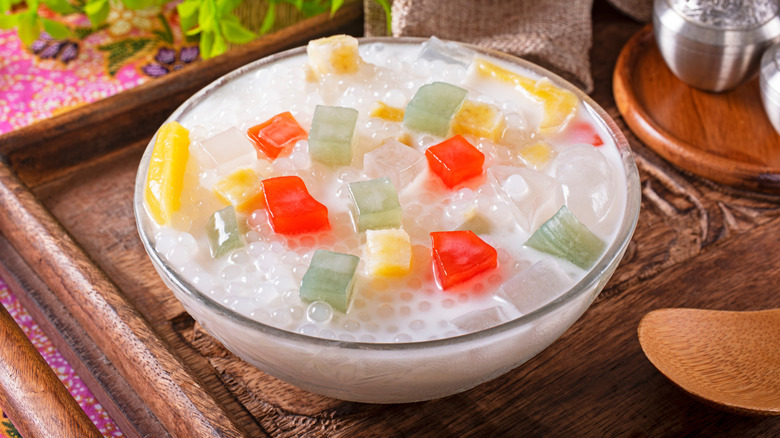
Malaysians cap the celebration off with a wide range of saccharine treats, such as bubur cha cha, a starchy dessert made with pandan-scented coconut milk soup and sweet potato, taro, black-eyed beans, and tapioca jelly. Peanut cookies and kuih bahulu, otherwise known as Malaysian madeleines, are other notable staples, along with a savory South Indian snack called murukku, and of course, pineapple tarts.
Philippines
The Chinese Lunar New Year was officially declared a special non-working holiday in the Philippines in the early 2010s, though Chinese, Filipino, and multi-ethnic Chinoy citizens have celebrated it for centuries. Festivities take place over about two weeks and mostly consist of the same traditional practices, like eating nian gao, which Filipinos refer to as tikoy. However, things begin to diverge the more you dive into the variety of foods.
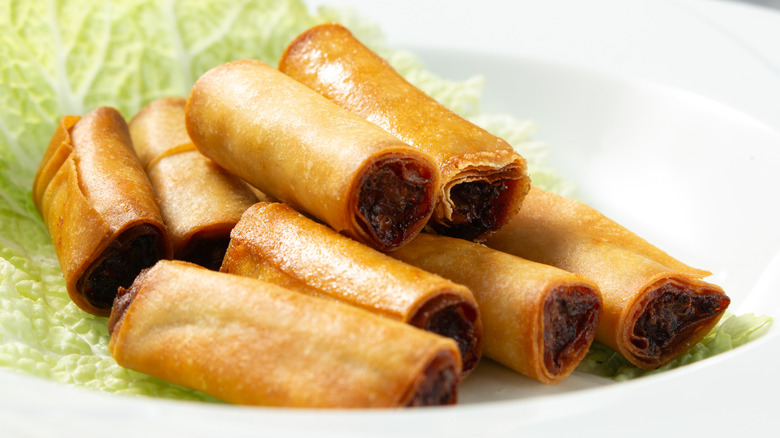
In place of spring rolls, locals typically eat lumpiang Shanghai, or simply lumpia. Longer and skinnier in shape, lumpia is made with a pastry-like wrapper and stuffed with a denser filling of pork or beef, water chestnuts, onions, and carrots. The signature noodle dish representing longevity in the Philippines is pancit; it comes in several varieties, including pancit bihon, which consists of vermicelli noodles, pork belly, cabbage, broccoli, carrots, and onion. Two of the most popular desserts include mamon, a sponge cake typically layered with buttercream frosting, and taho, a soy bean pudding made with warm silken tofu, arnibal, which is a special Filipino syrup, and tapioca pearls.
Mongolia
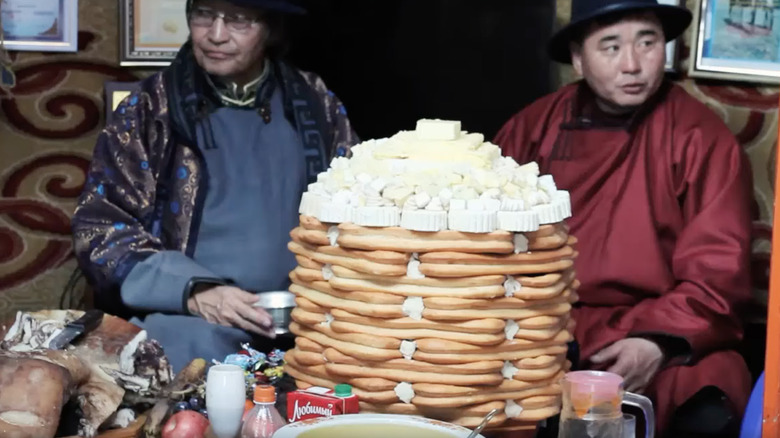
Mongolia's traditional Lunar Holiday celebration is completely distinct from China's. It's called Tsagaan Sar, which means "White Moon," and has been around since the 13th century. It's the country's biggest national holiday and lasts three days. Like the Chinese Lunar New Year, Tsagaan Sar revolves around the seasonal transition, family gatherings, honoring tradition, gift-giving, and a large feast on Bituun, otherwise known as New Year's Eve. White is a symbolic color that means goodness, holiness, and positivity, which not only connects to the name Tsagaan Sar, but also the types of foods that are eaten, as many are made of dairy.
To kick the feast off, people eat a white dessert called tsagaalga that's made with rice, ghee, various nuts, and dried fruits, though there is another variety made with milk curd and dates. The occasion's main drink is a salty milk tea called suutei tsai. Following that, several main dishes are served, including buuz, a white steamed pastry stuffed with grilled sheep and minced meat, along with boiled mutton, noodles, and ul boov, which translates to "shoe sole cake," and is a biscuit made of flour.
What makes ul boov special is how it's presented. Layers of ul boov are erected atop a wide dish in a fashion that resembles Mongolia's Mount Meru, a place with spiritual significance in Tibetan Buddhism. Sugar cubes, aarul (or sweet, dried curds), and candies are then placed on top. Other foods include a fried dough called boortsog, as well as sweetened yogurt.
Indonesia
Imlek, the name for the Chinese Lunar New Year in Indonesia, has been a national holiday since 2002. For many years prior, Chinese citizens were banned from celebrating traditional Chinese festivals due to religious discrimination and political strife. With an estimated population of nearly 11 million Chinese living in Indonesia at the time of writing, there are Lunar New Year celebrations in major cities across the country, in which non-Chinese people also take part in.
Aside from many of the traditional foods that you'd expect, like longevity noodles, which are called mie panjang, the holiday includes Chinese dishes that are less common, plus sweets from Indonesian culture. Tea eggs, or "telur teh," are one such food from South China. They're made by cooking eggs first in water, then in tea, soy sauce, and Chinese five-spice, which makes them resemble marbled deviled eggs. The signature Singaporean and Malaysian dish, yu sheng, is also popular there.
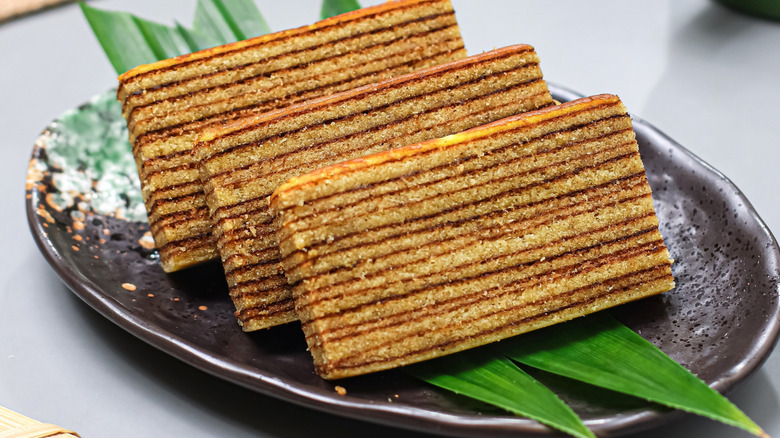
People enjoy an array of sweets, including mangkok cake, a steamed cake that looks like a blooming pastry flower, lapis legit, a beautiful layered dessert with an al dente pasta-like consistency, and a pyramid of banana leaf-wrapped rice cakes called kue keranjang. Indonesian rice cakes are distinct from the Chinese variety in taste and texture, incorporating local ingredients like pandan and durian. Another essential treat of Imlek that's often given as a gift is pineapple cake, which people refer to as nastar.