

10 Asian Snacks That Make Great Potato Chip Alternatives
We may receive a commission on purchases made from links.
If you want something crunchy beyond ordinary potato chips, there's a whole world of Asian snacks out there to tempt your tastebuds. We've found several categories of Asian snack alternatives to potato chips that may be as close as your nearest Asian market. Although, others might require an online purchase or even hunting down a recipe to make at home. Still, all of them have one thing in common with potato chips: savory flavors and satisfying crunch.
Crunchy snacks cross cultural boundaries so easily because the noise we hear when we crunch them tricks our caveman brain into thinking we're getting fresher and therefore healthier food (think crunchy versus soggy apples or celery). That's not to say that all these crunchy snacks are healthy or unhealthy, but the crunch will be just as satisfying as that of a potato chip. Plus, you'll get to experience new flavors and textures. In fact, you just might find a new favorite.
The Asian snacks on our list include chips, crackers, fried flatbreads, snack mixes, and even fried noodles with a wide variety of flavors and spices. So, if you're ready to expand your crunchy snack horizons beyond the humble potato chip, you'll want to take a look at these 10 satisfying and tasty Asian snacks and figure out which you want to try.
1. Shrimp chips
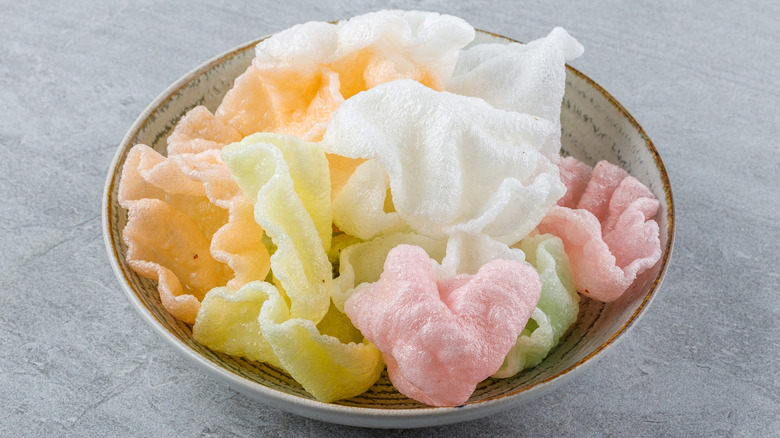
Shrimp chips are a great Asian alternative to potato chips because of its great texture and crunch. They're deep fried and are great piping hot and crisp straight from the kitchen, whether your own or a restaurant's. These chips come in various colors and are made from dried shrimp, tapioca, baking soda, and seasonings like garlic and sometimes whole peppercorns. They have an airy, porous melt-in-your-mouth yet crisp mouthfeel that reminds us of Munchos potato chips. Eating them is a little like crunching down on flavorful tasty Styrofoam, but we mean that in the best possible way. It's also a fun snack chip to make at home.
In English, you'll hear people call this snack shrimp chips, while others call them prawn crackers or shrimp crackers. However, they're found throughout Asia with different names. For example, Vietnamese have banh phong tom, Indonesians have krupuk, Malaysians have keropok udang, and Filipinos have kropek. One of the best parts about going to some Vietnamese restaurants is getting a free appetizer of shrimp chips, similar to getting tortilla chips in a Mexican restaurant. It's possible to buy brands like Sa Giang shrimp chips that come in ready-to-fry round or square disks. If you try making them at home, you'll likely be mesmerized by their otherworldly crackling sound and their 10-second transformation from a small dried disk into a large puffy chip.
2. Rice crackers
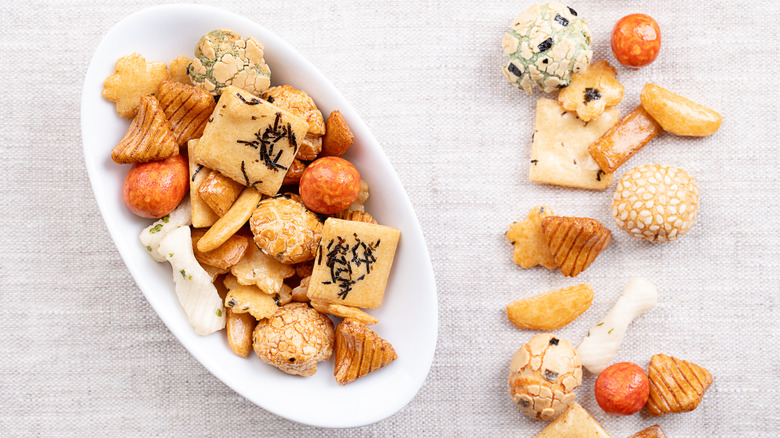
You'll find a never ending array of rice crackers throughout Asia. Before you dismiss them thinking they're like the dissatisfyingly soulless rice cakes you've likely tried as a diet food, you'll want to embrace the variety that are enjoyed in Asian countries. Once you start trying them, it might be difficult to land on just one favorite rice cracker to substitute for potato chips. We won't even try to list them all here, but we will hit some of the highlights. Some are completely savory, others are slightly sweet, and still others are spicy. But what they all have in common is a great crunch and just how addictive they can be.
Japan has a wide variety of rice crackers. Nori maki arare rice crackers are wrapped in seaweed with a savory soy sauce glaze. Japan also has himemaru rice cracker balls that mix spicy, umami, and sweet flavors together to create a delicious and crunchy treat. To try these and a variety of other flavorful and spicy Japanese-style rice crackers and crunchy wasabi peas, you can get a canister of Hapi mixed crackers.
Other countries have a different take on them. For a sweeter version, we like Taiwan's shelly senbei rice crackers, which are savory but have a frosted sugary coating on the outside. Thailand makes an interesting type that is a little sweet and a little spicy with meat floss on top, like ChaoSua rice crackers with pork floss and ChaoSua rice crackers with shrimp floss.
3. Seaweed snacks
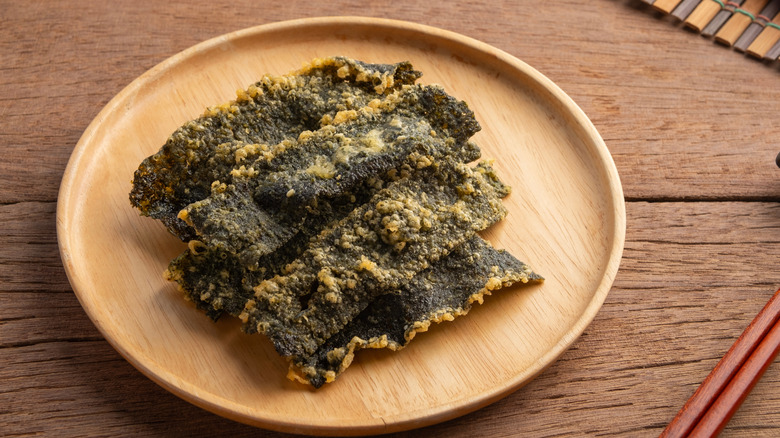
You'll find several varieties of seaweed snacks throughout Asia. If you're imagining that they're simply crispy versions of the seaweed wrappers you find in sushi, you need to expand your vision a little. Yes, the simplest versions are simply crisp roasted seaweed. Different countries have expanded upon the idea, not only experimenting with spices but also making ones that push the limits of what's possible to adhere to seaweed, like batter, seeds, and various crispy ingredients.
The more simplistic versions are plentiful and often easy to find without needing to make a trek to an Asian grocery store. In fact, Costco has an Asian-inspired version that's fairly decent. For more flavor, though, you might want to go authentic. For example, Thailand's Tao Kae Noi brand has simple crisp seaweed sheets that come in a multitude of flavors like tom yum gung, seafood, and spicy.
If you're looking for something a little different, Japan has seaweed fried with a tempura batter, like Tao Kae Noi tempura seaweed chips. South Korea makes Geem seaweed snacks, which takes seaweed crisps to the next level by adding ingredients like rice crisps and sesame seeds, along with flavored glazes ranging from sweet to salty or spicy. Taiwan has N.O.I. baked crispy seaweed that takes this idea even further with adding spices and ingredients like almond slices, sesame seeds, pumpkin seeds, even cuttlefish, and shrimp. So, you can pick just how simplistic or fancy you want your seaweed snacks.
4. Papadum crisp flatbread crackers
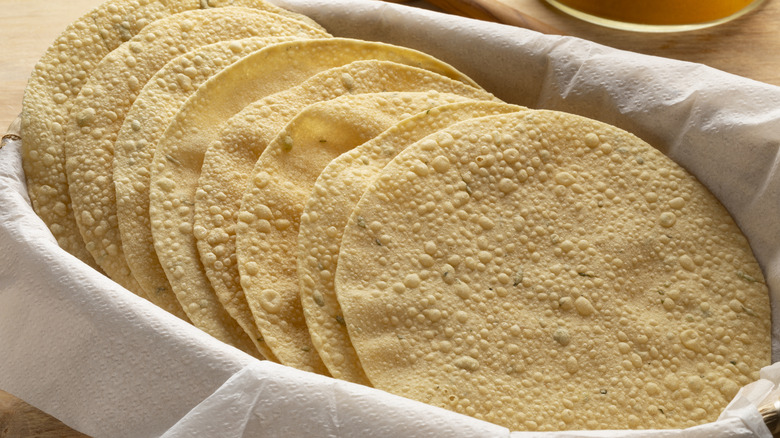
A popular Indian dish you'll find in restaurants in the U.S. is papadum, which often shows up as a complimentary appetizer. However, other nearby countries like Sri Lanka, Pakistan, Bangladesh, and Nepal make versions, sometimes spelled slightly differently (such as papadam or poppadum) or called papad. This extremely thin and shatteringly crisp flatbread can be made with a variety of flours like lentil, chickpea, or rice flour. And like potato chips, crisp papadum is great for dipping.
Recipes for papadum vary regionally. Different ones rely on different types of lentils (dal) or other flours like rice flour or millet, which provide a range of nutty and earthy flavors. Plus, there are often spices or seeds mixed in to make it both a flavor and texture experience. Some common flavorings include garlic, cumin seeds, ajwain seeds, black pepper, chilis, and asafoetida. Preparation methods also vary, ranging from traditional sun drying to frying or roasting.
Like the way Mexican restaurants serve salsa with its tortilla chips, Indian restaurants often serve papadum with a variety of chutneys. In fact, Indian onion chutney is a little like salsa. Some chutneys that are good with it are yogurt mint sauce, mango chutney, and plum chutney. In Rajasthan, street vendors serve masala papad with toppings like fresh onion, tomatoes, and cilantro, along with a sprinkling of a spice blend called chaat masala. So, you not only get a gratifying crunch from the papadum, but you also get fresh dips or toppings.
5. Chakli and muruku spiral snacks

Other Indian snacks you absolutely have to try as an alternative to potato chips are chakli (sometimes spelled "chakri") and muruku. These snacks are special enough to come out often during festivals like Diwali and other celebrations. There are regional differences, with plenty of flavors and shapes to try. However, they all come in spirals that have a look reminiscent of churros, but the texture is crispy.
There are some differences between chakli and muruku. Muruku is more delicate, firm, and crisp, while chakli is heavier and thicker with a stronger crunch. Chalki also tends to have a stronger flavor profile. Both are made from rice flour, but chakli also uses gram flour (besan) and sometimes yogurt, whereas muruku tends to add urad dal or even sometimes chana dal or wheat flour to intensify the crispness factor. The flavors in muruku come from milder spices, like cumin seeds, sesame seeds, and asafoetida. Meanwhile, chakli packs far more taste sensation with various chili powders, ginger, garlic, and turmeric.
If you'd like to try some, it's possible to buy pre-made types like Garvi Gujarat Gujarati chakri or Idhayam murukku, coming in bags just as potato chips do. There are also several types of mixes you can purchase to make this snack fresh at home if you don't want to source the individual ingredients. However, you'll need a tool like the Wazdorf Stainless Steel Kitchen Press to help you get the shape right before frying.
6. Bombay mix
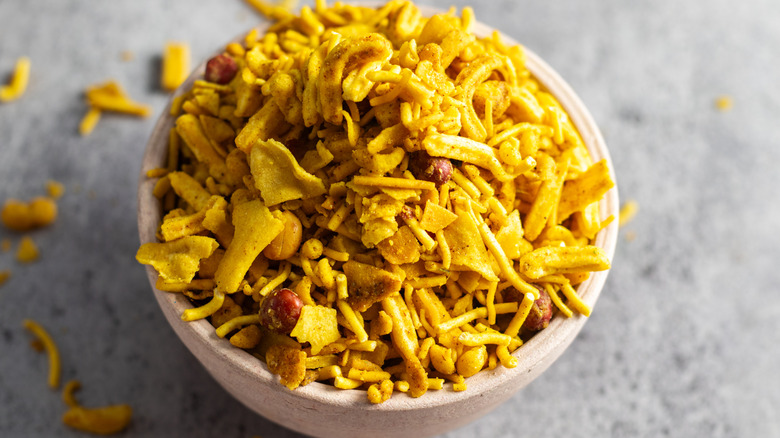
Another source for crunchy goodness to stand in for a potato chip craving is Bombay mix. It's sort of India's answer to Chex Mix, filled with a wide variety of crunchy ingredients bursting with flavor from a delightful mix of spices. This savory, crunchy snack blend originated in the Western area of India, especially making an appearance at festivals, feasts, and religious celebrations.
These snack mixes originated as street food in Bombay, which is why it's often called Bombay mix in places like Great Britain. In India, the name is sometimes chevdo, chevda, or chivda. The mix contains all sorts of tasty, crunchy, crispy ingredients, with different regions and families having a preference for what goes into it. Some of the differences are whether it comes with thick or thin chickpea flour noodles called sev or if it comes with flattened rice or puffed rice. Other ingredients include fried lentils, various nuts, corn, chickpeas, and even fried onions. The spices are strong, including curry powder and curry leaves or ground seeds like cumin and coriander, mustard seeds, sources of heat like chili powder, and turmeric.
While you can certainly go to the trouble of making all the noodles and frying all the lentils and other ingredients by hand, it's far easier to grab a pre-made mix in a bag like you would a bag of potato chips. Just keep in mind that there are a lot of regional variations, like spicier Punjabi mix from Northern India, Madras mix from the Southern area with curry leaves and coconut, and slightly sweet chana chur with mustard oil from the Bengali area.
7. Pofak puffed cheese snacks
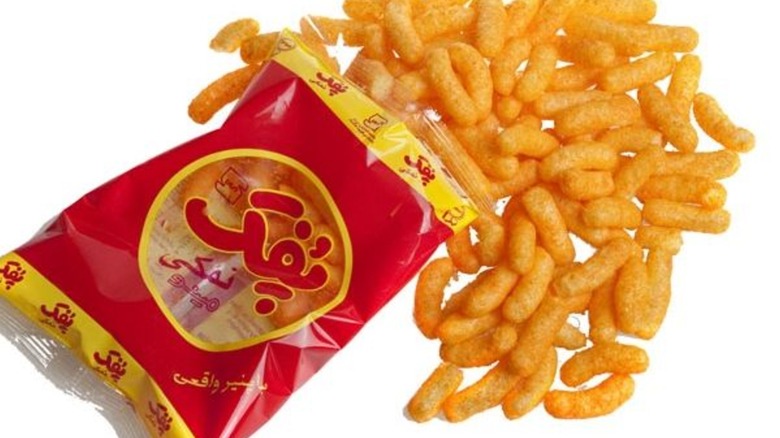
If you're craving something cheesy to eat that's not potato chips, look no further than Iran's pofak. When you first see them, these snacks are going to remind you a lot of Cheetos cheese puffs. As corn puff snacks, the texture is similar, in that they're light and airy puffs that start out crunchy but then melt in your mouth. Plus, they leave behind the tell-tale cheese dust behind like the cheese puffs you know. However, they have a flavor profile that's distinctive, coming in various shapes and flavors.
The cheese puff concept came about as a happy accident in a food manufacturing plant in the U.S. in 1935 while putting damp corn in a machine to clean it. However, Iranians really ran with the idea more than U.S. manufacturers. So, if you're standing in the chip aisle in Iran, you're going to be met with a wide array of pofak. They come in sticks, balls, wheels, springs, hoops, and other shapes. Plus, there are some extra flavors like ketchup and herbs with cheese. Those on social media who have tried both American Cheetos cheese puffs and Iranian brands like Chee-Toz cheese snacks talk about how absolutely superior the Iranian version is. If you can manage to locate some, you'll definitely want to give them a try to form your own opinion about the comparison.
8. Vegetable or fruit chips
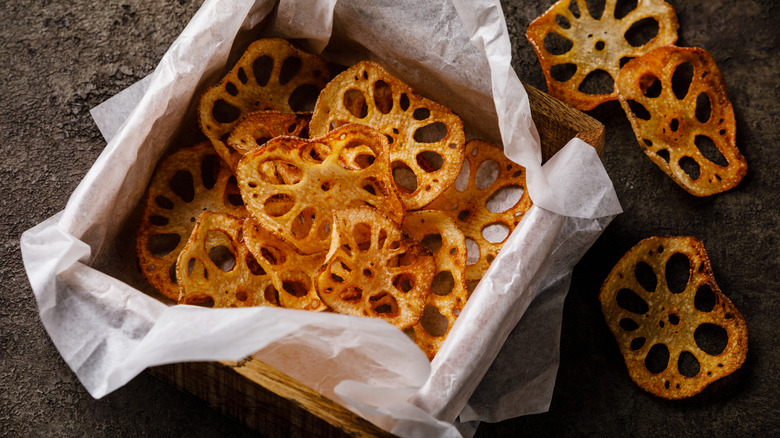
In the U.S., the majority of the fried vegetables you'll find in the chip aisle are turned into potato chips. But that's certainly not the only thing you can fry to turn into crunchy, crave-worthy chips. Throughout Asia, you can find a variety of vegetable and fruit chips to supplement the potato chips on the shelves.
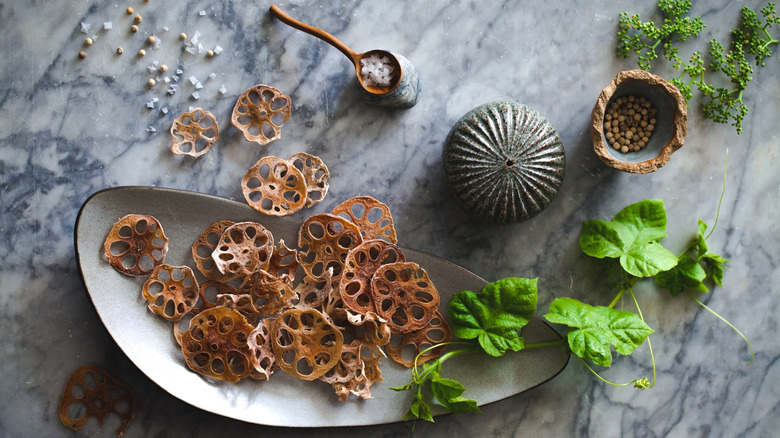
Basically, if you can fry it, you can turn it into a chip. While you might find a few alternative chips in specialty stores in the U.S., it's nothing like what you can find in Asia. There, even more roots and tubers regularly become chips, including sweet potatoes, taro, lotus roots, carrots, and cassava (yuca). Other vegetable chips include ones made from okra, and bitter gourd. Somehow, while the U.S. has managed to make everything else out of pumpkin, we've neglected it as a chip option even though you'll find it in Asian countries. If you can't find these on grocery store shelves near you, you can always make your own vegetable chips at home in the oven or air fryer.
Fruit chips make good alternatives to potato chips, too, especially when they have a decent amount of crunch like banana chips. Some other ones you'll find in Asia that are not so common in the U.S. except at an Asian market include jackfruit and durian chips.
9. Kuih siput snail-shaped snacks
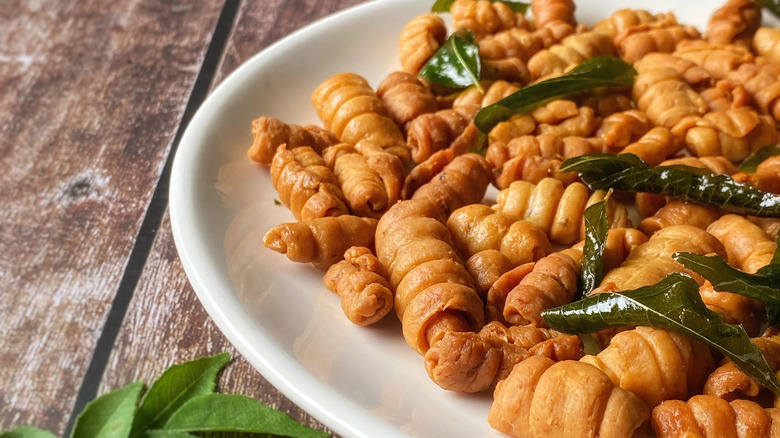
Kuih siput are fun crunchy snacks that originated in Malaysia. Siput is the word for snail in Malay, and it is an apt description of the snail-shell shape of these crispy and spicy snacks. They're special because they do take a little work to make, which is likely why they often pop up during celebrations for Hari Raya or Chinese New Year. They've also spread to Singapore, as well as to Indonesia, where they're called kue garpu.
There's a special board that home cooks use to make the spiral shape of kuih siput, but it's also possible to make them with a gnocchi board or something like a fork or comb you can rake across the dough. Once you get the hang of making them, they start to come together more quickly.
The dough is made with wheat flour and contains other ingredients like eggs, butter, and coconut milk. Different cooks use different flavorings, including dried shrimp, fennel, cumin, curry powder, garlic, coriander, and even sometimes sugar. The frying process makes the snacks crispy, and adding curry leaves to the hot oil provides extra flavor.
10. Fried snack noodles
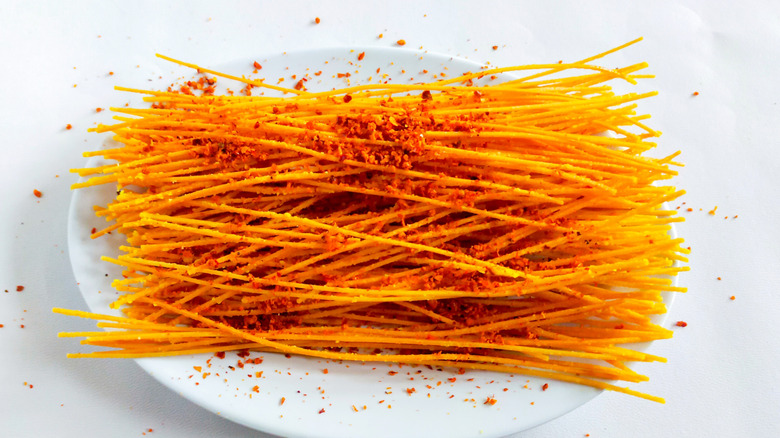
Our final category of Asian snacks that make a great potato chip alternative is the category of fried snack noodles. There are two specific ones that we want to mention: crispy ramen snacks and mie lidi.
If you've ever made ramen soup and decided you'd prefer some of the noodles to stick out of the water and stay crunchy, crispy fried ramen snacks might be a great potato chip alternative for you. In fact, the idea of fried ramen as a crispy snack has been around since 1959 when Baby Star crunchy ramen snacks debuted in Japan. The brand sells in Hong Kong and Taiwan. Various brands and styles have cropped throughout Asia in countries like Korea and Taiwan, and with each country adding its own flavors and concepts. Some are bite-sized chunks, while others like Mamee Monster from Malaysia come in a whole brick, ready to crush and shake with seasoning.
Ramen isn't the only pasta shape that makes a good snack, as evidenced by the popularity of crunchy mie lidi snacks from Indonesia, which are deep-fried thin spaghetti. Once fried, mie lidi are seasoned with spices. There are lots of varieties. However, you're likely to find seasonings like a mixture of spicy chili powder and chicken bouillon powder.