

Yes, A Microwave Can Keep Food Warm – Here's How It Works
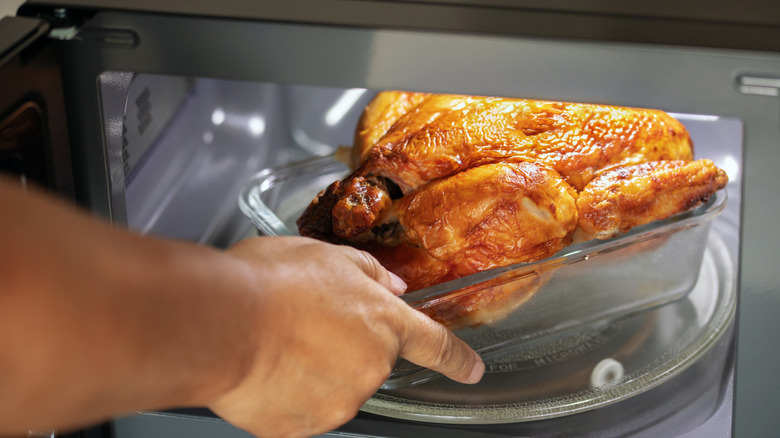
There are plenty of reasons why you might need to keep food warm for a little while after it's done cooking. Maybe your takeout arrives or dinner is ready before everyone is quite prepared to eat, so it needs to sit at that perfect temperature for a little while. Alternatively, when you are cooking a large and complex meal, you might need to finish a few courses early so that you aren't totally slammed right before it's time to ring the dinner bell. Whatever the reason, your microwave can actually be the perfect tool for this job, thanks to the keep warm function.
If you are scratching your head right now, you certainly aren't the only one. While the function doesn't exist on every single model, "keep warm" is one of those largely unknown microwave settings that we should all use more often. This function works by periodically zapping the food at a low power level, giving it just enough heat to keep it from cooling off, but not enough that it cooks further. This incredible function will allow you to keep your food at a perfect serving temperature for 30 to 90 minutes, depending on the model.
One word of warning, however: Don't forget that the vessel you put your food in is important. Aluminum foil should usually be kept out of the microwave, along with any other metal, be it a roasting tray or a layer of foil meant to seal the top of a dish of green bean casserole. Wood can also be a problem in the microwave, though that issue comes down to the risk of damage to the dishes themselves, rather than the pyrotechnics that come from microwaving metal.
Even without a keep warm function, your microwave can do the job
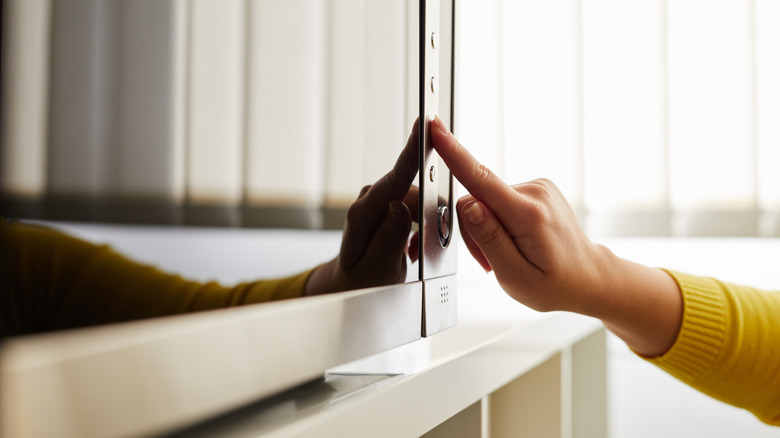
Once you experience this magic for yourself, you may be wondering why it wasn't already at the top of your list of the best microwave tricks and hacks. When you're cooking up a holiday feast and trying to figure out how to keep the mashed potatoes warm until dinner, that sort of time is a real blessing. But even if your microwave doesn't have this function, the appliance can still be helpful.
If you dig through all of the different settings and functions on your microwave and still can't find that mystical "keep warm" setting, don't worry, you can jerry-rig it yourself. Start by using the microwave's power level button. Turn it down as low as it goes, usually about 10%, and use that. Run it for a few minutes and then let things sit for a while. You won't have the carefully calculated timing that the function itself has, so it may take some experimentation to get this process just right, but it'll still be better than leaving the food out on the counter.
In truth, even if you never turn the microwave on, it will still help to keep your prepared dishes warm. Microwaves are small, insulated spaces, so when you stick a steaming casserole dish in there, it will not lose nearly as much heat as it would out in the open. It is the same principle as storing hot food in a cooler: insulation works both ways. A cooler will keep your hot things hot thanks to its insulation, and so will your microwave. You are certainly best off hitting the "keep warm" button, but any insulated space is better than nothing.