

Martha Stewart's All-Time Best Kitchen Design Tips To Steal For Your Own Home
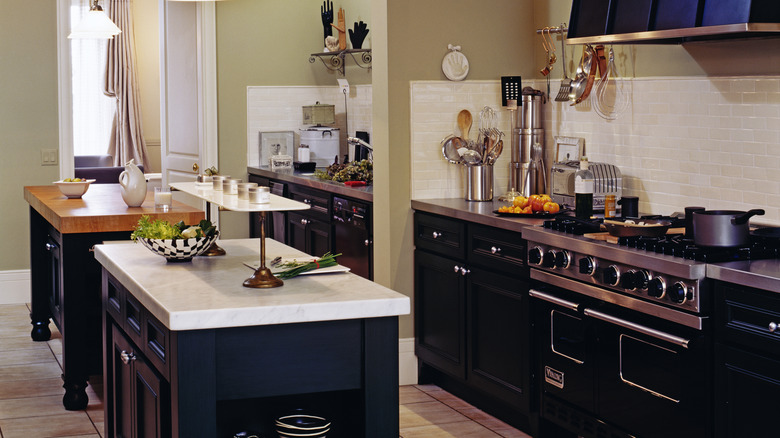
When designing your dream kitchen, there's no better place to look for kitchen design tips than Martha Stewart. She's a kitchen design genius who has designed more than a dozen kitchens for her properties alone, with some of her properties boasting multiple kitchens. Over time, she's found what does and doesn't work for her, opting for kitchen concepts that are classically elegant and highly functional.
When you look at the design of Stewart's kitchens as a whole, a clear pattern starts to emerge. She tends to design around natural light, maximizing space, entertaining, and creating an open feel. While design trends come and go, Stewart aims for kitchens that feel timeless rather than trendy. Her surfaces are durable and easy to clean, while her kitchen storage features are both stylish and easily accessible at a moment's notice. Whether you're remodeling your whole kitchen or looking to make a few small changes, Martha Stewart's kitchen design tips are invaluable for rethinking the way you want your kitchen to work for you.
Conscript as much space for your kitchen as possible
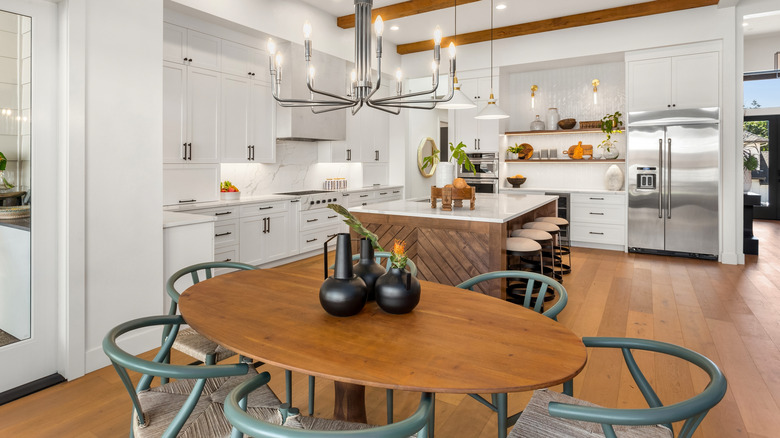
If you've ever seen Martha Stewart's personal kitchens, you'll notice that they're all enormous. One of her design tips for getting a bigger kitchen is borrowing space from other rooms. So, even if you start with a smaller kitchen than you'd like, you can expand it with some creative rearranging.
The easiest option is borrowing space from nearby rooms. For example, if your kitchen bleeds into your dining room, you can combine the two rooms to give you a bigger kitchen. Granted, you may need to remove walls, widen entryways between rooms, and rethink your dining area to make this option a reality.
If you're feeling really ambitious, you could move your kitchen altogether, looking at your floor plan as a whole to decide where the kitchen would best fit. People who spend more time in their kitchen than living room or have a living room that is too large for them somtimes opt to switch the two to acquire more space. Of course, this project requires putting in new plumbing, ventilation, wiring, gas lines, etc., but it's not an impossible option.
Make space, light, and airiness a priority
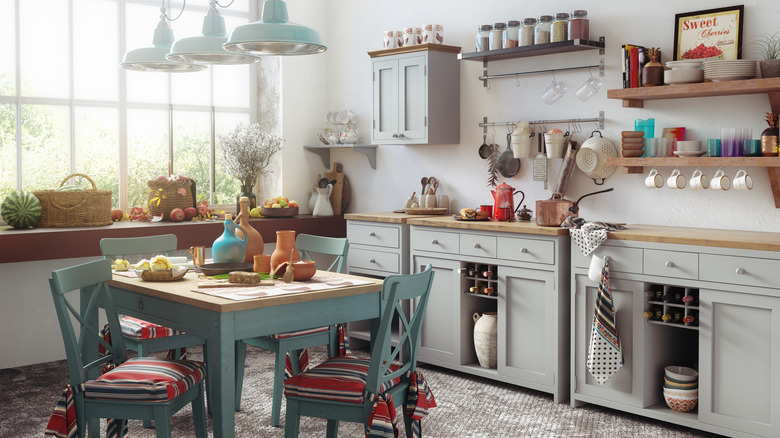
Another universal feature of Martha Stewart's kitchens is that they all have plenty of space and light. She likes having plenty of space to move around and entertain and for the room to feel open and airy. Plus, she wants lots of sunlight.
Starting with a bigger kitchen or borrowing space from another room helps to make space a priority. Having more space also means that you can entertain in your kitchen, bringing family and guests together to enjoy each other around food and meal prep.
There are some tricks for making your kitchen feel light and airy without lots of space or windows. One kitchen design choice Stewart uses to brighten and expand the feel of the kitchen using open shelving instead of dark and bulky upper cabinetry. Lighting under shelving or installing a kitchen door with a window can provide more light to darker rooms.
Divide the kitchen into specific zones
All of Martha Stewart's kitchens have a similar overall design, which incorporates a variety of zones for different tasks and storage. Not only does this zone concept help with the overall design, but it provides space for congregating.
Stewart prefers a kitchen layout that circles a center island. Throughout her kitchens, you'll find spaces for different tasks. For example, in her Winter House, her cooking space includes three built-in convection ovens, a deep fryer, a grill, a stovetop, and broiler. In another section, she has a gigantic clear-doored refrigerator, and yet another is a space for washing up. Different zones provide different storage opportunities as well.
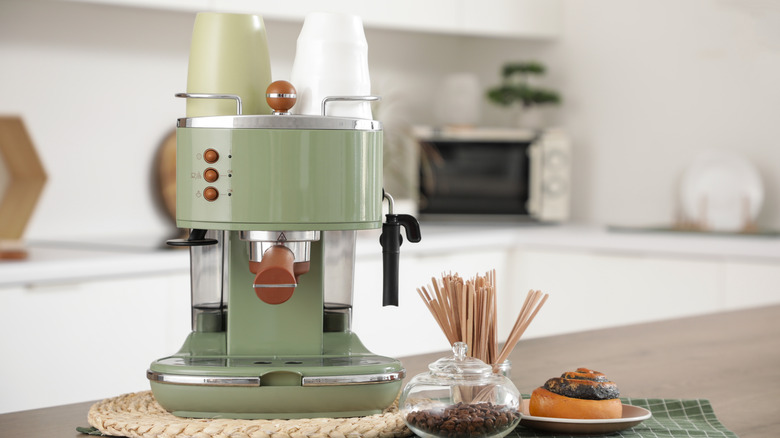
Stewart's favorite kitchen section in any of her homes is her coffee station, which includes a large cappuccino machine. Having such a section as well as a seating area for guests and family makes the kitchen an inviting area for them to congregate.
Create a clear line from your kitchen to your garden
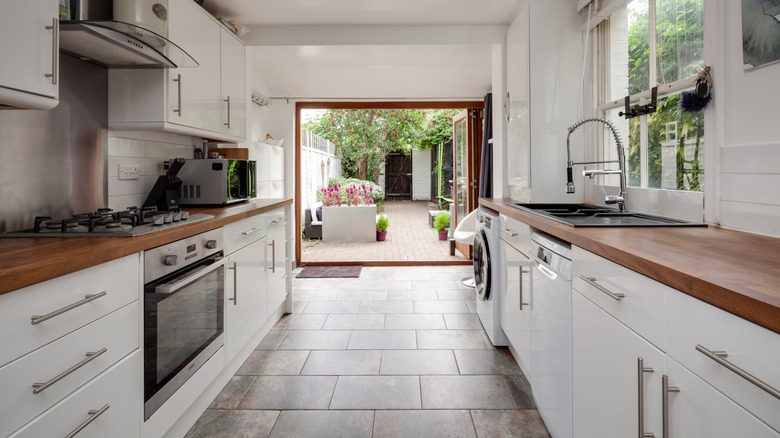
Integrating the indoors with the outdoors by having easy access to your garden via your kitchen is another design element Martha Stewart likes to employ in her kitchens. Gardening has been a lifelong love for Stewart, who started her gardening habit with a childhood vegetable garden.
Having a door leading outdoors directly from your kitchen to the garden is ideal. That way, it's easy to pop out to grab fresh herbs or vegetables when you need them for cooking. Stewart's herb and vegetable gardens are closer to her house than her other gardens to make them more easily accessible. However, even if you don't have space for a full garden, you can grow items in pots near the kitchen for easy access, like on a small porch or patio. To maximize a small space for pots, you could even make a graduated tower of herbs or veggies starting with a large pot, stacked with ever smaller pots on top.
Be strategic with the use of open shelving
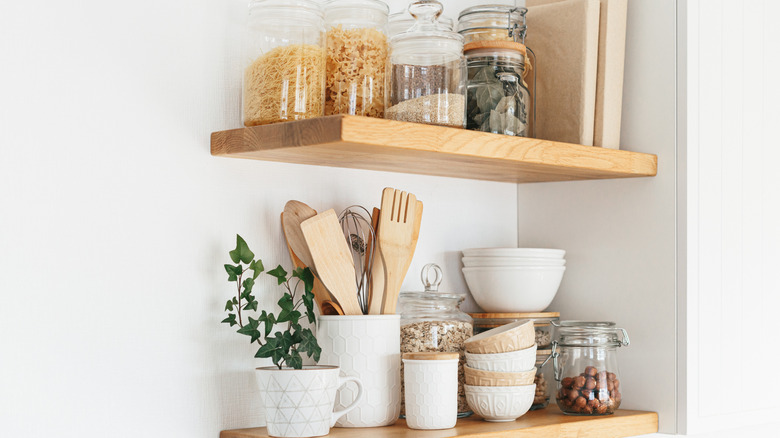
Open shelving not only serves the purpose of making your kitchen more light and airy, but it also makes it easier to see and access everything. Martha Stewart's kitchen design includes having shallow open shelves in each of her kitchen work zones.
Stewart takes a maximalist approach in her kitchens, displaying both showpiece and useful items rather than hiding everything away. You'll see items like her dishware collections, copper kitchenware, mortar and pestles, glassware, teapots and cookbooks on display in the open shelving in her kitchens. Shallow shelves make items more easily accessible. We've also seen her maximize shelving by creative stacking such as placing multiple saucer and cup sets on top of each other in the same shelf. Stewart likes open shelving in her pantry as well. So that she can find ingredients more easily, she transfers everything from bags and boxes to clearly-labeled storage containers.
The color you choose for your kitchen can keep it looking new

Using timeless rather than trendy colors can keep your kitchen looking modern for years to come. Simply changing your cabinetry paint color can renew your kitchen and give it a more classic look.
A good example of a timeless color is the Bedford grey Stewart chose for her Bedford, New York, farmhouse kitchen over 20 years ago. The color still looks as nice now as it did when she first chose it. It's a relaxing color she uses throughout her kitchen on shelving and cabinetry.
If you've been following Martha Stewart over the years, you probably have a general idea of the colors she likes to use, which are often muted pastels and neutral colors, often inspired by nature. Some other colors she loves for cabinetry are rainwater and sharky grey. In one of her kitchens, she even used black for all of her cabinetry.
Everything should be easy to clean
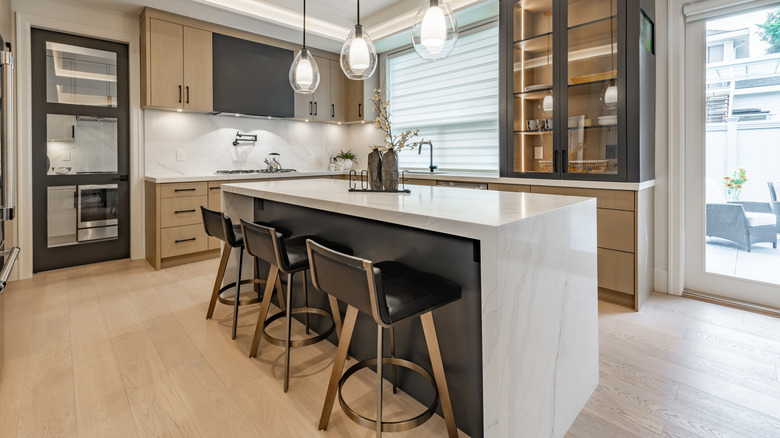
When it comes to the surfaces in Martha Stewart's kitchens, she chooses ones that are easy to clean. Nobody's immune to kitchen spills or even full out disasters like forgetting to put the lid on the blender. So, it makes sense to have easy-to-clean surfaces in a space that's likely to get messy.
Ease of cleaning governs what you will and won't find in Stewart's kitchens. For example, you won't find any upholstered chairs in Stewart's kitchens because spills can't be easily wiped off them. Instead, she uses wooden stools at countertops or wooden chairs at tables. You also won't find wooden countertops in her kitchens because stone countertops are much easier to clean. In her Manhattan apartment, she opted to have a more industrial-style kitchen with corrosion-resistant, easy-to-clean metal surfaces not only for her appliances, but also for her cabinetry, countertops, and backsplash.
Keep your cabinetry smooth and flush
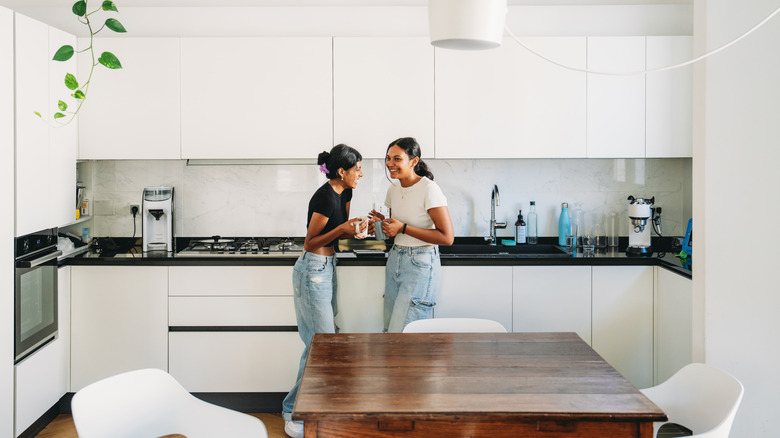
When it comes to the design of the section of Martha Stewart's cabinetry, she prefers a smooth and flush design. Not only does she prefer the way it looks but it's also a practical choice for keeping everything clean.
First of all, flush and simple lines keep everything looking classic. Having cabinets with smooth surfaces mean they're never going to go out of style. If she adds decorative molding in her kitchens, they're usually crown molding at the top of the cabinetry rather than on the cabinets themselves.
When there's a straight line from cabinet to floor without molding or indentions, cleanup is so much easier when you have spills. For one thing, spills are less likely to end up in your drawers. For another thing, you don't have to work so hard to clean everything out of grooves and around the edges of fancy molding when the cabinetry is flush.
Opt for no-fuss cabinet hardware
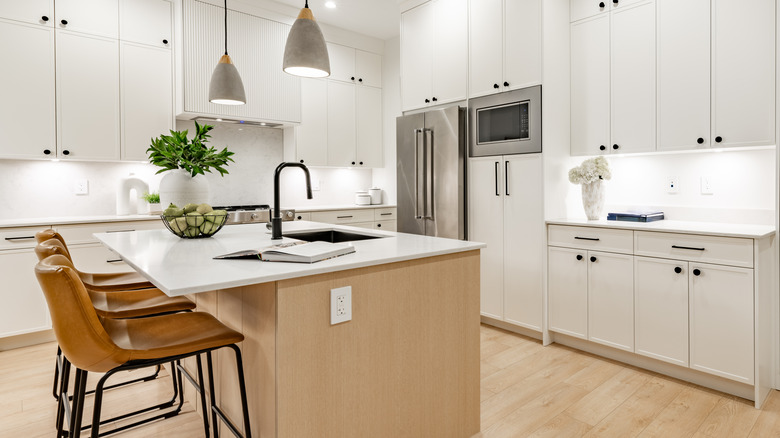
Another way to design your kitchen so that it's timeless is to choose cabinet hardware that's not going to go out of style. Martha Stewart prefers going minimal with the amount of hardware, only adding it where necessary and choosing simple designs to make the kitchen have a more classic look.
In both her personal kitchens and in her Martha Stewart Living Kitchens available at The Home Depot, you'll see an example of this classic hardware. In her personal kitchens, she most often uses small knobs even for drawers but has occasionally chosen horizontal drawer pulls when it fits the aesthetic (like in her all-metal Manhattan kitchen). In her Martha Stewart Living Kitchens collection, all the hardware is classic or has no-frills with sleek lines that blend into the design and won't catch on things. Her kitchen line also includes touch latch cabinetry that doesn't require knobs or pulls at all.
Stone and metal are ideal countertop choices
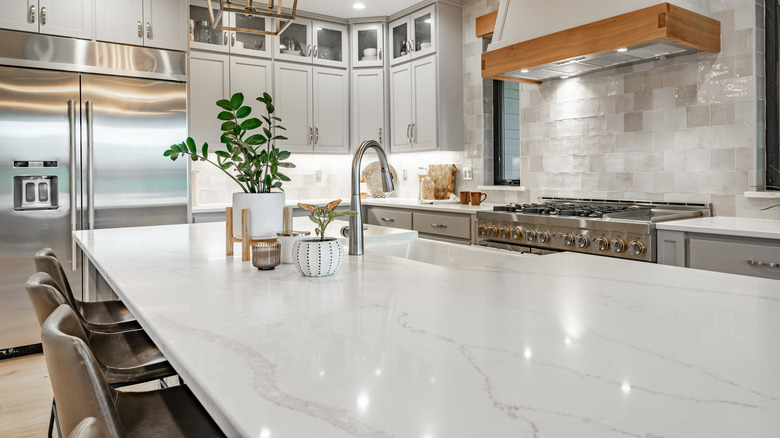
When choosing kitchen countertops, Martha Stewart gravitates toward natural materials like stone and metal. However, each of her surface choices in her different kitchens have distinctive pros and cons.
Some of Stewart's favorite stone countertop picks include marble and soapstone. Marble is heat resistant, but keep in mind that it's easily stained, easily scratched, and porous (requiring sealing). If those cons bother you, soapstone might be a better option since it doesn't stain because it's not porous. While it doesn't crack easily because it's relatively soft, it does get scratches. However, like marble, it's heat resistant.
When it comes to metal countertops, Stewart has a clear favorite: zinc. Zinc-covered countertops have an advantage especially if you like to bake, since dough doesn't stick to them. Other advantages include it being anti-bacterial and non-porous. However, keep in mind that the surface reacts to anything that touches it, easily staining until it finally develops a patina. Plus, you can't cut anything directly on the surface without expecting scratches because it's a soft metal.
Incorporate hanging storage into the kitchen design
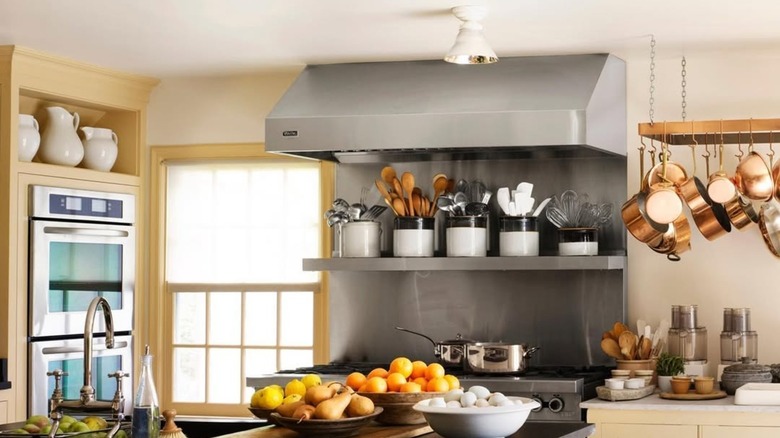
If you don't remember anything else about Martha Stewart's kitchens, you probably do remember her penchant for hanging storage. Specifically, she likes to hang her beautiful copper pots and pans as well as her baskets, but there are plenty of other items you can hang with a bit of creativity.
The main reason Stewart prefers hanging her pots and pans is for easy access — a sentiment that drives her design choices time and again. Specifically, she likes the idea of not having to rummage through cabinets, pull items out, and unstack them just to get to what she needs at the bottom of the stack in a back corner. A hanging rack or a pegboard in your kitchen is the perfect storage space for everything from pots and pans and colanders to utensils and even some cutting boards that already have a hole in the handle. Just remember you should clean even the bottoms of the pans for them to look nice hanging.
Another advantage of hanging items is that it opens up cabinet storage space to hold other items. So, if you're trying to figure out how to conjure up more space in a small kitchen, hanging items might just be the answer you seek.
Poplar is her choice of wood for cabinetry
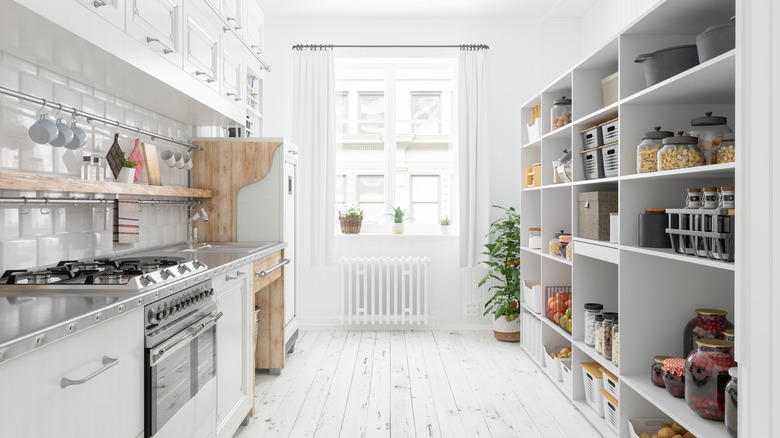
When it comes to the type of wood Martha Stewart likes for her cabinetry, poplar is her firm choice. It may not be a wood type on your radar, but it's worth considering for painted cabinetry.
Stewart has tried other woods for her cabinetry. For example, she once tried going for the sustainable option of repurposing the beautiful wood of a fallen sycamore in her yard into cabinetry. While sycamore is not an uncommon hardwood for making cabinetry, Stewart discovered that its softer nature made it prone to warping and developing cracks.
Like sycamore, poplar is also a softer hardwood. However, Stewart hasn't experienced the same warping and cracking problems with it. The trick for using poplar is that it needs to be painted since it doesn't stain well or look as nice without paint. However, since Stewart prefers painted cabinetry, it works for her just fine. While its soft nature means that it's less durable than some hardwoods, it's a low-cost option, which means that you may be able to afford more cabinetry than if you opted for a more expensive and harder wood like walnut.
Two islands are better than one
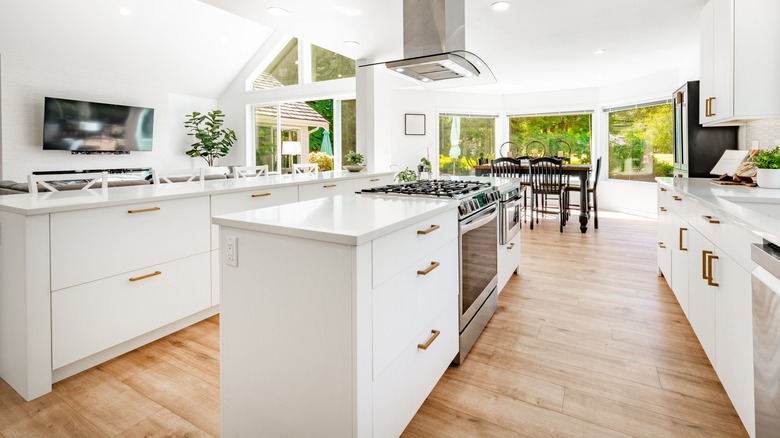
Martha Stewart is a big fan of having a large kitchen island as the focal point of her kitchen, but she advocates for having a second island as well. The second island can be a rolling or stationary one that can serve a variety of purposes as needed.
While Stewart suggests your main island be at least four feet across and 2.5 feet deep, her islands tend to be much larger as space allows. Although, to keep the kitchen feeling open and make it easier to move around while you're working, it's ideal to have an open space of at least three feet all around the island in every direction.
The second island Stewart likes to have can serve a variety of purposes. A big reason to have a second island besides extra storage and work space is that it can double as a seating space for guests. You can do all your prep work on the mobile one when you have guests since they'll appreciate you not cutting up a chicken or slinging flour near their cups of coffee or food. However, the advantage of having a rolling mobile island is that you can move it around wherever it's needed in the kitchen. For example, you can use it as extra prep space for any work zone or as extra buffet space at the end of a countertop for a dinner party.
Add a servery or butler's pantry
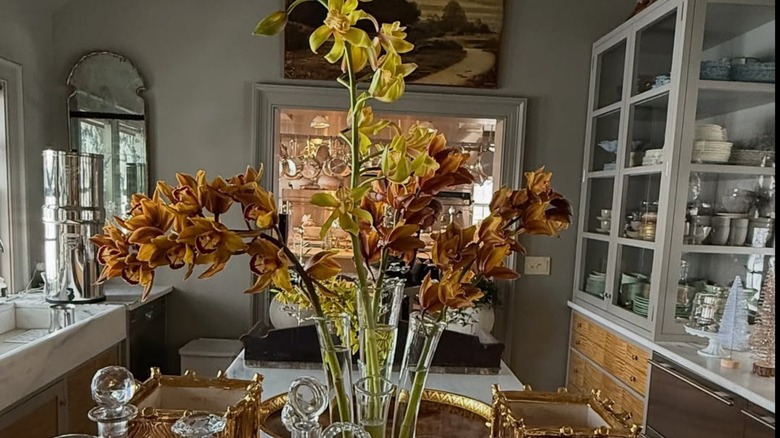
One design feature Martha Stewart likes that makes a lot of sense is the inclusion of what she calls a servery, also known as a butler's pantry. A servery is an area, alcove, or even an entire room that functions as a transitional service area between the kitchen and dining area. You'll often catch a glimpse of these areas when Stewart is showing off one of her fabulous kitchens on camera.
Stewart's servery areas tend to have storage areas, countertops, and even sinks. Admittedly, having a separate space to hand wash china and glassware near their storage area is not a bad idea. She also adds features like storage for linens and cutlery, refrigerated drawers, warming drawers, and an extra dishwasher. Another feature Stewart especially likes to add is a glassed-in countertop-to-ceiling storage cabinet for her glassware and china. With the sun shining through it like a curio cabinet, it provides an airy feeling to an otherwise small space.
Organize similar items together
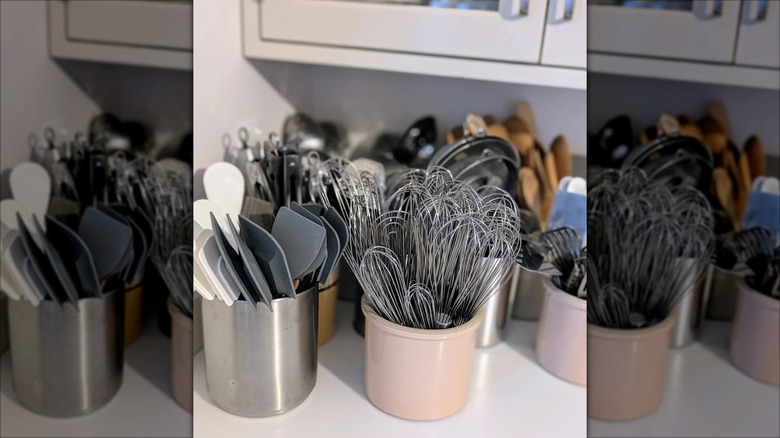
If, like Martha Stewart, you tend to collect multiples of certain items, your organizational best bet is to find a place where they can all live together. While you might not feel the need for collecting half a dozen whisks and dozens of wooden spoons like Stewart does, this organization strategy still works for keeping items in the same category together so they're easy to locate when needed.
Organization is of utmost importance for Stewart, whether she's storing utensils, dishes, food, or other kitchen items. Her drawers often have dedicated baskets to collect specific categories of things like cake servers, icing tips, or ice cream scoops. She also advocates for having a dedicated knife drawer, organizing by size and usage. She tends to keep large pieces of crockery out on her countertops to hold cooking and prep utensils so that they're easy to grab in the moment. We've already mentioned her penchant for organizing her pots and pans together on overhead racks. She also keeps bowls full of fresh ingredients she wants to remember to use at the back of her countertop, organizing them by ingredient type. Dish collections are organized together, or she might have a coffee and tea station where she keeps all her cups, saucers, and tea pots corralled together.
Add a coved countertop
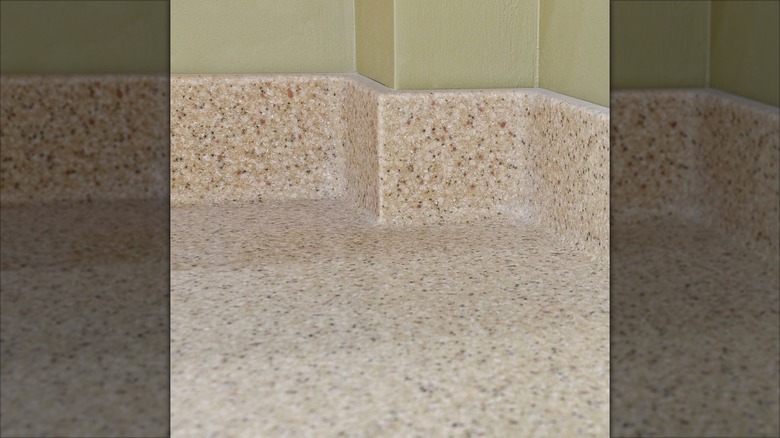
A unique feature you might notice in some of Martha Stewart's kitchen designs are coved countertops that have a side wall around them. We don't mean that they're butted up against a wall but that the countertop material itself curves and extends upward like a backsplash.
This is a feature she especially likes to use in the area where she rolls out pastry dough. Having high walls on your countertop provides a way to keep flour on the countertop as you make and roll out your dough. However, it's also a good feature near a door where wind can blow items off the counter as people walk in and out. Another advantage is that, since the countertop and its wall are all one continuous piece, there are no corners where crumbs can get stuck. You can opt for the side wall to be cut in a decorative way so that it is both a beautiful feature as well as providing a functional design.