

This Is The Actual Flavor Of Classic Mountain Dew
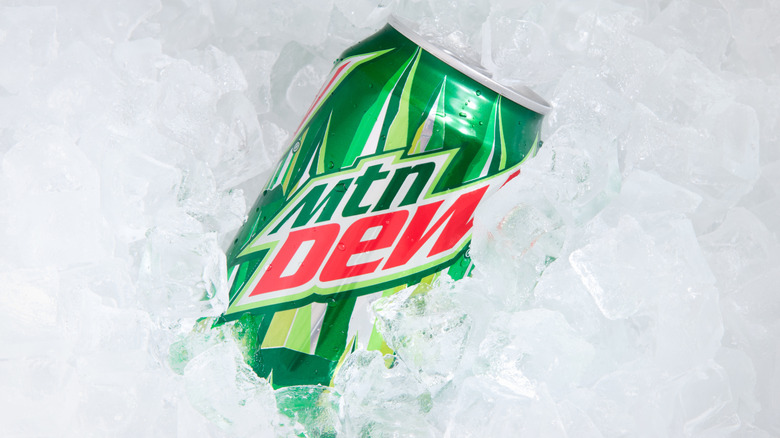
With a neon green color that resembles antifreeze more than anything, you would be forgiven for thinking that the unique flavor of Mountain Dew soda is entirely artificial — but you would be wrong. Surprisingly, this vibrantly-colored citrus soda actually gets its signature taste from real fruit juice. That's right, one of the main ingredients that separates Mountain Dew from other lemon-lime sodas is concentrated orange juice.
Mountain Dew is well known enough that PepsiCo doesn't even bother describing the flavor on its packaging. While it's definitely a citrus soda with lemon and lime flavors as well as orange juice — it's more than that. Mountain Dew is a flavor all its own. Interestingly, however, the original recipe was a much more like traditional lemon-lime soda, similar to a 7Up, with the orange flavor not arriving until around 1974.
These days there are many different Mountain Dew flavors. Flavors such as the Code Red and Livewire contain the same concentrated orange juice, but others, like Baja Blast, do not. This is fitting, as Code Red is the first nationally distributed Mountain Dew flavor, so it made sense to stick close to the standard recipe, and Livewire is an orange-flavored soda already, whereas Taco Bell describes the flavor of Mountain Dew Baja Blast as "tropical lime."
The origins of Mountain Dew
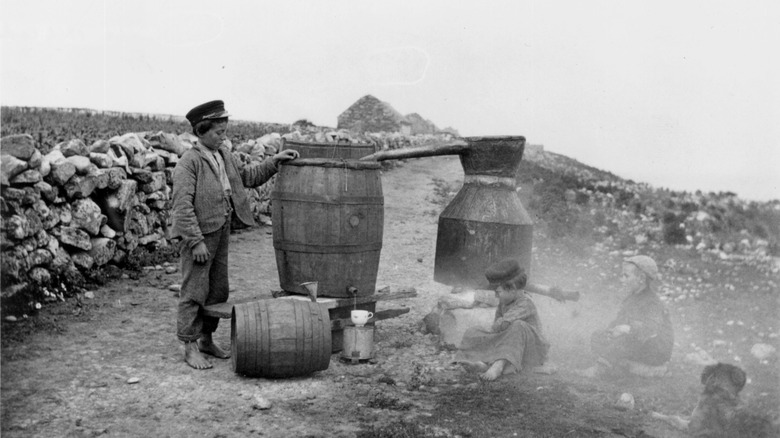
While Mountain Dew has proliferated over the years into a wide variety of products — including a few discontinued Mountain Dew flavors as well as the limited-time Taco Bell Baja Blast gelato – the soda's origin story goes back to early Appalachia. The term "Mountain Dew" was originally a slang term for poitin, an Irish moonshine liquor. In the early days of the U.S., moonshine was not a contraband item. In the mid-1900s, it was quite common for the rural folks of Marion, Virginia — where the soda was first made — to distill themselves a bit of moonshine liquor with the grains they grew.
When Mountain Dew was first released to the public in 1954, the advertisements featured a Tennessee moonshiner named Willy the Hillbilly, and was marketed as a "zero-proof hillbilly moonshine that will tickle yer innards," per The New York Times. The Pepsi-Cola Company acquired Mountain Dew in 1964, leading to nationwide distribution of the soda, but just nine years later it was decided that the moonshiner branding needed to go. These days, you will no longer see Willy the Hillbilly on Mountain Dew's packaging, but the moonshiner history subtly endures in the soda's name.