

The Rise And Fall Of A Midwest Burger Giant You Might Have Forgotten About
If you watched "Mad Men," you might remember Peggy taking point on a Burger Chef ad campaign during the show's final season. Depending on your age, you may not have realized that Burger Chef was a very real, and very popular, fast food restaurant chain. The first location opened in Indianapolis, IN in 1957, but within just 20 years, it would be plagued by problems, including financial issues, poor management, and even a high-profile murder case.
Frank P. Thomas, Jr. was the VP of General Equipment Company, a business that made ice cream and milk shake machines for restaurants. In 1956, the owner of a small hamburger chain asked Thomas to develop and manufacture a hamburger broiler, later named the Sani-Broiler. In 1957, Thomas opened a hamburger stand called Burger Chef specifically to showcase his flame broiler in action. The flame-broiled burgers, likely inspired by Burger King's famous flame-grilling method, were so successful that he soon expanded to three more locations.
Investors quickly swooped in, eager to purchase Burger Chef's flame broiled burger concept. The first sit-down Burger Chef fast food restaurant opened in 1958, and over the next four years, 97 more were opened throughout the Midwest. By 1966, it was the fastest growing hamburger chain in America with 440 locations. The restaurant's innovative menu and dedication to customer service made it a genuine trailblazer in the industry. We even named it one of the 15 defunct restaurant chains we actually miss. Unfortunately, trouble was already on the horizon.
Burger Chef's quick ascent and even faster fall
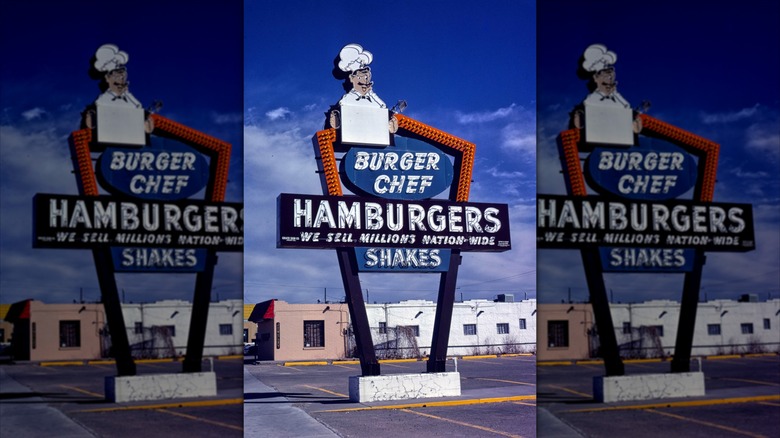
By the mid-60s, Burger Chef was the number two burger chain in America after McDonald's. The menu was somewhat revolutionary at the time and included a burger called the Big Shef, thought to be the inspiration for McDonald's Big Mac. In 1968, it was bought by General Foods and a year later opened its 1,000th restaurant. In 1972, the chain introduced salad bars in its restaurants, another novel concept that set it apart from its competitors.
Burger Chef also pioneered the fast food kid's meal concept, launching its Funmeal in 1973 and eventually inspiring the first McDonald's Happy Meals six years later. It also introduced fast food mascots Burger Chef and Jeff, Count Fangburger, Burgerini, Burgerilla, and Cackleburger – creations that even rivaled the Burger King mascot that was temporarily retired for its creepiness. The fast food chain was also a marketing wizard, hosting kid–friendly giveaways and meet and greets with celebrities. Despite its popularity, the chain began slowly losing money throughout the '70s due to mismanagement at the hands of General Foods.
One of the biggest contributing factors to the chain's decline was the 1978 robbery, kidnapping, and murder of four Burger Chef employees in Speedway, IN. The perpetrators were never prosecuted, and the small community was devastated and terrified. A few years later, General Foods sold all 679 Burger Chef locations to Hardee's parent company Imasco. Most locations were converted to Hardee's restaurants. The last remaining Burger Chef, which was located in Cookeville, TN, closed in 1996.
How Burger Chef's memory was revisited in Mad Men's final season
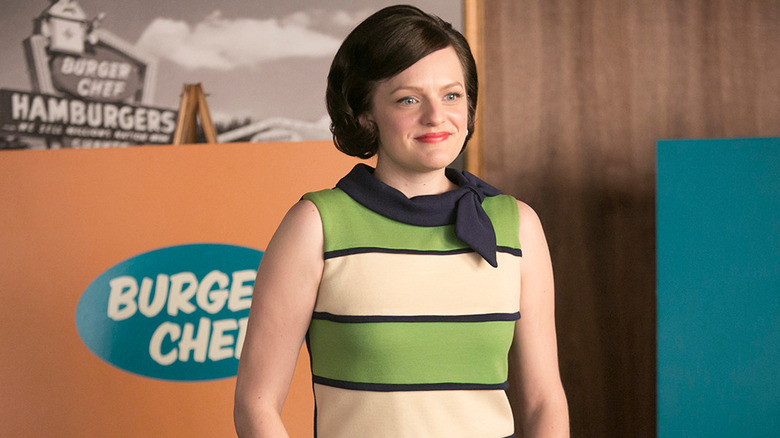
Almost two decades after the final Burger Chef location shuttered, its memory was revisited in the penultimate episode of the first half of the "Mad Men" final season. "The Strategy," the 6th episode of the show's 7th season, aired on May 18, 2014 and took place in 1969, at the height of Burger Chef's popularity. The episode renewed interest in the burger chain's history for "Mad Men" viewers of all ages.
In the episode, Peggy Olson was tasked with helming a television ad for Burger Chef. Peggy and her team eventually created a poignant TV commercial that addressed one of the challenges faced by some of the first fast food restaurants in America: Many mothers avoided getting fast food for their families because they felt too guilty about not preparing a home-cooked meal.
Her final ad reimagined a Burger Chef location as a welcoming home away from home where families from all walks of life gathered together to share a meal. Her campaign, called Family Supper at Burger Chef, wasn't too far off from campaigns the company was running at the time. The chain's 1970 slogans were "There's more to like at Burger Chef," and "Burger Chef goes all out to please your family." In real life, Burger Chef contracted with advertising firms McCann Erickson in 1968 and Ogilvy & Mather in 1971.