

10 Signs You Should Leave Behind That Vintage Dishware You're Eying At The Thrift Store
We may receive a commission on purchases made from links.
We know there are many temptations when looking at vintage dishware in a thrift store, but there are lots of reasons you shouldn't take some of them home with you. The main problem is that many of the materials used to create some dishware and to give them their color aren't food safe. As a result, some of the best vintage kitchen thrift store finds are only valuable as display items in your kitchen or dining area rather than for their intended use.
Dangerous vintage dishware gives off red flags to warn you against using it, as it could be harmful to you and your family. Yes, some of it requires guesswork, but there are some clear warning signs, too. One thing you need to know is the age of the item and if it was created before certain toxic materials were regulated in the dishware-making process. Even without knowing the age, you can determine the safety of the dishware by checking factors like color, integrity, country of origin, and information written on the piece itself. Plus, there are a few simple tests you can run in a thrift store. So, let's do a deep dive into the signs that can alert you to whether that vintage dishware you want to buy is a safe bet or not.
It was made in the U.S. before 1971
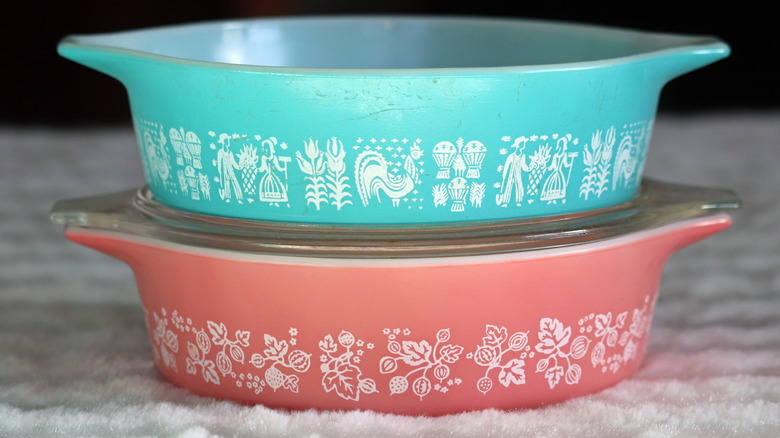
One of the biggest reasons to leave vintage dishware on the thrift store shelf is if it was made before 1971. Those plates, bowls, and other dinnerware forms may be cute, durable, and in a style that appeals to your aesthetics, but these older dishware can be dangerous if you buy them for any reason besides displaying in your kitchen. The problem with purchasing dishware created before 1971 is that the FDA wasn't regulating lead content in the U.S. crafting industry at the time. As a result, the lead in such dishware can leach into food and cause lead poisoning.
Don't get us wrong, there can still be lead in more modern dishware. For one thing, the earliest lead regulations for dishware weren't as strong as the ones we have today. The last time there were significant changes to the regulations regarding lead content in dishware was 1992. So, there's still a chance of dishware made before 1992 consisting of more lead than you'd want. Something else to consider is that, if the dishware is handmade, it could be risky, too, because nobody is checking the lead content of dishware that isn't commercially made. Even if you're eating from modern dishware, it still may not be lead-free, as the FDA still allows dishware to have a small amount of lead. However, the less you're exposed to this chemical, the better.
It's imported dishware
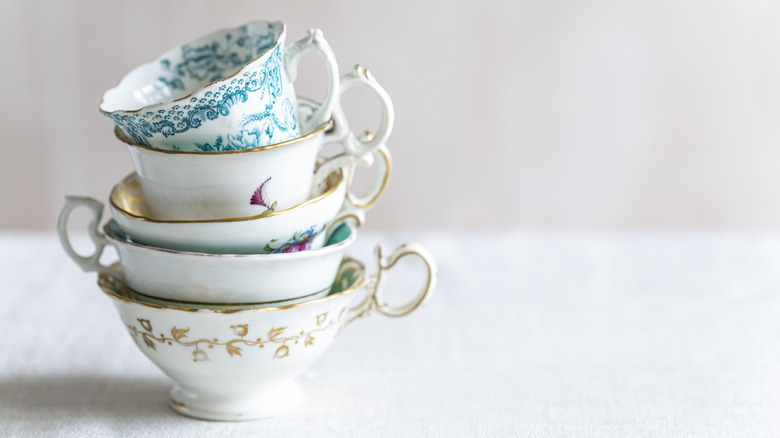
When we say modern dishware has a lower lead content than vintage, this may not apply to imported dishware not made in the U.S. After all, the FDA's lead content regulations do not extend beyond the U.S. borders. Luckily, the U.S. now has guidelines for when an imported piece of dishware should be detained or legal action should be taken because of high lead content. However, the older the imported dish, the less likely it is that it went through a vetting process. Sometimes, imported dishware will come with a stick-on label that indicates that it's not for food use because of its lead content. While permanent non-food-safe labels exist, if it were just a sticker, you're likely to miss this type of information when buying an imported dish from a thrift shop.
Imported traditional pottery can especially be an issue. The FDA has warned that some traditional terra cotta pottery labeled as lead-free has higher lead content than its glazed counterparts. However, glazing doesn't solve the problem either, since lead oxide can be present in glaze and may not incorporate into the structure of the dish properly if there are temperature inconsistencies during the firing process. Crudely made pieces that have irregularities should be even more suspect. Plus, a little research into the lead content of a particular imported brand or that country's lead regulations can be helpful, too, for vintage dishware. However, it's probably just best not to buy it.
It's brightly colored
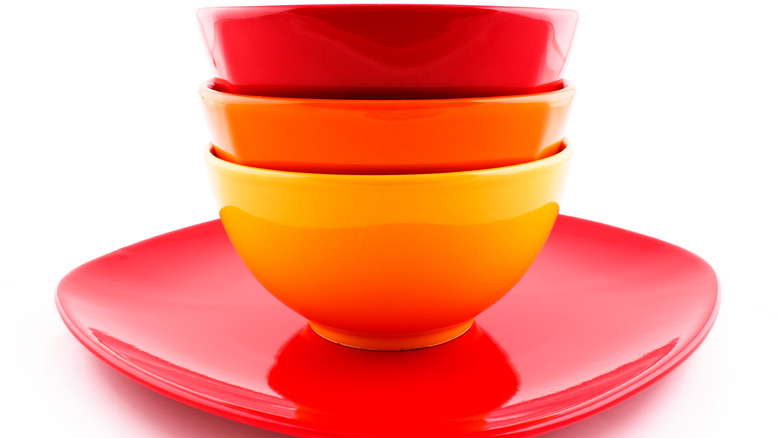
The color of a vintage dish can also be an indicator of higher lead content, signaling that it's best left on the shelf rather than coming home with you. The brighter and more vibrant the dish, the bigger the red flag of it not being food safe. It turns out that those bright colors are often so vibrant because the company mixed the colors with substances that would make the shades more intense. Plus, the lead leaching is made even worse if you store food, specifically of the acidic variety, in the dish, or heat food in it. If you have a choice between brightly colored and plain white vintage dishware, opt for the plain white ones. According to the California Department of Public Health, it's fairly rare that plain white ceramic dishware tests positive for lead.
However, lead isn't the only problem in bright vintage dishware. Cadmium in ceramics and glass can be a problem, too. It's another metal that intensifies colors and resists fading. Some older red-orange dishware also contains Realgar, which features poisonous arsenic sulfide. Additionally, some vintage bright red and orange dishware often used uranium oxide to attain an intense red-orange color. With that same chemical being confiscated during World War II for nuclear bomb-making purposes, you can imagine why you wouldn't want to eat off them. So, it's just best to avoid brightly colored vintage dishware in general, especially if the shade is striking.
The dishware has internal decorations or patterns that are starting to fade

Now that you know that the bright colors you see in vintage dishware are often a result of lead, you might think twice about any colored decorations on them. It turns out that lead coloring agents aren't just for brightening dishware; sometimes, they're in the decorative elements, too. However, it's the inside surfaces that come into contact with food that matter. A dish may not be problematic if all the decorations are in areas where food doesn't touch, like a bowl with colored patterns on its outer areas. But if the colors and decorations are on the inside, we'd suggest that you err on the side of caution and not buy it.
Additionally, you should be especially concerned if the decorative elements are on top of the glaze rather than under it. Sometimes, you can feel or see the difference. Decorative coloring that isn't under the glaze tends to wear off easily. So, you might notice that the pattern has begun to fade or some of it is missing. If you already have dishware that has decorations in the internal areas that come into contact with food, consider this easy test. Soak the dish in vinegar for a few hours and check to see if the decoration has faded. This will show how likely the decorative part is to leach its chemicals, if any, into your food. It's important to note, however, that while this DIY test works, it does not confirm the absence of lead.
The dishware is chipped, cracked, or has corroded glaze
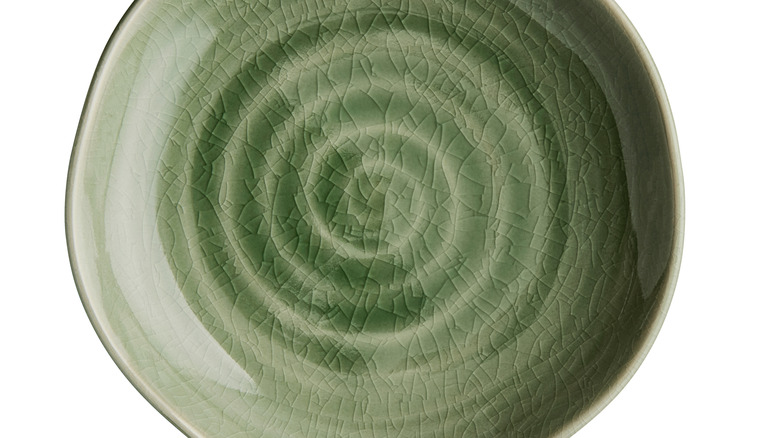
It's best to steer clear of vintage dishware with any type of imperfections, like chips, cracks, and corrosion, unless you're buying them for aesthetic reasons, such as to decorate a retro-inspired kitchen or dining room. Anything that compromises the glaze's surface is a concern because it could introduce lead or other dangerous chemicals into your food. Even if the dish is made of all food-safe material, bacteria can get lodged into cracks and contaminate your food.
Glaze corrosion is another issue to consider. You can tell if the glaze is corroded if the dish has a chalky or grey residue on it, especially if it appears after washing it. The appearance of spiderwebbing in the glaze (crazing) is also a cause for concern, as this indicates that the glaze is weak and could fail. Plus, bacteria can get caught in all those fine lines, providing a potential health concern. If the dishware is just too pretty to leave behind in the thrift store, consider only using them decoratively or with food items that don't directly touch the dish, like muffins that come wrapped in paper.
If simple testing reveals that the dishware might have lead
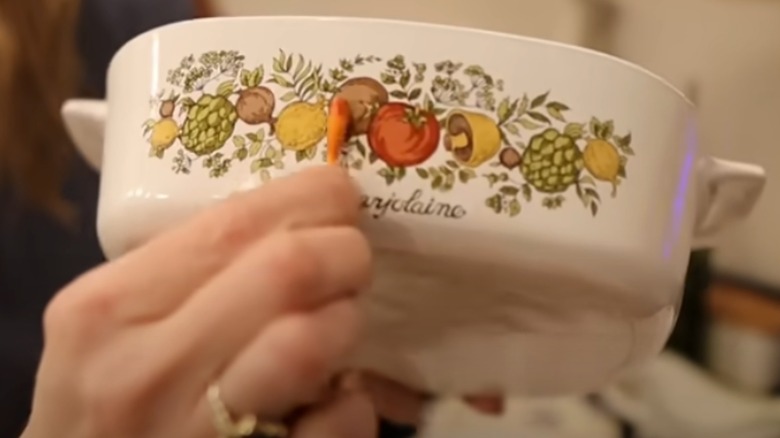
If you can't get enough of vintage dishware, consider bringing a lead test kit to the thrift store to test the item you want. Granted, lead isn't the only problem some of these dishware might have, but at least, you'll know if the one you want is lead-free. Testing kits like the NewPos Lead Test Kit can tell you in just 30 seconds if the item has significant amounts of lead or not. Simply dip the swab in vinegar or water (depending on the test) and rub it vigorously over the surface of the dish. Then, check the color the swab turns into to determine whether it contains lead.
Just be sure that the kit you get is for ceramics and not for painted surfaces like the ones generally sold in hardware stores, if you want the most accuracy. If the test shows any amount of lead, it could be dangerous to use. So, you might want to not only check the vintage dishware you're thinking about buying, but also the ones already in your kitchen. Keep in mind that it's not just ceramics that can contain lead. Dishware made of glass can also contain lead. Crystal glassware is especially suspect. For rudimentary testing, if the glass rings rather than clinks when hit, prisms when light shines through it, or has a thin rim, it may contain lead.
The Corelle dishware you want was made before 2005

While Corelle has always followed U.S. safety regulations in making its dishware, it's best to avoid using any of those created before 2005. The reason for the caution is that, as we've mentioned, lead regulations in the U.S. for dishware have changed over time, and independent testing has shown older ones to have unsafe levels of lead.
Corelle uses a third-party company to test all its products for lead and cadmium, and has also tested its older products. Before the current company that owns Corelle bought it in 2000, the decorative trim on its plates and dishware contained lead. While the lead quantity is small and completely enclosed in glass at very high temperatures, it's still there. According to Corelle, its vintage products made in 1978 and later have been tested to meet the FDA's current lead requirements.
However, patterned Corelle dishware dates back to 1970, and a lead-testing organization called LeadSafeMama has found that many of the most popular vintage patterns have alarmingly high lead content. Even patterns made in 1978 tested high for lead, as did the ones created in the 1980s and 1990s. Plus, ones from that period often tested high for cadmium and arsenic as well. So, worn glaze may have brought some of the lead to the surface. Therefore, if you want Corelle dishware, be sure to buy newer ones to eat from and use nostalgic vintage ones for decoration only.
It glows under black light
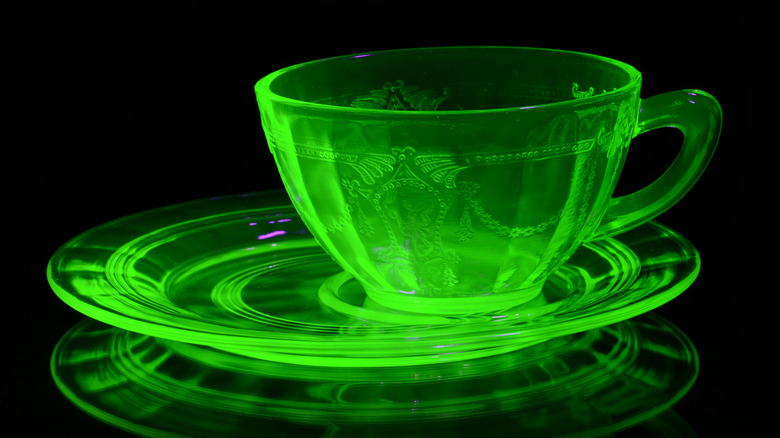
Taking a black light to the thrift store is one way to detect if the dishware you're considering contains unsafe elements. The color that the glassware transforms into while under black light indicates the chemical mixed into the glass. Probably one of the most well-known glowing glasses is uranium glass, which emits electric green under black light because of its uranium oxide content. If uranium glass contains lead, the glow will still be a bright green, but the lead quantities will determine the shade. Keep in mind that uranium glass comes in varying colors, ranging from clear to opaque and including everything from yellow and green (like a vintage Jadeite dishware) to milky white and even pink. While the radioactivity levels are relatively low, it's still not safe to eat or drink from it.
Other chemicals can make glassware glow under a black light as well. For example, manganese glows a faint greenish yellow rather than fluorescent green under black light. So, you may need a Geiger counter to know whether you're getting a uranium or manganese glow. Glass with lead in it will show ice blue. Antimony has a bluish white glow. Glassware with cadmium or cadmium and selenium gives off a yellow glow under a black light, while selenium alone gives off a pink glow. The list of elements that glow different colors under a black light is long, but many of the ones that show this transformation are toxic and worth a little research.
The Fiestaware logo and backstamp indicate it's newer
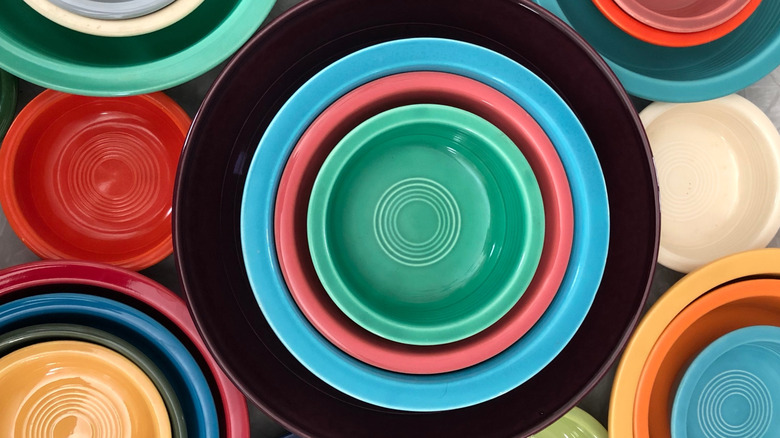
When we mentioned dishware that uses uranium oxide for vibrant coloring, we were thinking specifically about Fiestaware. Fiestaware used natural uranium in its dishware from 1936 to 1943 and depleted uranium from 1959 to 1969. Luckily, this information gives a hint about when they were made and their radioactivity status.
A 1980 study prepared for the U.S. Nuclear Regulatory Commission revealed a high radium content in vintage Fiestaware (a vintage dinnerware found in thrift stores). The amount is enough that any person near it or touching it with their hands or lips would be exposed to radiation in varying amounts. The radiation can also leach from the dish to any food in it. While we couldn't find any cases involving people getting radiation sickness from exposure to Fiestaware, specifically, the CDC notes that radiation exposure puts people at risk of kidney problems and cancer.
Luckily, you can identify older Fiestaware by looking at the logo and backstamp code. The first thing you need to do is to flip the dish upside down to determine if it's newer or older. Every piece has a backstamp code that corresponds to the year and quarter it was made, which can clarify its age if you can find a chart online. Starting in 1986, the "F" in "Fiesta" had a loop at the top. Newer pieces have the logo written in ink rather than as an indentation in the dish, and the logo has a capital "F".
You find plastic dishware that has a non-food-safe recycling number
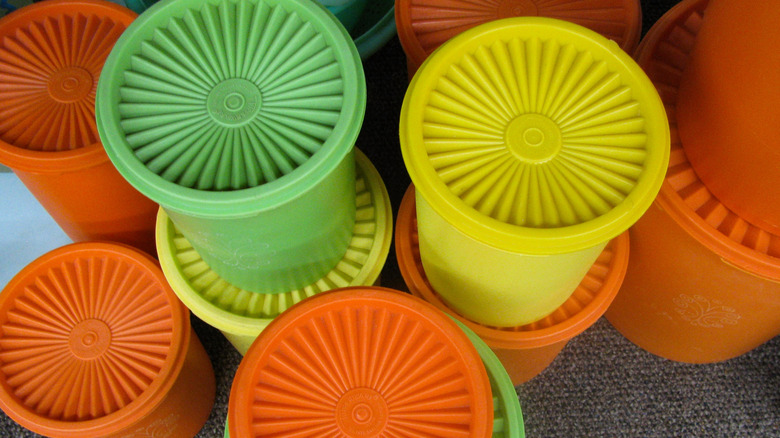
Finally, if you opt for plastic vintage dishware from the thrift store, it's essential that you note the recycling number on the bottom of the dish. The recycling number, or lack thereof, can give you a good indication as to whether the plastic is food safe or not. If the numbers indicate it's not food safe, you could purchase it to hold household items, but you shouldn't plan to eat from it or store food in it.
If you look at the bottom of the plastic dish, seeing recycling numbers 2, 4, or 5 indicates that they're food safe for more than one use. If there's no number at all, it may have never been intended for food use or could be old. So, err on the side of caution and avoid a plastic dishware without a number. Some other indications that it's food safe are a cup and fork symbol that shows that the dish is FDA-approved.
You should avoid scratched, chipped, stained, odiferous, and old plastic dishware, even if they have a food-safe number. Bacteria or chemicals can leach into food from cracks, while stains and smells may be a hint of bacteria. Meanwhile, plastic dishware made before 2010 may contain chemicals like BPA, which are now banned for use because of health risks. So, not only should you stop using vintage plasticware, but even more modern plastic dishware might not be safe.