

Taste Test: How Does Starbucks' And Dunkin's House Coffee Differ?
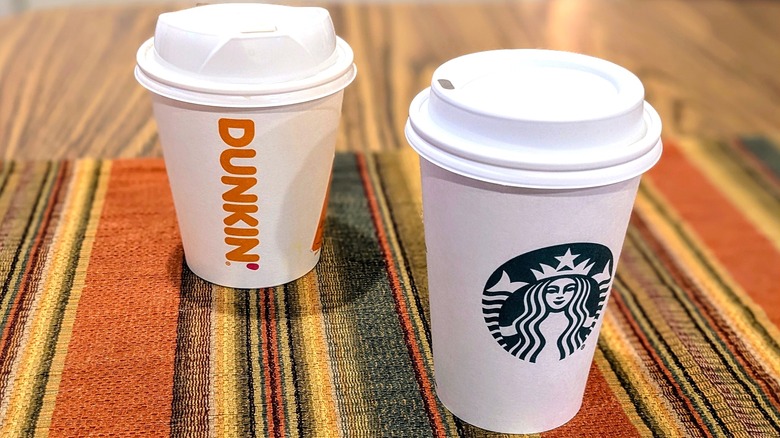
Chain coffee shops are as ubiquitous in America as pick-up trucks and hamburger joints. We love our fast, convenient, drive-thru coffee, but not just any chain coffee shop's brew will do. In the U.S., two coffee chains reign supreme in a classic battle of East Coast versus West Coast, each with a loyal following to rival that of professional football. Starbucks and Dunkin' both span (just about) the entire nation, and although both businesses seem similar on the surface, there are actually some major differences between the two American coffee icons.
The debate over whether Starbuck's or Dunkin' makes the better cup of coffee may never truly be settled, but I decided to take a crack at it, nonetheless. Although the coffees that both chains are famous for usually involve lots of milk, sugar, and the faux-Italian names, I decided to test out a beverage that we tend to forget is even an option as our quest for syrupy, seasonal sweets leaves us with tunnel vision: regular black coffee. I tried a hot house coffee sans milk and sugar from Dunkin' and the same from Starbucks to uncover their differences and similarities. I'll determine the flavor notes, body, and roast profiles of each to figure out how these two similar rivals compare on the battlefield of regular ol' joe.
What is Starbucks' house coffee?
Most cafés — whether they're chains or small businesses — offer a house coffee. The house coffee acts as the go-to when someone orders a regular cup of drip, or something like a red eye, which requires drip coffee. It's more often than not a coffee blend as opposed to a single-origin, and it usually falls middle-of-the-road in terms of body, acidity, and roast level, with flavor notes that aren't too funky, typically chocolate, caramel, and nuts.
At Starbucks, the house coffee is Pike Place, named for the historic Seattle market where the world's first Starbucks was allegedly located. This medium roast was created back in 2008 to act as the standard medium roast at all Starbucks locations. The company describes the coffee as smooth and well-rounded, with subtle notes of praline and chocolate. It claims it's a blend of Latin American arabica beans, but it's unclear which countries, specifically, Pike Place is crafted from. If you ever get a chance to glimpse the Pike Place beans, you'll find that they're small and very dark, with a light oily sheen coating each one.
What is Dunkin's house coffee?
When you pop into a Dunkin' and order a regular hot coffee or plain iced brew, you're getting a cup full of Dunkin's Original Blend. This is the coffee that the company claims put it on the map way back in 1950. Does that mean that Dunkin's OG coffee uses beans from the same origin that it did back in 1950, at the same exact roast level? I have no idea. In fact, it's unclear exactly where this coffee comes from. There are no clear origin countries labeled on the coffee, but that's not uncommon for large companies.
Dunkin' claims that the original blend is made with arabica beans, which leads me to believe that it's not 100% arabica, but rather a blend of arabica and robusta. Large coffee brands often include robusta in blends because it's cheaper and delivers a punch of bold flavor, but it's generally of lower quality than arabica beans, which are usually preferred.
Dunkin' doesn't dive into this coffee's flavor profile much, outside of mentioning that it's a lively, smooth medium roast with caramel notes, "easy drinkability," and the brand's signature taste (whatever that may mean). The beans look almost as small and dark as Starbucks' Pike Place blend, but they aren't nearly as oily.
Price and availability
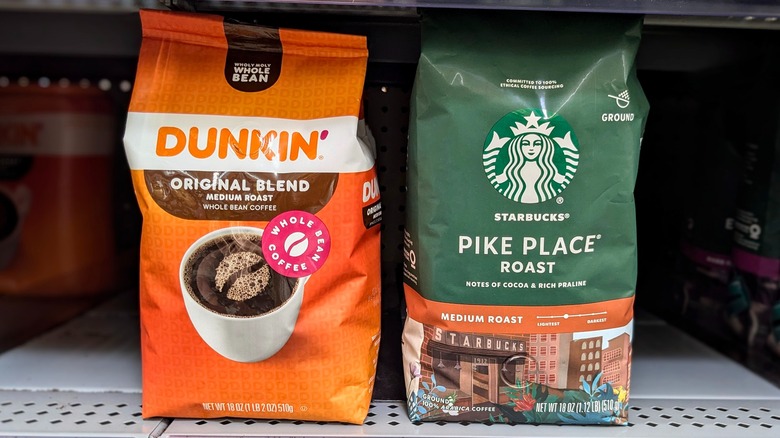
You'll find both Starbucks and Dunkin' house coffees, Pike Place and Original Blend, brewed fresh in-store just about every day. Starbucks guarantees that a hot pot of Pike Place is always on at each location (some locations may rotate offerings), and it's safe to assume that Dunkin' doesn't stray far from its Original Blend as a house coffee, since it doesn't offer a huge selection of other medium roasts. Both coffees are incredibly popular, so they're easy to track down at large retailers like Walmart and Target, too. Or you can just grab a bag of beans or a pack of K-Cups with your to-go coffee at a Starbucks or Dunkin' location.
At my local Starbucks, a regular cup of house coffee ranges in price from $2.55 to $3.25, from short to venti sizes. An iced house blend goes for $3.79 to $4.95, depending on which size you choose. A hot Original Blend coffee at Dunkin' ranges in price from $2.19 to $3.19, while an iced version falls between $2.99 and $3.79. If you're looking to pick up a bag of beans from either Target or Walmart, you can expect to pay about $17 for a 16-ounce bag of Starbucks whole bean coffee and around $13 for a 12-ounce bag of Dunkin's store-bought brew. These prices reflect those of my local Dunkin', Starbucks, and big-box stores in rural Pennsylvania, so you can anticipate slightly higher prices if you live in a major metropolitan area.
Taste test: Starbucks' house brew
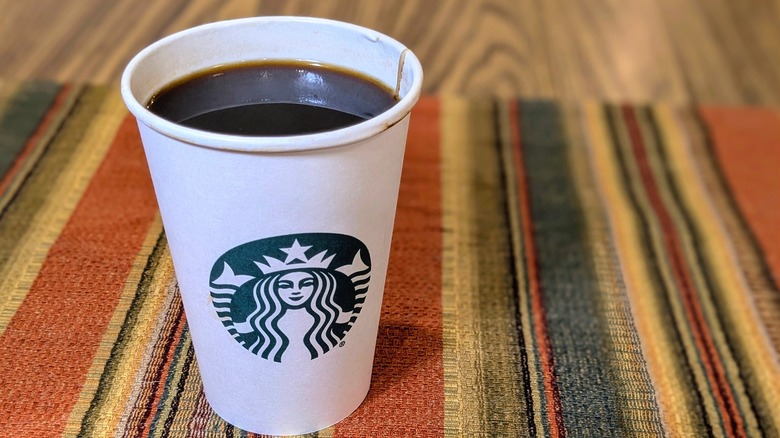
I opted for plain, black coffees for this taste comparison so that I could determine the profile of each without any sweeteners or milk to convolute the test. However, after taking one sip of Starbucks' house coffee, I fully understood why the caramel macchiato is a much more popular choice.
I find it very hard to wrap my head around the fact that Pike Place is a medium roast. It drinks darker than a typical medium roast — even the beans look like a famously dark French roast. This coffee was exceptionally bitter, but not necessarily in a way that made it taste burnt. It tasted like it was roasted for longer than it should have been, rather than bitter from sitting in a coffee urn all day. While trying to look past the acrid taste, I detected subtle nutty flavors and a bright vegetal taste, almost like that of bell peppers. But the flavors were muddled by the wildly long roasting time, which made the beans lose most of their character.
Once I let the coffee cool down a bit, the bitterness subsided, but not enough to make this coffee enjoyable without any additions. But it let me explore more of the flavors — I noticed dark chocolate and even a slight saltiness that worked well with the coffee's moderate body and bright acidity. After tasting it black, I added a tiny bit of sugar and a splash of whole milk, which made the coffee more palatable, although it wasn't enough to completely mask the intense bitterness in this brew.
Taste test: Dunkin' house brew
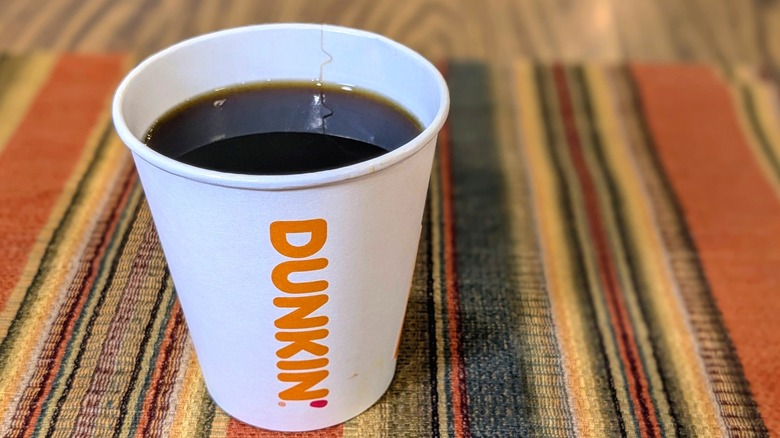
Although they're meant to serve the same purpose, which is to act as a reliable house medium roast for all your daily coffee endeavors, Dunkin's Original Blend was the antithesis of Pike Place. This cup had a bright, slightly fruity aroma that implied it would be promising. On my first sip, I got all the classic coffee flavor notes of chocolate, nuts, and caramel, with a whiff of floral sweetness. It was more complex than I anticipated, and its bold, but not overpowering, acidity worked well with these complex flavors. It had a silky body that carried its pleasant nutty, fruity, and floral flavors well. Overall, my particular cup of Original Blend was brewed on the weaker side, but I actually prefer this when it comes to non-specialty coffee. It's not as easy to taste sharp defects and flaws in a coffee that's brewed to tea-strength.
Dunkin's Original Blend could be the poster child for a typical American breakfast time cup: nothing artisanal, but not bottom-of-the-barrel, either, even a bit weak — just like Mom always brewed. It's smooth and approachable and relatively enjoyable without any sugar or milk which, if I'm being honest, caught me completely off guard. I always opt for milky lattes at chain coffee shops because I tend to assume that the drip is stale, burnt, or just plain bad, but Dunkin' threw me for a loop with its house brew.
Final thoughts
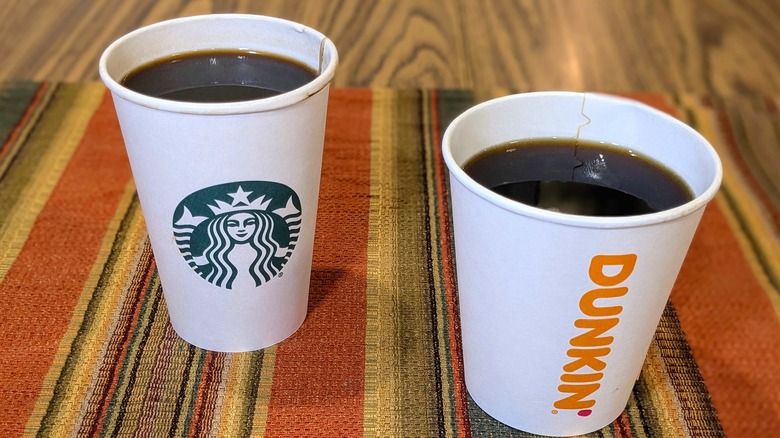
I went into this taste test assuming there would be more similarities than differences in Starbucks' and Dunkin's house coffees, having never tried either before. Although both come from beans that were clearly roasted well beyond the medium-roast mark, only Starbucks' house brew had the unmistakable characteristics of a coffee so dark that most of its nuances are cast away into the ether. Although I could detect subtle sweet and savory notes in the background of Pike Place, it wasn't enough to create a well-rounded, complex coffee that's bright and crisp sans sweetener or milk to help mellow it out.
Meanwhile, Dunkin' was able to achieve the bold, bright flavor that everyone looks for in their first cup of the day. However, that's not to say that this coffee isn't roasted a bit too dark. It's certainly darker than the typical threshold for a medium roast, but instead of frying the beans beyond all recognition, it gives the coffee's natural flavors a smokey backbone that actually enhances some of the floral and sweet caramel qualities. Overall, these two coffees couldn't be more different, despite looking nearly identical and spawning from two of the country's all-time biggest coffee retailers.