

The History Of Costco: How It Became The Warehouse Giant It Is Today
For millions of shoppers, walking through the concrete arch of a Costco warehouse is like entering an alternate universe, a temple of scale and surplus, where your heart's desire comes on pallets stacked to the rafters. With aisles wide enough for families to roll two carts side by side, and the faint perfume of Costco's crispy rotisserie chicken and bakery sugar wafting gently on the air, the dizzying proportions bend ordinary logic. Nothing is quite as expected, and time seems to melt like margarine under a heat lamp as you move deeper into the maze of abundance. It feels as if Costco has always existed, a mystical, eternal flame lit within the heart of America. But this liminal realm where snack dreams do come true has only been around for the last four decades.
Founded in Seattle by James Sinegal and Jeffrey Brotman in 1983, Costco Wholesale was born out of a radical idea: What if everyday people could access the deals and scale of the wholesale world, no business license required, with just a humble membership card? The model wasn't conjured from nowhere, but the original Costco distilled the warehouse model to its essentials, with fewer products, leaner margins, and an almost spiritual commitment to efficiency and value. From the beginning, the promise was simple: abundance at a price that felt like a secret.
Members marveled at the spectacle of twenty-pound bags of rice, televisions by the pallet, caskets, and diamonds under the same vast roof. Costco turned shopping into something more than a chore. It became an experience set to a chorus of erratic cart wheels as the democratic values of membership intertwined with the thrill of discovering a cult product or wandering into a personal parade of free samples.
From bulk basics to cult classics

As the first warehouse gained momentum, Costco's blueprint began to take form. The store stocked a tight selection, in stark contrast to the predictable purview of a typical supermarket. The first Costco location boasted concrete aisles lined with only the essentials geared toward more traditional bulk-buying business customers, like restaurants, convenience stores, and offices. They bought coffee by the can, office paper by the ream, and sacks of sugar meant for bakeries and businesses. But as families began joining for the deals, the inventory sprawled, eventually including everything from patio sets to plasma TVs and sweatpants to smoked salmon. With each additional item, Costco further outgrew its pragmatic origins, becoming a destination defined by wonder and possibility, a place where the ordinary and the outlandish meet, jumbo-sized, in every aisle.
In 1995, Costco launched the Kirkland Signature brand as the store's house-made cult. Vodka and pesto, batteries and socks, all bearing the minimalist label, sometimes manufactured by the very brands they sit beside. Kirkland products are made by top-tier producers, tucked behind an unassuming label named for Costco's first corporate home in Kirkland, Washington. Still, most simply call it the "Costco brand," letting the name fade into the background while the cult status spreads. For regulars, Kirkland is an insider's secret. Most shoppers might not be caught in a Kirkland logo sweatshirt, but the same people who fill their carts with Kirkland Signature wine, rotisserie chickens, and peanut butter are legendary among loyalists. Social media lights up any time someone declares that the "Costco brand" version of an everyday staple is not just a bargain but the best you can buy anywhere.
Legacy, loyalty and the big box dream
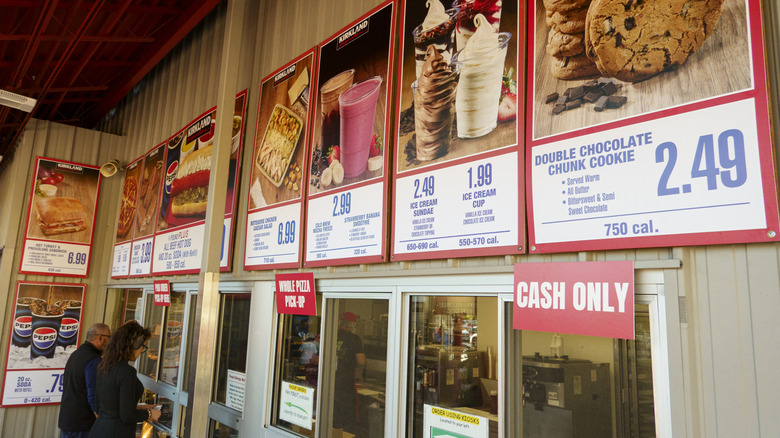
The food court, often the final ritual in the pilgrimage, wasn't always there. Early locations started with simple hot dog carts out front in the late 1980s, but the food court quickly became a fixture. By the early 1990s, every new warehouse included one, anchored by the forever-$1.50 hot dog and soda combo, a monument to Costco's resistance to inflation. The food court is now widely beloved, an oasis of pizza slices, chicken bakes, and XL fountain soda refills for the legions of tired, thirsty members footsore from miles of concrete, bulk deal-bedecked aisles.
Costco's evolution has been relentlessly expansive. The company went public in 1985, fueling an era of rapid expansion that saw new warehouses open first across the U.S. and, by the late 1990s, eventually abroad. In 1993, a landmark merger with Price Club — where Sinegal got his start in the warehouse business — cemented Costco's dominance and set the template for the warehouse giant recognized around the world today. As of 2025, Costco operates around 900 warehouses globally, serving over 120 million members.
Along the way, the warehouse club has both shaped and reflected the changing cultural landscape of American life and consumer religion: shopping as a social event, abundance as comfort, and membership as a kind of soft status. Its business practices have made headlines, from paying employees higher-than-average wages to keeping prices famously stable on beloved staples. Throughout, Costco has quietly held firm to its own standards of fairness and inclusion, resisting pressure to budge on longstanding commitments. These choices have fueled debate and admiration from members in political and business circles alike. Still going strong, Costco is more than just a retail empire; it's a peculiarly American institution: mythic, practical, and forever a little bit strange.