

10 Tips For Designing A Rustic-Style Kitchen
We may receive a commission on purchases made from links.
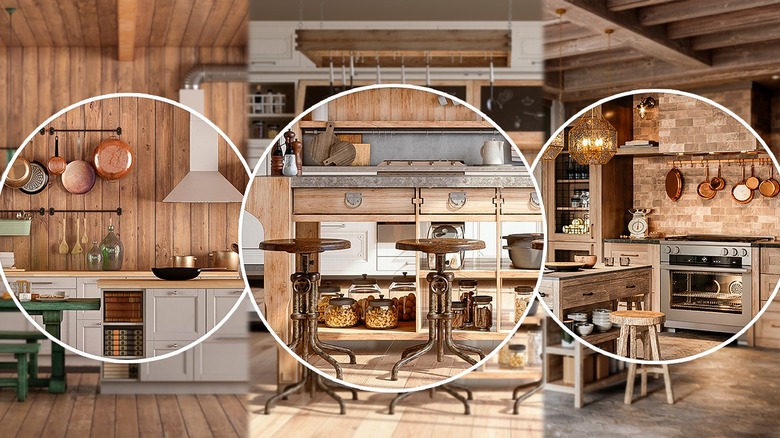
Whether you are remodeling your kitchen or building one entirely from scratch, plenty of decisions lie ahead. Do you want an open floor plan where the kitchen leads into the dining room, or do you want a layout that provides more privacy between spaces? Is having a kitchen island a priority? What color scheme will you ultimately choose? These decisions cannot be rushed. Taking inspiration from friends' kitchens and the internet can help, as can seeking professional guidance. In this article, we've turned to a few experts for tips on designing a type of kitchen that you have likely seen many times over on Pinterest, in magazines, and on HGTV: The rustic-style kitchen.
Isabella Migliarese is the owner and principal designer of Theodore B. Interiors. Joining her is Kendall Sharpe, the mastermind behind Kendall Sharpe Designs LLC. These two women are experts in their field with considerable experience designing all types of homes to suit the personalities, needs, and desires of their clients. Take or leave each tip they provide as it makes sense for your budget and goals. Ultimately, designing a kitchen is an art form, so don't hesitate to let your emotions flow, to dream big, and even to risk making a few mistakes (most of which can be fixed). It's not every day that you get to design your own kitchen, so no matter what, let this be a fun experience! Finally, it's worth noting that a rustic-style kitchen is not the same as a country-style kitchen, so make sure that you and your builder are on the same page.
Choose wooden flooring
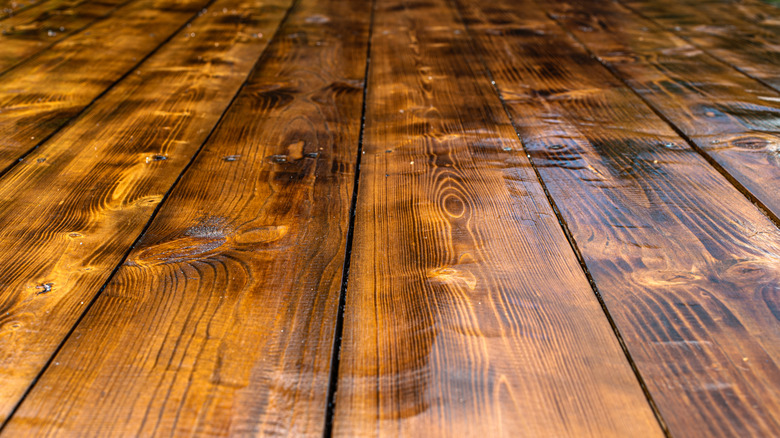
Kendall Sharpe recommends calling upon wide-plank wood flooring, particularly that which has been reclaimed, to add charm to your rustic kitchen. Wide planks better preserve the natural variations of wood, allowing your eyes to feast on dark rings and textured grains. These features will serve as constant reminders that your flooring is not synthetic, but instead came from nature. Plus, opting for reclaimed wood is one way to fill your kitchen with old-growth timber. Though it can be twice as expensive, such wood is often stronger and more durable than wood found on the market today. Furthermore, Isabella Migliarese shares that aged patina adds character to a kitchen, recommending weathered pine in particular.
Don't feel like you have to give up kitchen mats and rugs, though, which can make hours of standing at the sink washing dishes an endurable affair. Besides, kitchen runners can lend extra character to your space and can even be changed seasonally. It should not be a problem to incorporate a few tastefully chosen pieces into your kitchen, such as these cushioned, non-skid mats for placing in front of the sink.
Favor a few, mostly functional, decorations

Isabella Migliarese shares that rather than rushing to fill your kitchen with trinkets, it is "important to collect decor over time. Whether it's through antique markets, estate sales, [or] online finds through Facebook marketplace." Practicing restraint and refining your vision will help ensure that only decorations you truly love will find their way into your new kitchen. Indeed, Kendall Sharpe stresses that when it comes to decorations, "the goal is to balance beauty and purpose — everything in the kitchen should be useful, but it should also feel like it has a story or a sense of place. That's what makes rustic design so rewarding." This might be the opportunity you have been waiting for to pull out a few heritage items that evoke joy and fond memories.
Extra emphasis should be given to functional decorations, such as an egg timer or your grandmother's gravy boat. Sharpe recommends searching for "vintage kitchen tools...[like] wooden rolling pins, copper pots, or enamel bread boxes." Meanwhile, Migliarese points to linen dish towels in natural tones. That's not to say that you can't adorn your walls with a few paintings, though, or place purely aesthetic decorations here and there. Sharpe suggests hanging a favorite recipe on the wall and leaning into "still-life paintings, especially those depicting fruit, bread, or countryside scenes." Furthermore, Sharpe recommends "woven baskets, dried herbs, or a bundle of garlic hanging from a hook," or perhaps "a chalkboard or distressed sign with a hand-written menu or quote."
Design layered lighting
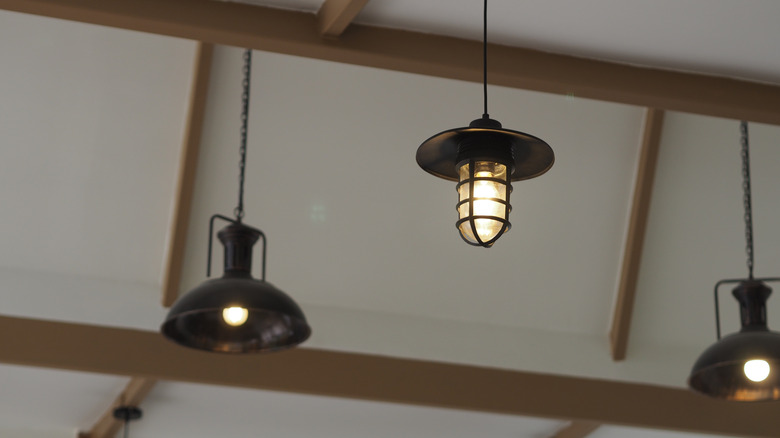
As Kendall Sharpe explains, "layered lighting is key" when designing a rustic kitchen. First up are pendant lights, which Sharpe says can be hung over islands or sinks to help illuminate your workspace. She advises looking for variations made with wrought iron or antique bronze, as well as those with glass shades. Isabella Migliarese shares similar advice, saying that "wrought iron pendants with Edison bulbs or hammered metal shades work beautifully over a kitchen island." Next, Sharpe recommends looking into "under-cabinet lighting for task functionality," but adds the caveat that these lights should be soft, not sharp like those favored in modern design. Migliarese agrees, recommending warm LED strips.
Thirdly, Sharpe explains that "a statement chandelier or lantern-style fixture in the center of the kitchen can add real impact." Chandeliers come in all shapes and sizes; a Sputnik chandelier or waterfall chandelier would be less likely to fit your vibe than a candle chandelier or cage chandelier. Finally, Sharpe recommends incorporating as much natural light into your kitchen as possible so that it feels spacious and light. If that is not possible, follow Migliarese's advice to "choose warm-toned bulbs, [which] is crucial to create an inviting aesthetic." To make your kitchen even brighter, Migliarese recommends "lantern-style fixtures in aged brass" and "pillar candles in hurricane glasses and lantern-style candles."
Implement a grounded color scheme
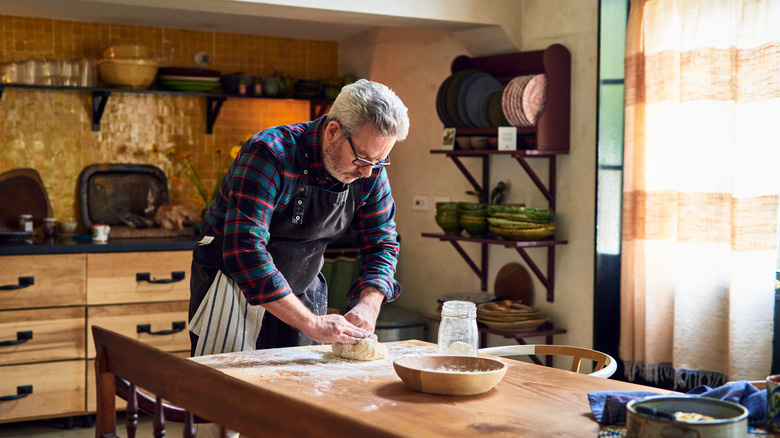
If you tend to spend hours in the paint store poring over swatches, Kendall Sharpe and Isabella Migliarese are here to help narrow down the selection pool. Both recommend opting for subtle, earthy tones and muted neutrals in your rustic kitchen. Migliarese points toward "warm whites, [including] creams, beiges, [and] soft grays." However, she cautions against stark whites. Sharpe agrees that soft creams and warm grays can be seamlessly integrated into a rustic kitchen, not only through your choice of paint, but also through your choice of backsplashes, decorations, and flooring. Sharpe says that you should "look for unlacquered finishes" in objects to complement their muted colors.
If you are looking for a bit more color, though, both Sharpe and Migliarese recommend dusty blue and sage green, as well as rich browns like warm terracotta and muted burgundy. Sharpe prefers a "deep navy or forest green for cabinetry, especially when paired with antique brass hardware." No matter what you choose, Sharpe says, "the idea is to mimic colors you'd naturally find in the environment — a grounded palette with lots of warmth." Migliarese adds that this means "avoid[ing] bright, saturated colors or stark whites. Colors should feel organic."
Consider varied options for storage space

Kendall Sharpe says that one of the most common mistakes she sees when folks are designing their own kitchens is "neglecting storage — form is great, but function wins. Rustic or not, the kitchen has to work for how you live." Thankfully, placing an emphasis on storage space does necessarily have to mean filling every inch of space with drawers and cabinets. Storage can be decorative as well as functional; for instance, Isabella Migliarese recommends storing dry goods in Mason jars or investing in a set of woven baskets that can be used to store napkins, tea bags, and candies. Incorporate natural materials as much as possible in your storage solutions; for instance, you might rescue a set of old soda crates to capitalize on their rustic appeal. Sharpe suggests purchasing a wooden bread box and ceramic canisters "for storing staples like flour, sugar, or coffee beans — these pieces add function and charm."
If you have the right furniture and enough space, cabinetry can add aesthetic appeal to your rustic kitchen. Sharpe says that a freestanding antique hutch can "add soul to the kitchen while giving you a home for bulk goods, linens, or dishware." Of course, drawers, cabinets, and pantries do not always have to shout to make their presence known. You might consider hiding your appliances underneath the kitchen island. You can also design the doors to your walk-in pantry so that they blend in with the surrounding cabinetry, or you can install a sliding farmhouse door to underscore the rustic aesthetic. Sharpe cautions against designing a kitchen with "too much open shelving — yes, it looks great, but if you don't love curating or cleaning, it gets chaotic fast."
Pull up a seat

If you are working with limited space or frequently find it too difficult to make it out of the kitchen before diving into a bowl of pasta, bar seating is an excellent addition to your space. You can purchase a set of stools constructed from wood (especially reclaimed wood), with touches of oil-rubbed copper, cast iron, wrought iron, or aged brass. Set these stools up in conjunction with a bar or high countertop, or arrange them on one side of a kitchen island. The goal here is to encourage conversation while one person is preparing dinner or pouring drinks. Even if you know that you will eventually sit down at a dining table, your bar stools may receive more use than any other chairs in the house.
In case you have a dining room in your house, you might choose to design it in such a way that it complements your rustic kitchen. That may mean extra work upfront, but it will be worth it for the stellar dinner parties that your future holds. Of course, a dining table, or even a breakfast nook, calls for traditional seating. Favor wooden chairs, and consider pairing them with cushions to make them more comfortable.
Invest in cooking equipment, serving ware, and cutlery that tell stories
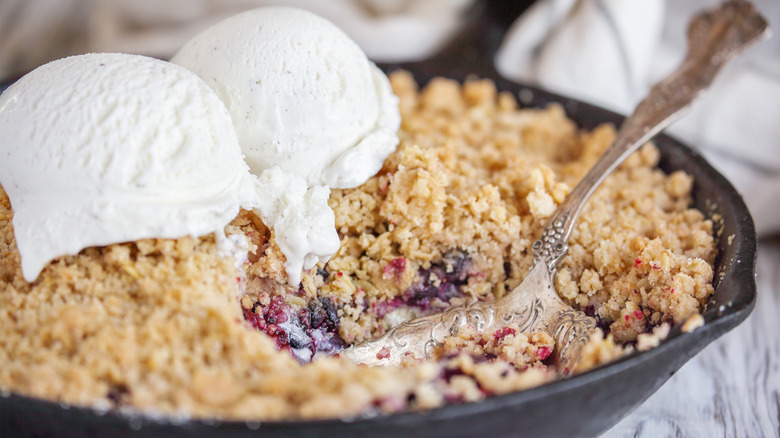
Kendall Sharpe stresses that in a rustic kitchen, "Everything should feel like it belongs there, like it's been in use for generations — even if it's brand new." Essentially, your kitchen should read like a book, with each item telling a story about your personality, interests, and history. Sharpe emphasizes that the design of your kitchen should be deeply personal, perhaps including "a set of your grandmother's dishes [or] a handmade cutting board." Commissioning a woodworker to craft a bowl from a special tree is also a fine idea. Sharpe clarifies, however, that you should blend the old with the new. "A rustic kitchen doesn't have to be stuck in time — you can have a dishwasher, just panel it or surround it with traditional elements so it integrates seamlessly."
Isabella Migliarese and Sharpe both recommend adding cast iron cookware, like a Staub Dutch oven or a Lodge Dutch oven, to your set of cooking appliances. "Not only are they beautiful when left out on the stove or displayed on a shelf," Sharpe says, "but they're essential for slow cooking, braising, and baking. I often leave one out as a styling piece — it says 'this kitchen is meant to be used.'"
Another way to add dynamism to your space, Sharpe says, is by installing a set of wall-mounted pot racks or hanging rails with S-hooks. "These are practical and beautiful — perfect for hanging your most-used utensils, copper pots, or even a linen tea towel. They save counter space while doubling as decor." Alternatively, Migliarese advises filling a ceramic crock with wooden spoons and placing it next to the stovetop for handy use while cooking.
Layer textures and motifs
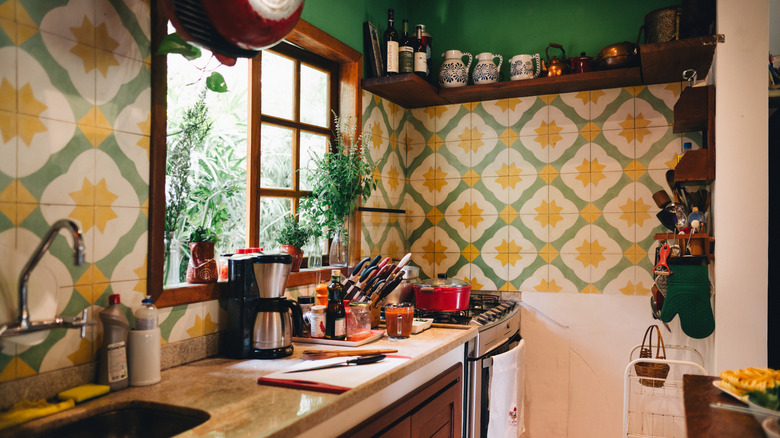
Texture is everything in a rustic kitchen. According to Kendall Sharpe, "the rustic kitchen draws heavily from early American farmhouses, European countryside homes — especially French and English cottages — and even 18th to early 20th century homesteads." If you are a fan of period films or have read your share of classic picture books, then this explanation likely evokes images of stone, brick, metal, and wood.
Sharpe says, "Rustic kitchens pay homage to an era when kitchens were the true heart of the home: Utilitarian, built to last, and full of texture. These spaces were often hand-built with local materials, which gives the style a grounded, honest feel that many people crave today."
What does this mean for your modern-day rustic kitchen? Isabella Migliarese points to several natural materials that you can incorporate into your design plans. For wood, she recommends "reclaimed barn wood [and] weathered pine." You might use this as an opportunity to incorporate a butcher block countertop into your kitchen. For stone, you can favor "granite, slate, [and/or] limestone, typically in a tumbled finish" (Sharpe adds soapstone to this list). When it comes to metals, Migliarese says, look for "wrought iron, aged brass, copper, and oil-rubbed bronze."
Finally, she recommends bricks in "weathered red or whitewashed finishes." Migliarese explains that you should layer and contrast these materials mindfully. For instance, you might "pair sleek granite countertops with wood shelving or contrast smooth ceramic subway tiles with textured natural stone on your countertop." Sharpe echoes that "tumbled stone or handmade tiles add that authentic, imperfect charm" are great for backsplashes.
Don't forget to look up and install wooden beams
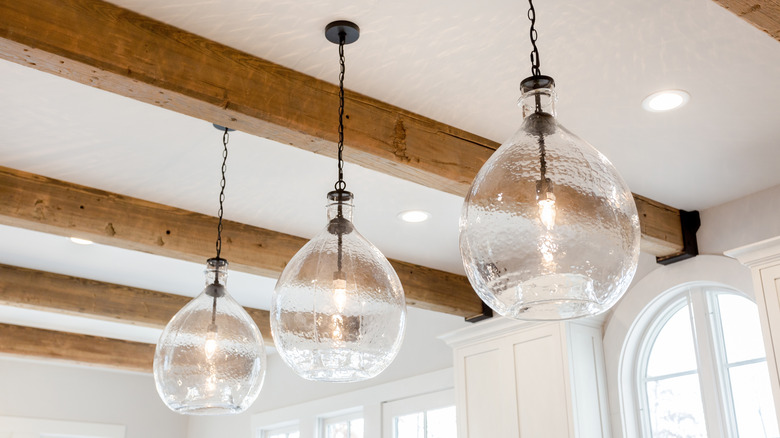
Exposed wooden beams are certainly worth looking into if you have the capacity for tall ceilings in your kitchen. They will help imbibe the space with an element of nature, which is crucial for a rustic-style kitchen. That's why these versatile design elements are found in a large proportion of rustic-style kitchens. Though they once served a practical and economical purpose, exposed beams today are sometimes employed more for decoration and aesthetic appeal. When incorporating exposed beams into your kitchen design, you should work closely with an expert to consider the infrastructure that might be impacted, including electrical wiring, plumbing, and HVAC.
Once constructed, you can draw even more attention to exposed beams by hanging dried herbs or soft lights (such as pendant lights or chandeliers) from the ceiling. Installing a set of overhead shelves is also a fantastic way to make space for greenery in your kitchen. Choosing plants with draping vines will encourage your eyes to look up and appreciate all the work you put into the beams overhead.
Everything in moderation

Isabella Migliarese suggests that home designers "start with one statement element and build around it, whether it's a statement chandelier or a favorite piece of art." This can help limit the amount of clutter or conflicting themes that can otherwise manifest in your kitchen. At the same time, Migliarese says, "overly playing to a theme can be a huge mistake." In a rustic kitchen, this might look like "excessive roosters or farm animals, [or] every surface covered in barn wood." She stresses that "authentic rustic design should feel effortless and organic."
Kendall Sharpe echoes this sentiment, stating that one should "add soul without clutter." She notes that "going too far with distressed finishes or kitschy décor can feel like a movie set." But she also cautions against "mixing in too many modern finishes that clash with the rustic mood (like high-gloss cabinets or super-sleek appliances)." While modern and vintage can be tastefully combined in many cases, glossy surfaces perhaps should not be given a place in your rustic-style kitchen at all.
Finally, if you have a type A personality, you should keep it in check during the design process. Migliarese and Sharpe both point out that imperfections are an essential part of rustic kitchens. Migliarese encourages folks to "embrace the character that comes with age and craftsmanship," and Sharpe adds that "rustic design isn't about polish — it's about character. Choose materials that age gracefully, don't shy away from visible grain, dings, or knots in the wood, and make peace with patina." At the end of the day, Sharpe stresses, "you want things to feel real, not manufactured."