

Costco Price Tag Endings Explained: What .97, .00 & .88 Really Mean

There's a secret or three lurking on every Costco price tag, and we're here to explain what all the price endings and other writing can tell you. A price tag isn't just a price tag at Costco; it's a peek into valuable information about products. Sure, there's the name of the product and the price, but the actual numbers and other info on the tag often conceal important information that can help you make more informed buying choices.
Costco doesn't announce sales items and price adjustments in the store with big sales notices or specially-colored signs like some other grocery stores do, but it turns out that the price ending and symbols tend to do that job instead. The color and date on the tag give you some information, including when you might need a little extra information before buying something. Plus, paying attention to the price tag can earn you a price adjustment for various reasons. While it can be annoying how often your favorite Costco items seem to disappear, the fact that they get discounted before they leave the store can work in your favor. While there are a few exceptions to the pricing rules, we don't think you'll mind too much when you find out more about them. Since we know you want to know all the secrets Costco's price tags have been hiding from you, we've created a guide to help you make sense of them and make more informed purchase choices.
Standard prices end in .99
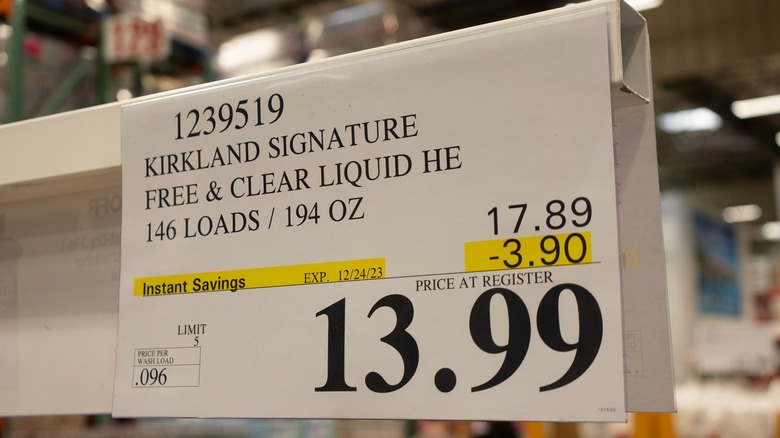
Once you start paying attention to the price tags more closely, you'll start noticing that the most common price tag ending is .99. The reason you'll see more .99 price tag endings than any other endings is because any full-priced item that's not on sale ends in .99. These are also items that you don't have to worry about disappearing. However, we've also seen some sales items with a .99 ending, but we'll talk more about that in the next section.
As long as the penny still exists, you're going to see .99 price tag endings at Costco as being the most common. In fact, a .99 ending is common in many stores because it feels like you're getting more of a deal than if the price were a whole number, because most people see the number in front of the .99 rather than rounding up. Just think about how much smaller a price tag of $9.99 feels versus $10, or a $999 price tag instead of a $1,000 price tag. Sure, there's just a penny or dollar difference there, but most people are looking at the .99 rather than rounding up, which makes a difference from a psychological perspective.
Plus, that .99 at the end makes it feel like we're getting a deal and that maybe the product is more affordable. A variety of stores throughout history have found that items just sell better when they're priced with a .99 ending rather than a whole dollar ending.
Catch items ending in 9 while they're at this lower price
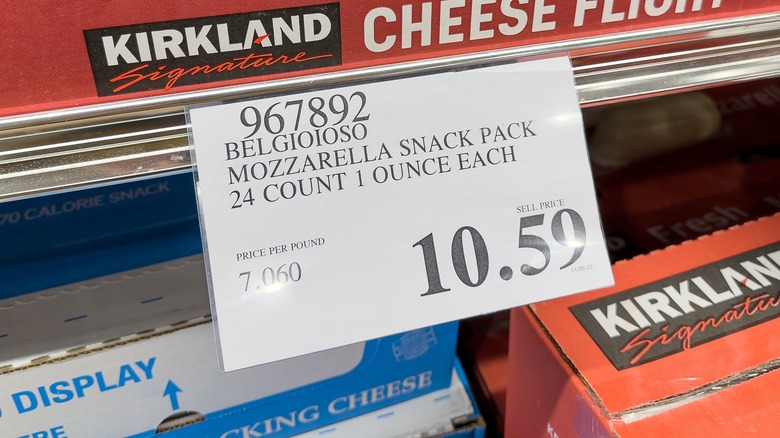
Not all items that have a price ending in a 9 are regular-priced items. If you see a 9 at the end, and it's not a .99 ending, then you're looking at a product that is on sale for a limited time. So, if it's something you buy often and is something that will keep for a while, you might want to go ahead and get several while they're at a lower price.
These limited-time sales items end in something like .59 or .79 rather than .99. And the lower price ending in a 9 also tells you that it's a sale that's coming down from the manufacturer. For example, maybe Tide is offering a temporary $5.40 discount on its normal $29.99 for Tide Pods, taking the price down $24.59 temporarily. Although, the tricky thing is that we've also seen manufacturers' discounts for whole dollar amounts, leaving the price ending for discounted items at .99. For example, we found a $4 manufacturer's discount on Clorox Disinfecting Wipes that brings the price down from $20.99 to $16.99. So, the .99 ending doesn't always mean it's the regular price if the manufacturer's discount is a whole dollar amount.
Some customers have also reported seeing a 9 ending when Costco is doing a price match. They've reported especially seeing 9 endings in the produce department when Costco is trying to match the prices at a local store.
Items with price tag ending in .97 may be on their way out
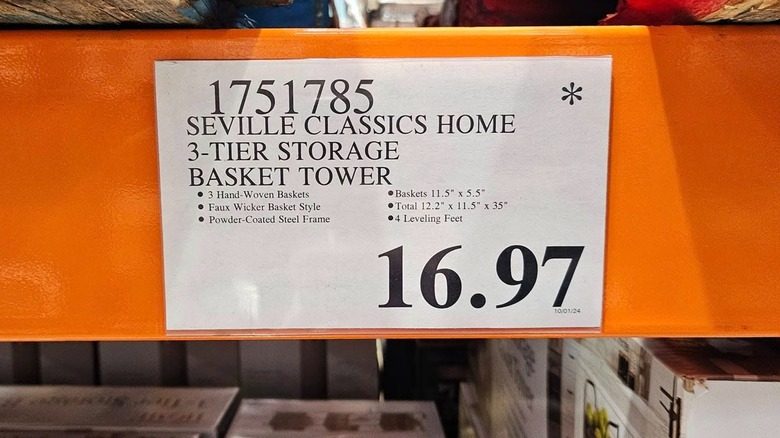
The .97 price tag ending at Costco still carries the same psychological effect as a 9 ending, but it also gives you a hint about what's going on behind the scenes with the product. The .97 ending at Costco tells you that it's a sales item, as well as the fact that you may not see it again. Thus, knowing how to find these clearance items when you shop can save you money.
Items ending in .97 aren't just a couple of cents less than normal. No, they're actually usually discounted quite a lot. Sometimes, it's just around a dollar off, but usually, it's a lot more. However, you'll want to grab something with a .97 price ending while it's still around because these items are either manager markdowns or are actually on clearance and are not likely to continue to be available in the store after they're gone. Some people go as far as to ask a manager what the original price was so that they know just how good a deal they're getting.
However, don't think that you're going to find this product for a better price if you just wait it out because this is probably already at the lowest price you'll ever see. There's also a chance it might go lower to move it off the shelf if it's a really bad seller, but don't count on it.
If you see an asterisk, it may be your last chance to buy the item
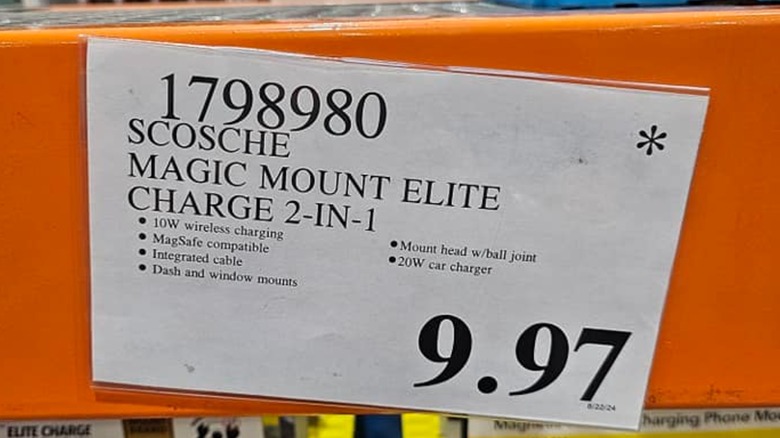
The asterisk on Costco price tags is also known as the Death Star and for good reason. You can guarantee that if you see an asterisk in the upper right corner of the price tag, once the warehouse runs out of that item, it's going to disappear from shelves.
Luckily, the asterisk doesn't always mean the item is gone forever, but sometimes it does. There are two reasons you might be seeing an asterisk on a product. If it's seasonal, it might just indicate that the season is ending. So, go ahead and stock up while you can and hope it is popular enough to return next year. However, if it's not a seasonal item, the Death Star might mean the death of the product because it's being discontinued. So, once again, it's your signal to buy up extras if it was something you really liked.
It's not uncommon to see an asterisk together with a .97 price tag. In such a case, not only is it leaving the store, but it's also being discounted on its way out. Lowering the price is likely to get it out the door sooner to make space for new products.
Special markdowns end in .00 or .88
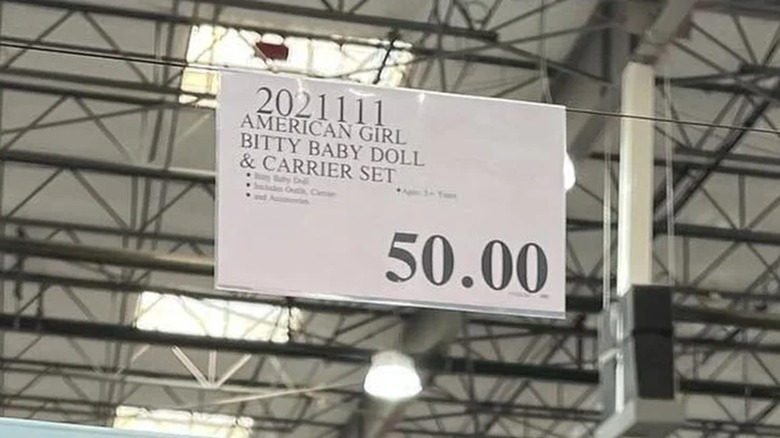
Another price ending that you might find at Costco is .00 or .88, which tells you that it is an out-of-the-ordinary markdown. In fact, that .00 or .88 ending can be a warning sign to scrutinize the product more closely or ask questions about it because it's likely marked down for a reason.
If you see an .00 or .88 ending, it won't tell you everything you need to know about the product, but it does tell you that it might have been returned. It could also signal that it's damaged or has missing parts. Granted, it could just be an item that has a super low inventory, but you'll certainly want to know why it's been marked down before you make a buying decision.
Those .00 endings aren't using the psychology of begging you to buy them. So, perhaps it's better to see them as warning signs. Everything could be perfectly fine, but there's a reason the company isn't stocking the product anymore or is selling it at a discount. Still, making a point to look for these items is one of the many ways to save money buying groceries at Costco if you don't mind braving the unknown.
Dates below prices give information about how long its been at that price
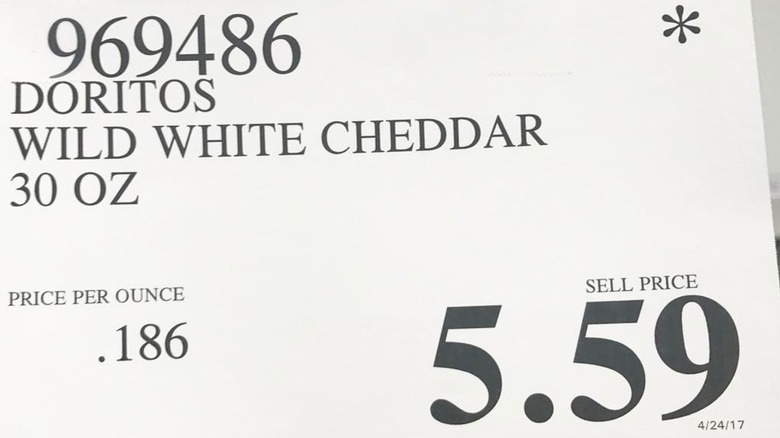
Another piece of information that you've likely not taken note of or known the significance of is the date. You'll find the date toward the bottom right of Costco price tags underneath the price. They're often really small. So, you may have to work a little to find them.
The date on the price tag tells you when Costco last updated the price for the item. If it's something that's been marked down to sell, like a .97 price tag, looking at the date can tell you how long it's been at that price, which could be important if you're looking for deals. If it's been reduced for a couple of weeks rather than a couple of days and there's still a lot of products left, the store may be willing to reduce the price even more to get it out of the store and make room for another product. So, keep watching. If it doesn't have an asterisk to tell you that it's being discontinued for the season or forever, it's even more likely to get another discount if it's been at the present discounted price for a while.
Look for green tags to help you find organic products easier
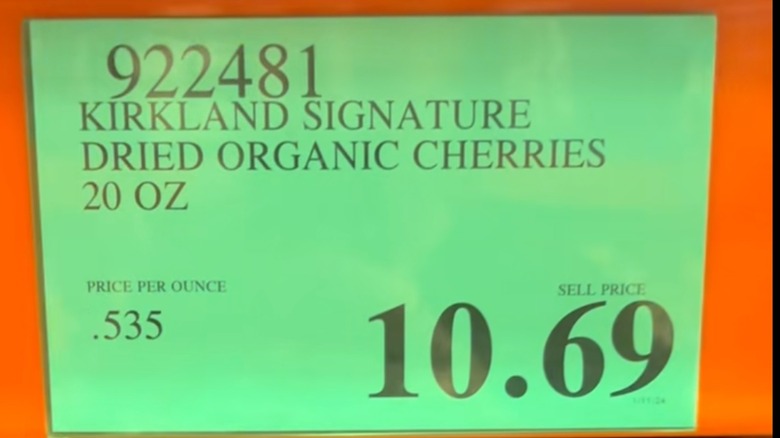
Unlike at some grocery stores, Costco doesn't use a lot of colored tags. In fact, the only color you'll ever see besides white is a green tag. This green tag tells you that the product is organic, and Costco beats out even Whole Foods in its total sales of organic foods. So, if you're someone who values eating organic foods, head toward the green signs, but don't head toward it thinking it indicates some type of price deal.
Now, if you don't see green signs in your Costco, that doesn't mean that your Costco doesn't have organic products. Some Costcos just haven't adopted the green sign practice for organic products. However, more and more have started adopting this practice. So, watch out for it in your favorite Costco locations. The nice thing is that the green signs are bright enough to see from a distance, so you can follow them like little organic breadcrumbs throughout the store.
Look for instant rebate tags
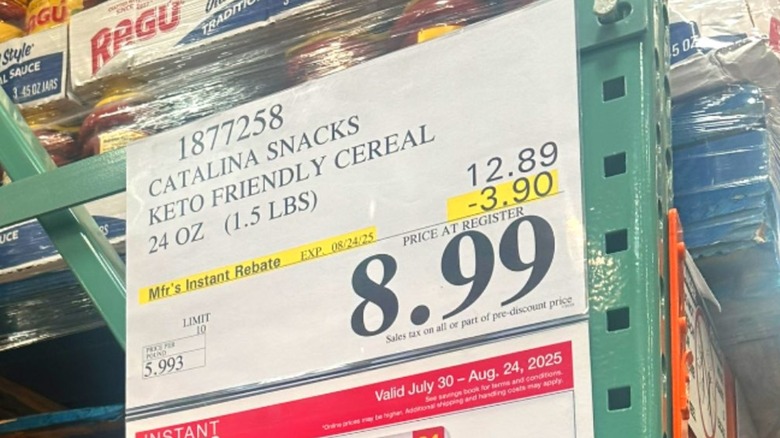
Finding an instant rebate is a completely pain-free way to save money at Costco. So, keep an eye out for price tags that feature instant rebates from the manufacturer. While Costco doesn't accept manufacturer coupons, it has plenty of these instant rebate items throughout the store. It works a lot like an item simply being on sale or like instant coupons with no paperwork involved.
The good news about having no paperwork with an instant rebate is that the "instant" part of the equation means that you don't have to do anything but buy the product to get the discount. There's no need to go through the whole rigamarole of sending in proofs of purchase and filling out forms to get money back for buying the product. Instead, all you have to do is buy the product, and the instant rebate results in money off the price at the register instead of money back after paying full price.
Luckily, the price tag explains everything, showing the normal price in small print, minus the instant rebate value in small print, with the adjusted price listed in larger print as the price you should expect to pay. For example, you might see a copier with a regular price of $79.99 and a subtracted instant rebate of $10, yielding $69.99 as the price you'll end up paying at the register.
Watch for price tags that are lower than you paid earlier in the month
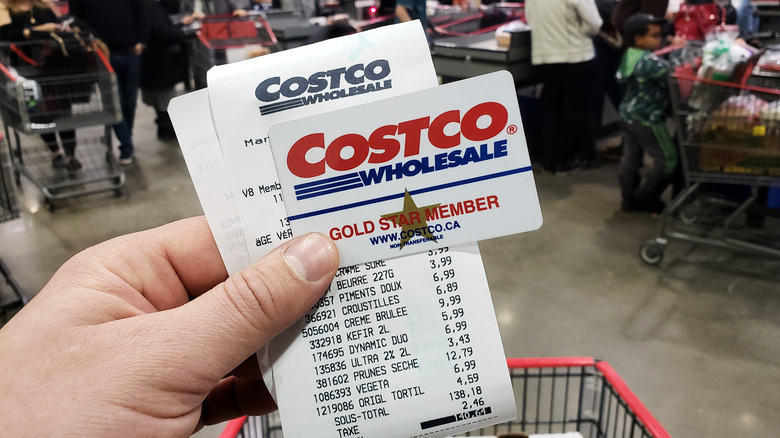
Something you may not have realized is that Costco has a price adjustment policy that can work in your favor. However, you have to be diligent to keep track of product prices to take advantage of it.
Basically, if you buy a product and notice it listed for less any time in the next 30 days, you can ask for a price adjustment. So, if you buy something for $29.99, and you see it on sale later in the month for $19.79, you bring in your receipt to ask for the $10.20 difference to be refunded to you.
Granted, there are some limitations. One of the limitations is the number of items eligible for a price adjustment if the sale has a quantity limiter. For example, if you're limited to three boxes of crackers for the discounted price, you can only get a price adjustment on three boxes of crackers. The price adjustments are also for in-store purchases only. Thus, there are no price adjustments available for sales you find from other sellers or for online sales prices you find on the Costco website.
If you're at Costco in Canada, paying attention to the price tags can save you up to $10
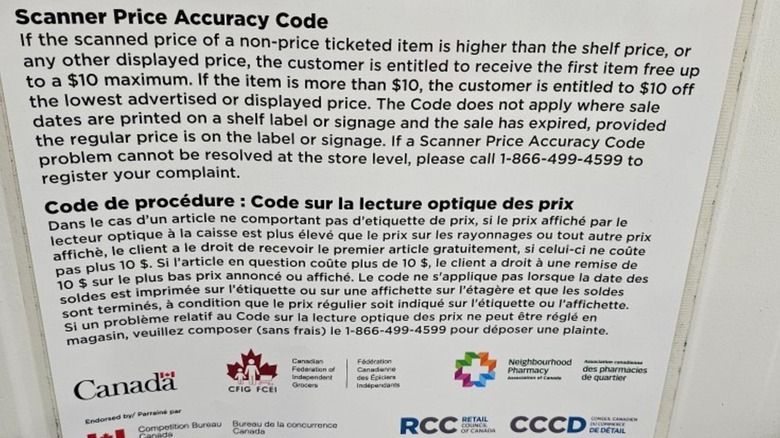
In Canada, Costco participates in SCOP (Scanning Code of Practice), which means you should pay close attention to how prices ring up at the cash register. SCOP protects customers from having the product ring up for a different price than on the price tag or advertisements at checkout. If the prices don't match when you get to the register, you'll receive a discount on the product for your troubles. You can likely find Scanner Price Accuracy Code specifications near the checkout counter if you're unsure whether your product qualifies.
The discount can be up to $10. Thus, an item with a listed price of $10 or less ends up being absolutely free if it rings up wrong. If an item over $10 rings up wrong, the discount works a little differently. You get $10 off the lowest price that is listed either on store signage or in advertisements. If you bought multiples of the item, this discount only applies to the first item, but you'll get the rest of the items at the regular listed price.
The only time you may not get up to $10 off a mispriced item is when the listed sales price on a shelf price tag has expired. So, look to see if the tag mentions a certain timetable for the price. If the sales price has expired, then there's not going to be a discount.
You should always expect the same price tag on rotisserie chicken
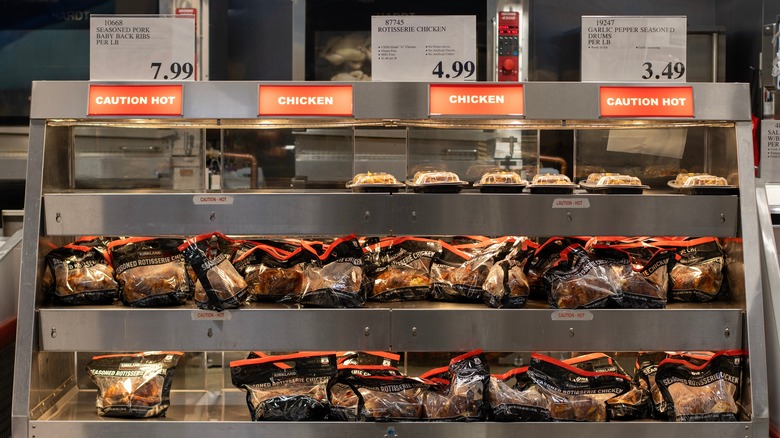
The cost of a rotisserie chicken is one thing you can always count on being the same at Costco: $4.99. While most items at Costco have risen in price with the economy, you don't even have to look at the price tag on the store's beloved rotisserie chicken to know it's going to be $4.99.
The ending of the price is in keeping with what we mentioned about standard prices ending in .99. In fact, $4.99 has been the standard price since 2000. Granted, there was a short time during the 2008 financial crisis when it went up by a dollar to $5.99. However, after the Wall Street bailout at the end of the year, everything started stabilizing again, and rotisserie chicken prices were back to normal by 2009.
To give you an idea of how popular rotisserie chickens are, Costco sold around 137 million of them in 2023, and that number increases every year. It also loses millions of dollars each year on them. However, it's a loss leader since many people come in for it and end up getting other groceries or other components of a no-fuss meal with more profitable items like sides, drinks, and desserts. So, profits still happen indirectly.
The price tag is always the same for the hot dog combo deal, too
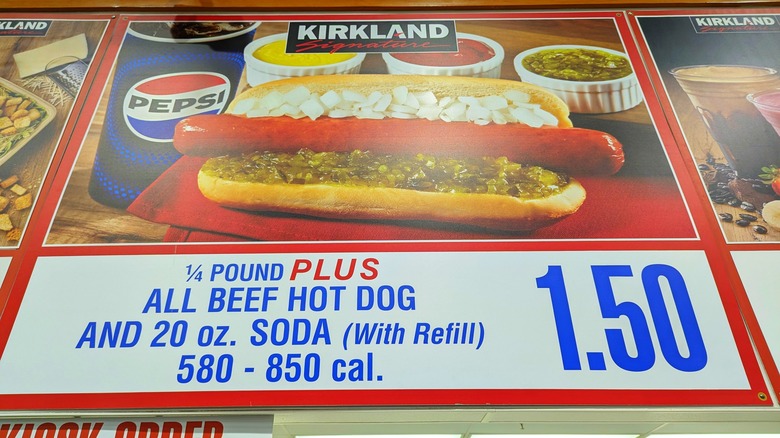
Another item with a price tag that always lists the same price is the hot dog combo meal, which is a mere $1.50. If that sounds like a price from the 1980s, you're right. The price of a quarter-pound, all-beef hot dog with 20 ounces of soda literally hasn't changed since the middle of the 1980s. Plus, you still get free refills on the soda.
Granted, it doesn't follow the normal rules for price tags that end in a 0. However, with it having been at the same price since the last century, we won't complain if it doesn't follow this century's pricing codes.
Like the rotisserie chicken, the hot dog combo is a loss leader. If Costco hadn't decided to keep its hot dog combo price the same all these years, you'd likely be paying around $4.40 for it. So, while it doesn't make money directly, it gets people in the door to buy items that do make profits for the company. In fact, Costco finally managed to sell over 200 million of the combos in a year's time in 2023, which vastly surpassed sales for rotisserie chickens. Plus, while they're at the food court, people buy other items that have increased in price over the years.