

This Is Where Costco Sources Its Mangoes
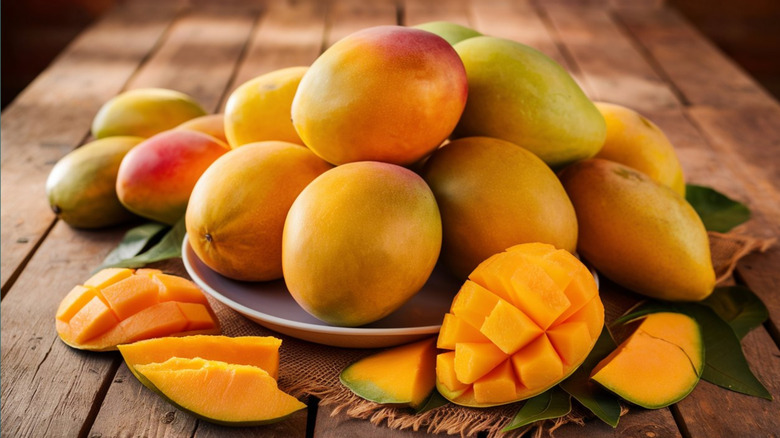
Mangoes are a vibrant slice of the tropics, with their sweet and tangy flavor and melt-in-your-mouth texture. Grown in South and Southeast Asia for millennia, they were first brought to the United States in the 1800s. Now, mangoes appear in nearly every grocery store, Costco included. The retail giant sources these colorful beauties mainly from Peru, Mexico, Brazil, Ecuador, and Guatemala, along with a few other countries. For example, elephant mangoes, grown primarily in Vietnam, have been offered at some stores, and Indian mangoes have been available at certain Costco locations.
According to USDA trade data reported by The Packer, in 2023, the U.S. imported over 60% of its mangoes from Mexico, followed by Peru, Brazil, and Ecuador, so Costco's model isn't that different from the norm. Mangoes are also grown in some U.S. states and territories, including Florida, Hawaii, California, and Puerto Rico. Yet despite there being more than 1,000 mango varieties, only a handful of types are widely available in the U.S., like Kent, Keitt, and Honey.
Costco stocks both regular and organic fresh mangoes, along with frozen and dried fruit versions. While our rankings placed the frozen option among the best frozen fruit at Costco, the Kirkland Signature Sweetened Dried Mangoes, produced in Cambodia, were described as "ultra-sweet" and "gritty" by our writer. However, Costco also stocks an unsweetened dried version, along with mango nectar and fruit bowls. Other mango offerings included a mango smoothie from Costco's food court. But some shoppers described it as "sickly sweet" and "overripe," and it's no longer available.
Mangoes shine in a variety of dishes
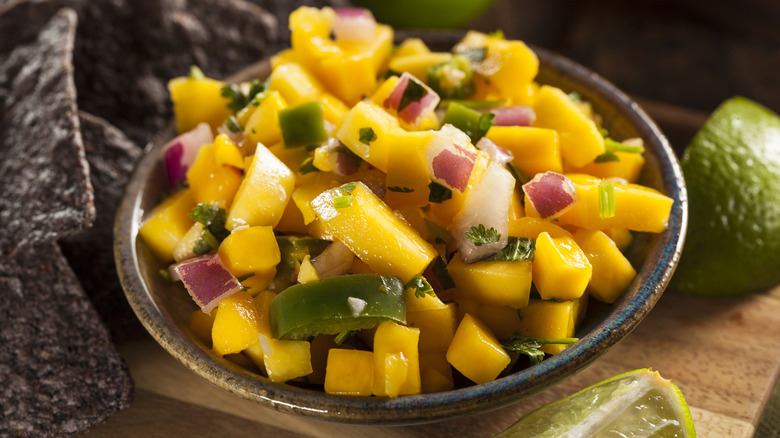
Americans have upped their consumption of mangoes in recent decades – hardly a surprise when different mango varieties peak at different times of year, keeping mangoes in season year-round. There are also plenty of ways to enjoy this tropical treat. For example, recipes for fresh mangoes include sides like mango salsa and mango guacamole, desserts such as mango flan and mango pavlova, and savory dishes like mango chicken curry and mango shrimp salad. There's even a Japanese fruit sandwich, stuffed with flavored whipped cream, mangoes, kiwis, and strawberries.
For most recipes, you'll want to make sure your mangoes are ripe. First, give the fruit a gentle squeeze. If it's firm but gives slightly under your fingers, it's likely ripe. If it's super hard, it's probably not ready, while mushiness can be a sign of overripeness. You can also give it a sniff — if it gives off an appealing, fruity smell, that's another sign it's ready. On the other hand, color isn't a reliable signal since different mango varieties can be green, yellow, or red when ripe. If you ever end up with an unripe mango, you can always transform it into a salty snack. Peel and slice the mango, and then sprinkle it with salt and chili powder. The result is a crunchy and sour treat with a hint of spice — one more way to enjoy this delectable fruit.