

When And Why You Should Be Rubbing Onions On Your Kitchen Knives
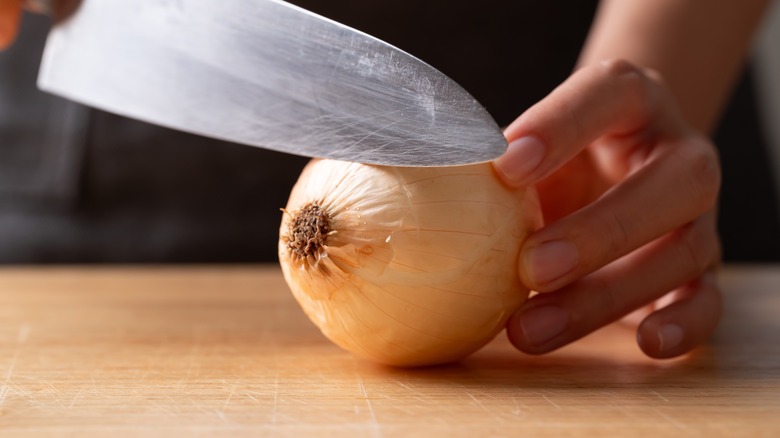
Most of us treat a high-quality chef's knife a little more carefully than everything else in the kitchen drawer. It gets washed by hand and dried right away, at least on most nights. Then one evening it ends up sitting in a wet sink, and the next morning there are little orange spots near the heel. Rust like that usually looks worse than it is, and one of the easiest ways to get rid of it is with an onion.
It sounds like folklore, but the trick is simple enough that it wouldn't really cost you anything (besides a few onions) to give it a try. One technique involves sawing the rusty stretch of the blade back and forth into an onion until the spots start to lift. You could also rest the knife flat on a cutting board, rub the onion over the rust, and then let the onion sit on the blade for 24 hours before washing it off. And for those who are feeling especially lazy today, you can push the blade into the onion a few times, and that'd be that. The method doesn't really matter, as long as onion juice ends up on the blade.
The key agent in loosening rust is sulfenic acid, which an onion releases once it's cut open and which reacts with rust to help break it down. The juice also contains mild organic acids, mainly citric and malic, which may help too. Once the rust loosens, a few passes with the onion's fibrous flesh can scrub it off, leaving you with a clean blade.
Making the onion trick work for your knife
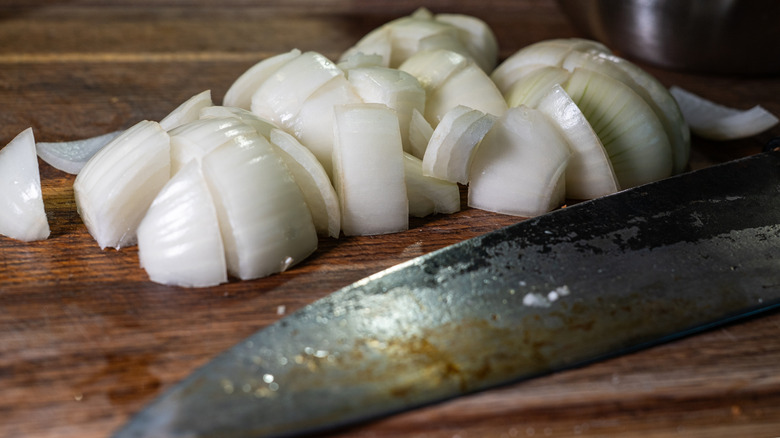
A neglected onion at the back of the fridge (as much as it would've cut down on waste) isn't a good candidate for the job. Onions lose moisture and offer less juice, as well as turning softer, the older they get — the exact opposite of what you're looking for in an onion scrubber. Rust comes off a lot easier with a fresh, firm one. Once the blade is spick and span, wash off the juice and dry thoroughly. The onion goes in the trash. Do not reuse the rust-flecked onion for cooking.
An onion won't be able to fix every rusty knife. This trick works best on light surface rust, like the small spots a stainless steel blade can pick up after a run through the dishwasher or a few hours in a damp dish rack. Thick, flaky rust and pitting, where corrosion has eaten into the steel, are another story. For those, you might want to try a rust eraser or, if the damage is bad enough, take it to a professional sharpener. In the worst-case scenario, the knife might have to be replaced entirely.
And if you own a carbon steel knife, pay extra attention to the onion juice. The steel readily reacts with acids, even those as mild as an onion's, and a blade that stays damp afterward can rust all over again. Wash, dry, and optionally oil it right away after every treatment. Over time, you might even be rewarded with a blue-gray patina from the repeated treatments. This layer of oxidized metal is harmless and can protect your blade from further rust in the long run, and it's pretty to boot!