

The 11 Most Popular Food Court Restaurants Of The '80s

Mall food courts certainly did not originate in the 1980s. Yet, the decadent decade is when these areas of eating truly grew into cultural institutions that support the way we dine today. A proving ground, the 1980s mall food court tried and tested business models and new dishes. Companies succeeded and failed through this space. Take, for consideration, the fact that Chick-fil-A, which started in a food court in '67, came up with menu hit after menu hit during this decade. At the same time, once-hot brands like Orange Julius or Farrell's Ice Cream Parlour would show signs of cooling off by the end of the '80s. Likely, these business swings weren't on the mind of shoppers looking around for their next great deal.
Mall rats may not have been thinking specifically about innovations in the world of food, but they were happening all the same, setting America up for its next several decades of culinary creation. The decade incubated such hits as Panda Express' Orange Chicken, and it helped prove that restaurants with singular concepts — like 1 Potato 2 or Great American Cookies — were capable of surviving, and in some cases, thriving.
The legacy of food courts during the 1980s is one of choice and speed. Today, a group of diners can enter a space filled with a multitude of concepts, split into different directions, and all get something that satisfies their particular cravings. That may not sound so unique now, but these popular restaurants show just how far we've come since then.
Sbarro
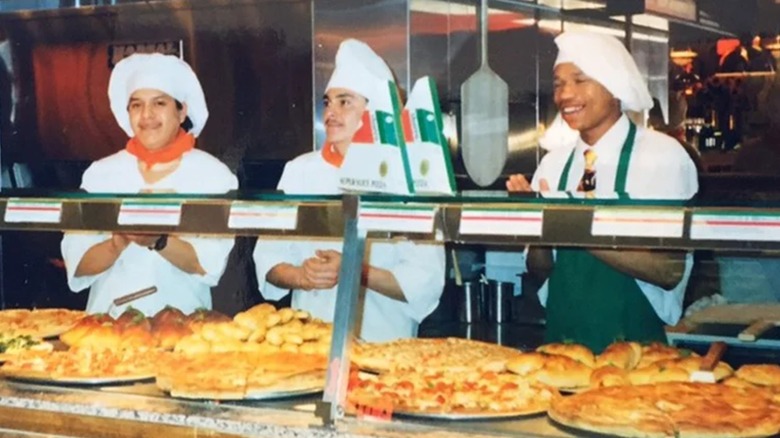
Today, we sort of know Sbarro as being synonymous with mall food courts. It wasn't always the case, and fortunately, the '80s were a crucial decade for Sbarro supremacy. The Italian-American casual dining chain actually first opened as an off-shoot iteration of a Brooklyn-based salumeria, which originated in 1956. Sbarro's initial mall location opened in the 1970s, was also in Brooklyn, and would lead to Sbarro's early aughts peak. In 2004, Sbarro had nearly 1,000 locations spread across North America and Puerto Rico. Getting to this point took rapid expansion, much of which happened in the late '70s and '80s.
Dear reader, you may have your own opinions about Sbarro today, but back in the decade of decadence, the idea was to provide quality food without table service. The idea was a novel one for that decade. More than settling for snack foods, mall shoppers could have pasta dinners with garlic knots, salads, and of course, New York pizza to satiate and replenish themselves. Once Sbarro planted its green-white-red flag in the mall food court territory, the results spoke for themselves. In 1980, Sbarro rose to about a dozen locations. Just four years later, there were over 100, with franchise opportunities rapidly expanding.
Orange Julius
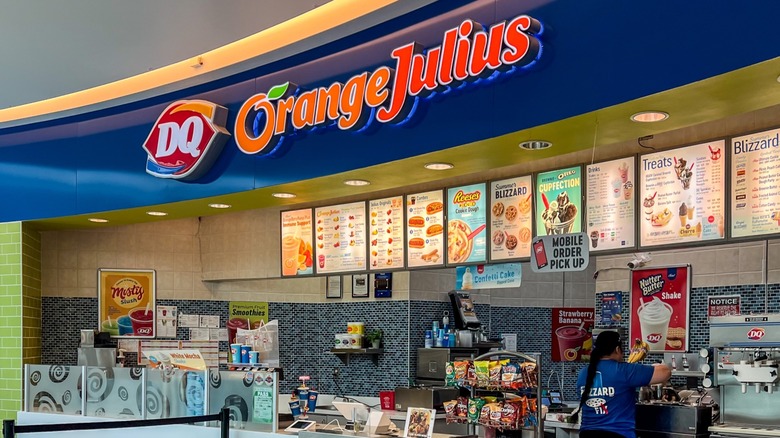
Grab a time machine and transport a mall rat of the '80s to the current day, and they would have a hard time navigating today's food court landscape, being that it's seriously lacking in Orange Julius locations. When it was a standalone chain, Orange Julius was a point of interest on every mall floor map during that decade. Although its offerings weren't the most versatile (as opposed to a stop at Sbarro), hitting an Orange Julius for its namesake drink was a way to keep something refreshing in one hand while you flipped through a sales rack with the other. (That's pretty hard to do with a slice of 'za folded in hand.)
What made Orange Julius so special? At the time, there wasn't anything like it. The signature blended drink, close to a smoothie but not quite, could be ordered with pineapple or strawberry in place of orange. Rumor has it that the 1980s recipe even included raw eggs, or the option to add an egg in for an upcharge and an extra-frothy top layer. In the late '80s, Orange Julius was purchased by Dairy Queen. Although this once-popular drink chain is still around at DQ locations today, it's far from the crucial food court stop it was back in the '80s.
Hot Sam Pretzels
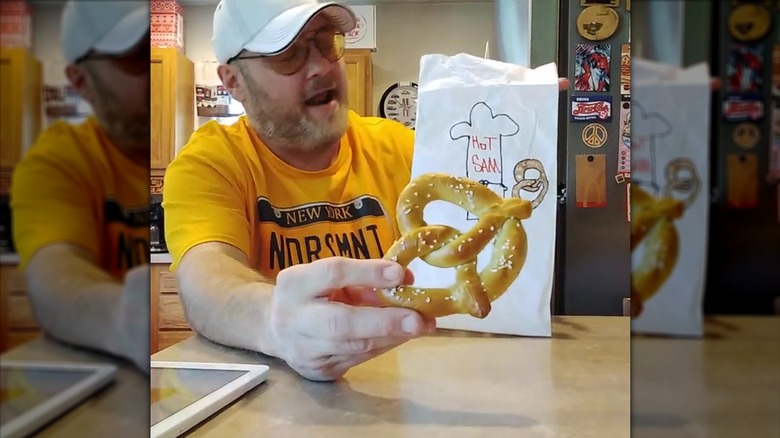
In retrospect, the 1980s food court could almost be looked at as an incubation space, as so many fast casual and fast food chains were developing and fleshing out business models in them. Some of these chains would reshape the way we eat while shopping, others would go on to become dominate businesses beyond malls. Hot Sam Pretzels was one food court stall that defined '80s. And the 1980s were just as defining for it.
Soft pretzels had been a common mall snack long before the invention of the food court, or the founding of Hot Sam — and of course they were. An easily transportable snack, served from a kiosk, quick and affordable for both operator and eater; there's a reason Auntie Anne's and Wetzel's Pretzels are still so successful. By 1985, Hot Sam had 175 locations, selling anywhere between $30 and $50 million worth of pretzels per year. This was for an operation that was slower than fast food!
Hot Sam promised a superior product, however, as the pretzels baked for 16 minutes in traditional, rotating drum ovens. Despite the wait time, the Detroit-based chain did business to the tune of 18 million pretzels a year, filling mall food courts with mustard, fudge, and nacho cheese dipped snacks.
Hot Dog on a Stick
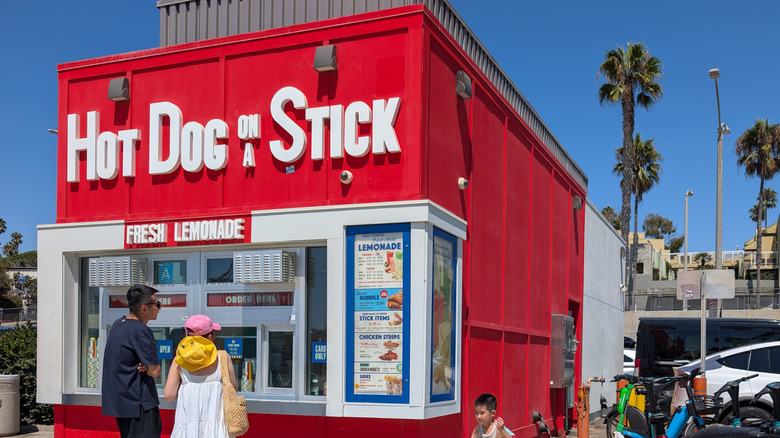
For a food as iconic as the corn dog, there aren't many national restaurant chains that have built a reputation from serving them. In the 1980s, Hot Dog on a Stick looked like the brand that might the one to do it. So long as it could learn to live inside, that is. At the time of its founding in 1946, and until it established its first mall location in the 1970s, Hot Dog on a Stick was a strictly outdoor stand, serving the Santa Monica Pier and tempting those on Muscle Beach with batter-dipped dogs and fresh lemonade. Following its entrance into shopping malls, Hot Dog on a Stick became a must-visit stall for West Coast shoppers.
Hot Dog on a Stick hit the mall food court scene with a stand at the Old Town Mall in Los Angeles. From that location, success bubbled. The menu was simple: Fare food for fair prices, including cheese sticks, fries, funnel cakes, lemonade, and corn dogs, all for under $1 each. The business eventually reached over 100 locations. At each one, the brightly striped uniforms of Hot Dog on a Stick employees welcomed guests with the vibrant color palette that the '80s were known for.
Panda Express
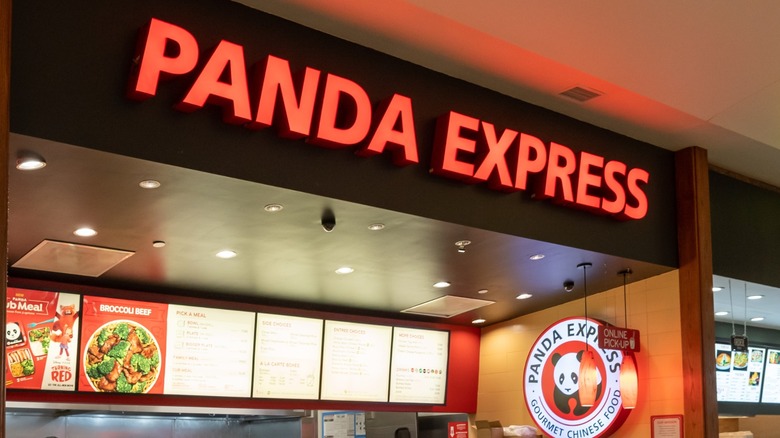
Much like Sbarro, Panda Express used the 1980s to show just how scalable a full meal at the mall food court could be. Prior to opening up in the Glendale Galleria Mall in Glendale, California, Panda Express was a restaurant called Panda Inn. A Pasadena favorite, Panda Express drew the attention of the Galleria Mall developers, who inquired whether a fast food version of the restaurant was possible. The first location opened in 1983. From there, the chain grew faster than bamboo. For many mall visitors, it was their first introduction to Chinese-American cuisine.
There were several things that helped Panda Express and its growing fanbase eat so well during the decade of decadence. For starters, the business strategy looked toward quick expansion, spreading the Panda footprint as quickly as possible. Panda Express also had innovative operations for the time, including leading the industry in computerized POS systems. Then came its most remarkable success. In 1987, while crafting recipes for a soon-to-come Hawaii outpost of Panda Express, company chefs hit on Orange Chicken, which has since become the chain's signature dish. As far as thriving mall food court restaurants go, it was a penchant for innovation that helped Panda Express explode into the next decade and century beyond.
Chick-fil-A
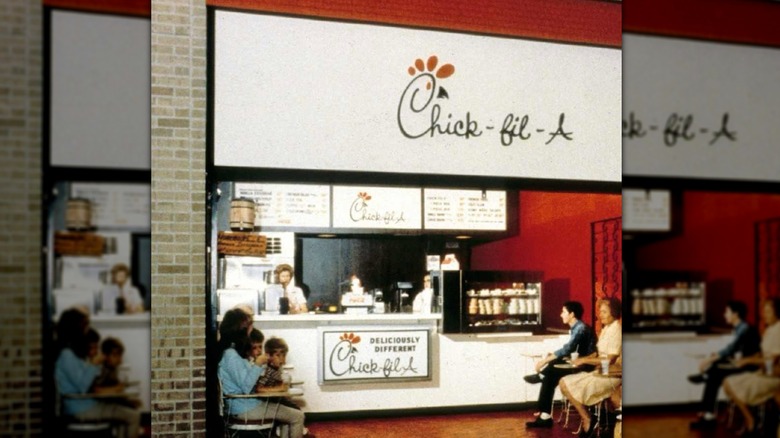
Unlike many other businesses that were popular around 1980s food courts, Chick-fil-A is the rare chain that arrived before the boom and then leveraged the decade's trends to make like a chicken flock and flap out of it. In 1982 came the chain's chicken nuggets; '85 the waffle fry. Beyond malls, the first free-standing location opened in 1986, the same year the restaurant's chicken biscuit dropped. Chick-fil-A closed out the decade with the release of the grilled chicken sandwich — and a goal of making a billion dollars. It's done that and then some, all because of its formative innovation and its reception in malls throughout the '80s.
Chick-fil-A may be moving beyond mall food courts these days, but Chick-fil-A will always be a mall restaurant. Malls were the inception, after all. The chain's first location was famously at Atlanta's Greenbriar Mall, where a stall under 400-square-feet large is credited as having led the way for the modern mall food court. It was aided by innovations in quick-service chicken cooking, like a pressure fryer that founder S. Truett Cathy used to prep poultry as quick as hamburgers, plus, of course, its service.
"I also remember one of the workers standing out front with a tray of nuggets on toothpicks and gave them out as samples to folks strolling past," said a reminiscing Redditor on an r/ChickFilA thread. "Good times!"
Mrs. Fields Cookies
A mall may be all about excess, but a mall also offers balance — in its own ways. For every savory snack, there must also be something sweet, for example. For every pretzel, a cookie. Maybe that's why the '80s were so good to Mrs. Fields Cookies. As salty snack stalls filled with corn dogs, Orange Chicken, and yes, pretzels, proliferated, so too did Mrs. Fields. From '77 — when the chain was founded — to '88, Mrs. Fields Cookies grew from one shop to 275, with the vast majority of them being mall locations. By the end of the 1980s, the company was selling more than $87 million worth of cookies.
Success was baked chocolate chip by chip, with fresh cookies being so highly prioritized that ones older than two hours were donated. The reputation for fresh-baked, chocolate chunk cookies made the red-and-white stores something that mall rats couldn't miss. (The coconut macadamia, oatmeal raisin, and walnut cookies weren't slacking, either.) "Mrs. Fields was like a religious movement at our mall," said one Redditor on r/80s. "People lost their minds. It was that good tho."
1 Potato 2
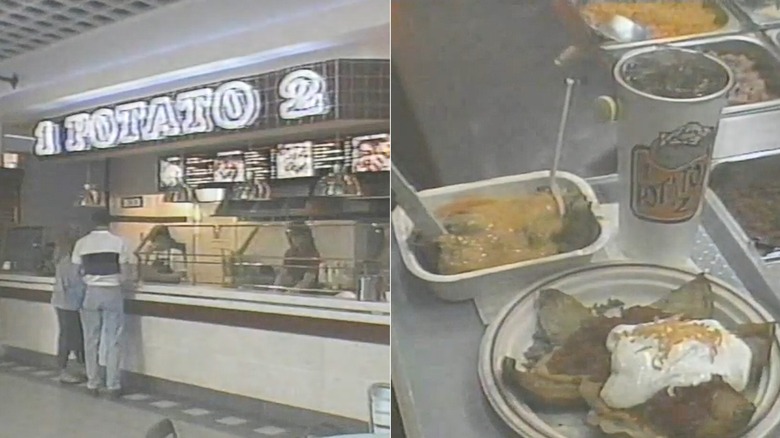
Sometimes, when you're shopping, you want a snack. Other times, you need a full meal. Then there are those rare instances when you need something right in between. Well, back in the day, that something could have been a baked potato and miles of toppings. But you had to be lucky. You had to have a location of 1 Potato 2 in your local mall. They weren't everywhere, but wherever they were, they were popping.
Played up as something that's healthy-eating years before the rest the industry would catch up to that trick, baked potato stalls were a hot concept in the decade of decadence. 1 Potato 2 emerged from Minneapolis, Minnesota. It franchised baked potato stalls as far as Las Vegas. As the natural order declares, its baked potatoes were offered with a wide array of toppings. Anecdotes from nostalgic '80s shoegazers suggest that the broccoli and cheese was popular. Others fondly remember a Mexican-style potato. The chain's store numbers during the 1980s are hard to verify, but by the time the 1 Potato 2 chain was purchased by Wrapsters in 1999, there were 29 locations.
One only needs to scroll through social media threads to find out how well loved this potato joint was. "1 potato 2 left a potato sized hole in my heart that can never be filled," said one Reddit commenter in r/fastfood.
A&W
If you know burger history, then you'll know that the 1980s were actually pretty rough on A&W — though, how much of that fault belongs to the restaurant is tough to say. In one of the most infamous WTF moments of American fast food history, A&W tested and released a ⅓-lb. burger in the '80s. The plan was to compete with McDonald's Quarter Pounder. Reportedly, the A&W burger was tastier. With more meat, it was even a better value. But American customers apparently didn't do the math, and A&W ultimately had a flop on its hands.
Still, A&W locations were considered favorites because of the chain's comforting and simple food offerings, like hot dogs, chili cheese fries, burgers, onion rings, and corn dog nuggets, or even a milkshake. Not to mention, root beer poured straight from the tap into towering ice-cold glasses. Over 60 years old by the start of the '80s, A&W's orange-and-brown branding was trusted, and steady business kept it afloat to survive in decades beyond. 60 new A&Ws would open between 1986 and 1989, and in 1990, the chain even doubled down on its mall presence by taking over 200 hot dog kiosks formerly run by Carousel Snack Bars.
Farrell's Ice Cream Parlour
For some, Farrell's Ice Cream Parlour will always be a bit of cautionary tale about the failure to evolve in changing times. Just as the decade's quick-service-format chains were taking off, this one was beginning to run out of runway. But for 1980s mall shoppers, it was a food-court-adjacent favorite.
Farrell's was founded in Portland in 1963. It was a sit-down experience that bordered on the theatrical. Staff would wear straw hats. The menu was full of towering sundaes and gigantic portions, like the famed Trough, a massive ice cream dish. As you can imagine, Farrell's Ice Cream Parlours were the sort of place where every kid wanted to have a special moment. Farrell's was so synonymous with the mall experience that when Bill and Ted bring Napoleon Bonaparte to modern times in the film "Bill & Ted's Excellent Adventure," the scene takes place in a shop that is conspicuously similar to Farrell's. In another reference, there's also a bowl of ice cream about as big as the Trough once served by Farrell's.
Banana splits and old-fashioned floats weren't the only things at Farrell's; sandwiches, franks, and burgers were also there to satiate. Unfortunately, the sit-down, surrealist ambiance was at odds with the direction mall food courts were going, and Farrell's began to slip from our collective consciousness toward the end of the decade.
Great American Cookies
Along with Mrs. Fields, Great American Cookies was a key shop in the cookie wave that wafted a signature smell through the 1980s mall. The chain was still fairly young in that decade, having been founded in 1977 with a family recipe for chocolate chip cookies. Atlanta — apparently a hotbed for the founding of various mall food court restaurants — was the first city to host a Great American Cookies location, but it was far from the last. GAC began franchising almost immediately, and how could you not when your company invented something as monumental as the cookie cake?
Tottering into the decade of decadence on three-year-old legs, Great American Cookies used the 1980s to begin ramping up business. Much of it was driven by slices of cookie cake. Per reporting by The Takeout, Katie Thoms — the senior marketing director of Great American Cookies' parent company, FAT Brands — explained, "The cookie cake slice was, and still is, such a popular impulse buy, especially in the mall environment, because it's easy to walk around with."
By 1985, the chain was earning $100 million of revenue per year. "I remember travelling and seeing the others," recalled one Redditor of other food court cookie spots, "but that colorful GAC logo was the defacto 'mall cookie place.'" Before it reached the new millenium, Great American Cookies was purchased by rival and competitor Mrs. Fields.
Static Media owns and operates Tasting Table and The Takeout.