

6 Things To Check If Your Gas Grill Isn't Getting Hot Enough
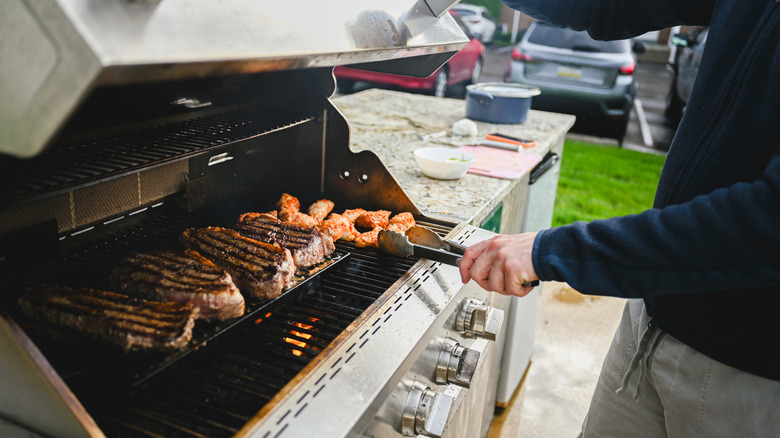
It can be disappointing if you've planned a meal of ultimate grilled burgers and crispy corn-on-the-cob ... only to find your gas grill isn't getting hot enough to begin cooking. Rather than stand around and scratch your head, a simple checklist can help you jump into action troubleshooting your grill so you can get back to business.
To find out more about what to look for should we discover our gas grill isn't warming up to the desired temp, we consulted with chef Dennis Littley, culinary expert at Ask Chef Dennis. He provided us with a number of areas to check, beginning with the first line of defense: Checking the propane tank to make sure you have enough fuel to run your grill. This may seem like an obvious step, but it's one thing that can cause a cold or lukewarm grill. Other malfunctions can occur even if the tank is low or empty, and having a systematic gas grill checklist can help you become familiar with the appliance while ensuring your grill's parts are in working order.
Once you've cleaned and inspected your grill to determine the cause of insufficient flames, you can move on to fixing it so burgers can commence. While Littley notes you may need to have it professionally inspected if you can't get it up and running properly, here are some things to check yourself first if your gas grill isn't heating up enough.
Consider the weather first
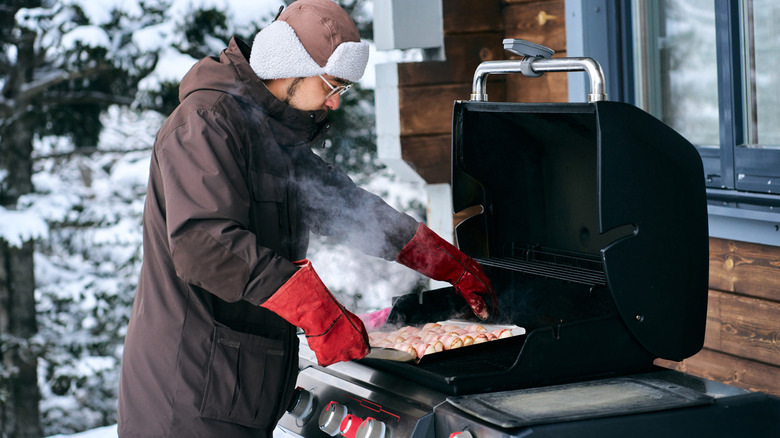
Inclement weather can get in the way of your flames, with both wind and moisture often enough to reduce the heat output of your grill. Flames may appear weak or flickering, though depending on where you stand in the world, weather may not mean much when it comes time for grilling. For instance, New Englanders are known for grilling outside in all weather, come rain or come shine (or hurricane winds or mountains of snowfall). But bad weather can indeed ruin your grilling adventure according to Dennis Littley.
Flames, wind, and water are competing factors that can confuse your grill. "Wind and extreme temperatures definitely may affect your gas grill in a couple ways," Littley explained. "Strong winds will make it difficult to get consistent flame height on your grill." Additionally, when it's bitterly cold out, the grill may have a difficult time getting up to temp. But if you prefer grilling in any type of weather, take precautions. Littley recommended finding an area "that protects the grill from strong gusts of wind," though you also want to "be sure there is good airflow." When you're done grilling, be sure to store your grill's propane tank properly.
Get to know your propane tank
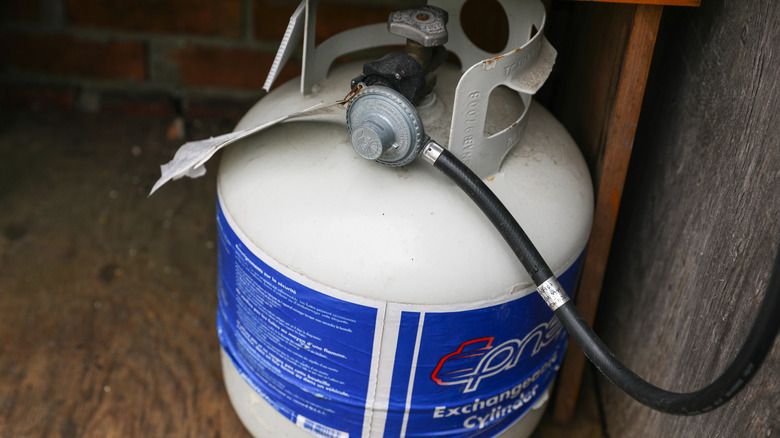
If you ignite your grill and notice weak flames, or none at all, chef Dennis Littley said you'll want to check your propane tank. If the tank is full, then the problem likely lies elsewhere. But how do you determine if there's enough fuel? An easy water test can check the propane levels and help you get a read on whether the tank may or may not be the issue.
If you just filled your tank, believe it or not, an overfilled tank could be a problem, too. Tanks aren't filled to capacity due to expansion, so if the tank has too much fuel, it may trip the bypass (a safety feature in the regulator). You'll want to understand what kind of propane tank you have; typical sizes range from 15 to 30 pounds for home grills (or 3 to 7 gallons of fuel). A 20-pound tank will last roughly up to 20 hours with moderate use. Of course, should you forget to turn off your gas grill, the tank may lose fuel while it's just sitting.
Knowing the weight of your tank can help determine how much is left. For instance, an empty 20-pound capacity tank weighs about 17 pounds, so when there's 20 pounds of fuel in there, the total weight is 37 pounds. A short burger cooking time may only require a little bit of propane, but a tank that's nearly empty can still starve the burners of pressure. So while you may have enough propane for burgers, there may not be enough to run the appliance at full heat.
Understand how the regulator works
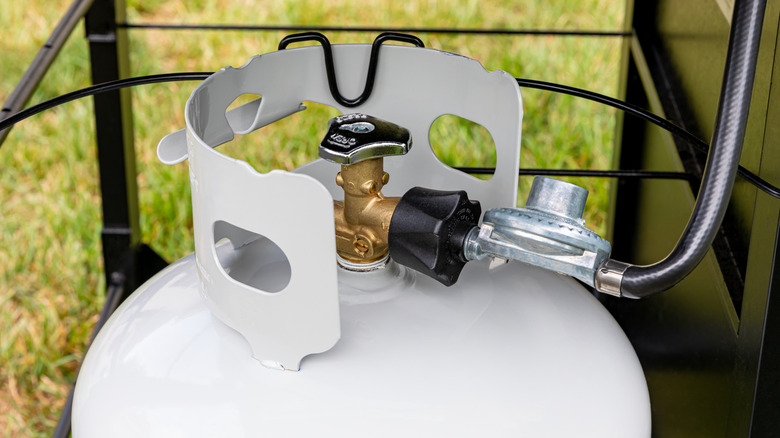
Once you've sheltered your grill adequately and ensured you have enough fuel for cooking, the next thing to check is the regulator. As Dennis Littley explained, this is the device that attaches the hose to the tank and monitors pressure.
"Beginning with very low flames when you have a lot of gas is likely due to your regulator restricting the flow," Littley told us. "Regulators will occasionally block gas flow if they go into an excessive flow safety state.” Regulators compare pressure in the tank to pressure in the hose, and if it senses something off — like a sudden rush of gas — it shuts the flow down to around 25% for safety. This will result in low, weak, or no flames. This is common if you've just switched tanks, opened the valve too quickly, or opened the valve while a burner is on.
Littley advised turning off all burners and the gas supply if this occurs. Disconnect the regulator, and wait at least 1 minute before reconnecting it. Then, reopen the valve slowly. Wait about 5 seconds before turning on a burner to test it. Should the problem persist after this, Littley recommends taking it elsewhere to be checked, adding, "do not attempt to bypass or fix the regulator on your own."
Inspect the hose
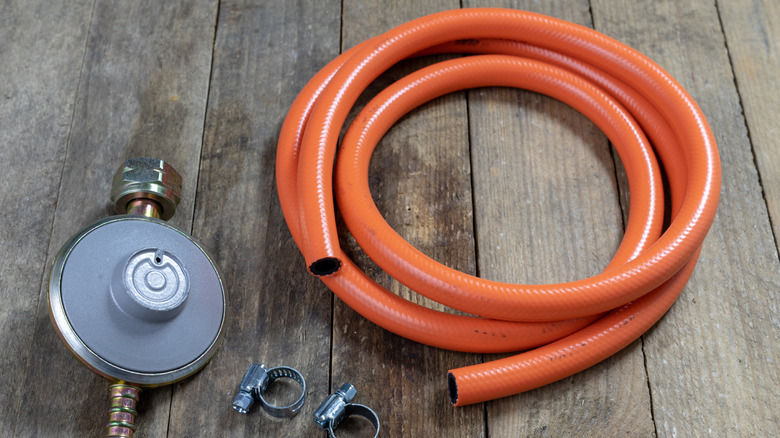
While the regulator monitors the pressure of gas in the tank and hose, the hose could be the reason why your grill is not getting hot enough. A problem with the hose can trip the regulator and in turn, reduce the fuel getting to your grill.
Chef Dennis Littley told Tasting Table hose damage of any kind can be problematic. "Check it for visible damage while the grill is cold and the gas turned off," he added. If the pressure inside the hose is faulty — like if there's a crack causing a leak — the regulator-hose assembly is manufactured for safety and fuel will automatically decrease.
Since you're dealing with a gas grill, make sure everything is turned off when checking. A quick test to find hard-to-see damage on a hose requires only soap and water. Brush soapy water on the hose and slowly open the tank valve. If there's a leak, you'll see bubbles. "If your hose has been damaged or if you believe there may be an internal blockage, replace it using a proper manufacturer-approved hose," Littley said, "or have it inspected by a professional."
Check all parts of the burners
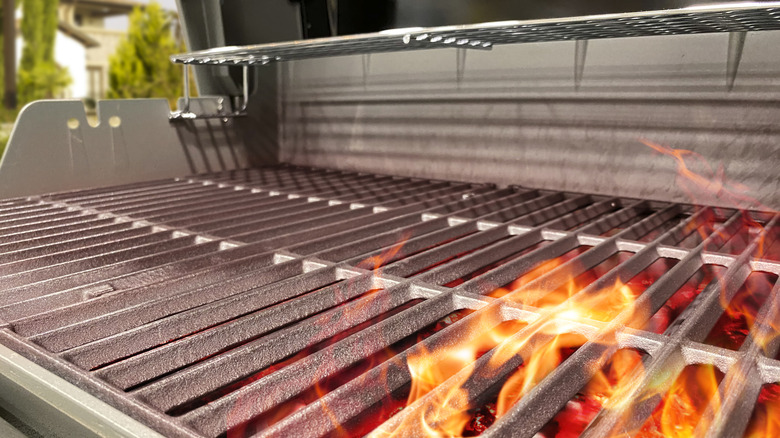
A strong clue you have a burner problem is when uneven heat is generated; in other words, one area is weak while others look normal. An empty or low tank, faulty regulator, or damaged hose usually affects the entire grill at once, meaning there's often low flames on every burner, not just random spots. So if you've started your grill but only part of it is working or the flames keep going out, turn it off, let it cool, and inspect all parts of the burners.
Your inspection should include the control valves behind the knobs, orifices (jets that squirt out the gas), tubes that carry the gas, and ports (where the flames come out). These frequently become clogged with food drippings, dirt, or rust, and must be cleaned to maintain functionality. Of course, before you inspect or clean anything, it can't be stated enough: First be sure you turn the grill off, let it cool, and disconnect the gas supply.
After you've checked everything from the manifold (which houses the valves and connecting tubes) to the burner ports, chef Dennis Littley said you'll want to clean. ”Remove debris using the manufacturer's recommended cleaning method," he noted. "A suitable grill brush can clean burner ports, while a soft brush can remove dust, grease, and spider webs around the burner tubes." Be gentle, and never use sharp or heavy-duty tools like knives or drills since they could damage your grill and make matters worse.
Determine the temperature of your grill grates
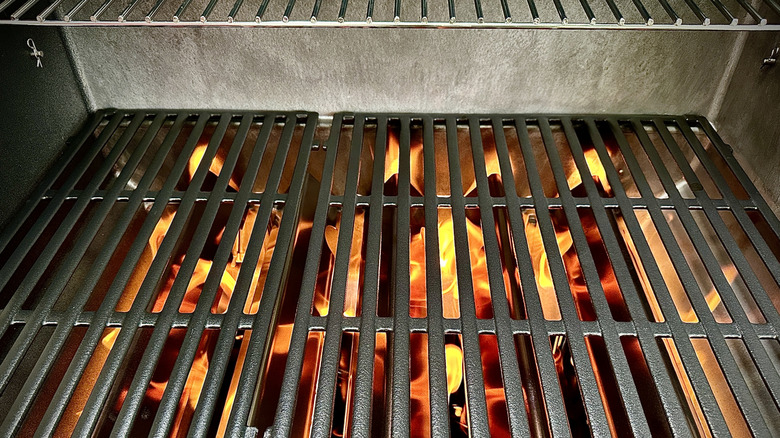
You've inspected and cleaned your entire grill from top to bottom, noted everything appears to be in working order, and the flames seem to be doing what they're supposed to be doing. If you still aren't achieving the sear on your foods that you should get with high heat, it might be time to consider the idiosyncrasies of your particular grill. After all, it's natural to find hotter and cooler spots when cooking with a gas grill.
"Learning about your grill's 'hot' and 'cool' areas, as well as checking the temperatures of your grates at multiple locations," Dennis Littley explained, "will help you know exactly how much heat is in each location so that you can achieve better results with your grilling." To determine where these spots are, Littley suggested using a high-temperature digital probe to test several areas.
While your grill's lid thermometer can give you an overall reading for the grill's internal temperature, it doesn't accurately read the grate's surface. The construction of your grill may have one burner that operates slightly different than another, for instance, which will cause your grill to have varying temperatures depending on the grate. You can also consider these additional tips for using your gas grill from Robert Irvine.