

How To Keep Burgers Flat Without Pressing Out The Juice
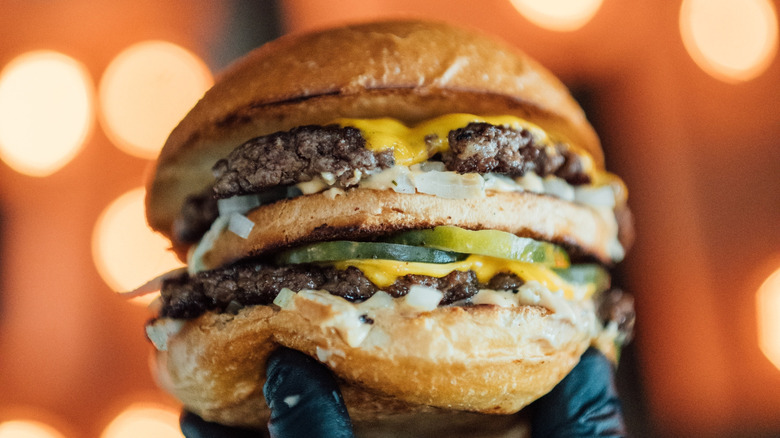
A good burger is one of the most comforting, down-to-earth meals out there, but it's also a delicate balance of math, physics, and chemistry, from the ratio of fat to lean meat to the geometry required to keep those delicious juices in. To keep your burger flat without squeezing out all the good stuff, start by shaping the raw patty with a shallow indentation in the center, then resist the urge to press it down with your spatula once it's sizzling. It might seem counterintuitive, but the path to a burger that stays flat during cooking actually begins with a shape that isn't perfectly flat.
This is because the shape you put on the heat isn't the shape you're going to end up with on your bun — you've probably seen it happen when you start out with a fairly flat disk, then watch the burger somehow decide to become a meatball in the hot pan. As beef cooks, heat causes the muscle proteins to denature and contract, while the meat loses some of its ability to hold onto water and fat. The patty shrinks as those juices are expelled, changing its dimensions in the process.
A shallow dimple, pressed into the center with your thumb or the back of a spoon, anticipates that process. As the meat contracts inward, the indentation helps compensate for the tendency of the center to swell, leaving you with a more evenly shaped burger at the end. In other words, you're building the solution into the raw patty instead of trying to reshape it later by flattening it when pressing down, which can force moisture and rendered fat out of the cooking meat.
Smash burger science
The quintessential, flat disk shape of a burger has a practical purpose too. A burger that balloons up through the middle has become much thicker at the point that takes longest for heat to get to, leaving the deliciously crispy burger edges to be overcooked as they continue taking heat. The shape also determines how much beef gets direct contact with the hot cooking surface, whether skillet or griddle. The part of the meat that touches hot metal is where the browning happens, known as the Maillard reaction. An even, flat patty and a good sear avoid unnecessary cooking time, preserving those juices.
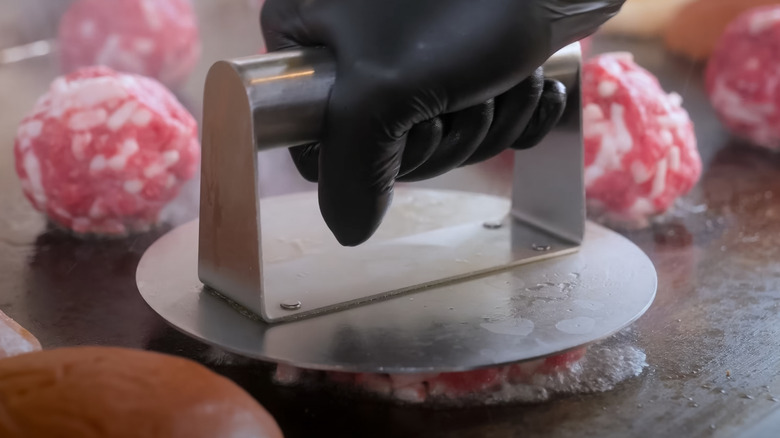
You may remember the smash burger craze of the 2010s — super thin and super crispy, but somehow still juicy, they're the exception to the indented patty trick. The strategic manipulation of geometry and timing is a big part of why the technique works. With a smash burger, loosely packed beef is formed into a ball shape, then smashed at the exact right moment, immediately after hitting a ripping-hot flattop, spreading it thin and maximizing contact between meat and metal for intense browning and a generous crust.
Timing and technique will make or break your smash burger, but pressing down on a thick, conventional burger later in the cooking process, after heat has already begun contracting the proteins and rendering the fat, can physically squeeze those mobile juices out onto the cooking surface, dehydrating the interior and causing the burger to stick to the pan. Your carefully engineered center indentation has already taken care of the shape problem, so there's little to gain and a lot to lose from leaning on it with your spatula.
Handle your burger with care
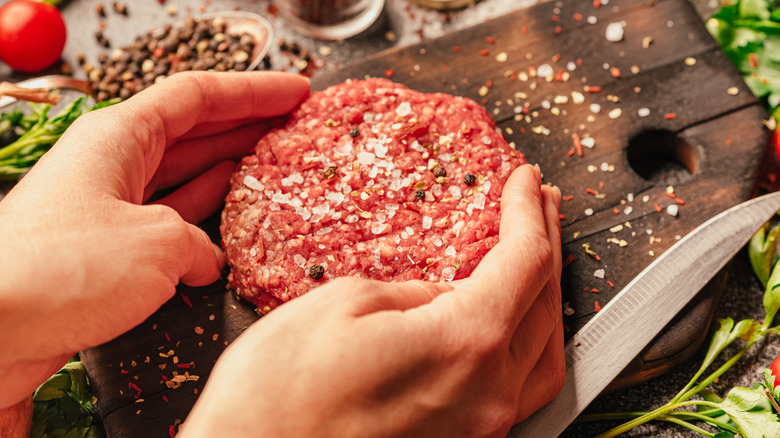
A perfectly juicy hamburger's preparation doesn't end with geometry. How you handle the raw ground beef influences the internal structure before it even starts cooking. Aggressively kneading and compressing the meat packs its disrupted muscle fibers together, creating a denser patty, and research suggests that the way ground beef is compacted can affect both its tenderness and cooking time. Salt can change the texture, too, because it will solubilize the meat proteins, making them stick together and forming a stronger network. That's useful when you're aiming to produce a cohesive, springy texture, like in sausage or meatballs, but a good burger should have a looser patty.
Keep in mind that the temperature of the raw meat also matters as much as how hot the pan is. Starting out cold, and keeping it cold, helps the fat stay firm and distributed coherently throughout the meat, instead of softening and smearing as you work it with warm hands. So, for a flat, juicy, and tender burger, handle it minimally, shape it gently and intentionally, and season the outside rather than kneading salt through it. Once it's cooking, the best technique you can apply is leaving the burger alone.
Flip it only as necessary, rather than repeatedly poking, prodding or smushing it, and use a food thermometer to determine when it's done — the USDA recommends cooking ground beef to an internal temperature of 160 degrees Fahrenheit. By then, the math, physics and chemistry have come together to create a perfectly flat, juicy burger. Starting with the right proportions creates an interplay of interior juiciness and a well built, flavorful exterior crust. The shape of the patty accounts for the way the heat will transfer, while gentle handling and strategic seasoning keep the protein structure tender.